There was no reason to drive toward unstable ground in darkness.
Not when trained responders were already there.
Boone stood beside me, shivering.
I brought him inside.
At 4:17 a.m., the hillside failed.
I know the time because the emergency alert appeared on my phone while I was standing in the kitchen.
The message ordered people to avoid the eastern access road and warned of active slope movement.
I looked out the window.
Even from my ranch, I could see floodlights illuminating a huge break in the dark pavement.
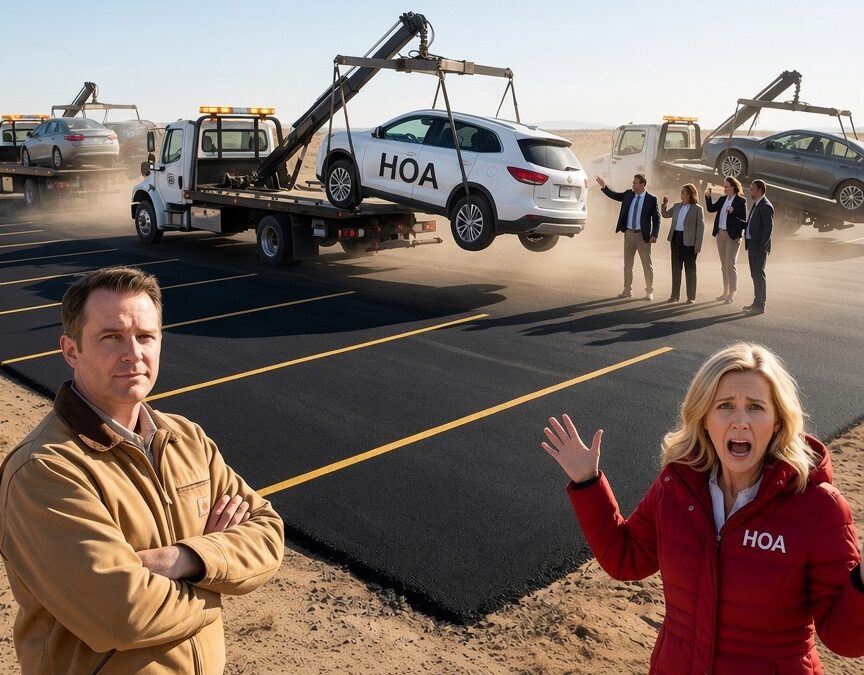
The southern portion of the parking lot had dropped into the runoff corridor.
Water and mud surged through the exposed ground.
A black SUV sat nose-down near the failed edge.
Farther uphill, part of a retaining terrace had shifted, pulling a backyard fence sideways.
The sight was terrible.
Not because it looked like a movie disaster.
Because it looked like something that had happened slowly, one ignored decision at a time, until the ground finally refused to carry the weight.
I called Mara.
She answered immediately.
“I’m on my way.”
“Do they have everyone out?”
“Emergency crews are checking.”
I looked toward the lights.
“Please tell me nobody’s hurt.”
“We don’t have confirmed injuries right now.”
I stayed at the ranch until daylight.
At sunrise, I drove only as far as the public safety perimeter.
Deputies had closed the access road.
Evacuation buses waited near the clubhouse.
Residents stood beneath blankets while responders moved between vehicles.
A county engineer I knew approached the barricade.
“Elias.”
“How bad?”
He looked exhausted.
“About sixty feet of pavement and shoulder failed. Some vehicles were damaged. The terrace movement is being assessed.”
“Any fatalities?”
“None reported.”
I exhaled.
It was the first full breath I’d taken since the alert.
Mara arrived shortly afterward.
Her boots sank into the mud as she approached.
“County executive resigned,” she said.
I looked at her.
“When?”
“Early this morning.”
“And Draper?”
“Represented by counsel. Investigators are pursuing the records.”
I nodded.
Beyond the barricades, workers were inspecting the damaged slope.
The water had followed the original drainage corridor.
Exactly where the old maps said it would.
Exactly where my father had warned me to respect the land.
Then I saw Cynthia.
She stood near the clubhouse steps wearing a black coat soaked through by rain.
No umbrella.
No entourage.
No practiced smile.
I walked toward her.
She watched the emergency crews without looking at me.
“They evacuated twelve homes,” she said.
“I heard.”
“I didn’t think this would happen.”
I stood beside her.
For a moment, I considered saying nothing.
Then I asked, “Did you know there was a drainage problem before construction?”
She looked at the mud.
“We were told it could be managed.”
“By whom?”
She didn’t answer.
“Cynthia.”
Her face tightened.
“We had already committed the money. The contractors were scheduled. People were demanding the parking.”
“Then you should have stopped.”
She finally looked at me.
“I thought we could finish it and make the corrections afterward.”
I stared at her.
There it was.
Not a complicated engineering theory.
Not an obscure legal dispute.
Just a decision.
Finish now.
Fix later.
She looked toward the collapsed pavement.
“I never wanted anyone hurt.”
I believed her.
That didn’t make her decisions harmless.
“Wanting isn’t enough,” I said.
She lowered her head.
A deputy called for people to move farther from the restricted area.
We separated without another word.
Later that day, Mara told me Daniel Hurst had agreed to cooperate with investigators.
He’d provided internal emails and meeting records.
One email, sent weeks before paving, contained a sentence Cynthia would spend months trying to explain.
We need construction completed before thaw exposes the drainage issue.
It wasn’t the only evidence.
But it was among the clearest.
I went home and sat beside Boone while the television replayed footage of the collapse.
Reporters called it a development scandal.
An engineering failure.
A corruption investigation.
They used photographs of Cynthia at ribbon-cutting ceremonies.
They showed Bradley Pierce entering a courthouse.
They interviewed residents who said they’d trusted the board.
I turned the television off.
Boone looked up.
“Too much noise,” I told him.
He rested his head on my boot.
Outside, the rain finally began to ease.
The next few weeks were filled with investigations, surveys, engineering reports, and legal proceedings.
Thomas Bell arranged for an independent survey of my boundary.
The results confirmed that the parking lot had extended onto Mercer Ranch property.
The county’s historical drainage records also established that the protected runoff corridor had been affected.
My civil case proceeded separately from the broader financial investigation.
Thomas reminded me of that every time I tried to discuss everything at once.
“One problem at a time, Elias.”
“They’re connected.”
“Yes. And each has to be proved properly.”
He was right.
The survey established where my land ended.
The engineering review addressed the drainage damage.
The financial investigation examined what happened to the money.
The public approval review considered who authorized construction and why.
Keeping those questions separate made the evidence stronger.
It also kept me from turning into the kind of man who believed his own certainty was enough.
By early April, the county announced a public hearing.
The courthouse chamber filled before nine.
Residents crowded the aisles.
Reporters lined the walls.
State investigators sat beside engineers and county officials.
Cynthia arrived with counsel.
Pierce was no longer representing Silver Ridge. His own financial connections to project contractors were under investigation.
Daniel Hurst was absent.
I sat near the back beside Mara.
“You ready?” she asked.
“No.”
“Good answer.”
The hearing lasted almost six hours.
Samuel Ortiz presented the engineering findings.
He showed the original drainage corridor, the altered development overlays, the unstable fill, and the progression of the parking lot failure.
His explanation was measured and precise.
“The available evidence indicates that concentrated runoff and inadequate stabilization contributed to progressive saturation and settlement during thaw conditions.”
A commissioner asked whether the collapse had been foreseeable.

