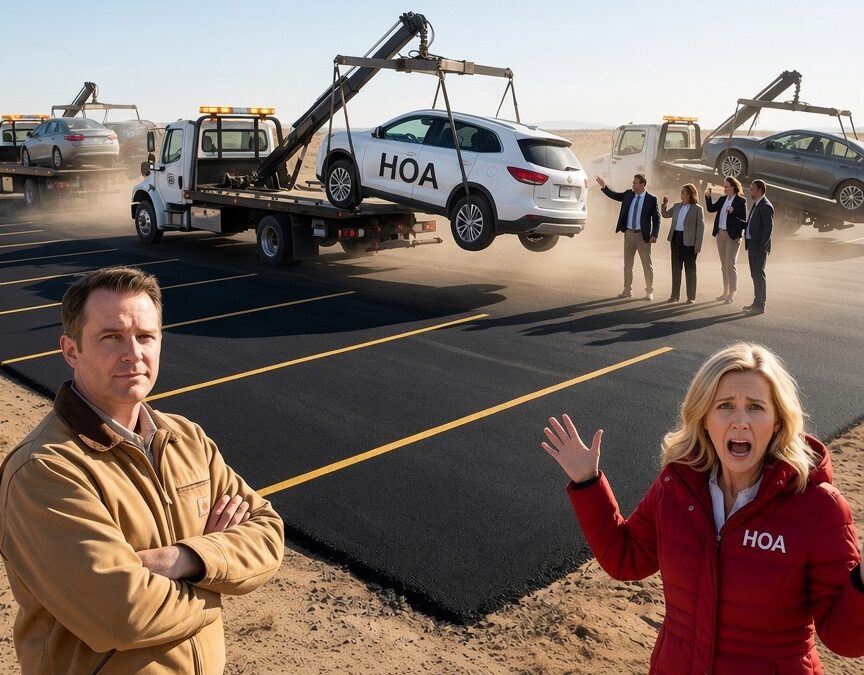
The second charged Silver Ridge for emergency drainage mitigation before the parking project had supposedly received final approval.
The memorandum was marked:
BOARD EXECUTIVE SESSION — CONFIDENTIAL.
Several lines had been blacked out.
But the surviving text was enough.
County concerns regarding runoff maps.
Mercer boundary issue unlikely enforceable.
Complete grading before thaw.
I sat at my kitchen table and read those lines until Boone nudged my knee.
Someone inside Silver Ridge knew.
And someone had decided I needed to know, too.
I scanned the pages, preserved the originals, and started an evidence log.
Then I called Warren Pike.
Warren worked in county permitting. We’d known each other since the days when our knees still worked and neither of us needed reading glasses.
He agreed to meet me at the parking lot that afternoon.
When he climbed out of his county truck, he looked at the cracked asphalt and sighed.
“Hello, Elias.”
“Morning, Warren.”
“You making friends?”
“Never been my specialty.”
He walked toward the southern shoulder.
The water had spread.
He crouched, examined the fill, and stood again.
“That’s ugly.”
“You approve this?”
“No.”
“Who did?”
He shoved his hands into his pockets.
“Approval came through an executive override.”
I watched him.
“Whose?”
“Elias.”
“Warren.”
He looked uphill toward the clubhouse.
“Councilman Draper was pushing the development schedule.”
I knew the name.
Draper had served on a regional development committee with Cynthia two years earlier.
He was always photographed cutting ribbons, shaking hands, and explaining how tourism investment would bring prosperity to the valley.
“Was environmental review completed?”
Warren looked away.
“That’s part of what we’re checking.”
I said nothing.
He finally continued.
“I’ve recommended temporary restrictions on the lot pending a slope assessment.”
“Mandatory?”
“Not yet.”
“Make it mandatory.”
“That’s not solely my decision.”
“Then get whoever makes the decision down here before the thaw.”
He rubbed his beard.
“You’re still as pleasant as ever.”
“And you’re still waiting for a committee to tell you what your eyes already know.”
He almost smiled.
Before leaving, he handed me a copy of his preliminary inspection notice.
It documented unstable runoff conditions and recommended restricting vehicle loads.
It wasn’t enough.
But it was a beginning.
That evening, I walked the old southern boundary.
I found three more survey stakes pulled from the ground and thrown near the creek embankment.
The snow around them had been disturbed recently.
I photographed the stakes and their surroundings.
Then I installed a trail camera on my property, facing the access route.
I didn’t expect much.
People usually behave themselves when they know somebody’s watching.
But sometimes they get careless.
At 11:42 that night, my phone received a motion alert.
I opened the footage.
Two men had arrived in a pickup.
Both wore heavy jackets.
One carried a shovel.
The other carried survey stakes.
They worked without headlights, moving markers toward the north.
I watched them for almost four minutes.
Then one man turned toward the camera.
His face was clear enough to recognize.
Daniel Hurst.
Silver Ridge’s board treasurer.
I leaned back in my chair.
Boone snored beside the stove.
“Well,” I said, “that’s a problem.”
At five the next morning, I called Mara Quinn.
Mara had worked state investigations before transferring into financial crimes in Helena.
We’d met during a procurement case involving a highway contractor who billed the county for equipment that had never existed.
She answered on the second ring.
“Elias, somebody better be dying.”
“Nobody yet.”
“That’s not reassuring.”
“I’ve got suspected boundary tampering, questionable contractor invoices, and an HOA parking lot sitting on an unstable drainage corridor.”
Silence.
Then she said, “You couldn’t have taken up golf?”
“I tried.”
“What happened?”
“They asked me to stop explaining the drainage around the ninth hole.”
She sighed.
“Tell me everything.”
I did.
I explained the survey markers, the missing attachment, the anonymous documents, the executive override, and Daniel Hurst’s midnight activities.
Mara listened without interrupting.
When I finished, she asked one question.
“Have you accused the attorney of anything publicly?”
“No.”
“Good. Don’t. Suspicion isn’t proof.”
“I know.”
“Send me the footage and the financial documents. Keep the originals secured.”
“Already done.”
“Of course you have.”
She paused.
“Elias, if public officials helped bypass required reviews, this could become much bigger than an HOA dispute.”
I looked out the kitchen window.
The parking lot was a dark rectangle against the snow.
“It already is.”
Two days later, the county posted warnings near the Silver Ridge entrance.
Residents gathered to read them.
A few stopped parking in the overflow lot.
Others complained that I was trying to destroy their property values.
Cynthia encouraged that interpretation.
She sent a neighborhood email describing my concerns as an ongoing disagreement with a neighboring landowner.
She did not mention the moved survey markers.
She did not mention the runoff swale.
And she certainly did not mention the executive-session memorandum.
I drove to the clubhouse that afternoon with photographs in a folder.
Cynthia stood outside beside Pierce, talking to a group of residents.
When she saw me, her expression hardened.
“Mr. Mercer, you need to stop harassing this community.”
I handed Pierce the first photograph.
Daniel Hurst stood beside the relocated markers, his shovel visible in the infrared image.
Pierce looked at it.
Then he looked at me.
“Where was this taken?”
“On my property.”
Cynthia took the picture.
Her face changed.
I gave her the second photograph.
Then the third.
A resident in a brown work jacket stepped closer.
“Is that Daniel?”
Nobody answered.
He looked again.
“Why is Daniel moving survey stakes?”
Cynthia straightened.
“These photographs are being presented without context.”
“Then provide the context,” I said.
She stared at me.
“What exactly do you want?”
“An independent survey. Closure of the lot until the drainage is assessed. Preservation of every document connected to the project.”
Pierce folded the photographs carefully.
“Those are substantial demands.”
“So is paving somebody else’s land.”
A woman near the entrance spoke up.

