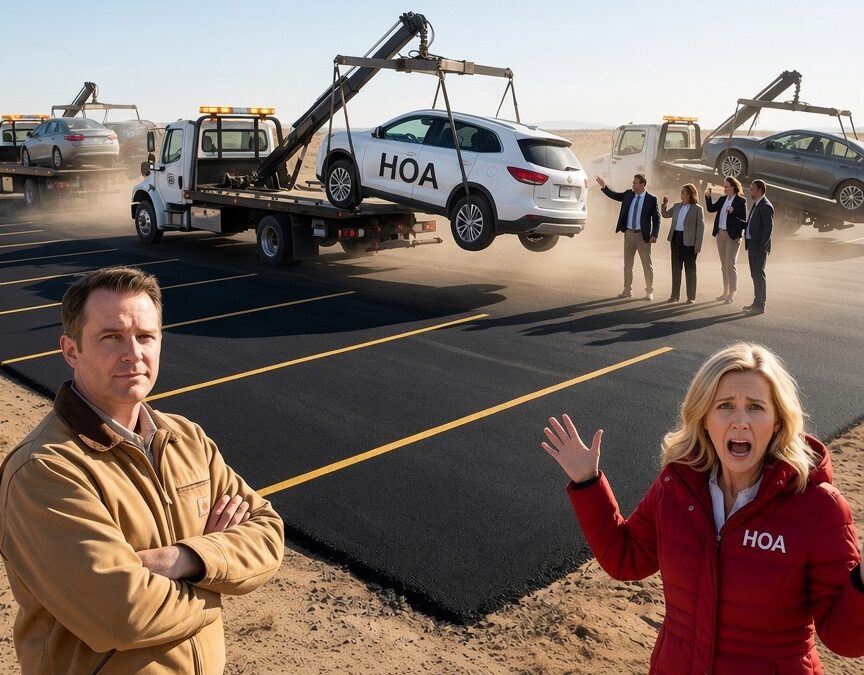
The first thing I saw that morning was steam rising from black asphalt.
It curled into the Montana cold like smoke from a fire somebody had tried to bury. Beyond it, the mountains stood pale beneath a February sky, and the cottonwoods along Bitter Creek rattled their bare branches in the wind.
I parked my truck beside the split-rail fence my father built in 1987.
For a while, I didn’t get out.
I just sat behind the wheel, staring at forty yards of fresh pavement where my cattle had grazed the previous autumn.
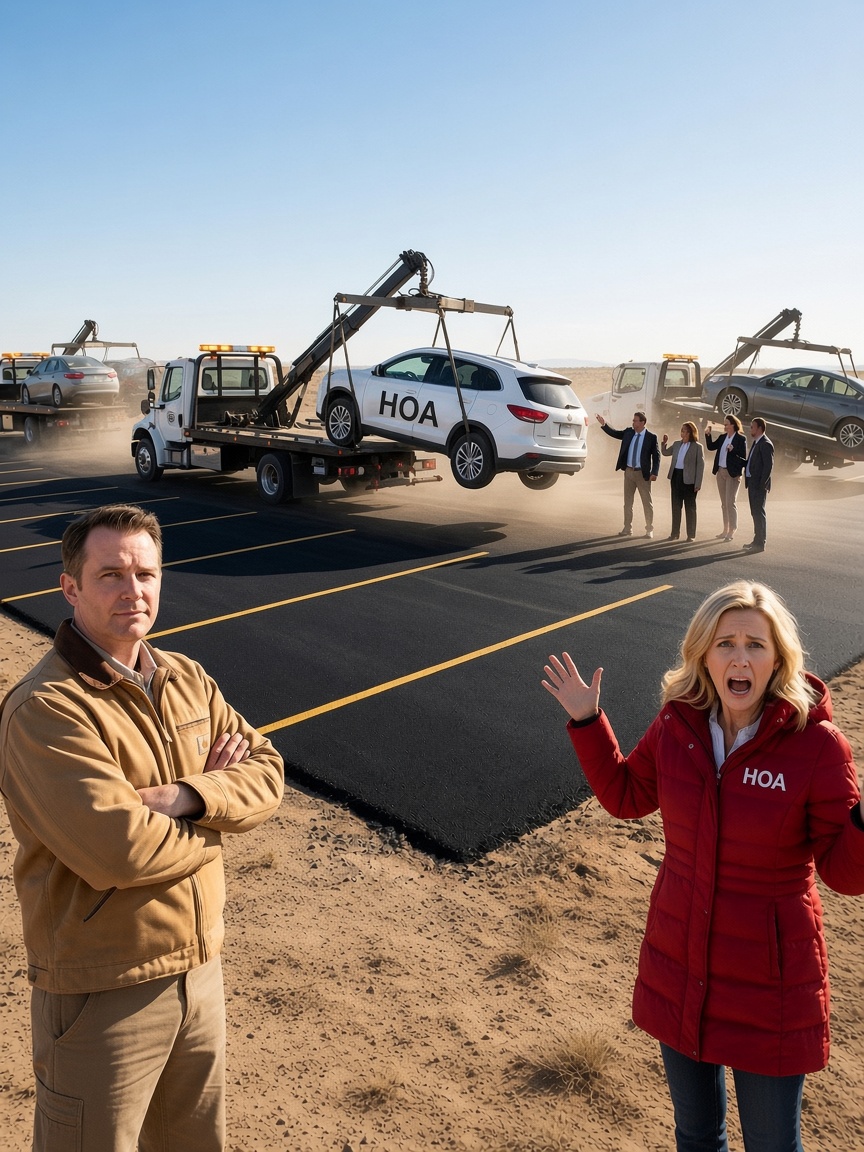
There were yellow parking lines. Concrete wheel stops. Two decorative light poles. And right in the middle stood a polished cedar sign bearing the mountain-shaped logo of Silver Ridge Estates.
VISITOR OVERFLOW PARKING.
AUTHORIZED BY COUNTY DEVELOPMENT OFFICE.
I read it twice.
Then I turned off the engine.
The silence afterward was remarkable. My truck had a habit of rattling even when it was running well, and without it, I could hear the distant machinery working somewhere above the ridge.
I climbed out into six inches of crusted snow.
At sixty-one, my knees weren’t particularly interested in mornings like that. Thirty-two years working county roads had left me with enough aches to predict weather changes better than the television forecasters.
But the pain disappeared when I saw the broken survey marker.
It lay half buried beneath a ragged shoulder of asphalt, its iron shaft bent where an excavator had struck it.
I knew that marker.
My father had stood beside the county survey crew when they set it in 1972. Five years later, after a flood changed the drainage patterns along Bitter Creek, he’d made sure the county preserved the original ranch boundaries and runoff protections.
He’d explained the whole thing to me when I was twelve.
“Land doesn’t care what you think you own, Elias,” he’d said. “That’s why you measure it.”
Now somebody had measured it differently.
Or pretended to.
I crossed the pasture toward the pavement.
A woman in a white wool coat stood near a skid steer, talking to two contractors. Her blonde hair was arranged so perfectly that I wondered whether she’d checked the wind forecast before coming outside.
Cynthia Vail.
President of the Silver Ridge Estates Homeowners Association.
She noticed me before I reached the pavement. Her expression tightened, then relaxed into the polished smile I’d come to recognize over the previous year.
“Mr. Mercer,” she called. “You’re up early.”
I stopped beside the damaged survey pin.
“Who authorized this?”
She glanced at the parking lot.
“The county approved our expansion.”
“Who authorized paving my pasture?”
Her smile remained in place.
“Our attorneys reviewed the applicable easements.”
I crouched and brushed snow from the iron cap.
MERCER SOUTH LINE.
The lettering was worn but unmistakable.
“Your attorney should have reviewed the ownership records.”
“He did.”
“Then he knows this isn’t your property.”
One contractor shifted his weight. The other suddenly found something fascinating about the skid steer’s hydraulic hose.
Cynthia stepped closer.
“Mr. Mercer, Silver Ridge has a genuine parking problem during winter tourism season. We have homeowners paying substantial dues, guests arriving every weekend, and vehicles blocking emergency access.”
“Then build parking on your land.”
“The county map establishes a different boundary.”
I looked up at her.
“Which county map?”
She hesitated.
It lasted barely a second.
But I’d spent most of my working life dealing with people who relied on other people not noticing small things.
That hesitation told me more than her answer.
“The approved subdivision plat,” she said.
I stood.
“The plat you filed eighteen months ago?”
“Yes.”
“The one that doesn’t match the recorded boundary amendment from 1978?”
Her smile faded.
“I don’t know what you’re referring to.”
“I think you do.”
A pickup pulled into the new lot behind us. Two residents stepped out carrying coffee. One of them, a younger man wearing a ski jacket, looked from Cynthia to me.
“Everything okay?”
Cynthia answered immediately.
“Just a routine boundary clarification.”
“No,” I said. “Your HOA paved part of my ranch without permission.”
The man’s eyes dropped to the asphalt beneath his boots.
“Seriously?”
“Seriously.”
Cynthia gave a strained laugh.
“Mr. Mercer has opposed our development from the beginning.”
“That’s not true.”
“You’ve sent numerous complaints.”
“I sent drainage reports.”
“Which our consultants reviewed.”
“Then your consultants should have told you not to pave over a runoff channel.”
The contractor nearest the skid steer looked at me.
Then at the southern edge of the lot.
His expression changed.
I followed his gaze.
Fresh grading marks extended beyond the pavement into a shallow depression that had carried spring runoff for as long as I could remember.
The old swale.
They hadn’t merely covered my grazing land.
They’d blocked the natural drainage corridor beneath the ridge.
I walked toward the southern shoulder.
The fill looked wrong. Too loose near the edge, with no visible drainage outlet and a slope steeper than I expected from the plans I’d seen. Meltwater was already collecting where the compacted ground met the asphalt.
I knelt and pressed my glove against the damp soil.
Even in freezing weather, water was moving underneath.
Cynthia followed me.
“What are you doing?”
“Looking.”
“You’re not a licensed inspector.”
“No. I retired from county transportation after thirty-two years of right-of-way and infrastructure work.”
“I’m aware.”
“Then you’re also aware that I know what an unstable drainage fill looks like.”
She folded her arms.
“You’re exaggerating.”
I took out my phone.
Wide photographs first.
Then the broken marker.
The pavement edge.
The water.
The grading cuts.
The sign.
I photographed everything.
“Are you recording me?” Cynthia asked.
“No.”
I took another picture.
“I’m documenting what you’ve done.”
Her voice sharpened.
“You’re wasting your time.”
I turned toward her.
“You just paved evidence across my ranch.”
For the first time, her expression showed something other than irritation.
Fear.
It disappeared almost immediately.
But I’d seen it.
I walked back to my truck without another word.

