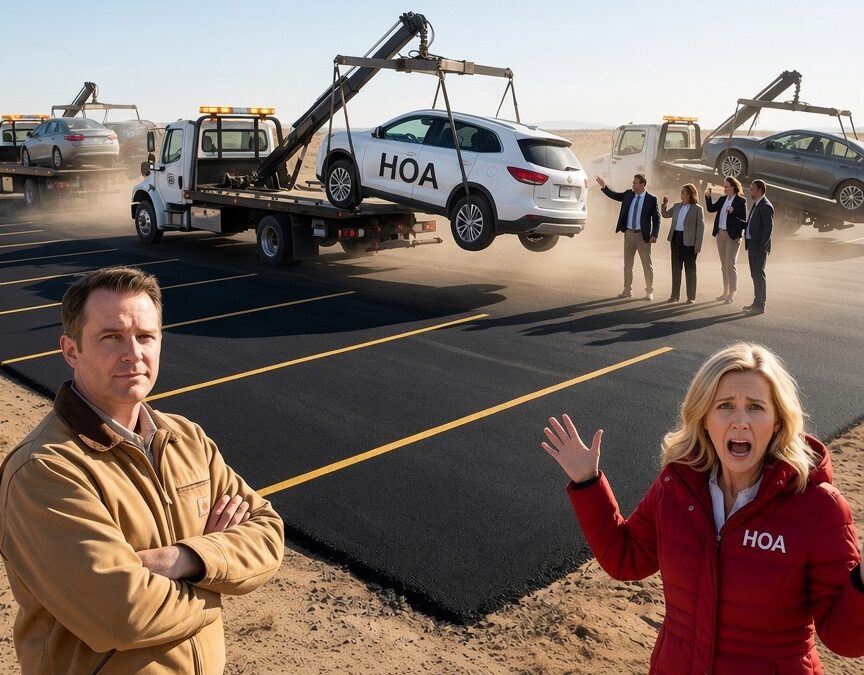
Behind me, the contractors restarted their equipment.
The engine noise rolled across the valley, and somewhere beneath the fresh asphalt, water continued moving through the ground.
I knew that sound.
And I knew what it meant.
Three days later, the first serious storm arrived.
By sunrise, snow was blowing sideways across the pasture, hiding the fence posts and turning the eastern ridge into a gray shadow.
I stood on my porch with burnt coffee in one hand and Boone pressed against my leg.
Boone was an old black Labrador with a white muzzle and one cloudy eye. He’d been my wife’s dog before he became mine, although Claire would have argued that Boone had never belonged to anybody.
He’d simply decided to live with us.
Claire had been gone seven winters.
Some mornings, I still reached for a second coffee mug before remembering.
That morning I caught myself doing it.
I set the extra mug back in the cabinet and looked toward Silver Ridge.
Through the blowing snow, I could see maintenance trucks moving near the new parking lot.
They were spreading sand along the southern edge.
Which meant the water problem had already become visible.
I went into the hall closet and dragged out a cardboard archive box.
Claire used to call it my second marriage.
Inside were old plats, drainage maps, survey overlays, and county transportation records I’d lawfully kept as reference copies after retiring.
Most people would have thrown them away.
I never could.
A map from 1991 showed the natural runoff corridor running south from the eastern ridge, crossing the edge of what was now Silver Ridge Estates, and spreading into the pasture before draining toward Bitter Creek.
I unfolded a newer subdivision plat beside it.
The runoff channel had moved.
Not physically.
On paper.
According to the current development plan, the swale ended fifty yards north of my pasture.
I studied the two documents beneath the kitchen light.
Then I said, “You idiots.”
Boone lifted his head.
“Not you.”
He went back to sleep.
I opened the county’s online GIS portal and compared the expansion filings.
Three revisions.
Two amendments.
One missing supporting document.
The final drainage submission referred to a revised mitigation plan, but the accompanying soil analysis wasn’t attached.
I called the county records office.
Denise answered after four rings.
“Gallatin County Records.”
“Morning, Denise. Elias Mercer.”
There was a pause.
“Well, I’ll be damned. I thought retirement was supposed to keep you out of my filing system.”
“I tried fishing.”
“And?”
“Fish don’t appreciate criticism.”
She laughed.
“What do you need?”
I gave her the Silver Ridge filing number.
“Specifically, the drainage attachment from the phase-two amendment.”
I heard her keyboard.
Then silence.
“That’s odd.”
“What’s odd?”
“The index lists an attachment, but there’s no digital file.”
“Can you check the archive?”
“Maybe. Some of those records went into physical storage during the migration.”
“Would you?”
“For you? I’ll consider it.”
“Coffee’s on me.”
“Make it lunch.”
“Done.”
Before hanging up, she lowered her voice.
“Elias, is this about that parking lot?”
“Yes.”
“I heard there’s a boundary dispute.”
“There’s more than a boundary dispute.”
“How much more?”
I looked at the map.
“Enough that I wouldn’t park there.”
By noon, the snow had eased enough for me to drive toward Silver Ridge.
Water was collecting along the new asphalt shoulder. Muddy streaks ran beneath the frozen surface, and small cracks had appeared near the southern corner.
I parked outside the clubhouse.
The building was enormous, all stone fireplaces, exposed beams, leather chairs, and artificial pine fragrance.
Silver Ridge liked to present itself as an authentic Montana mountain community.
Nothing about the place felt authentic to me.
Cynthia stood near the reception desk beside a man in a navy overcoat.
Bradley Pierce.
Attorney.
I’d encountered him years earlier during a road-access dispute. He was intelligent, expensive, and careful about never saying more than necessary.
He recognized me.
“Mr. Mercer.”
“Bradley.”
“I understand you’re concerned about a boundary interpretation.”
“I’m concerned about trespass.”
Cynthia sighed.
“We’ve already discussed this.”
“Not with the right documents.”
I placed the old drainage overlay on the counter.
Pierce examined it.
His expression changed slightly.
“This predates the current grading approval.”
“Water doesn’t care when the paperwork was approved.”
I pointed to the original swale.
“Your parking lot sits directly above this drainage corridor. You concentrated runoff beneath fill that doesn’t appear to have proper stabilization.”
Cynthia crossed her arms.
“Our contractors are professionals.”
“Then ask them where the drainage outlet is.”
Neither answered.
I unfolded the 1972 survey overlay.
“And here’s my property boundary.”
Pierce studied the stamp.
Then the signatures.
Then the line crossing the parking lot.
“Where did you obtain this?”
“County records.”
“These historical surveys sometimes require reconciliation.”
“Then reconcile them before pouring asphalt.”
Two residents sitting near the fireplace had stopped pretending not to listen.
One was a woman in her forties wearing a red ski jacket.
She approached.
“Excuse me. Is the parking lot unsafe?”
Cynthia answered quickly.
“No.”
I looked at the woman.
“There are warning signs of drainage instability. I can’t tell you the exact risk without a proper engineering investigation.”
“Should we park there?”
“I wouldn’t.”
Cynthia turned sharply.
“That is irresponsible.”
“What’s irresponsible is telling residents there’s no problem when you haven’t verified it.”
Pierce stepped between us.
“Perhaps we should continue this discussion privately.”
I looked around the lobby.
The woman in the red jacket was watching him.
So were three other residents.
“No,” I said. “I think the people paying for that parking lot deserve to hear the answers.”
Outside, snow struck the windows.
Inside, Cynthia’s smile disappeared.
The anonymous envelope arrived the following morning.
No stamp.
No return address.
Just a white business envelope tucked into my mailbox between a feed catalog and an electric bill.
Inside were three photocopied pages.
Two invoices.
One internal HOA memorandum.
The first invoice listed almost ninety thousand dollars in subsurface stabilization materials.

