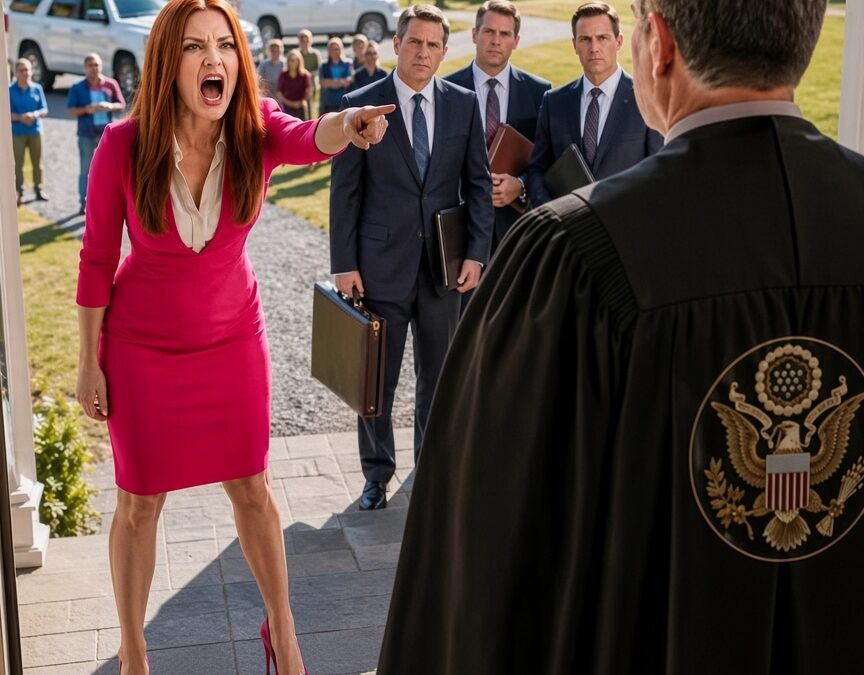
When it ended, I stepped into the corridor wearing my judicial robe, which I’d put on for a formal court photograph connected with the visiting-judge program.
I intended to return to the office, change, and join Karen in courtroom one.
Then I rounded the corner near the water fountain.
And there they were.
Todd Brennan.
Katherine Mercer.
Douglas Ashford.
All three stood outside courtroom one, reviewing documents.
Victoria was beside them in a charcoal dress, carrying an ivory handbag.
She saw me first.
At least, she saw the robe.
Her eyes moved from the black fabric to my face.
She frowned.
Before she could speak, a court clerk emerged from the administrative hallway.
“Judge Callaway, the presiding judge said to thank you for coming by.”
The conversation stopped.
Brennan turned.
His eyes widened.
He stared at me as if he’d seen someone climb out of a photograph.
Mercer looked from the robe to my face.
Her expression changed immediately.
Ashford lowered the folder in his hands.
For several seconds, nobody spoke.
Then Brennan said, very quietly, “Judge Callaway?”
“Good morning, Mr. Brennan.”
Victoria looked at him.
“What?”
Brennan swallowed.
“Mrs. Ashworth, we need to talk.”
“About what?”
Mercer stepped forward.
“Your Honor, I wasn’t aware—”
I raised one hand.
“Ms. Mercer, I’m here as a private party in a case before Judge Kingsley. This isn’t the place for a discussion.”
She stopped.
Ashford straightened.
“Of course, Your Honor.”
Victoria stared at us.
“Your Honor?”
Nobody answered.
She looked directly at me.
“You’re a judge?”
“Yes.”
“A real judge?”
Brennan closed his eyes.
I looked at Victoria.
“I serve on the Tennessee Court of Appeals.”
She turned toward her lawyers.
“You told me he was a farmer.”
“I am a farmer,” I said.
Mercer stared at the floor.
Ashford’s jaw tightened.
Brennan looked as though he was trying to remember every conversation he’d had on my porch.
Victoria’s voice rose.
“Why didn’t anyone tell me?”
I answered before the lawyers could.
“You never asked.”
She opened her mouth.
Then closed it.
For months, she’d treated me as though my work boots made me insignificant.
Now she was staring at a judicial robe and trying to reconcile it with the man she’d threatened in his own barn.
I didn’t enjoy her fear as much as I’d expected.
Mostly, I felt tired.
I looked at the three attorneys.
“For everyone’s sake, I suggest we keep the proceedings focused on the evidence. I’ve taken the appropriate steps concerning any professional conflicts.”
Ashford nodded.
“Understood.”
I turned toward the administrative offices.
Behind me, Victoria demanded, “What professional conflicts?”
Brennan’s reply was low and urgent.
I didn’t stay to hear it.
At ten o’clock, I entered courtroom one in a charcoal suit and sat beside Karen.
Claire was in the second row.
Tammy Hollis sat behind her.
Gil Whitaker had arrived wearing his one good sport coat, a navy jacket he usually reserved for funerals and weddings.
Several Ridgefield homeowners occupied the remaining benches.
Victoria sat with her attorneys across the aisle.
She no longer looked quite so certain of herself.
Judge Kingsley called the case.
Karen rose.
“Your Honor, we seek temporary injunctive relief preventing the plaintiffs and their agents from entering or altering the disputed boundary pending final resolution of title.”
She began with the deeds.
My grandfather’s original purchase.
The subsequent recorded transfers.
The historical surveys.
Then Sam Prescott’s certified resurvey.
A large map appeared on the courtroom screen.
Sam testified about the monuments, the measurements, and the discrepancies in Ridgefield’s survey.
Karen asked him to identify the original boundary.
He did.
She asked whether the existing fence crossed onto Ridgefield Crossing property.
“No,” Sam said.
“Are you certain?”
“To a reasonable degree of professional surveying certainty, yes.”
She showed him photographs of the disturbed markers.
“Can you explain what these images show?”
“Evidence that three monuments were removed and a fourth was relocated.”
“Can you identify who did that?”
“No.”
Karen nodded.
“Thank you.”
Brennan cross-examined him.
He questioned the age of the original records, the accuracy of GPS measurements, and the possibility that historical fence placements had shifted.
Sam answered each question calmly.
At one point, Brennan suggested the original monuments might have been incorrectly located.
Sam opened a survey notebook.
“Then you’d have to explain why the 1958, 1987, and 2011 surveys all agree, and why your client’s recent survey doesn’t.”
Brennan paused.
He had no useful answer.
Karen next introduced the demolition work order.
Ray, the contractor, had agreed to testify.
He described arriving at the farm under instructions to remove the fence.
“Who gave those instructions?” Karen asked.
“Mrs. Ashworth.”
“Did you have a court order authorizing removal?”
“No.”
“Did you verify ownership?”
“No. We relied on the customer.”
“Why did you stop?”
“Mr. Callaway told us the boundary was in litigation. I wasn’t going to risk tearing down somebody else’s property.”
Victoria whispered angrily to Brennan.
He leaned toward her.
She kept talking.
He shook his head.
Judge Kingsley looked over her glasses.
“Mrs. Ashworth, please allow your attorney to handle the proceedings.”
Victoria leaned back.
Karen then presented evidence of the broader dispute, including the expansion plan and the records connecting Holt Partners to the demolition order.
She did not ask the court to decide whether public corruption had occurred.
That wasn’t the purpose of the hearing.
Instead, she argued that the documents showed a substantial risk of further interference with my property unless the court maintained the existing boundary until trial.
Judge Kingsley listened carefully.
Then she turned to Brennan.
“Counsel, what evidence do you have that your client will suffer immediate harm if the fence remains in place?”
Brennan stood.
He looked down at his notes.
“Your Honor, the association maintains that the fence interferes with the planned use of common property.”
“Planned use based on what title?”
“Our survey and the recorded development plat.”

