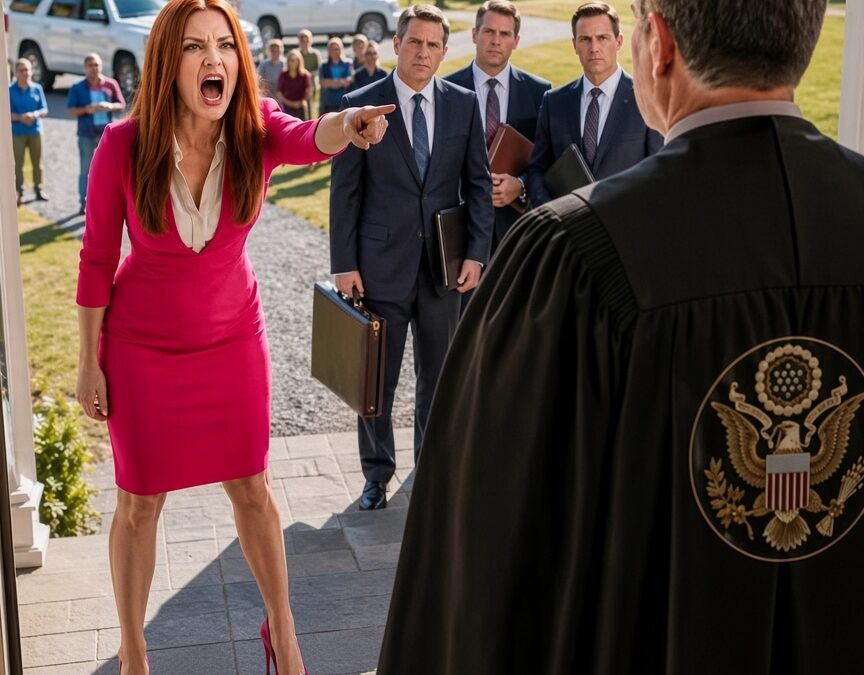
“You haven’t even considered the offer.”
“I’ve considered selling the farm many times over the years. The answer has always been no.”
Ashford spoke.
“Mr. Callaway, your legal exposure could be substantial if this matter proceeds.”
“That’s something my attorney can discuss with you.”
Victoria rolled her eyes.
“You’re going to hide behind a lawyer now?”
I looked at her.
“You brought three.”
She stepped closer.
“Listen carefully. I have access to resources you cannot begin to imagine. I can keep this case in court for years. I can challenge your zoning, your permits, your agricultural operations, everything.”
Ashford shifted.
“Victoria—”
She ignored him.
“By the time we’re finished, you’ll be lucky to afford a trailer on the other side of the county.”
I didn’t answer.
She reached into her bag and pulled out the check.
“Take the money.”
“No.”
“Then you’re making a terrible mistake.”
She dropped the check at my feet.
I looked at it, then at her.
“Are you finished?”
“No.”
She turned toward the road, where a flatbed truck had just arrived.
Several contractors climbed out.
An excavator followed.
I hadn’t seen the equipment approaching.
Victoria smiled.
“Since you insist on dragging this out, we’ll begin removing the encroaching fence.”
Ashford looked sharply at her.
“That’s not what we discussed.”
“I don’t care what we discussed.”
She pointed toward the eastern line.
“Tear it down.”
The foreman hesitated.
He was a broad-shouldered man in a faded baseball cap.
“Ma’am, we were told the property was cleared for demolition.”
“It is.”
I walked toward him.
“What’s your name?”
“Ray.”
“Ray, have you seen a court order authorizing this work?”
He looked at Victoria.
“No, sir.”
“Do you have written permission from the owner of this property?”
“Mrs. Ashworth said—”
“I’m the owner.”
Victoria laughed.
“Not for much longer.”
I took my phone from my pocket and called Karen.
She answered immediately.
“Wade?”
“The contractors are here. Victoria has instructed them to remove the fence.”
“Has anyone started?”
“No.”
“Keep it that way. I’m contacting the court.”
I ended the call and addressed Ray.
“There’s pending litigation over this boundary. My attorney is seeking emergency relief. If you touch the fence, you may become involved in a lawsuit you have nothing to do with.”
Ray looked toward the excavator.
Then he turned to Victoria.
“Ma’am, we’re stopping until somebody gives us proper documentation.”
Victoria stared at him.
“I’m paying you.”
“Yes, ma’am. But I’m not getting arrested for a fence.”
“Do you know who I am?”
Ray looked at me, then back at her.
“No, ma’am. And it doesn’t matter.”
He signaled to the operator.
The excavator shut down.
For the first time since I’d met Victoria, someone she’d hired had refused to follow her orders.
Her face flushed.
“This is unbelievable.”
Ashford took her by the elbow.
“We need to leave.”
She pulled away.
“Don’t touch me.”
“Victoria. Now.”
Something in his voice finally reached her.
She turned toward her Porsche.
Before getting in, she pointed at me.
“You’ll regret embarrassing me.”
I bent down, picked up the check, and brushed the dirt from it.
“No,” I said. “I don’t believe I will.”
After they left, Ray approached.
“Sir, I apologize. We were told this was HOA common property.”
“I understand.”
“Do you need our company information?”
“Yes, please.”
He handed me a business card and a copy of the work order.
The work order identified Holt Partners Development as the contracting party.
I looked at the signature authorizing the job.
Vance Holt.
That evening, Karen called.
The judge had issued an emergency order preserving the status quo until the scheduled hearing.
No fence removal.
No construction.
No entry onto the disputed strip for development purposes.
Karen sounded relieved.
“Now we can address this properly.”
I sat on the porch with the order in my lap.
The pasture was quiet.
I could hear the cattle shifting near the water trough.
For the first time in months, I allowed myself to feel angry.
Not because Victoria had insulted me.
I’d heard worse from defendants, litigants, and occasionally attorneys who thought the microphone was off.
What angered me was how casually she’d threatened to destroy something she didn’t own.
She had looked at my family’s land and seen an obstacle.
She hadn’t seen my grandfather’s labor, my father’s years, or the life Ann and I had built there.
She certainly hadn’t seen the people who depended on neighboring farms for their livelihoods.
To Victoria, all of it was simply acreage.
Something to acquire, rezone, subdivide, and sell.
Claire arrived the next evening.
She found me sitting at the kitchen table with the original deed.
“Dad?”
I looked up.
She pulled out the chair across from me.
“Mom used to sit there,” she said.
“I know.”
Claire studied the deed.
“Granddad’s handwriting?”
“Your great-granddad’s. On the back.”
She turned it over.
In faded pencil, Thomas Callaway had written the purchase date and the amount paid.
Beneath it was a short sentence.
For those who come after us.
Claire read it twice.
Then she placed the deed between us.
“We’re not losing this place.”
“No,” I said. “We’re not.”
June 12 arrived hot and humid.
By eight in the morning, the courthouse parking lot was already crowded.
The hearing was scheduled before Judge Martha Kingsley, an experienced trial judge known for running an orderly courtroom.
I had taken the day away from my appellate duties to attend as a private litigant.
My robe remained in my chambers in Nashville.
That was the plan.
But a separate administrative matter required me to stop briefly at the courthouse’s judicial offices that morning, where I’d previously been scheduled to assist with a docket review.
I arrived early, carrying a garment bag and a folder of documents.
A court employee asked whether I needed to meet with the presiding judge before leaving.
I did.
The meeting took fifteen minutes.

