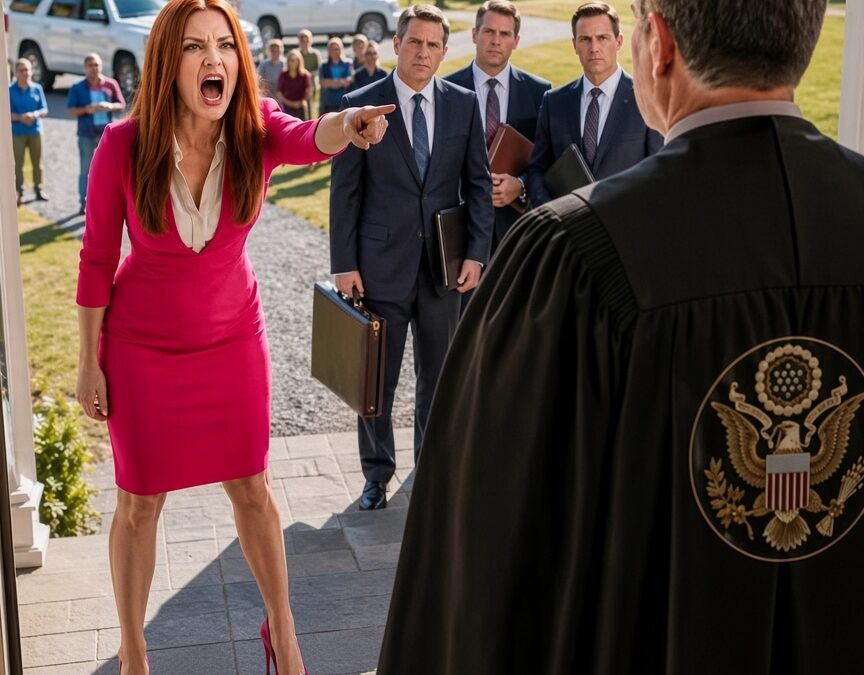
He glanced toward the pasture.
“Mr. Callaway, I don’t think you understand how expensive this kind of litigation can become.”
“I understand litigation costs.”
“You may be looking at years of legal proceedings.”
“Then I suggest your client make sure her evidence is accurate.”
He closed his briefcase.
“I’m trying to help you avoid unnecessary hardship.”
I looked at him.
“Mr. Brennan, if you’re genuinely trying to help, start by verifying the survey before somebody makes a decision they can’t undo.”
He left without finishing his coffee, which I hadn’t offered him.
As his car disappeared down the driveway, I went inside and called Sam Prescott.
Sam had surveyed the farm twice.
He was sixty-three, meticulous, and entirely unimpressed by expensive development plans.
“I need the eastern line checked,” I told him.
“Something move?”
“Three monuments are gone. One’s been reset.”
He was silent for a moment.
“Don’t touch anything else.”
“I haven’t.”
“I’ll be there Thursday.”
Sam arrived with two assistants, modern surveying equipment, and a stack of historical records.
They spent three days walking the line.
On the second afternoon, Sam called me over to the northern corner.
He pointed to the relocated marker.
“See the soil around it?”
I nodded.
“Recently disturbed. And whoever reset this didn’t even match the original depth.”
He showed me a photograph from the 2011 survey.
The marker had stood beside a distinctive limestone outcrop.
Now it was twelve feet west.
“Can you establish the original boundary?” I asked.
“Absolutely.”
“Can you document the interference?”
“I can document the physical evidence and explain what it means. Who moved it is another question.”
That was precisely the distinction I needed.
I didn’t want guesses.
I wanted facts that would withstand cross-examination.
While Sam worked, I called my northern neighbor, Gil Whitaker.
Gil was sixty-nine, a retired Army Corps of Engineers employee who had farmed the adjoining acreage for more than thirty years.
He answered on the fourth ring.
“Wade.”
“Gil, have you had anybody surveying your property recently?”
“Funny you should ask.”
He told me a man had entered his pasture carrying a measuring wheel and clipboard.
When Gil challenged him, the man claimed he was performing a boundary assessment authorized by Ridgefield Crossing.
“I told him Ridgefield Crossing doesn’t own my property,” Gil said.
“What happened?”
“He left.”
“Did you get his name?”
“No. Got his truck plate, though.”
I wrote it down.
Then Gil said something that made me stop writing.
“Victoria Ashworth tried to buy my place last fall.”
“How much did she offer?”
“Four hundred thousand.”
Gil’s land was worth considerably more.
“I told her no. She said I was making a mistake.”
“What exactly did she say?”
“She said she’d find another way to get what she needed.”
I looked toward the eastern pasture.
“Gil, would you be willing to put that in a signed statement?”
“For you? Sure.”
“And keep the photographs and the plate information.”
“Already have them.”
I thanked him and hung up.
By then, I was beginning to see a pattern.
Victoria wasn’t simply trying to force me out.
She and Vance Holt appeared to be targeting multiple neighboring properties for a development expansion that couldn’t proceed without our land.
The second attorney entered the picture in May.
Her name was Katherine Mercer.
She was a senior partner at a respected Nashville firm, experienced in property litigation and politically well connected.
I knew her professionally.
She was also being considered for a federal judicial appointment.
I served on an advisory review panel connected with that process, although I had no intention of allowing my private dispute to influence her evaluation.
That separation mattered to me.
A judge who uses public office to settle a private grievance becomes exactly the sort of person he is supposed to restrain.
One afternoon, I returned from Nashville and noticed Victoria’s Porsche parked near my fence.
Beside it was a white Mercedes.
Victoria and Mercer were studying a large document spread across the hood.
I approached along the farm access road.
They saw me before I reached them.
“Mr. Callaway,” Mercer said.
“Ms. Mercer.”
She looked briefly surprised.
“Have we met?”
“Professionally, yes.”
Her expression tightened, though she didn’t pursue it.
Victoria stepped forward.
“We’re prepared to establish our rights to this strip through adverse possession if necessary.”
I looked at Mercer.
“Is that your position?”
Mercer answered carefully.
“We’re evaluating all available theories.”
“Your subdivision was completed less than three years ago.”
“Prior use by predecessors in interest may be relevant.”
“Then I hope you’ve identified those predecessors and the specific possession you’re relying on.”
Mercer folded the map.
Victoria frowned.
“Why are you arguing technicalities? The neighborhood needs this land.”
I turned toward her.
“Needing something doesn’t make it yours.”
Her face hardened.
“You people are impossible.”
“Which people?”
“Farmers who think the world should stop changing because their grandfathers owned a few cows.”
I looked past her toward the pasture.
“My grandfather owned the land. The cows came later.”
Victoria didn’t appreciate the distinction.
She got into her Porsche and slammed the door.
Mercer remained beside the Mercedes.
“Mr. Callaway,” she said quietly, “I hope this can be resolved without unnecessary hostility.”
“So do I.”
She studied me another moment.
Then she left.
That evening, I contacted an attorney of my own.
Her name was Karen Goss, a Memphis litigator with extensive experience in property disputes and no professional connection to the Ridgefield development.
I explained the situation and sent her the documents.
When she learned I was a sitting appellate judge, she immediately asked whether any opposing counsel had matters pending before my court.
“Possibly,” I said.
“Then we need to address that before anything else.”
I agreed.
Over the next several days, I disclosed the potential conflicts through the appropriate judicial channels and arranged to be screened from any cases involving attorneys whose representation in my private dispute created an appearance of conflict.
I also withdrew from any advisory consideration involving Mercer.

