A second followed.
The vote passed without opposition.
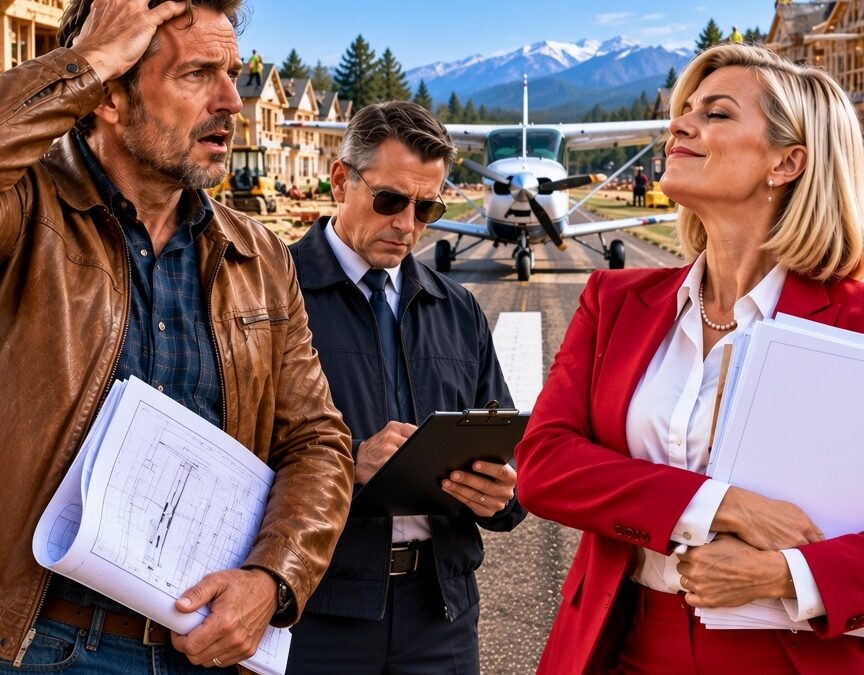
Rebecca sat at the center of the table with her crimson folder closed in front of her.
For months, that folder had arrived at my property carrying complaints, notices, and claims about what was supposed to happen.
Now the document that mattered most wasn’t inside it.
Robert turned toward her.
“Would you like to add anything?”
Rebecca was silent for several seconds.
Then she looked at me.
“I believed the development materials reflected something more definite than they did.”
It wasn’t a grand apology.
It wasn’t the admission some people in the room probably wanted.
But it was the first time I had heard her acknowledge the difference between what she believed and what the records established.
I could have reminded her of every unanswered question.
Every formal letter.
Every time she had insisted that the presence of houses somehow gave her association authority over my land.
I didn’t.
“That’s why I kept asking for the document,” I said.
She nodded once.
Nathan explained that the developer would separately review historical sales materials and any representations made to buyers.
Laura reminded everyone that those questions should be addressed through evidence rather than speculation.
Michael was equally careful.
His review hadn’t declared my airstrip immune from oversight.
It hadn’t guaranteed unlimited future operations.
Applicable aviation requirements still applied, and legitimate safety concerns could still be examined.
What his work established was simpler.
The runway had remained in the same physical location while the residential environment around it changed.
And nothing he reviewed supported treating its expected closure as a commitment from me.
The meeting ended shortly after eight.
As people gathered their belongings, Robert approached me.
“Grant, I’d like to apologize for the board’s handling of this.”
I shook his hand.
“I appreciate that.”
“We should have asked for the underlying documents sooner.”
“Yes.”
He nodded.
“I intend to make sure we do next time.”
Outside the clubhouse, several homeowners stopped to speak with me.
Some apologized.
Others asked questions about the airstrip.
One man admitted he still disliked the noise.
I told him I understood.
We didn’t have to agree about everything.
We only had to stop pretending that disagreement gave one person authority over another person’s land.
A week later, Rebecca resigned as president of the homeowners association.
The announcement described it as a personal decision after a demanding period for the board.
Robert became interim president.
I didn’t ask for Rebecca to resign.
I didn’t demand a public apology.
I didn’t want homeowners to punish anyone on my behalf.
The result I needed was already visible.
The letters demanding closure stopped.
The claim that I had promised to discontinue operations disappeared from association correspondence.
Brookstone Ridge adopted a procedure requiring future complaints involving neighboring property to begin with a basic question.
What authority does the association actually have?
The developer continued reviewing historical sales representations.
That was a separate matter between the developer and the people who had purchased homes.
I stayed out of it unless someone needed factual information about my property.
I also agreed to maintain a direct contact process for reasonable neighborhood concerns.
When unusual aviation activity was planned, I would provide advance notice when practical.
I adjusted a few habits where doing so cost me nothing.
Not because Rebecca had forced me.
Not because Brookstone Ridge had acquired authority over my runway.
Because being considerate of neighbors was reasonable.
Courtesy had never been the problem.
Confusing courtesy with obligation had been.
Several months later, on a cool fall morning, I opened the equipment barn and rolled my airplane toward the grass strip.
The air smelled of damp leaves and freshly cut grass.
A thin layer of mist hung over the lower section of the field.
Beyond the eastern fence, porch lights were switching off one by one as Brookstone Ridge woke up.
The houses were still there.
The runway was still there.
Neither had to disappear for the other to exist.
I completed my preflight inspection, checked the weather, and walked along the aircraft one last time.
For a moment, I stood beside the wing and looked toward the newest homes.
I thought about the first survey stakes I had photographed.
The first polite letter.
Rebecca’s visit.
The planning maps.
The meetings.
The email.
Assuming.
One word.
One word that had moved through years of paperwork until people forgot it had never been anything more than a prediction.
Michael stopped by later that morning to return one of the enlarged planning exhibits.
We stood beside my pickup looking toward Brookstone Ridge.
“Quieter?” he asked.
“Much.”
He handed me the document.
“Complicated way to discover the importance of one word.”
I smiled.
“Assuming.”
“Exactly.”
He looked toward the runway.
“People often want a clean answer before they’ve established the facts.”
“Rebecca certainly did.”
Michael shrugged slightly.
“She wasn’t the only one relying on that language.”
“No.”
“And that’s why the sequence mattered.”
I nodded.
After he drove away, I carried the exhibit back toward the barn.
I had spent nearly two years feeling as though I needed to defend every inch of my property against a neighborhood that wanted me gone.
But the documents had revealed something less dramatic and, in some ways, more troubling than a deliberate scheme.
A planning team had made an assumption.
Another document had described that assumption as an anticipated condition.
Later materials treated the anticipated condition as an expectation.
Some buyers apparently heard that the airstrip probably wouldn’t last.
The association eventually spoke as though closure were already part of the deal.
Then Rebecca came to my property and asked me to honor an agreement I had never made.
Nothing about that progression required a conspiracy.
That was what made it so unsettling.
An assumption didn’t need to be malicious to cause damage.
It only needed to be repeated by enough people who stopped checking where it came from.
I put the planning exhibit into a storage tube and placed it on the shelf beside my property records.

