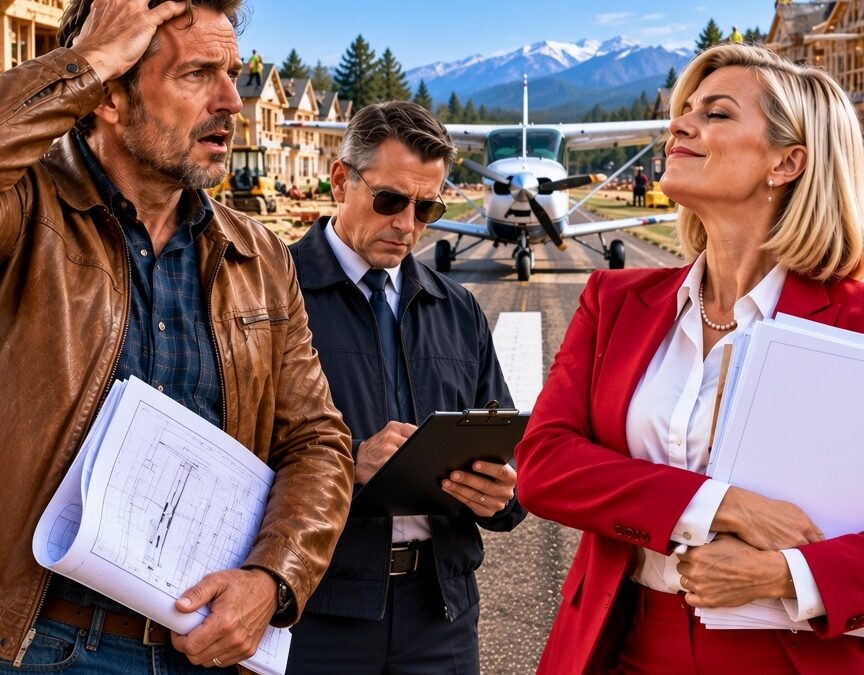
“When Laura asked whether the later planning language was supported by a signed commitment, did we produce one?”
“No.”
Robert glanced at the enlarged email.
“And now the earliest source we’ve located says the planning team was assuming the runway would stop operating.”
Rebecca looked down.
Her hand rested on the crimson folder.
She didn’t open it again.
Michael arranged the documents in order.
Old aerial photograph.
Preliminary subdivision exhibit.
Later western phase map.
Archived email.
“This is the sequence,” he said. “Existing airstrip. Planning assumption. Residential construction closer to the airstrip. Buyer expectations. Formal complaints.”
He looked around the table.
“Those events shouldn’t be rearranged because a different sequence is more convenient.”
The room was silent enough that I could hear the ventilation system.
For nearly two years, I had been asked why I refused to adapt my property to a neighborhood that now stood beside it.
That night, the question reversed.
Why had a neighborhood been planned closer to an existing airstrip while relying on a future condition nobody had secured from the person who owned the land?
Rebecca had spent months pointing toward the houses as proof that my circumstances had changed.
The maps showed something else.
The airstrip had stayed exactly where it was.
What had moved was Brookstone Ridge.
What had hardened was an assumption.
And what nobody could produce was the promise.
I thought the discovery would end the dispute immediately.
It didn’t.
The next three weeks were less dramatic than the meeting, but in some ways more important.
The association hired an independent attorney to review its records.
The developer began examining historical sales materials and correspondence.
Laura completed another review of my property documents.
Michael continued the aviation portion of his inquiry.
Nobody wanted to make a final statement based on one email alone.
I appreciated that.
The entire dispute had grown because people treated assumptions as facts.
I didn’t want the resolution to make the same mistake.
During those weeks, I received an unexpected visitor.
His name was Daniel Mercer.
He lived in one of the newer houses near my eastern boundary.
He was thirty-nine, worked in information technology, and had two young children.
I had seen him walking his dog along the subdivision road but had never spoken to him.
He called first and asked whether we could talk.
I told him to come by Saturday morning.
He arrived in jeans and a navy jacket, carrying no folder.
We sat on my porch with coffee.
“I owe you an apology,” he said.
I looked at him.
“For what?”
“I was one of the people complaining about the airplane.”
“You’re allowed to complain.”
“Not the way I did.”
He looked toward the runway.
“When we bought the house, we were told the aviation activity probably wouldn’t continue much longer. I didn’t think much about it. Then I heard your airplane one morning, and I got irritated.”
I waited.
“I assumed you were refusing to honor something everybody had agreed on.”
“Everybody except me.”
Daniel gave a brief, embarrassed smile.
“Apparently.”
He told me he had attended the last board meeting.
“I didn’t realize the airstrip was on the original planning maps.”
“Neither did I until I started looking.”
“That surprised me.”
“It surprised me too.”
Daniel stared into his coffee.
“I still worry about aircraft near the houses.”
“That’s fair.”
“And I still wish the area were quieter sometimes.”
“Also fair.”
He looked at me.
“But those concerns aren’t the same as saying you promised to shut down.”
“No, they aren’t.”
We talked for almost an hour.
I explained how frequently I used the runway, the precautions I took, and why I maintained the field.
He asked sensible questions.
I answered them.
Before leaving, he said something I hadn’t expected.
“I think a lot of us were angry at the wrong person.”
I shook my head.
“Maybe. But I’d rather everybody get the facts right than spend another year deciding who’s to blame.”
After Daniel left, I stood on the porch looking toward Brookstone Ridge.
For the first time in months, I felt as though the neighborhood contained actual neighbors again.
Not just a board, a developer, and a stack of complaints.
People.
People who had bought houses believing certain things.
People who worried about their families.
People who sometimes trusted information they had no reason to question until it mattered.
That didn’t excuse everything Rebecca had done.
But it helped me understand how the dispute had grown.
The final board meeting took place three weeks after the original email was found.
The room felt different.
There were no dramatic photographs of aircraft presented as evidence of a crisis.
No speeches about what everyone supposedly understood.
No demand letter waiting for me at the end of the table.
The independent attorney had reviewed the available board records, development correspondence, subdivision planning materials, and archived email.
Laura had completed her own examination of my property records.
Michael had finished his review of the aviation concerns referred to him.
Nathan had confirmed the development timeline as far as the records allowed.
The attorney’s conclusion was narrow, careful, and impossible to turn into the result Rebecca had been demanding.
No record anyone had located showed that I had agreed to close the airstrip.
The earliest planning documents treated it as an existing neighboring use.
A later planning email stated that the team was assuming future cessation of regular operations while evaluating the western residential layout.
Subsequent documents repeated that projected future condition with increasing confidence.
But repetition had never turned the original assumption into my consent.
The attorney recommended that Brookstone Ridge immediately stop representing closure of my airstrip as an established obligation unless actual supporting documentation could be produced.
He also recommended that the association distinguish between legitimate neighborhood concerns it could communicate, aviation matters for the appropriate authorities, and property rights it did not control.
Robert read the recommendation aloud.
“Motion to adopt?”
Another board member raised his hand.
“So moved.”

