I agreed immediately.
“What would you like me to have available?”
“Anything that helps establish the history and current use of the airstrip.”
I spent the following evening organizing documents in the equipment barn.
I arranged them chronologically across a folding table.
Old photographs.
Property surveys.
Maintenance records.
Planning exhibits.
Association correspondence.
Laura reviewed the folder before Michael arrived.
“Answer what he asks,” she told me. “If you don’t know something, say you don’t know.”
“I’m not planning to hide anything.”
“I know. I’m reminding you that speculation won’t help.”
Michael arrived shortly after nine.
He wore work boots and carried a canvas bag containing measuring equipment and documents.
We shook hands beside my pickup.
“Before we get into the paperwork,” he said, “I’d like to see the property.”
We walked the runway.
He asked about its dimensions, maintenance, drainage, aircraft use, and surrounding terrain.
I answered as accurately as I could.
He took notes without offering much reaction.
Near the eastern end, he stopped and looked toward Brookstone Ridge.
The newest houses stood beyond my fence.
Their upper windows faced the field.
“Those are part of the most recent development phase?”
“As far as I know.”
“When were they approved?”
“I don’t have the exact date.”
“Do you have planning materials?”
“Some.”
He studied the houses for another moment.
Then he checked distances from several positions and compared them with his map.
Back at the barn, Michael examined the documents.
When he reached the preliminary subdivision exhibit, he stopped.
“Where did you get this?”
“County planning records.”
He placed it beside the later map.
Then another.
His finger moved between the airstrip and the residential lots.
“The airstrip appears here.”
“Yes.”
“And here.”
“Yes.”
He studied the third document.
“But the description changes.”
“That’s what my attorney noticed.”
Michael didn’t interpret it immediately.
He asked for Laura’s contact information and continued working.
About twenty minutes later, Rebecca arrived.
I hadn’t invited her.
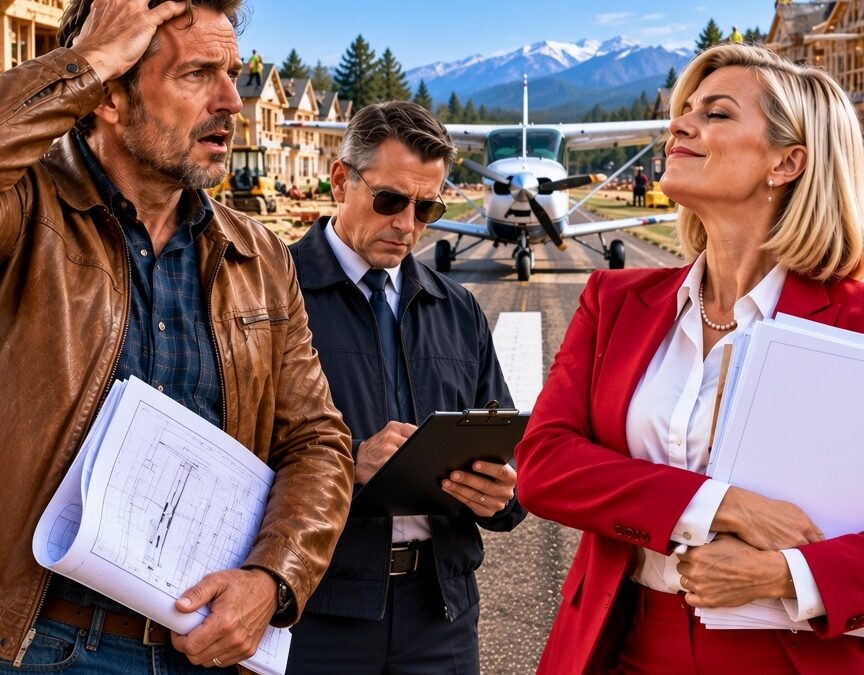
She parked beside my pickup and approached the barn with her crimson folder.
She greeted Michael and introduced herself.
Then she began explaining the homeowners’ concerns.
Michael listened.
Rebecca described Brookstone Ridge as a growing residential community whose conditions had changed substantially since the runway was established.
“That may be true,” Michael said. “I’m trying to establish the sequence.”
“The important issue is current safety.”
“Current conditions matter. So does how those conditions developed.”
He pointed toward the newest houses.
“Do you know when that phase was approved?”
Rebecca said the developer would have the dates.
“Was the airstrip shown on the planning material?”
“I believe everyone knew there was aviation activity nearby.”
“Was the development designed on the assumption that activity would stop?”
Rebecca shifted the folder from one hand to the other.
“My understanding is that long-term planning anticipated a change in use.”
“Based on what?”
“Coordination during the development process.”
“With Mr. Holloway?”
She didn’t answer immediately.
Michael waited.
Then he asked the question that would follow us through the rest of the dispute.
“Who told you this airstrip was closing?”
Rebecca could not give him a name.
She could not produce an agreement.
She could only repeat that the development had been planned around certain expectations.
Michael made no accusation.
He simply requested the records behind those expectations.
Before leaving, he told both of us the same thing.
“I need documents, not recollections.”
Rebecca gave a stiff nod.
I told him I understood.
Two days later, Laura called me to her office.
She had spread three large maps across the conference table.
The oldest showed my airstrip before Brookstone Ridge existed.
The second showed the preliminary subdivision layout with the runway identified.
The third showed the newer residential phase and its more ambiguous description of future aviation activity.
“Look at the same feature across all three,” she said.
I studied the pages.
The runway hadn’t moved.
The residential lots had.
The language had also changed.
Laura pointed to the third map.
“This is where we need to be careful. It doesn’t say you agreed to close anything.”
“Exactly.”
“But it may show that someone planning the subdivision expected something to change.”
“Something on land they didn’t own.”
“Possibly. We need the underlying correspondence.”
Michael called later that afternoon.
He had been reviewing the same planning history.
“Did the physical location of your runway change during construction?”
“No.”
“Did you shorten it?”
“No.”
“Move the approach area?”
“No.”
“All right.”
He didn’t explain further.
The next day, Rebecca announced a community meeting about aviation concerns.
The notice described the airstrip as an ongoing issue affecting Brookstone Ridge.
It said nothing about the runway appearing on subdivision plans before the newest homes were built.
I forwarded it to Laura.
Her response was short.
Bring the timeline.
The meeting took place on a Thursday evening.
Brookstone Ridge’s clubhouse looked like the lobby of a moderately expensive hotel.
There were upholstered chairs, decorative lighting, a stone fireplace, and a long conference table near the front of the room.
Almost forty homeowners attended.
Some looked curious.
Others looked annoyed.
One man watched me enter and immediately whispered something to his wife.
I wasn’t surprised.
For months, the association had been discussing my airstrip as a neighborhood problem.
Most residents had probably never heard my side.
Laura and I took seats near the front.
Michael sat separately near the end of the table.
Rebecca stood beside a screen displaying photographs of the subdivision.
Robert Hayes, a retired accountant and longtime board member, sat beside two other directors.
Rebecca began with a summary of complaints.
Noise.
Safety.
Property enjoyment.
Concerns about aircraft operating near homes.
I listened without interrupting.
Some of the complaints were understandable.
One homeowner worked night shifts and disliked being awakened on weekends.
Another worried about aircraft flying near her backyard.
A third wanted to know what would happen if an airplane experienced mechanical trouble.
Those were legitimate questions.
I didn’t want to pretend otherwise.
But then Rebecca said something familiar.

