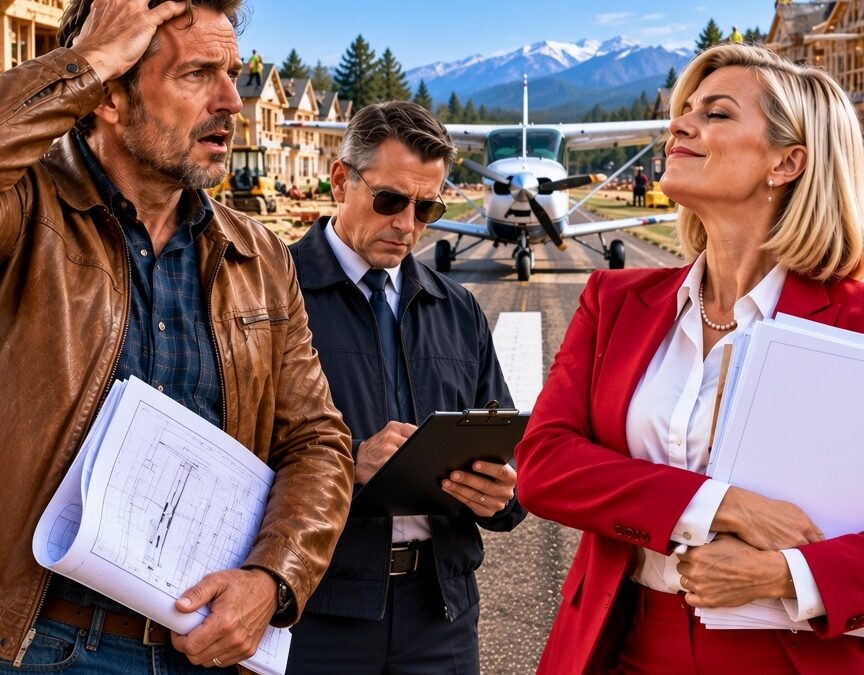
“I’d like you to recognize that the neighborhood has changed.”
“I recognize that.”
“And that the airstrip may no longer be appropriate.”
“Appropriate according to whom?”
Her expression tightened.
“We’re trying to resolve this cooperatively.”
“So am I. But if somebody promised you my airstrip would close, I want to see the promise.”
Rebecca returned to her SUV a few minutes later.
She left without showing me anything that required me to stop flying.
That evening, I went into my office and pulled out the documents from my property purchase.
I spread the closing survey across the kitchen table.
The paper was creased and slightly yellowed. The property lines were clear.
Ninety-six acres.
The equipment barn.
The access lane.
The grass airstrip.
There was no Brookstone Ridge on that survey.
The eastern tract was still undeveloped.
I examined the deed and the other property records I had received at closing.
Nothing mentioned an agreement to discontinue aviation activity.
But I wasn’t a lawyer.
And I knew that finding nothing in one folder didn’t mean there was nothing to find.
The next morning, I called Laura Bennett.
Laura was forty-eight, a property attorney who had helped me several years earlier when a neighboring landowner questioned an access easement.
She had a habit of making complicated disputes sound less exciting and more manageable.
That was exactly what I needed.
I explained Rebecca’s visit and repeated the sentence about the runway never being supposed to remain an issue.
Laura listened.
“Did she say you signed an agreement?”
“No.”
“Did she identify a recorded restriction?”
“No.”
“Did she tell you who made this supposed commitment?”
“No.”
“Then don’t argue with the implication. Ask for the source.”
“I did.”
“And?”
“She didn’t provide one.”
Laura paused.
“Good. Now let’s find out what the actual records show.”
Within a week, my kitchen table was covered with documents.
I gathered old aerial photographs, surveys, property records, runway maintenance notes, and dated photographs of Brookstone Ridge’s construction.
Laura requested subdivision planning materials and relevant public records from the county.
She also advised me to preserve every letter and email from the association.
“Don’t edit anything,” she said. “Don’t write angry replies. And don’t make claims you can’t support.”
“I wasn’t planning to.”
“You sounded ready to accuse the developer of fraud five minutes ago.”
“I said somebody must have told Rebecca something.”
“That’s different from knowing what they told her.”
I leaned back in my chair.
“You take all the fun out of being irritated.”
“That’s why you pay me.”
The first important document appeared two weeks later.
It was a preliminary subdivision exhibit.
Laura called me into her office and turned her monitor toward me.
The image showed the eastern tract before Brookstone Ridge was built.
My property boundary was visible.
So was my runway.
Not vaguely.
Not as an unidentified patch of open ground.
The airstrip had been drawn into the planning material as an existing neighboring feature.
I leaned forward.
“So they knew.”
Laura lifted one hand.
“The document shows the airstrip. It establishes that the information was available in the planning process.”
“Which means they knew.”
“It means we can prove what was on the page. That’s where we start.”
She enlarged a notation near the western edge of the proposed subdivision.
It identified neighboring aviation activity as a planning consideration.
I stared at it.
“Then why build houses closer?”
“That’s one of the questions we need answered.”
We compared the preliminary exhibit with a later phase map.
The early residential sections maintained more distance from my property.
The newer layout extended farther west.
Roads curved toward my boundary.
Residential lots appeared closer to the runway’s eastern end.
Then Laura opened a third document.
On this one, the airstrip was still shown, but the accompanying language had changed.
Instead of describing aviation activity simply as an existing neighboring use, the document referred to anticipated future conditions.
I read the phrase twice.
“What does that mean?”
“By itself, not enough.”
“Rebecca used almost those exact words.”
Laura looked at the screen.
“Then we need to find where they came from.”
The next association letter arrived three days later.
It stated that Brookstone Ridge was reviewing available options regarding continued aircraft operations near residential properties.
I called Rebecca.
“I received your letter.”
“Then you understand the concerns are becoming more serious.”
“I understand that people are concerned. I still haven’t seen anything saying my airstrip was supposed to close.”
“Grant, you’re focusing on wording instead of the reality around you.”
“The wording matters if you’re claiming I agreed to something.”
“There are families living here now.”
“I know.”
“Then surely you understand why this can’t continue indefinitely.”
I looked through my kitchen window.
The runway was empty.
Beyond it, the new houses stood in the afternoon sunlight.
“Who told you it wouldn’t continue?”
She paused.
“The development process involved discussions that happened before many of these homeowners purchased their houses.”
“Was I involved in those discussions?”
“You’d need to ask the developer about the full history.”
That answer was more useful than she probably realized.
I thanked her, ended the call, and wrote down the conversation while it was fresh.
I didn’t know what Rebecca believed.
I didn’t know what the developer had told her.
But I knew she still hadn’t identified a commitment from me.
The dispute became more serious when a formal aviation safety concern was referred for review.
Rebecca called that afternoon.
“This is what I was trying to avoid,” she said.
I looked at the notice on my desk.
“You were trying to avoid somebody examining the facts?”
“I was trying to prevent a neighborhood concern from becoming something larger.”
“Who submitted the complaint?”
“Several residents have raised concerns.”
“That wasn’t my question.”
“The association documented the concerns it received.”
I didn’t press further.
There was no point arguing over the phone.
A few days later, Michael Turner contacted me.
He introduced himself as an aviation safety inspector and asked whether he could visit the property.

