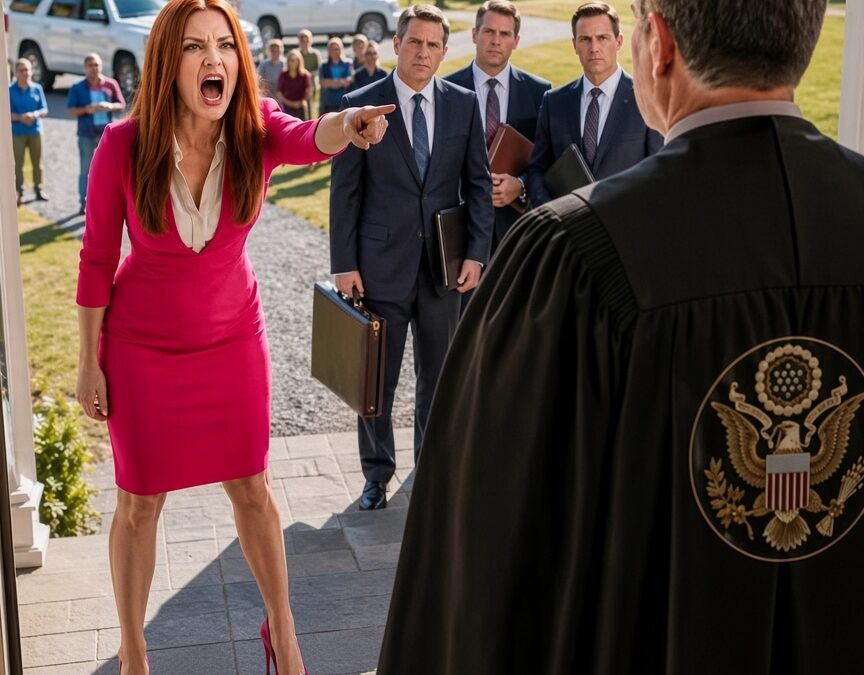
“Your fence? Sweetheart, that land already belongs to us. I have three lawyers and a demolition crew. What do you have? Mud on your boots and a dream?”
Victoria Ashworth stood beside her white Porsche Cayenne, pointing one manicured finger at the cedar fence my father had helped build forty years earlier.
Behind her, six contractors waited beside a flatbed truck carrying a hydraulic post puller. A yellow excavator sat on the shoulder of the county road, its engine idling. Two men had already unhooked the chain securing my eastern gate.
“My family has owned this property since 1941,” I told her.
Victoria looked me up and down.

I was wearing a faded flannel shirt, jeans stained with red Tennessee clay, and work boots that had seen better decades. I’d spent the morning repairing a water trough. There was grease beneath my fingernails and a streak of mud across my sleeve.
She smiled.
“Nobody cares how long your family has been squatting out here. Look at yourself. You’re filthy. You’re an embarrassment to this entire neighborhood.”
One of the contractors glanced at me, then looked away.
Victoria reached into her designer handbag and pulled out a folded check.
“Two hundred thousand dollars. Take it, sign the papers, and disappear. Otherwise, I’ll bury you in legal fees until your daughter has to sell whatever’s left.”
I didn’t reach for the check.
She held it out another moment, then let it fall into the dirt between us.
“Fine.”
She turned toward the excavator operator.
“Tear it all down. Now.”
I kept my hands in my pockets.
What Victoria didn’t know was that I had already photographed every vehicle, recorded the contractors’ arrival, and obtained an emergency court order prohibiting anyone acting on her behalf from touching that fence.
What she also didn’t know was that the three attorneys standing behind her had each made a serious professional mistake.
And none of them had recognized the man they were threatening.
My name is Wade Callaway. I’m fifty-six years old, and for the past eleven years I’ve served on the Tennessee Court of Appeals.
Before that, I spent fourteen years as a trial judge in Rutherford County.
But long before anyone called me Your Honor, I was a cattle rancher’s son who learned to repair fences before I learned to drive.
Our family farm sits between Nashville and Murfreesboro, 380 acres of rolling pasture, hardwood trees, limestone creek beds, and stubborn Tennessee clay.
My grandfather, Thomas Callaway, bought the original acreage in 1941 with money he’d saved working for the railroad. He wasn’t wealthy. He was a careful man who believed land was the one thing a family could hold onto when everything else went wrong.
He paid cash.
My father expanded the cattle operation, built the main barn, and taught me that a boundary fence wasn’t just a collection of posts and wire.
It represented a promise.
You respected your neighbor’s property, and you expected him to respect yours.
For most of my life, that arrangement worked.
Then the developers arrived.
Two years before the trouble began, my wife, Ann, died without warning.
It happened on a Sunday morning.
We’d been married thirty-one years. She was sitting across from me at the kitchen table, drinking coffee and reminding me that the upstairs bathroom faucet was still leaking.
I told her I’d fix it after church.
She gave me the look she’d perfected over three decades of marriage.
“You said that last Sunday.”
I was about to answer when her coffee mug slipped from her hands.
By the time the ambulance arrived, I already knew.
Ann had suffered a catastrophic brain aneurysm.
There had been no warning signs, no chance to prepare, and no final conversation.
One minute we were discussing a faucet.
The next, I was sitting in a hospital waiting room trying to understand how a person could disappear from a life she’d helped build.
After the funeral, I stopped spending unnecessary time in the house.
I still went to work. I still heard cases. I still wrote opinions and attended meetings.
But when I came home, I changed into my work clothes and went outside.
I repaired equipment that didn’t need repairing. I cleared brush from fence lines. I replaced boards on the barn that would probably have lasted another ten years.
The work gave me something grief couldn’t interrupt.
My daughter, Claire, understood.
She was twenty-eight, a large-animal veterinarian based near Knoxville, and she’d inherited her mother’s practical intelligence and my father’s stubbornness.
Every Friday evening, she’d drive down to the farm with her veterinary bag, a cooler of groceries, and some new excuse for why she needed to spend the weekend.
Sometimes she helped vaccinate calves.
Sometimes she cooked dinner.
Sometimes she just sat beside me on the porch while the sun went down.
She never asked me to stop missing Ann.
That was one of the reasons I loved her so much.
The trouble started when a developer named Vance Holt purchased two hundred acres of former soybean fields east of my property.
Within eighteen months, those fields became Ridgefield Crossing, a luxury subdivision with ninety-seven houses, landscaped entrances, decorative streetlamps, and a clubhouse that looked like a small resort.
The houses started around $650,000.
The homeowners paid four hundred dollars a month in association dues.
Their amenities included a swimming pool, tennis courts, walking trails, and a dog park covered in artificial turf.
What they didn’t have was any legal authority over my farm.
That distinction became important when Victoria Ashworth moved into the largest house in the subdivision.
Victoria was thirty-seven, impeccably dressed, and married to Harrison Ashworth, whose family controlled a substantial private investment business.
She had the kind of confidence that comes from never having to wonder whether a check will clear.
Within six months, she’d become president of the Ridgefield Crossing Homeowners Association.
By the end of her first year, she’d turned the HOA into a personal enforcement agency.

