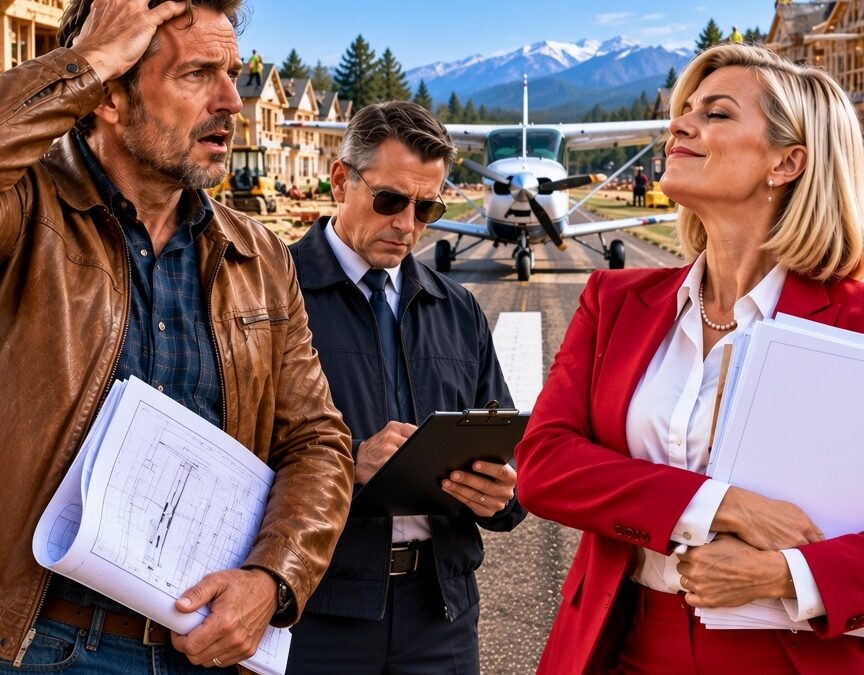
“Who told you this airstrip was closing?”
Michael Turner asked the question so quietly that Rebecca Sloan almost answered without thinking.
Almost.
We stood at the eastern end of my grass runway on a clear Virginia morning. Behind me stretched ninety-six acres of land I owned outright. Beyond the fence stood the newest homes in Brookstone Ridge, their freshly painted siding and expensive windows facing an airstrip that had existed long before anyone thought to build a subdivision there.
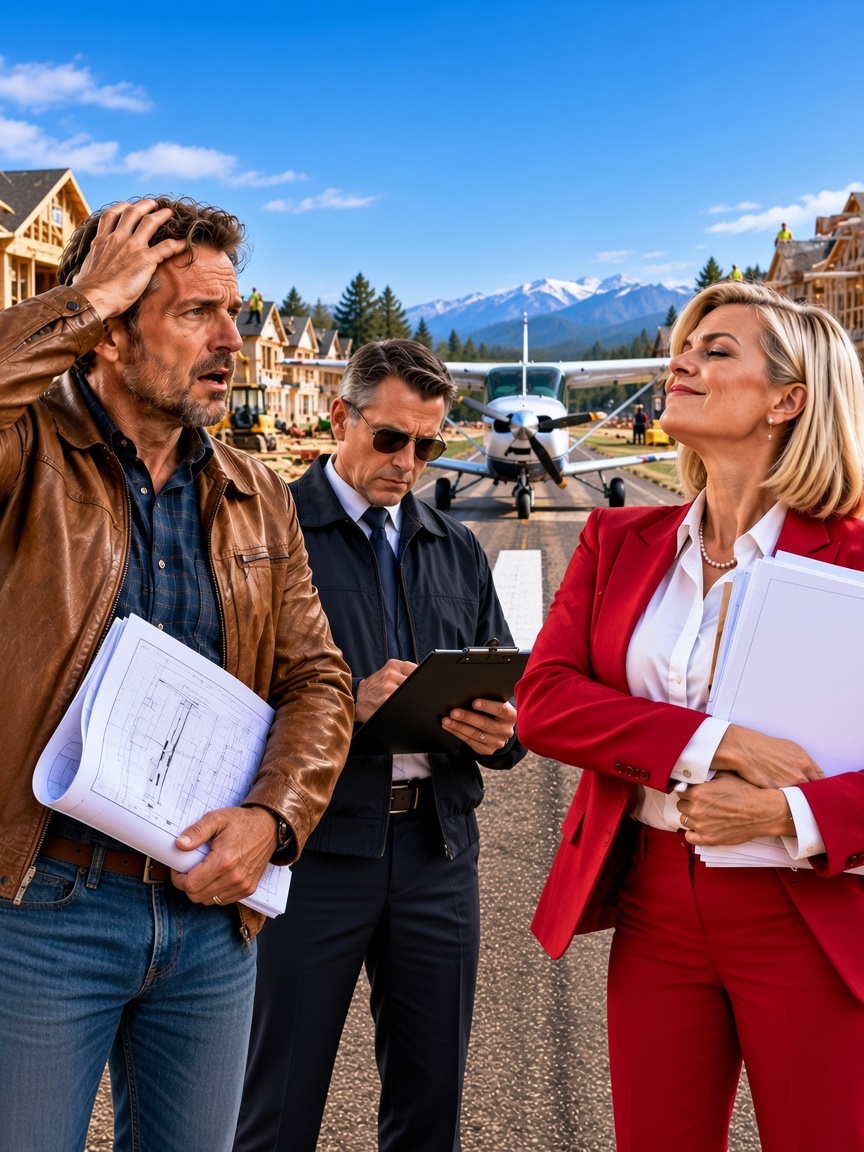
Rebecca stood ten feet away in a crimson blazer, clutching a red folder against her chest. Six homeowners had gathered near the fence. Two association board members stood behind her.
Michael, an aviation safety inspector, had arrived that morning to investigate complaints about my runway. I expected questions about aircraft noise, operating procedures, and whether my property complied with applicable aviation requirements.
Instead, he was asking the president of Brookstone Ridge’s homeowners association to explain a promise she had spent nearly two years insisting I was obligated to honor.
“The development was planned with the understanding that regular flight operations would eventually end,” Rebecca replied.
Michael glanced at the document in his hand.
“That wasn’t my question.”
Rebecca adjusted her grip on the folder.
“There was coordination during the development process. The developer was involved. County planning was involved. The community was built around certain expectations.”
Michael waited.
He was fifty-four, with gray hair at his temples and the kind of patience that made people uncomfortable when they were accustomed to winning arguments through persistence.
Finally, he asked again.
“Who told you Mr. Holloway agreed to close his airstrip?”
Rebecca looked toward the newest houses.
“The issue is more complicated than whether Grant signed one particular document.”
“Then show me the complicated version. Who made the commitment?”
She opened her folder.
For the first time since I had met her, Rebecca Sloan appeared uncertain which page she wanted.
I kept my mouth shut.
Six months earlier, I would have interrupted. I would have explained that my property was outside her association, that the runway predated the neighborhood, and that I had never promised anyone I would stop flying.
But Laura Bennett, my attorney, had taught me something important.
When someone claimed authority over my property, I needed to stop arguing about what they wanted and start asking what gave them the right to demand it.
Michael turned toward the subdivision.
“When was the western phase approved?”
“I would need to check the development records.”
“And was this airstrip shown on the planning materials?”
“Everyone was aware there was aviation activity nearby.”
“That’s not what I asked.”
One of the board members shifted his weight.
Rebecca opened her folder wider.
“Yes. I believe it appeared on some of the earlier materials.”
Michael turned to me.
“Mr. Holloway, did you move your runway during the development of Brookstone Ridge?”
“No.”
“Shorten it?”
“No.”
“Relocate the approach area toward those houses?”
“No.”
He looked back at Rebecca.
“Then I need to understand what changed.”
Rebecca gestured toward the rooftops.
“What changed is that families live there now.”
“That is obvious,” Michael replied. “I’m asking what changed in the records.”
She removed a planning sheet from her folder.
“The project materials anticipated changing conditions.”
Michael accepted it.
“Anticipated by whom?”
“The planning team.”
“Based on whose commitment?”
Rebecca looked toward the two board members.
Neither answered.
Michael placed the sheet on the folding table beside my property survey and an old aerial photograph.
“Mr. Holloway, did you sign an agreement promising to discontinue regular aviation operations?”
“No.”
“Did you tell the developer you intended to close the airstrip?”
“No.”
“Did you authorize anyone to tell future homebuyers that you would?”
“No.”
Rebecca exhaled.
“Grant, circumstances change.”
I looked past her toward the houses.
“They certainly do. My runway didn’t.”
Michael studied the three maps spread across the table.
Then he said something that changed the entire direction of the dispute.
“Before we decide whether this airstrip became incompatible with the neighborhood, I want to understand whether the neighborhood was planned on the assumption that the airstrip would disappear.”
He looked directly at Rebecca.
“And if it was, I want to know where that assumption came from.”
Less than twenty minutes earlier, Michael had arrived because someone had filed complaints about my property.
Now he was examining the planning history of Brookstone Ridge.
And I was beginning to understand that the argument had never really been about a grass runway.
It was about how an expectation concerning my land had somehow become a promise that everyone believed I had made.
The problem was simple.
Nobody had ever asked me to make it.
My name is Grant Holloway. I was forty-five years old when the dispute reached that point, and I had owned my ninety-six acres in rural Virginia for almost twelve years.
I bought the property because I wanted space.
Not prestige. Not a spectacular mansion. Not a gated entrance with stone columns and landscaping that required three different contractors.
Space.
The farmhouse was a two-story white building with a wraparound porch, a kitchen that needed updating, and a roof I replaced during my second year there. Behind it stood an old equipment barn that had been built when the property was still part of a larger farm.
The land itself was the reason I signed the closing papers.
Rolling pasture, a stand of hardwood trees along the western boundary, a shallow creek, and a long, level section of ground that had been used as a private grass airstrip for years.
The runway was approximately 2,600 feet long.
I maintained it carefully, mowing it regularly, checking drainage after storms, and keeping the approach areas clear of obstacles on my own land.
I owned a small aviation equipment business, supplying and servicing components for private aircraft owners and maintenance shops. The business paid my bills and allowed me to work mostly from the property.
I also flew recreationally.

