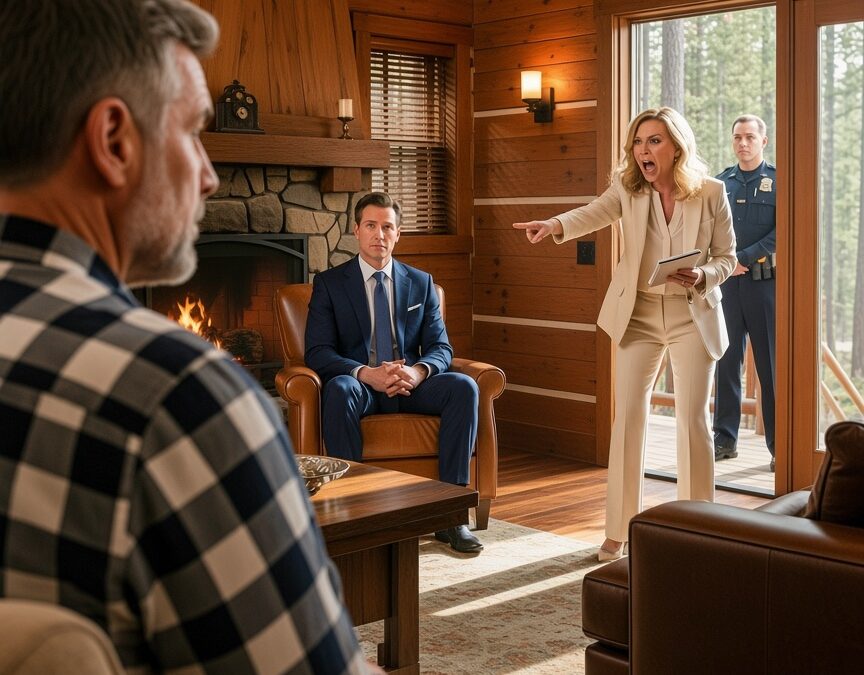
His tone was still pleasant.
But the conversation no longer felt friendly.
He leaned toward me.
“I need you to understand something. There are people who would exploit your grief, your project, and your credibility for their own purposes.”
I stared at him.
“Are you talking about Magnus?”
“I’m telling you to be careful.”
Before I could respond, my phone rang.
Elena.
I answered.
“Garrett,” she said, her voice shaking. “It’s Magnus. He’s in the hospital.”
I stood immediately.
“What happened?”
“His oxygen equipment stopped working overnight. His neighbor found him.”
I grabbed my jacket.
Morrison rose.
“Is everything all right?”
“No.”
I moved toward the door.
He followed me.
“Garrett, whatever happens, don’t make accusations until we understand the facts.”
I stopped.
For one brief moment, I wondered whether that was sincere advice.
Or a warning.
Magnus was awake when I reached the hospital, but he looked twenty years older.
His face was pale, and an oxygen tube rested beneath his nose.
He waved me closer.
“Wasn’t an ordinary outage,” he whispered.
I sat beside him.
“What do you mean?”
“I heard a truck outside. Then the power went. Just my house.”
“Could’ve been the service line.”
He shook his head.
“Backup battery wasn’t working either. I checked it last week.”
A hospital nurse entered, adjusted his equipment, and asked him not to strain himself.
When she left, Magnus gripped my wrist.
“Somebody was inside the house while I waited for help.”
“Did you see them?”
“Flashlights. Two of them.”
“Did you call the sheriff?”
“My neighbor did.”
I looked at the monitor beside his bed.
I had known Magnus for years.
He was stubborn, suspicious, and occasionally wrong.
But he wasn’t a man who frightened easily.
“Where are the documents?” I asked.
His mouth twitched.
“Safe.”
“Magnus.”
“Garrett, my father didn’t trust one hiding place. Neither do I.”
Then he told me about the additional records.
Copies in bank deposit boxes.
Documents stored with a trusted attorney.
Historical materials shared with tribal archives.
And, most importantly, financial records that appeared to connect the original land transfer to payments made to county officials.
Including Robert Morrison Sr.
I sat back.
“Why didn’t you tell me sooner?”
“Because I wanted to know whether you were serious.”
I stared at him.
“Someone may have tried to kill you.”
His expression hardened.
“Then I suppose they know I’m serious too.”
That evening, Elena called again.
Someone had broken into her university office.
Several research drives and paper files were missing.
Rosa’s office had also been entered.
The intruders had ignored electronics and cash but removed boxes containing old land cases.
The timing was impossible to ignore.
We reported everything.
Then Rosa contacted a federal attorney outside Morrison’s professional circle.
The response was discouraging.
The office wanted additional verification before opening a formal investigation and had been advised that the state was already handling related matters.
Rosa hung up furious.
“Someone is steering this back through Morrison’s office.”
“Can he stop federal prosecutors?” I asked.
“Not legally. But influence and bureaucratic caution can delay things.”
I looked at Magnus through the hospital room window.
“We don’t have time for delays.”
“No,” she said. “We don’t.”
The next morning, the hospital informed us that a petition had been filed seeking an evaluation of Magnus’s decision-making capacity.
The petitioner was Brenda Castellanos.
She claimed to be acting on concerns raised by members of the community.
Magnus read the paperwork and nearly tore it in half.
“That woman doesn’t even know my birthday.”
The petition alleged confusion, paranoia, and an inability to manage important personal affairs.
Rosa reviewed it carefully.
“This doesn’t automatically make him incompetent,” she said. “And it certainly doesn’t erase his testimony. But it could create delays and pressure.”
Magnus looked at her.
“Can you stop it?”
“We’ll contest it.”
A court-appointed evaluator named Dr. Franklin Pierce arrived that afternoon.
He was courteous at first.
Then he began asking questions about Magnus’s claims concerning federal land fraud.
“Do you believe powerful government officials are conspiring against you?” he asked.
Magnus crossed his arms.
“I believe some government officials took money they shouldn’t have.”
“Do you have evidence?”
“Yes.”
“Where is it?”
“With people I trust.”
Pierce wrote something on his clipboard.
“Do you often feel people are watching you?”
Magnus glanced toward me.
“Considering somebody broke into my house, I’d say that’s a reasonable concern.”
The doctor didn’t smile.
I interrupted.
“Doctor, have you reviewed the police report?”
“That isn’t necessary for my preliminary interview.”
“Have you reviewed the property records?”
“My role isn’t to resolve a land dispute.”
“Then you shouldn’t treat the existence of that dispute as evidence of delusion.”
Pierce closed his notebook.
“I’ll conduct my evaluation according to professional standards.”
Rosa requested the basis for his appointment and began investigating possible conflicts.
What she found was extraordinary.
Financial records obtained through lawful investigative channels indicated that Pierce had received substantial payments from businesses associated with Brenda’s development interests.
The payments did not, by themselves, prove that he had falsified an evaluation.
But they raised serious questions about his independence.
Rosa submitted the evidence to the court and requested his removal.
The court suspended his involvement pending review.
For the first time, Brenda’s attempt to discredit Magnus had produced evidence against her.
That same evening, another ally arrived.
Tommy Lightfoot was an environmental officer representing a tribal government whose ancestral lands bordered the disputed watershed.
He had been reviewing the historical maps with tribal legal counsel.
“The federal records deserve a formal investigation,” he said.
“Can your council help?” I asked.
“We can bring our own concerns to federal agencies and request consultation where our interests are affected.”
He placed a folder on the table.
“Our council has authorized a submission.”
Rosa examined the documents.
“This could help move the evidence through an independent channel.”
Tommy nodded.

