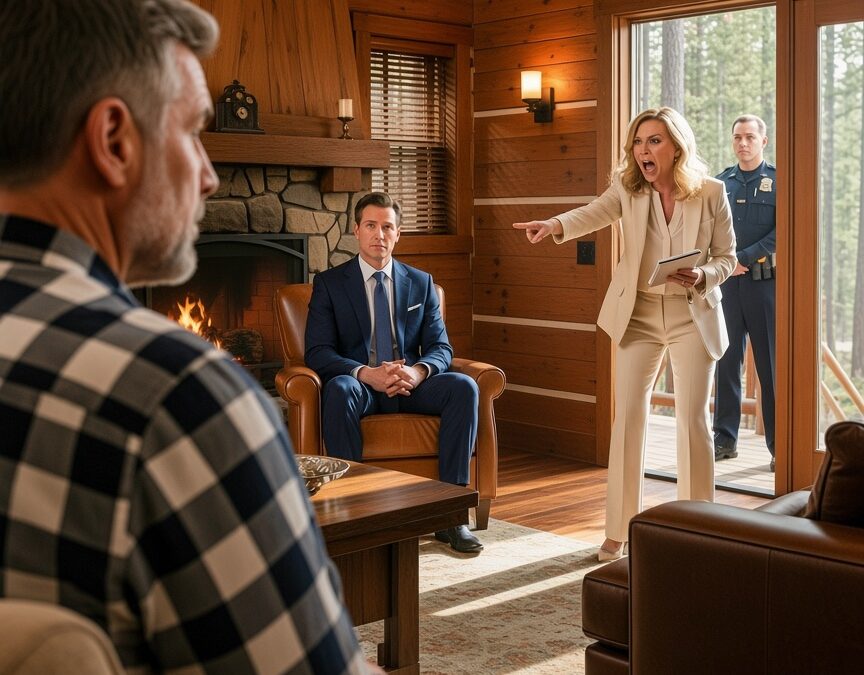
“Your property falls within the Cascade Valley community influence zone.”
I had never heard that phrase before.
Apparently, neither had Morrison.
He leaned forward.
“Could you explain the legal basis for that designation?”
Brenda turned toward him with visible irritation.
“Are you his attorney?”
“No.”
“Then this doesn’t concern you.”
I almost smiled.
Morrison placed his cup on the table.
“I’m Daniel Morrison.”
She looked at him without recognition.
“Congratulations.”
He reached into his jacket, took out a business card, and handed it to her.
She glanced at it.
For the first time, her expression changed.
Only slightly.
But I saw it.
“State attorney general?” she asked.
“That’s correct.”
Brenda recovered quickly.
“Well, then you should appreciate the importance of enforcing regulations.”
Morrison looked at the papers in her hand.
“Which regulations?”
She pushed the folder toward me instead.
“Fifteen thousand dollars in outstanding compliance assessments. Removal of unauthorized renewable-energy structures. Suspension of all commercial activities until further notice.”
I opened the folder.
The documents were printed on HOA letterhead. Several cited architectural standards adopted only eight years earlier.
My grandfather’s land had been privately owned long before the association existed.
“Brenda,” I said, “you don’t have jurisdiction over this property.”
“We’ll let the courts decide that.”
“Fine.”
Her eyes narrowed.
“Fine?”
“File a case.”
She clearly hadn’t expected that answer.
Morrison’s phone vibrated. He read the screen, then stood.
“I need to return a call from the governor’s office.”
As he passed me, he spoke quietly.
“Preserve everything she gives you. And don’t agree to anything.”
He walked to his sedan.
Brenda watched him leave with the satisfaction of someone who believed she had intimidated an inconvenient witness.
“Good,” she said. “Now we can discuss this without your government friend interfering.”
I looked down at her papers.
There was no court order.
No valid county enforcement notice.
Just threats, invented fees, and a deadline.
“Get off my property, Brenda.”
She stepped closer.
“You’re making a serious mistake.”
“Then you’ll have plenty to tell a judge.”
Her face hardened.
“This valley is changing, Mr. Reynolds. People like you need to understand that.”
She turned and walked toward her Escalade.
Before getting in, she pointed at my solar panels.
“Those are coming down.”
I watched her drive away.
Behind me, Sarah’s wind chimes moved in the breeze.
I reached up and steadied them.
“I think we’ve got a problem,” I whispered.
I had no idea how large that problem would become.
The following morning, a county inspection truck arrived.
The man who climbed out introduced himself as Dale Krueger.
He wore a county-issued jacket and carried a clipboard so tightly that his knuckles had gone pale.
“Mr. Reynolds, we’ve received a complaint about your electrical installation.”
I looked past him.
Brenda’s Escalade was parked near the entrance to the neighboring development.
Of course it was.
“What complaint?”
“Unpermitted solar generation. Possible fire hazards. Unsafe off-grid distribution.”
“Who filed it?”
He hesitated.
“I’m not authorized to disclose that.”
I invited him to inspect the equipment.
That seemed to surprise him.
We walked to the workshop, where I opened the electrical cabinet and showed him the disconnects, grounding system, battery enclosure, and installation documentation.
His eyes moved over the equipment.
“You did this yourself?”
“I designed it. Licensed contractors handled the work requiring their certification.”
He examined the drawings.
“Who prepared these?”
“I did.”
He looked at the name in the title block.
Then he looked at me.
“Garrett Reynolds?”
“Yes.”
He swallowed.
“You’re the Reynolds who worked on the county electrical safety standards?”
“I helped develop the earlier protocols and served on the technical review committee.”
His grip tightened around the clipboard.
I continued.
“The installation was reviewed under the applicable county requirements. The permits and inspection records are in that binder.”
I handed it to him.
He flipped through the pages.
The longer he read, the more uncomfortable he became.
Finally, he closed the binder.
“There may have been a misunderstanding.”
“Then let’s correct it.”
He looked toward the driveway.
“Mrs. Castellanos was very insistent.”
“I imagine she was.”
He lowered his voice.
“She said the county expected immediate enforcement.”
“Did the county tell you that?”
He didn’t answer.
I waited.
Eventually, he admitted that Brenda had contacted him directly and suggested that additional emergency inspection charges could be assessed.
“How much?” I asked.
“Eight thousand.”
“For what?”
He stared at the floor.
That was answer enough.
I documented the encounter and requested a written inspection report.
Before Dale left, I told him something I had learned during thirty years of engineering work.
“Never sign your name to a technical conclusion someone else wants you to reach.”
He looked at me for a long moment.
Then he nodded.
Within hours, Morrison called.
“There are concerns about Krueger’s inspection history,” he said. “Similar complaints have surfaced in other counties.”
“Connected to Brenda?”
“Possibly. Don’t confront anyone. Keep your records.”
That evening, my neighbor Magnus Olsen arrived carrying a jar of homemade liquor and a stack of old maps.
Magnus was seventy-eight, broad-shouldered despite his age, and permanently dressed like he had just come down from cutting firewood.
He had lived in the valley almost his entire life.
His family had owned land there for generations.
He settled into the rocking chair Sarah used to occupy.
“That woman came to my place,” he announced.
“Brenda?”
“Who else? Took pictures of my wellhouse. Asked questions about my septic system.”
“What did you tell her?”
“That she could ask the county for my inspection records like everybody else.”
He took a drink.
“She didn’t like that.”
I laughed.
Magnus didn’t.
“Garrett, she’s buying something.”
“What?”
“Land. Or control over it. And she’s been pushing people for years.”
He spread a faded map across the porch table.
It showed the valley before the roads, golf course, and luxury homes existed.
“Look at these boundaries.”
I leaned forward.
The old federal survey markers didn’t match the modern subdivision map.
Not even close.
“Where did you get this?”

