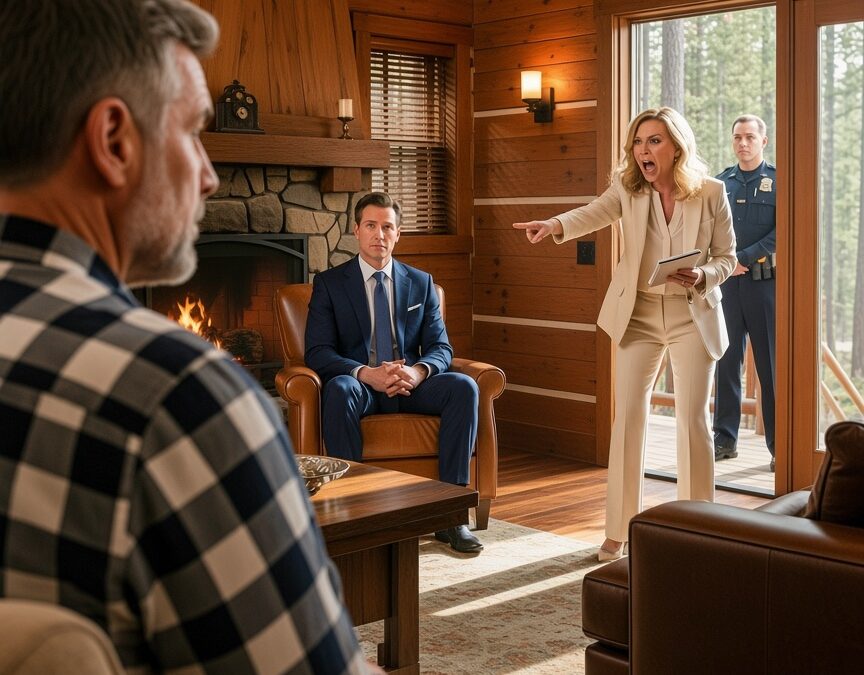
“Then we object to any suggestion that possession of this document establishes a zoning violation. The county must identify the actual use, applicable ordinance, and evidence supporting its enforcement action.”
The hearing lasted nearly three hours.
The board did not dismiss every concern. We still needed a final determination about occupancy limits and certain educational uses.
But it declined to order immediate closure.
We received a temporary authorization to conduct the scheduled day programs while the remaining reviews proceeded.
It wasn’t the sweeping victory I wanted.
It was enough.
That evening, the grant office confirmed that the first phase of funding had been approved, subject to compliance and final administrative conditions.
I should have celebrated.
Instead, I sat with Magnus on the porch, staring at the copied pages Brenda had somehow obtained.
“Someone close to Morrison leaked this,” I said.
Magnus didn’t answer.
He was looking at an old photograph.
“There’s something I need to show you.”
The next morning, he arrived before sunrise carrying a metal box.
He placed it on my kitchen table.
“My father kept these because he never trusted what happened in the seventies.”
Inside were federal survey records, correspondence about conservation restrictions, county transfer documents, and photographs.
One photograph showed a developer named Harrison Walsh shaking hands with a county official.
The caption on the back identified the official as Robert Morrison Sr.
I stared at the name.
“Daniel Morrison’s father?”
Magnus nodded.
“Same man.”
I studied the photograph again.
The resemblance was unmistakable.
Magnus unfolded a letter dated 1973.
Walsh had requested permission to acquire protected land for private recreational development.
The federal response rejected the proposed transfer.
Yet a county deed recorded the following year appeared to convey a substantial portion of that same land into private ownership.
I read the documents repeatedly.
The dates didn’t fit.
The authorities cited didn’t fit.
The survey boundaries didn’t fit.
And Robert Morrison Sr.’s name appeared on the county paperwork.
“Did anyone challenge this?” I asked.
“My father tried.”
“What happened?”
“He was told the matter had been resolved.”
“By whom?”
Magnus tapped the photograph.
“People who had more power than he did.”
I looked toward the window.
The first sunlight was reaching the tops of the pines.
For weeks, I had believed Daniel Morrison was helping me fight corruption.
Now I was holding documents suggesting his father had been involved in the original land transfer that made Brenda’s development possible.
My phone rang.
Daniel Morrison.
I let it ring.
Magnus watched me.
“Don’t show him those papers yet.”
I looked down at the photograph.
“Why not?”
“Because we don’t know which side he’s on.”
For the first time since Brenda’s arrival, I felt genuinely afraid.
Not because of her.
Because I might have trusted the wrong man.
Over the next two days, Magnus introduced me to people who had spent years asking questions about the valley.
The first was Dr. Elena Vasquez, a geologist at the state university.
Her office was crowded with rock samples, survey maps, and folders labeled by watershed.
She listened while Magnus explained what we had found.
Then she opened a cabinet and removed a thick stack of reports.
“I’ve documented contamination and unauthorized excavation in this region for twenty years,” she said.
She showed us maps of drainage systems, mining sites, and development boundaries.
Several investigations had stalled after being referred to state agencies.
“I’m not saying every delay was corruption,” she told us. “But the pattern deserves independent review.”
Rosa joined us that afternoon.
She brought legal records involving disputed acquisitions, eminent-domain proceedings, and unsuccessful attempts to challenge development permits.
Her own family had lost a ranch decades earlier.
Robert Morrison Sr. had been involved in the county proceedings.
“That’s why I started practicing environmental law,” she admitted.
I asked whether the old survey documents were enough to prove federal ownership.
“Not by themselves,” she said. “We need authenticated records, title history, and a federal determination. But if the restrictions were never lawfully extinguished, the consequences could be enormous.”
Elena pointed to a drainage map.
“And if unlawful development damaged protected watersheds, that raises separate environmental issues.”
For the first time, I saw the outline of something larger than Brenda’s harassment.
The solar panels.
The well inspections.
The zoning complaints.
The pressure on Magnus.
All of it might have been connected to an effort to control the remaining historic properties surrounding the development.
We decided to seek independent federal review.
Rosa would assemble the legal history.
Elena would prepare the environmental evidence.
Magnus would authenticate his father’s records as far as possible.
And I would continue speaking with Morrison without revealing what we had discovered.
I didn’t like that part.
But someone needed to learn what he knew.
The following afternoon, I entered Morrison’s office carrying a small recording device, after Rosa had advised me on the applicable consent rules.
His office overlooked the state capitol.
The furniture was expensive, the shelves immaculate, and the walls decorated with photographs of him beside governors, senators, and federal officials.
He greeted me warmly.
“Garrett. I’m glad you came.”
He led me to a conference table.
“We’ve uncovered something troubling.”
He spread photographs across the polished wood.
They showed people moving around my property at night.
One image appeared to show someone near the solar array.
Another showed a figure beside the wellhouse.
I leaned forward.
“Where did these come from?”
“Protective surveillance.”
“Whose?”
He hesitated.
“An interagency investigation.”
“How long has my property been watched?”
“Since shortly after the initial complaints.”
“Why wasn’t I told?”
He folded his hands.
“Because disclosure could have compromised the operation.”
I examined another photograph.
It showed Magnus carrying his metal box toward my cabin.
Another showed Rosa arriving with a briefcase.
A third showed Elena near the creek.
Morrison watched my reaction.
“Garrett, you’ve been meeting with people who have longstanding grievances against state agencies.”
“People are allowed to have grievances.”
“Of course.”
“Then why are they being photographed?”
“Because this investigation has become sensitive.”

