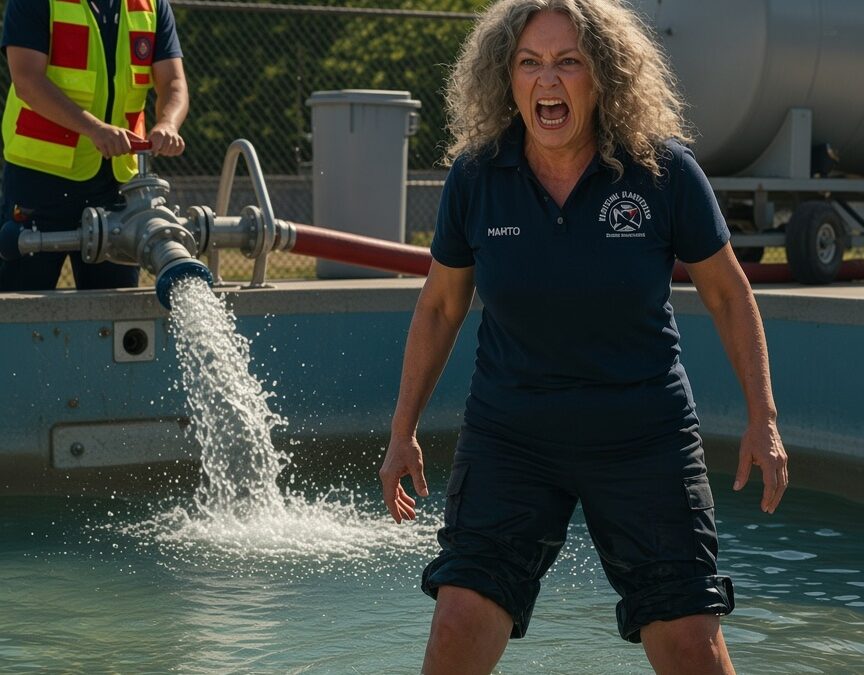
And nobody, regardless of their position on the HOA board, could casually empty the pool to settle a personal disagreement.
The final administrative resolution arrived several weeks later.
There would be no additional action provided we complied with the terms of the settlement.
I read the letter three times.
Then I called Sully.
“It’s over.”
He was quiet.
“Really?”
“Really.”
“How much did it cost us?”
I told him.
He whistled.
“That’s the most expensive tomato plant in American history.”
“Probably.”
“Next time, buy one at the grocery store.”
“I intend to.”
A few days later, we met for lunch at a diner on the edge of town.
Sully ordered a cheeseburger, fries, and a milkshake.
I ordered the same.
When the waitress left, he leaned back.
“So, Mr. President. How’s life in public office?”
“Terrible. I’ve already received six complaints about parking.”
“Any about gnomes?”
“Not yet.”
“Give it time.”
I laughed.
Then I reached into my jacket and placed a small envelope on the table.
“What’s that?” he asked.
“A thank-you.”
He opened it.
Inside was a photograph.
Norman stood in the middle of a newly prepared garden bed beside the clubhouse.
Sully studied it.
“Is that your gnome?”
“Head of community garden security.”
He grinned.
“Promotion looks good on him.”
“He’s very committed.”
Sully slipped the photograph into his pocket.
Then his expression grew serious.
“You doing okay, Leo?”
I thought about the question.
Three months earlier, I’d have said yes automatically.
I would have made a joke about unemployment or told him I was enjoying the break.
Instead, I answered honestly.
“Better.”
“Good.”
“I started applying for engineering jobs again.”
“About time.”
“And Sarah helped me update my résumé.”
He raised an eyebrow.
“Sarah, huh?”
“Don’t.”
“I’m not saying anything.”
“You’re saying plenty with your face.”
He grinned into his milkshake.
Two weeks later, I received an interview invitation from a regional infrastructure consulting firm.
The position involved municipal water planning.
I almost laughed when I read the description.
Apparently, despite my recent adventures, I still loved the work.
I prepared carefully.
I reviewed old projects.
I practiced technical questions.
And when the interviewers asked why I’d left my previous position, I answered without bitterness.
The company had restructured.
My role had been eliminated.
I’d used the time to reconsider what kind of work I wanted to do.
I didn’t mention Brenda.
There are limits to professional honesty.
The interview went well.
A second followed.
Then a third.
By the end of August, I had an offer.
It wasn’t the highest salary I’d ever earned.
But the work mattered, the team seemed competent, and nobody used the phrase strategic workforce optimization during the interviews.
I accepted.
That evening, I walked over to Sarah’s house.
She opened the door wearing hospital scrubs, her hair pulled into a loose ponytail.
“What’s wrong?” she asked immediately.
“Nothing.”
She studied me.
“Leo, you look like you’re about to announce either a medical emergency or a winning lottery ticket.”
“I got the job.”
Her face changed.
“Seriously?”
“Seriously.”
She stepped forward and hugged me.
It happened so quickly that I barely had time to react.
Then I hugged her back.
For several seconds, neither of us said anything.
When she stepped away, she smiled.
“I knew you would.”
“You were more confident than I was.”
“Somebody had to be.”
I looked at her.
“Can I take you to dinner?”
She tilted her head.
“To celebrate?”
“That was the original plan.”
“And now?”
“Now I’m hoping you’ll let me call it a date.”
She smiled slowly.
“I was wondering how long that would take.”
The community barbecue happened the following Saturday.
It was the first large neighborhood gathering we’d held without Brenda supervising the placement of napkins.
The pool was open.
The grills were smoking.
Music played from portable speakers.
Families spread picnic blankets across the grass.
People brought homemade salads, desserts, and enough hamburger buns to feed a small army.
Mr. Henderson arrived carrying a tray of brownies.
Mrs. Gable brought lemonade.
Sully showed up with a ridiculous apron that said GRILL SERGEANT.
He insisted it was official equipment.
I was assigned to cook burgers.
Sarah organized the tables.
And near the clubhouse, the new community garden stood in a patch of afternoon sunlight.
There were peppers, herbs, cucumbers, and a row of tomato plants.
Healthy ones.
The first ripe tomatoes were beginning to turn red.
Norman stood in the center.
His fishing pole had been repaired.
His chipped boot remained exactly as it was.
I refused to repaint it.
Some things were supposed to show their age.
As the afternoon continued, I found myself watching the neighborhood.
People were laughing.
Neighbors who had barely spoken before were sharing food.
Children played in the water while parents sat nearby talking.
Nobody was checking the height of the grass.
Nobody was measuring decorative lights.
Nobody was threatening fines over flowerpots.
It was loud.
Messy.
Imperfect.
And wonderful.
Mr. Henderson approached the grill.
“How are the burgers coming?”
“Almost ready.”
He looked toward the garden.
“You know, Leo, I’ve lived here for eleven years.”
“Really?”
“Eleven. And this is the first time I’ve felt like I knew half the people on this street.”
I turned a burger.
“That’s a little sad.”
“It is.”
He smiled.
“But it’s changing.”
I looked toward Sarah.
She was laughing with Mrs. Gable, one hand resting on the back of a folding chair.
Beyond them, Sully was attempting to teach Chad how to operate a charcoal grill.
Chad appeared deeply confused.
Some things never changed.
Mr. Henderson followed my gaze.
“You know what I think?”
“What’s that?”
“I think people sometimes confuse quiet with peace.”
I considered his words.
He continued.
“Brenda kept this place quiet. Everybody was too afraid to do anything.”
“She certainly had a gift for it.”
“But peace is different.”
He gestured toward the pool.
“Peace is knowing your neighbors won’t turn on you because you planted the wrong flowers.”
I nodded.

