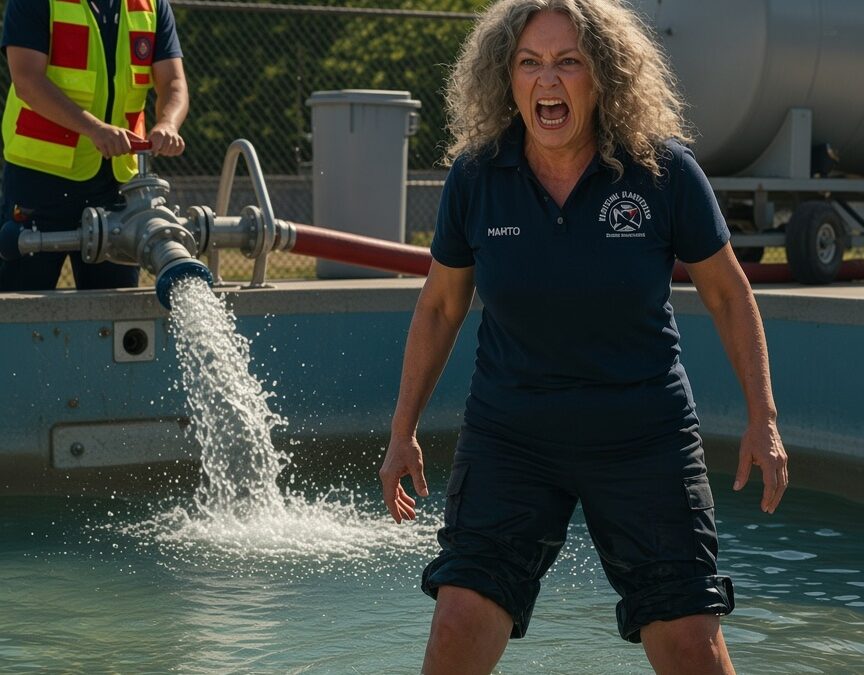
I stepped closer and examined the water.
“Well, look at that.”
Chad pointed.
“It was empty!”
“That does seem to be a problem with draining a swimming pool, Chad.”
“It was empty last night!”
I nodded thoughtfully.
“And now it’s full. Fascinating.”
Brenda advanced toward me.
“How did you do it?”
“Brenda, I don’t even know what you’re accusing me of.”
“You filled my pool!”
I looked around.
“Your pool?”
She corrected herself.
“The community pool.”
“Right. The community pool that you drained because of my tomato plant.”
Sarah made a small choking sound behind her coffee cup.
Brenda ignored her.
“I’m calling the police.”
“About the pool being full?”
“About vandalism!”
I glanced at Mr. Henderson.
He lowered his newspaper.
“Well,” he said mildly, “it’s certainly a new kind of vandalism.”
The police arrived fifteen minutes later.
Officer Miller stepped out of the first cruiser looking like a man who had been interrupted halfway through breakfast.
His younger partner, Officer Johnson, followed him.
Brenda launched into an explanation before either officer had reached the gate.
She described the empty pool.
The mysterious refill.
My alleged threats.
My history of noncompliance.
And my suspiciously relaxed attitude.
Officer Miller listened.
Then he looked at the water.
“Ma’am,” he said, “you’re reporting that somebody filled a swimming pool?”
“Without authorization!”
“Was anything damaged?”
“The entire authority of this association has been undermined!”
Miller blinked.
“That’s not generally something we investigate.”
A few neighbors laughed.
Brenda pointed at me.
“Ask him where he was last night.”
Miller turned.
“Mr. Maxwell?”
“At home.”
“Anyone with you?”
“No.”
“What were you doing?”
I swallowed.
“Watching television.”
“What program?”
For some reason, that question nearly broke me.
“A competition about glass blowing.”
Johnson looked away.
His shoulders moved suspiciously.
Miller sighed.
“Do you have any evidence that Mr. Maxwell entered the property or tampered with equipment?”
Brenda opened her mouth.
Closed it.
Then said, “Look at his face!”
Miller looked at my face.
I tried very hard to make it an ordinary face.
He turned back to Brenda.
“Ma’am, we can document your complaint. But the pool being full isn’t proof of a crime. If you believe municipal equipment was interfered with, you should contact the water department.”
Those last words struck me harder than I expected.
The water department.
Of course.
I’d been so focused on Brenda that I hadn’t considered the people who actually managed the system.
Miller and Johnson left.
The neighbors lingered.
Brenda continued accusing me until Sarah finally interrupted.
“Brenda, maybe you should focus on why you drained the emergency pool in the first place.”
Brenda turned on her.
“That decision was made by the board.”
“Was it?”
“Yes.”
“Then I’d like to see the meeting minutes.”
Chad looked suddenly uncomfortable.
Sarah noticed.
“So would everyone else, I imagine.”
That was the first time I saw Brenda lose control of a conversation.
She wasn’t accustomed to being questioned.
She was accustomed to issuing instructions and watching people obey.
But something had changed.
The pool was full.
Her punishment had failed.
And the people around her were smiling.
By Monday, the mystery had become the most popular subject in the Harmony Creek neighborhood group.
Someone called it the Miracle Pool.
Someone else suggested underground springs.
Mr. Henderson proposed extraterrestrial intervention.
“Aliens,” he wrote, “have always shown an interest in our water supply.”
I laughed so hard I had to put down my phone.
The theories multiplied.
A secret fire department exercise.
A hidden maintenance system.
A freak weather event.
An underground reservoir.
One woman suggested the pool had never actually been empty and that Brenda had imagined the entire thing.
That theory received twenty-three likes.
Brenda responded to nearly every comment.
She demanded seriousness.
She threatened fines.
She announced an investigation.
And each new message made her look more ridiculous.
For the first time since moving to Harmony Creek, I saw neighbors openly criticizing her.
People who had previously whispered complaints over fences were now telling stories in public.
The woman whose porch decorations had been confiscated.
The retired teacher fined for planting purple flowers.
The family ordered to repaint their front door three times.
The widower warned that his birdbath attracted unauthorized wildlife.
The discussion wasn’t really about the pool anymore.
It was about years of resentment.
And Brenda had no idea how much of it she’d created.
I was sitting outside Monday afternoon, enjoying the spectacle, when Sully called.
His face appeared on my screen.
He wasn’t smiling.
“Leo, we’ve got a problem.”
My stomach tightened.
“What problem?”
“The city.”
I sat upright.
He explained that municipal water systems record pressure and flow anomalies. An unexpected movement of that much water wouldn’t necessarily disappear into the background.
Someone might review the records.
Someone might investigate.
And if the investigation reached the pool, there were only so many explanations.
I stared at the screen.
“How serious?”
“Serious enough that I haven’t slept much.”
Neither had I.
For several seconds, we said nothing.
Then I asked, “What do we do?”
Sully rubbed his forehead.
“We stop pretending it was harmless.”
That sentence stayed with me.
Because he was right.
We’d laughed about Brenda.
We’d celebrated the pool.
We’d enjoyed the neighborhood’s reaction.
But the water system belonged to the city.
It protected real people.
And we’d treated it like a prop in a practical joke.
“I should have known better,” I said.
“Both of us should have.”
“We could tell them.”
“We might have to.”
The idea frightened me.
I was unemployed.
My savings were shrinking.
A serious legal problem could ruin my chances of finding another engineering position.
But the alternative was waiting for someone else to discover what we’d done.
Sully looked at me.
“Let’s see what happens when they review the system. But no more stories. No more jokes. If somebody comes asking technical questions, we don’t invent answers.”
“Agreed.”
I ended the call and sat staring at the pool beyond the trees.

