It smelled of machine oil, lumber, coffee, and the kind of practical competence I hadn’t encountered since leaving my engineering job.
Shelves lined the walls. Tools hung in precise rows. Heavy equipment sat beneath canvas covers.
Sully was a broad-shouldered man with a thick beard and hands permanently marked by honest work.
He examined my drawings while I explained what Brenda had done.
When I reached the part about the tomato plant, he stopped me.
“She threw it away?”
“Had a worker do it.”
“Was it dying?”
“No.”
“Diseased?”
“No.”
“Blocking an emergency exit?”
“It was a tomato plant, Sully.”
He shook his head.
“Some people shouldn’t be allowed near a clipboard.”
We spent the afternoon talking.
At first, the discussion was mostly theoretical.
Then it became less theoretical.
We reviewed the municipal drawings, discussed the risks, and argued about whether any version of the idea could be justified.
Sully was more cautious than his joking manner suggested.
He knew that unauthorized interference with a pressurized public water system could injure people, damage equipment, or compromise emergency services.
I knew it too.
I’d spent years designing systems specifically to prevent reckless interference.
Yet every time I started to abandon the idea, I pictured Brenda standing beside the shattered pot.
I told myself the pool was supposed to be full.
I told myself we would be restoring an emergency resource.
I told myself a dozen things that sounded reasonable when spoken quickly.
What I didn’t say was the simplest truth.
I wanted to humiliate her.
And that desire was making me careless.
By evening, we had a plan.
It was a terrible plan.
We both knew it.
But neither of us walked away.
That night, we parked near the wooded boundary behind Harmony Creek and watched the pool area from a distance.
The empty concrete basin looked strangely sad beneath the security lights.
Without water, the whole place seemed abandoned.
Brenda appeared shortly after ten.
She carried a flashlight and walked the perimeter like a prison warden inspecting the fences.
She checked the gate.
Looked toward the pump house.
Examined the pool.
Then stood still for nearly a minute, apparently admiring the results of her authority.
“Look at her,” Sully whispered.
“Please don’t make me look at her any longer.”
“She’s proud of that.”
“I know.”
“She’s standing there looking at an empty swimming pool like she conquered France.”
I covered my mouth to keep from laughing.
Eventually, Brenda returned home.
Her porch light went out.
The neighborhood settled into silence.
We waited.
Then we made the decision that would haunt me for the next several days.
We went forward.
I won’t pretend the operation was elegant.
It was dark, awkward, and much more frightening than either of us had anticipated.
The equipment was heavier than expected. Every metallic sound seemed loud enough to wake the entire subdivision.
At one point, a light appeared in an upstairs window across the street.
I froze.
Sully froze.
We remained motionless until it disappeared.
Then we continued.
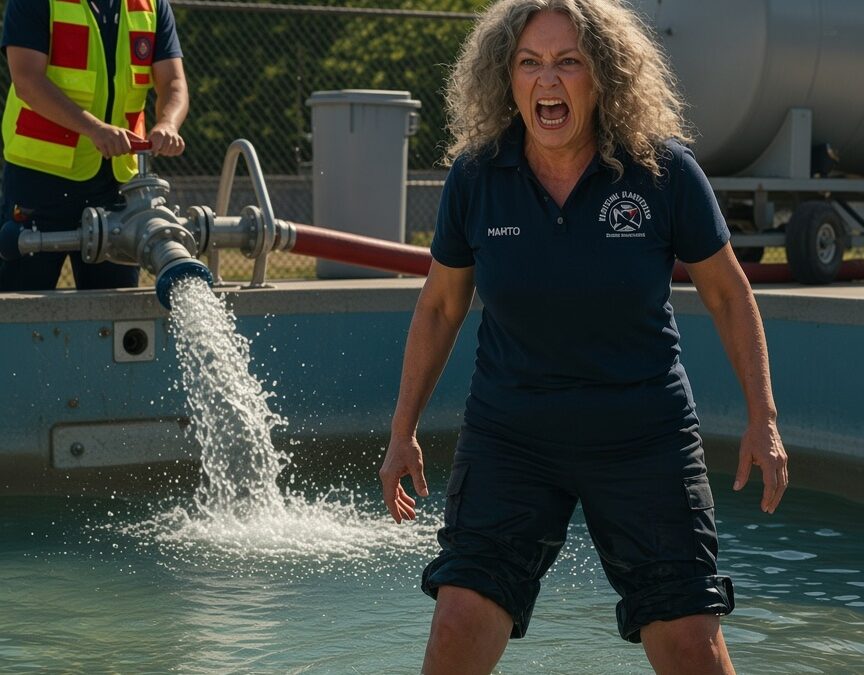
The moment the water began moving, I understood how badly I’d underestimated the forces involved.
The system answered with a roar that seemed to rise from beneath the ground.
The hose shuddered.
Water struck the empty pool with astonishing force.
I had imagined a controlled, almost graceful restoration.
Instead, the pool became a churning basin of white water.
The noise was deafening.
My excitement vanished.
For several seconds, all I could think about was how many things could go wrong.
I shouted for Sully.
He couldn’t hear me.
The water continued rising.
I shouted again.
Finally, he understood.
The flow stopped.
The sudden quiet was so complete that I could hear my own breathing.
We stood there, soaked and trembling.
The pool was full.
I looked at Sully.
He looked at me.
Neither of us spoke.
Then he began laughing.
Not because it was funny.
Because we were frightened, exhausted, and unable to believe we’d actually done it.
I joined him.
For a few seconds, we laughed like idiots.
Then Sully gripped my shoulder.
“We need to leave.”
We gathered our things and disappeared into the darkness.
Back at my house, I stood in the kitchen staring at the clock.
The entire event had taken only minutes.
It felt like hours.
Sully drank a glass of water and set it carefully on the counter.
“Never again,” he said.
“Agreed.”
“I’m serious.”
“So am I.”
He studied me.
“You realize we could have gotten ourselves killed?”
I nodded.
“And if somebody investigates, we’re in trouble.”
“I know.”
He sighed.
“Was it worth it?”
I thought about Brenda’s face.
Then I thought about the sound of that water moving through the system.
“I don’t know yet.”
Sully left shortly before midnight.
I tried to sleep.
I couldn’t.
Every noise outside made me sit upright.
A passing car.
A dog barking.
The neighbor’s garage door.
At three in the morning, I was still awake, wondering whether I’d destroyed my future over a tomato plant.
At seven, I finally gave up.
I made coffee.
Went outside.
Sat on my patio.
And waited.
At 8:05 a.m., Brenda screamed.
It was magnificent.
Her voice traveled over the fences, through the trees, and across the entire neighborhood.
I nearly spilled my coffee.
Then came another scream.
“CHAD!”
I closed my eyes.
For one beautiful moment, I allowed myself to enjoy it.
A few minutes later, I walked toward the pool.
Neighbors were already gathering.
Mr. Henderson stood in slippers and a bathrobe, holding a newspaper.
Sarah Jenkins, the emergency-room nurse who lived next door to me, had arrived carrying a travel mug.
Two homeowners stood near the gate, whispering.
And in the center of everything was Brenda.
Her face was bright red.
Chad stood beside her, staring at the water as though it had personally betrayed him.
Brenda spotted me.
“YOU!”
I stopped.
“Good morning.”
“You did this!”
I looked toward the pool.
“Did what?”
“Don’t play games with me!”

