Long-term monitoring would continue, but the immediate trend was encouraging.
We stood near the back walkway, where the first crack had appeared.
The concrete had been repaired after the underlying conditions were assessed.
Mark looked downhill.
“You know, Ryan, the most useful thing you did wasn’t predicting the exact movement.”
“I never predicted the exact movement.”
“Exactly. You recognized an unresolved risk, documented the changes, and kept the measurements consistent.”
I nodded.
“That’s what the job requires.”
He smiled.
“Not everyone remembers that when a project gets political.”
After he left, I sat on the porch with Claire.
The valley was bright beneath the afternoon sun.
Below us, workers were finishing a drainage channel.
The Glass Lounge stood behind temporary fencing, its windows reflecting the mountains.
It would eventually reopen.
The final project would be more expensive than anyone had imagined.
But the hillside would have a properly evaluated stabilization system, and residents would finally have a clearer understanding of what supported their homes and shared amenities.
Claire leaned back in her chair.
“Do you think Victoria understands now?”
I thought about that.
“I don’t know.”
“She hasn’t apologized.”
“No.”
“Does that bother you?”
“Less than it would have three months ago.”
She looked at me.
“Why?”
“Because I wasn’t trying to win an argument with her.”
Claire followed my gaze downhill.
“You were trying to keep the hill where it belonged.”
“Something like that.”
We sat quietly for a while.
Then she said, “I still think the view is worth it.”
I laughed.
“So do I.”
The following spring, the HOA invited residents to a reopening ceremony.
The invitation was noticeably different from the original promotional material.
There were no grand claims about redefining luxury living.
No photographs of Victoria.
No promises that the building would transform property values.
Instead, the notice explained that the corrective stabilization work had been completed, independently reviewed, and accepted by the relevant authorities.
The association also announced that long-term monitoring and maintenance requirements would be incorporated into its permanent records.
I attended with Claire.
The lounge looked beautiful.
Its glass walls opened toward the valley.
The stone terrace had been redesigned, but the view was just as impressive.
Inside, homeowners gathered around tables with coffee and pastries.
Susan Patel, now the elected HOA president, approached me.
“Ryan, would you say a few words?”
I shook my head.
“I think the engineers’ report says enough.”
“People would appreciate hearing from you.”
I looked around the room.
Harold was talking with Daniel near the windows.
Several homeowners were examining a display explaining the new drainage and stabilization work.
Children were pointing toward the mountains.
People were enjoying the building.
That was what the place had been meant for.
I turned back to Susan.
“Then tell them something simple.”
“What’s that?”
“Make sure the maintenance plan stays funded. Keep the monitoring records. And whenever somebody proposes changing the hillside again, review the existing engineering before approving the new design.”
She nodded.
“We will.”
“Put it in the board’s procedures.”
She smiled.
“Already done.”
I was satisfied with that.
Later, I walked outside onto the terrace.
The air was cool, and the valley stretched beneath a clear blue sky.
I could see the upper edge of my property from where I stood.
The hillside looked ordinary.
Grass.
Shrubs.
Retaining walls.
Drainage outlets.
Nothing about it suggested the months of arguments, inspections, calculations, and corrective work that had gone into keeping it stable.
That was how it should be.
A properly designed system doesn’t need to impress people.
It needs to work.
I thought about the morning I first saw the six red circles.
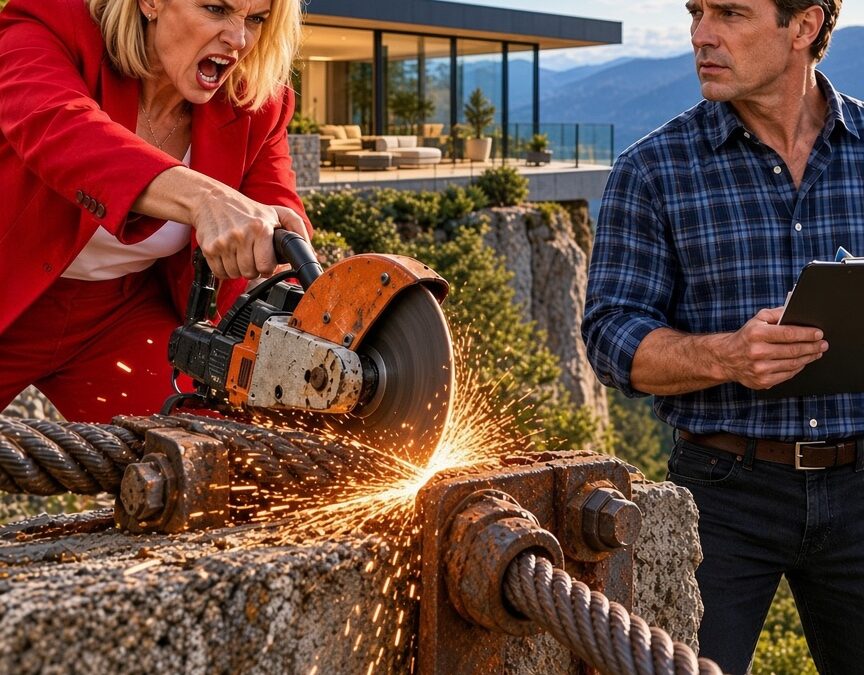
The cutting equipment beside the trench.
Daniel’s hesitation.
Victoria’s certainty.
The unanswered request for an engineer’s name.
Then I remembered the storm.
The trembling glass.
The crack behind my house.
The sound of the ground moving in the dark.
I had spent months trying to explain that those exposed steel heads were only the visible ends of something much larger.
The anchors connected the surface to stronger material deep below.
They resisted forces that nobody standing on the terrace could see.
They were part of a system built to handle conditions that might not occur for years.
And when someone removed them without understanding how the system would respond, the hillside did not immediately collapse.
It waited.
It absorbed the changes.
It responded to new loads and altered groundwater.
And eventually, during a night of heavy rain, it moved enough that nobody could pretend the problem was imaginary.
Victoria had thought she was arguing with a stubborn homeowner.
She had believed that if she could outvote me, dismiss my questions, and keep construction moving, the problem would disappear.
But engineering doesn’t work that way.
A board can approve a schedule.
A president can authorize spending.
A contractor can build exactly what appears on a drawing.
None of those actions changes the forces acting beneath the ground.
As I stood on the completed terrace, Mark Ellison joined me.
He looked toward the hillside.
“Not bad,” he said.
“No,” I agreed. “Not bad at all.”
He rested his hands on the railing.
“Think they’ll remember what happened?”
I watched a group of homeowners step outside to admire the view.
“Some will.”
“And the others?”
I looked at the landscaped slope, where the new anchor heads were concealed beneath carefully finished retaining structures.
“They won’t have to think about it every day. That’s the whole point.”
Mark nodded.
Then he walked back inside.
I stayed a little longer.
The building was finally doing what Victoria had promised it would do.
People were gathering.
Enjoying the view.
Making plans.
Living their lives.
But beneath their feet, a carefully designed system was carrying loads they would never see.
That was the part I hoped Willow Ridge would never forget.
Because the most important things supporting a community are not always the things people notice.
Sometimes they’re buried beneath the ground.
Sometimes they’re hidden in technical reports.

