Then Victoria Langford became president of the Willow Ridge Homeowners Association.
Victoria was forty-seven, impeccably dressed, and remarkably good at making expensive ideas sound inevitable.
She had spent much of her career in luxury real estate marketing. She understood how to sell a lifestyle, how to frame an amenity as an investment, and how to convince homeowners that questioning a project meant questioning their own property values.
Her first year as president brought upgraded entrance signs and new landscaping.
Her second brought a renovated pool area.
By her third, she wanted something bigger.
The Glass Lounge.
At the first presentation, she stood beside an enormous rendering of a modern building perched above the valley.
“Imagine bringing guests here at sunset,” she told us. “Imagine what this does for the reputation of Willow Ridge.”
People were impressed.
I understood why.
The design was attractive. The proposed location offered spectacular views. And if properly engineered, a building there might have been feasible.
But when I saw the site plan, I immediately recognized the location.
It overlapped part of the old stabilization system.
I raised my hand.
“Has the design team reviewed the existing ground-anchor layout?”
Victoria looked at me.
“I’m sure all relevant site conditions have been considered.”
“That wasn’t my question.”
A few residents turned around.
I pointed toward the rendering.
“That western foundation line appears to cross several permanent anchor locations. Has the engineer accounted for them?”
Victoria smiled.
“Ryan, we’re still in the design phase.”
“Then this is the right time to ask.”
She promised to pass my question to the consultants.
I assumed she would.
That was my first mistake.
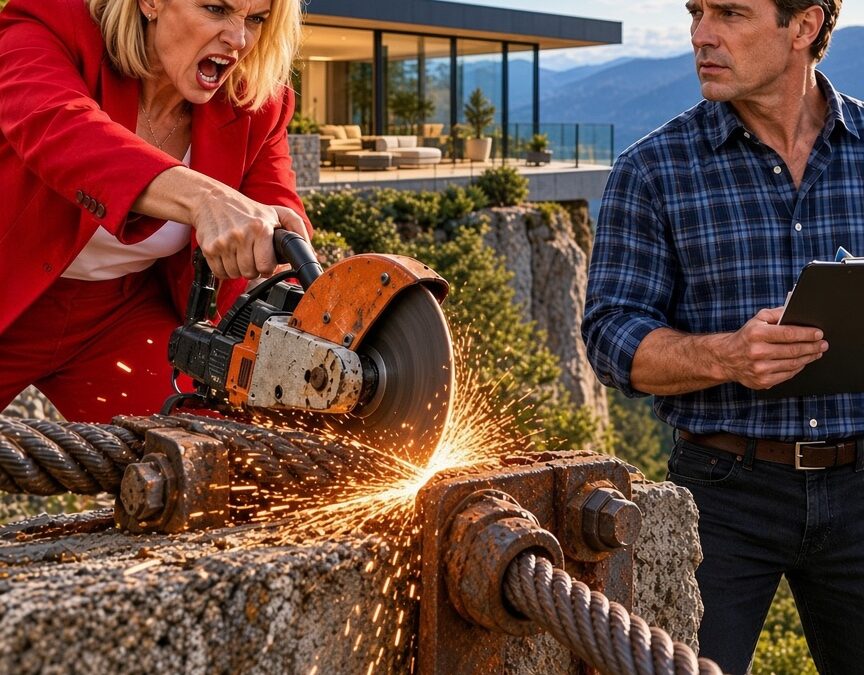
Three months before the storm, I was walking along the upper service path when I noticed six red circles painted around exposed steel anchor heads.
A compact excavator stood nearby.
Two workers were unloading cutting equipment.
I stopped.
The red marks were positioned exactly where the new lounge foundation and utility corridor would intersect the old stabilization system.
I approached the site superintendent, Daniel Brooks.
Daniel was forty-three, broad-shouldered, with a sunburned neck and the permanently tired expression of someone responsible for keeping too many subcontractors moving at once.
“Morning, Daniel.”
“Ryan.”
I pointed toward the nearest anchor.
“Why are those marked?”
He glanced at the steel plate.
“Interference with the foundation. We’re modifying a few existing components.”
“Modifying how?”
“Removing what conflicts with the new work.”
I looked at him.
“Those are permanent ground anchors.”
“That’s what I’ve been told.”
“Have you seen the original stabilization drawings?”
He hesitated.
“I’ve got the current construction package.”
“Can I see it?”
He took a rolled set of plans from his truck.
We spread them across the hood.
I examined the foundation details, retaining wall sections, drainage notes, and excavation plans.
Then I checked the existing-conditions sheet.
There were no anchor locations.
No reference to the original stabilization report.
No calculations describing how the slope would behave after removing part of its reinforcement.
I looked up.
“Where’s the geotechnical review for the anchor removal?”
Daniel rubbed his forehead.
“The design team handled that.”
“Which engineer?”
“I’d have to check.”
“Did anyone provide a signed analysis?”
He looked toward the equipment.
“Ryan, I’ve got crews scheduled and concrete deliveries coming next week.”
“That’s not an answer.”
“I know.”
His expression told me more than his words.
He was not comfortable.
But he was also not prepared to stop a multimillion-dollar job because a homeowner had raised a question.
I took out my phone.
“Before anybody cuts anything, I strongly recommend getting the original stabilization documents reviewed by a licensed geotechnical engineer.”
Daniel lowered his voice.
“You need to talk to Victoria.”
So I did.
She answered after four rings.
“Ryan, I’m in the middle of something.”
“I’m at the lounge site. Your contractor is preparing to remove six permanent ground anchors.”
“We’ve discussed this.”
“No. We’ve discussed whether the anchors were included in the design. They weren’t. Now the contractor is preparing to cut them.”
“The project has been approved.”
“Approved based on what analysis?”
“The appropriate professionals have reviewed everything.”
“Then give me the name of the engineer who approved removing those anchors.”
There was a pause.
“Ryan, I am not going to conduct an engineering seminar over the phone.”
“I’m asking for a name.”
“I’ll have the office send you the documentation.”
She ended the call.
I stood beside Daniel’s truck for a moment.
Then I photographed the six marked anchor heads, the visible excavation limits, the construction drawings, and the drainage channel running behind the proposed foundation.
I recorded the date and time.
Daniel watched me.
“You’re really worried about this.”
“Yes.”
“Even if they only remove six?”
“Especially because of where those six are.”
He looked downhill.
I pointed to the western section of the future terrace.
“The old system was designed to work together. Those anchors transfer forces through weak material into stronger ground. If you remove a group of them and add a heavy structure above the same area, you change the way the entire slope carries load.”
“Wouldn’t the new retaining wall take care of it?”
“Maybe, if someone designed it to do that. But I haven’t seen that design.”
Daniel was silent.
I rolled up the drawings.
“Don’t mistake the absence of immediate movement for proof that the change is safe.”
Two days later, the HOA held its monthly meeting.
The clubhouse was packed.
Victoria had placed a large image of the finished lounge on the screen behind her.
She talked about rising property values, future events, and the grand opening scheduled for October.
When she invited questions, I raised my hand.
“Has the board received a signed geotechnical analysis specifically addressing removal of the six existing ground anchors?”
Victoria’s smile tightened.
“The project has been reviewed by qualified professionals.”
“Does that include a review of those six anchors?”
“The contractor has confirmed that certain older components conflict with the new foundation.”
“Who confirmed they can safely be removed?”
She folded her hands.

