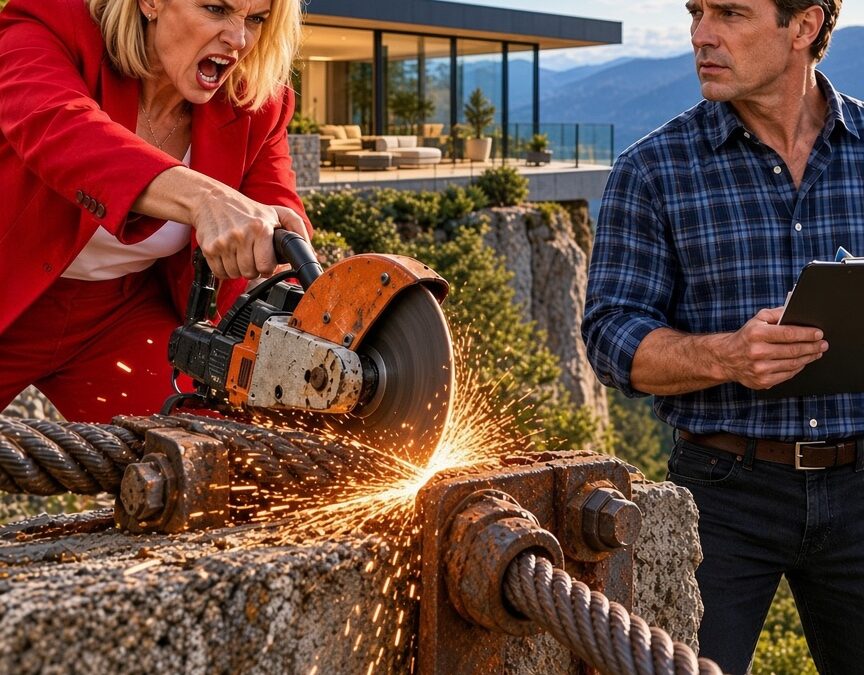
“Ryan, you are not the engineer of record on this project.”
“No, I’m not. That’s why I’m asking for the engineer who is.”
Someone coughed.
A man near the front whispered something to his wife.
Victoria turned toward the audience.
“We appreciate residents taking an interest in our improvements. But we cannot allow every individual concern to derail a project supported by the community.”
I stood.
“This isn’t about whether I like the building. The original stabilization report identifies these anchors as part of a system designed to resist slope movement. The current construction drawings omit that system. That’s a technical discrepancy that needs to be resolved before work continues.”
Victoria looked directly at me.
“Progress always makes someone uncomfortable.”
I heard a few murmurs of agreement.
I answered quietly.
“Gravity doesn’t care about our schedule.”
Nobody laughed.
But nobody asked to stop construction, either.
After the meeting, Victoria approached me beside the coffee station.
Her expression was no longer friendly.
“You embarrassed the board tonight.”
“I asked for an engineering document.”
“You made it sound as though we’re building something dangerous.”
“I’m saying there’s a safety question that hasn’t been answered.”
“We’ve spent almost two years getting this approved.”
“Then another two weeks to verify the anchors shouldn’t be a problem.”
She shook her head.
“You don’t understand the financial consequences of delaying a project this size.”
“I understand the financial consequences of a slope failure.”
“That’s speculation.”
“So is assuming everything will be fine.”
She stared at me.
Then she said something I would remember months later.
“At some point, Ryan, you have to trust the people in charge.”
I looked toward the rendering on the wall.
“Trust isn’t a substitute for calculations.”
The following Wednesday, the HOA office emailed me a large collection of documents.
I spent the evening reviewing them.
Architectural drawings.
Structural details.
Drainage calculations.
Foundation specifications.
Permit correspondence.
Contractor schedules.
The lounge itself had been designed by licensed professionals.
The new retaining walls had engineering details.
But the original anchor system was still missing from the relevant plans.
There was no completed analysis showing what would happen when those six anchors were removed.
I sent a written request for that specific document.
The reply arrived the next morning.
My concerns had been noted.
Construction would proceed.
Thursday morning, I heard cutting equipment from my kitchen.
Claire was making coffee.
“Is that the construction site?”
“Yes.”
I looked through the window.
“They’re cutting the anchors.”
She put down her mug.
“Can you stop them?”
“Not by walking down there and arguing.”
“Then what can you do?”
I took my phone from the counter.
“Document exactly what’s happening. Notify the people responsible. And make sure nobody can claim they weren’t warned.”
At the site, Daniel was standing near the first marked anchor.
Victoria arrived shortly afterward in a white SUV.
She stepped out wearing a red blazer and expensive boots that looked entirely unsuitable for a muddy construction zone.
“Ryan,” she said. “I thought we’d settled this.”
“Have you obtained the geotechnical approval?”
“The contractor is authorized to proceed.”
“That’s not what I asked.”
She turned toward Daniel.
“Are your crews ready?”
He hesitated.
“Yes.”
I spoke before she could give another instruction.
“Victoria, those anchors are part of the hillside stabilization system. Disconnecting them without a replacement design could compromise the slope. I’m asking you to stop until the engineering review is complete.”
She looked at me.
“We are already behind schedule.”
“Then delay it.”
“We are not delaying a $3.7 million project because you disagree with the design.”
“This isn’t a disagreement about the design. It’s a missing analysis.”
She turned back toward Daniel.
“Proceed.”
Daniel looked at the equipment.
Then at me.
I stepped outside the work boundary and began recording.
The first anchor assembly was disconnected before noon.
Nothing moved.
The retaining wall remained standing.
The excavator continued working.
By the end of the day, three anchors had been taken out of service.
The remaining three followed as excavation advanced.
That evening, I sat at my desk and wrote a formal notice to the HOA board, the project manager, the contractor, and the association’s management company.
I identified the affected anchor locations, referenced the original geotechnical report, and explained why the removal required evaluation.
I recommended suspending additional loading in the affected area until the review was completed.
I also made clear that I had not performed a full independent stability analysis and could not determine the slope’s actual safety margin from the available information.
I wasn’t going to exaggerate what I knew.
The facts were serious enough.
The response was brief.
The board acknowledged receipt.
Work would continue.
I read the email twice.
Then I created a folder on my computer labeled WILLOW RIDGE SLOPE MONITORING.
I saved everything.
Photographs.
Emails.
Meeting minutes.
Original drawings.
Construction schedules.
My written notices.
I stopped trying to persuade Victoria.
Instead, I began measuring.
I installed simple surface reference markers in accessible locations on my own property and, with permission from the relevant property owners, established additional observation points outside the active construction zone.
I photographed each marker from consistent locations and recorded the measurements against stable reference points.
I knew the limitations of the equipment. This was not a substitute for a professional instrumentation program.
But it could identify changes that warranted investigation.
Every evening, I walked the same route.
I inspected drainage outlets.
I photographed the retaining wall.
I checked for cracks.
I recorded rainfall.
At first, nothing changed.
For nearly two weeks, the readings stayed within the range of ordinary measurement uncertainty.
Then one marker shifted.
Just over three-eighths of an inch.
I checked it again.
And again.
I inspected the surrounding ground for signs that the marker itself had been disturbed.
It hadn’t.
Three days later, the point had moved farther downhill.
I sent the HOA a written observation report.
Victoria’s office replied that minor settlement was expected during construction.
I saved the response.

