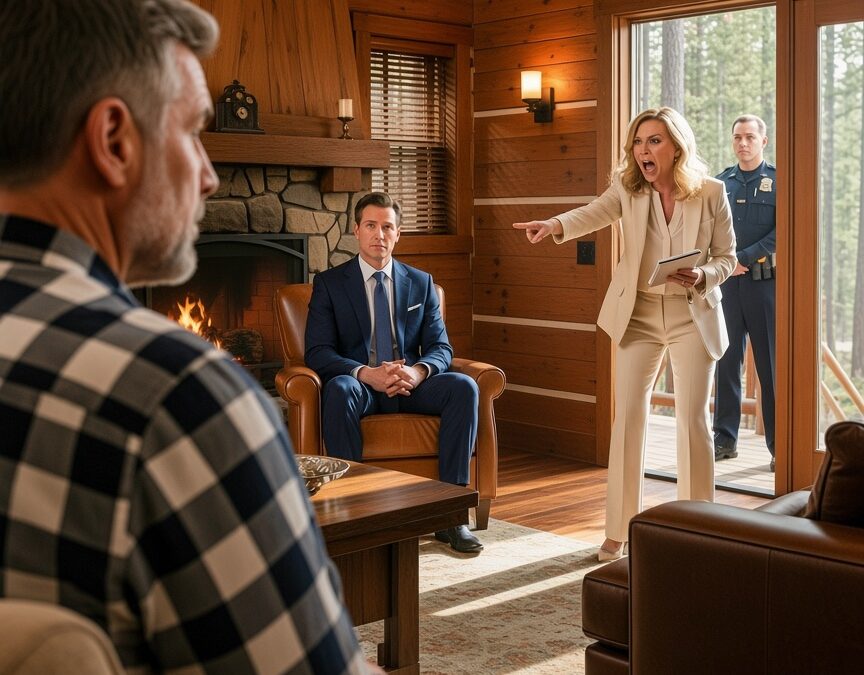
The last peaceful morning I remember began with the smell of pine trees, fresh coffee, and bacon sizzling in a cast-iron skillet.
I was sitting on the porch of my grandfather’s cabin, discussing a two-million-dollar environmental education grant with the state attorney general, when a black Cadillac Escalade came roaring up my gravel driveway.
It stopped directly in front of Sarah’s memorial garden.
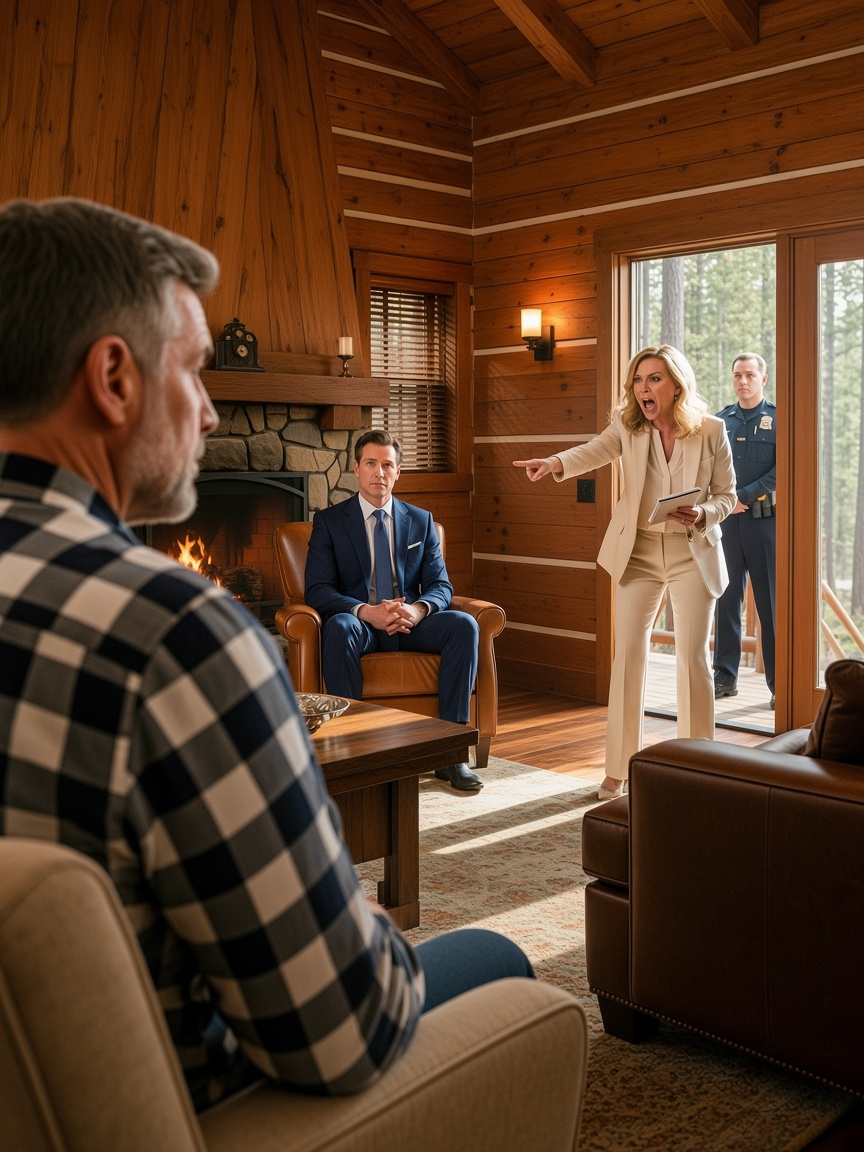
A woman stepped out wearing a cream-colored designer suit, oversized sunglasses, and heels that had no business being anywhere near a mountain trail. She slammed her door, marched toward my porch, and raised her phone to record me.
“This illegal structure is condemned,” she announced. “I’m Brenda Castellanos, president of Cascade Valley Estates Homeowners Association. Your little operation is finished.”
Beside me, Attorney General Daniel Morrison lowered his coffee cup.
“Excuse me?” he asked.
Brenda barely glanced at him.
“I’m not here to negotiate with your friends, Mr. Reynolds. I’m here to enforce the rules.”
I looked at the woman standing beneath the wind chimes my dead wife had hung with her own hands.
Then I looked at the state’s chief law enforcement officer, who had just witnessed a stranger threaten a government-supported environmental project.
I should have been furious.
Instead, I had one very clear thought.
This woman had absolutely no idea whose porch she had walked onto.
But neither did I know that the man sitting beside me was connected to a secret buried beneath this valley for more than forty years.
And before it was over, one of my closest friends would nearly die, an entire luxury development would become the center of a federal investigation, and I would discover that the most dangerous people in Cascade Valley weren’t necessarily the ones making the loudest threats.
My name is Garrett Reynolds. I’m fifty-two years old, a retired electrical engineer, and until that morning, I believed the most difficult part of my life was already behind me.
I had spent thirty years designing electrical distribution systems, renewable-energy infrastructure, and smart-grid technology for municipalities across the state. I had worked through ice storms, budget disasters, political arguments, and more emergency engineering meetings than I cared to remember.
A handful of patents eventually gave me enough money to retire without worrying about another paycheck.
I didn’t buy a mansion or a yacht.
I went home.
My grandfather had purchased forty acres in Cascade Valley decades before anyone imagined turning the surrounding mountains into a luxury residential development. He had been a mining engineer, a stubborn man who trusted measurements more than promises and believed a person should own enough land to hear the wind without hearing the neighbors.
When he died, the property passed through the family until it eventually became mine.
There was an old timber cabin, two weathered mining buildings, a workshop, a spring-fed well, and a stretch of forest that descended toward a creek.
To most people, it looked like a retirement project.
To my wife, Sarah, it had been something else.
She had always wanted to build a place where children could learn about the natural world without being rushed through it.
Not a summer attraction with plastic climbing walls and gift-shop souvenirs. A real outdoor classroom where students could test water, identify native plants, learn how solar energy worked, and understand why protecting a watershed mattered to people living fifty miles downstream.
Sarah taught middle-school science for twenty-three years.
She could explain erosion to a room full of restless twelve-year-olds using nothing more than a baking tray, a handful of dirt, and a pitcher of water.
She believed curiosity was something you protected.
When her cancer returned, we stopped discussing retirement trips and started talking about the cabin.
One evening in the hospital, while rain tapped against the window, she took my hand.
“Promise me something, Garrett.”
I leaned closer.
“Anything.”
“Don’t just hide up there when I’m gone.”
I tried to interrupt, but she squeezed my fingers.
“Build the place we talked about. Let those kids see what we loved.”
I promised.
She died eleven days later.
For months afterward, I barely left the cabin. I repaired things that didn’t need repairing. I reorganized tools. I walked through the forest until darkness forced me home.
Then one morning, I found a folder of Sarah’s handwritten lesson plans.
The first page was titled The World Outside the Window.
Underneath, she had written:
Every child deserves to know what is worth protecting.
That was when I began working.
I converted the old mining office into a classroom, reinforced the second building for equipment storage, restored the trails, and installed an independent solar system to power the learning center.
I paid for most of it myself.
When a regional environmental education grant became available, I applied for funding to expand the project and provide scholarships for students from communities that rarely had access to outdoor programs.
Attorney General Morrison became interested after the governor’s office circulated a list of promising conservation projects.
He contacted me personally.
We had spoken several times before he visited the cabin, and I found him surprisingly easy to talk to. He was in his late fifties, carefully dressed, with silver hair and the polished confidence of someone who had spent decades speaking in rooms where everyone listened.
That morning, he was reviewing my proposal over breakfast.
“Two million dollars,” he said, turning a page. “Possibly more if the federal partnership comes through.”
I poured him another cup of coffee.
“That’s enough to finish the second classroom, hire instructors, and fund transportation for the first three years.”
He studied the plans.
“The governor wants a model that other counties can replicate. This has potential.”
Then Brenda arrived.
She stood at the bottom of my porch holding a thick folder.
“Mr. Reynolds, you have thirty days to remove every unauthorized solar panel from this property.”
I remained seated.
“Unauthorized by whom?”
“The homeowners association.”
“My property isn’t part of your association.”
She gave a dismissive laugh.

