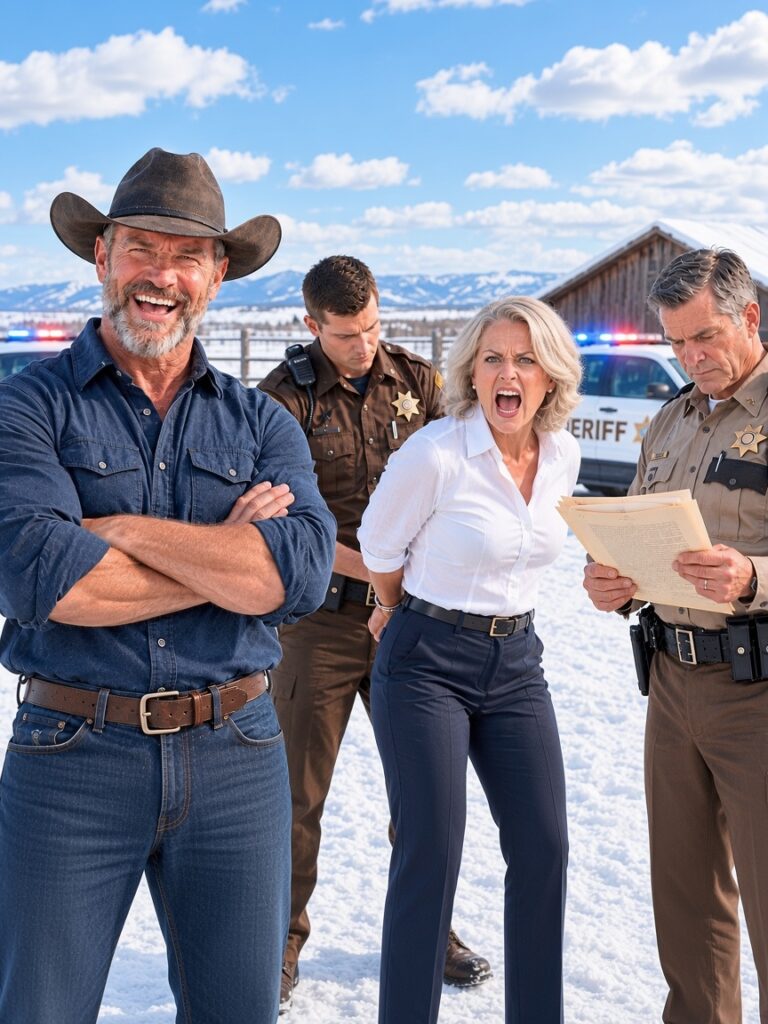
“My deed is inside. My attorney has been reviewing the boundary records.”
Norris asked me to retrieve it.
I went into the kitchen and opened the old steel cabinet where my father had kept the ranch documents.
The deed lay inside a worn folder with his handwriting across the front.
When I returned, Robert had arrived. I’d called him as soon as the sheriff’s vehicles entered the property, and he had been nearby.
Norris examined the deed while Robert explained the discrepancy between the original survey and the HOA’s boundary map.
Then Norris reached the access provision.
He read it again, more slowly.
Robert pointed to the relevant paragraph.
“The corridor is reserved to the recorded landowner. Mr. Mercer has never consented to association control.”
Vanessa stepped forward.
“That language is outdated.”
Robert looked at her.
“Do you have a recorded instrument changing it?”
“Our survey establishes the boundary.”
“Your survey depicts a different boundary. That’s precisely what we’re disputing.”
Robert opened his folder.
He showed Norris the original survey information, the altered boundary depiction, and the county filing they had traced.
One of the parcel references on the disputed survey appeared inconsistent with the date represented on the document.
Norris asked Vanessa who had submitted it.
“My attorney handled the paperwork.”
“Did you sign the filing?”
She hesitated.
“Yes.”
“Did you review the information before signing?”
“I relied on professional advice.”
Norris didn’t accuse her of a crime on the spot.
Instead, he asked for copies of the documents and told Vanessa that the deputies would not remove me based on the HOA notice.
She protested until he told her firmly to stop interfering.
When the vehicles finally left, my father’s deed was still in my hands.
PART 4: THE FALSE BOUNDARY CLAIM BEGAN UNRAVELING UNDER OFFICIAL REVIEW
The sheriff’s visit didn’t settle ownership. Robert made that clear as soon as we went inside.
“We’ve prevented an improper removal today,” he said. “Now we need to resolve the records.”
Over the following weeks, Robert worked through the formal process of challenging the disputed filings.
The county examined the recorded documents and the conflicting survey information. The sheriff’s office separately reviewed the complaint that had brought six deputies to my ranch.
I supplied photographs of the cattle, operating records, tax documents, and evidence that I’d occupied and maintained the property continuously.
Luke organized the photographs of the survey stakes and HOA signs.
Robert also pursued information about the developer’s agreement and the representations made concerning the access corridor.
As the investigation progressed, Vanessa’s position became harder to defend.
The original boundary documentation did not place my northern pasture inside Silver Ridge Estates. Nor had Robert found any signed consent transferring control of the private corridor to the HOA.
The disputed filing and Vanessa’s statements to law enforcement became subjects of further investigation.
Eventually, Vanessa was arrested in connection with allegations involving false property records and the report made to law enforcement. Her arrest did not establish guilt, and the criminal proceedings were separate from our property dispute.
I learned about it from Robert.
Luke was standing beside me when the call ended.
“After everything she did, I thought you’d be celebrating,” he said.
“I wanted her to leave us alone. That’s all.”
The legal and administrative work continued.
The county ultimately corrected the property mapping to reflect the established boundary. The disputed access claim could no longer be treated as proof that the HOA controlled my land.
But Silver Ridge’s homeowners had been hearing a different story for months.
They’d been told I was threatening their neighborhood, interfering with emergency access, and trying to take away a road they depended on.
Now they were seeing the original survey.
And some of them wanted to talk.
PART 5: THE OLD GATE REMAINED OPEN UNDER MY FAMILY’S TERMS
Three homeowners came to the ranch one afternoon.
There was an older couple, a firefighter who lived in the development, and a young mother who had brought her two children.
The firefighter did most of the talking.
“Mr. Mercer, we owe you an apology.”
“You don’t owe me anything.”
“We believed what Vanessa told us.”
The older man looked toward the northern pasture.
“She said you were trying to take our emergency road away.”
“I’m not trying to take anything from you. I just don’t want an association claiming it owns part of my ranch.”
The firefighter nodded.
“That’s fair.”
I explained that I’d never opposed emergency vehicles crossing the property under a proper agreement. What I opposed was a private organization declaring authority it didn’t possess.
That conversation was the first decent one I’d had with anybody connected to the HOA in months.
Six months after the deputies came to my porch, Silver Ridge Estates had a replacement board. Vanessa no longer controlled the association.
The proposed $42 million expansion lost the agreement on which its planned access depended. The developer’s project did not proceed under that arrangement.
The corrected maps showed the ranch boundary where it belonged.
Robert then helped me establish a formal emergency access agreement with the county.
Fire trucks, ambulances, and law enforcement could use the designated corridor when necessary. The agreement did not transfer ownership or give the HOA authority to regulate my ranch.
That was a solution I could live with.
One evening, Luke and I stood beside the old gate, watching the last light disappear behind the western hills.
He leaned against a fence post.
“Remember when Vanessa brought six deputies here to throw you out?”
“Hard to forget.”
“And all those notices she sent?”
“Thirty-eight thousand dollars in imaginary fines.”
He laughed.
“She really thought she could make you leave.”
I looked toward the pasture.
“I think she believed that if she kept saying she owned it, eventually everybody else would believe her.”
Luke glanced at the folder in my hand.
“Good thing Grandpa kept those papers.”
I opened it carefully.
My father’s handwriting was still visible, faded but recognizable.

