I looked through the window toward the western pasture.
“Keep the letters. Photograph anything she puts on our land. We need a record.”
That was the first time I seriously considered that Vanessa might try more than sending ridiculous invoices.
Three months later, Luke found orange survey flags in our northern pasture.
Someone had driven wooden stakes into the ground, marking a line that cut across our land.
A sign beside them read: PRIVATE HOA ACCESS ROAD.
I walked the marked route.
It crossed pasture we used for grazing, passed near the equipment shed, and connected toward the western boundary.
There was no public road there.
There never had been.
I pulled the sign out and carried it back to the house.
Vanessa appeared the following morning.
She stepped out of her SUV and pointed toward the empty stakes.
“You removed association property.”
“You installed a sign on my ranch.”
“That route is necessary for emergency access.”
“Then somebody should have discussed it with the landowner.”
“We have an agreement.”
“Show it to me.”
She didn’t.
Instead, she accused me of obstructing emergency services.
I told her that if the fire department needed access, its representatives could contact me directly.
She pulled out her phone.
“You’re making a serious mistake.”
“No, Vanessa. I’m asking you to stay off my property.”
She made a call, spoke quietly for a moment, then returned to her vehicle.
Before leaving, she lowered the window.
“You’ll regret being this difficult.”
That evening, Luke brought his laptop to the kitchen table.
“Dad, come look at something.”
He had opened a parcel map published on the HOA’s website.
Beside it lay one of our older survey drawings.
At first, I thought the difference was a printing problem.
Then Luke pointed to the northern boundary.
“Look where they’ve drawn the line.”
I measured the distance using the scale.
The HOA’s map appeared to move our boundary nearly eighty yards.
Under that version, the proposed access road, a portion of the northern pasture, and our equipment shed sat inside Silver Ridge Estates.
I stared at the screen.
“Where did they get this?”
“That’s what I want to know.”
The next morning, I called Robert Hayes.
Robert had handled my father’s estate and several property matters over the years. He knew the ranch, its history, and most of the paperwork associated with it.
He arrived carrying a briefcase and spent nearly two hours examining the documents.
He compared the deed, original survey, and HOA map.
Finally, he took off his glasses.
“Jack, we need to find out whether this map was actually filed anywhere.”
“You think they’ve changed the county records?”
“I don’t know. But we shouldn’t assume this is just a picture on their website.”
He turned to the last pages of my deed.
“There’s something else here.”
He pointed to a provision concerning an old private access corridor.
I remembered my father mentioning the corridor when I was younger. It had been reserved as part of the ranch’s recorded property arrangements.
Robert read the provision carefully.
It stated that the corridor remained under the recorded landowner’s exclusive control and could not be transferred, restricted, or incorporated into a private homeowners association without that owner’s written consent.
“Did you ever sign such an agreement?” Robert asked.
“No.”
“Did your father?”
“Not that I know of.”
Robert nodded.
“Then we’re going to establish exactly what the recorded documents say before anyone does anything with that road.”
Luke leaned against the kitchen counter.
“Why would they go through all this trouble?”
Robert looked at the map.
“That’s what concerns me.”
PART 2: A FORTY TWO MILLION DOLLAR PLAN BEHIND THE DISPUTE
Three days later, Robert returned with documents concerning a proposed development beside Silver Ridge Estates.
The developer wanted to construct another hundred homes. The estimated project value was $42 million, and its plans depended on obtaining a second emergency access route.
The proposed route crossed our northern pasture.
Luke spread the drawings across the table.
“They can’t build it without crossing us?”
“Not according to the route shown in these plans,” Robert said. “There may be alternatives, but this is the one they’re pursuing.”
He also had paperwork showing that the HOA had entered into an agreement with the developer concerning the proposed access.
I looked at the line drawn through my pasture.
“So Vanessa wants to promise them a road she doesn’t own.”
“That’s one possibility. We still need to establish what she represented and to whom.”
Robert had also located a filing claiming the ranch was abandoned or no longer actively occupied.
I looked out the kitchen window at my pickup, barns, and cattle.
“Abandoned?”
“That’s the allegation.”
“Anybody who drove through the gate could tell them otherwise.”
“Which is why we’ll challenge it with evidence.”
Robert began gathering photographs, tax records, ranch operating documents, and the ownership history. He also requested certified copies of the relevant county records and the survey used in the HOA’s claim.
He warned me not to move any remaining stakes or confront Vanessa again.
“We need the record to be clear,” he said. “Don’t give them a separate dispute to use against you.”
I followed his advice.
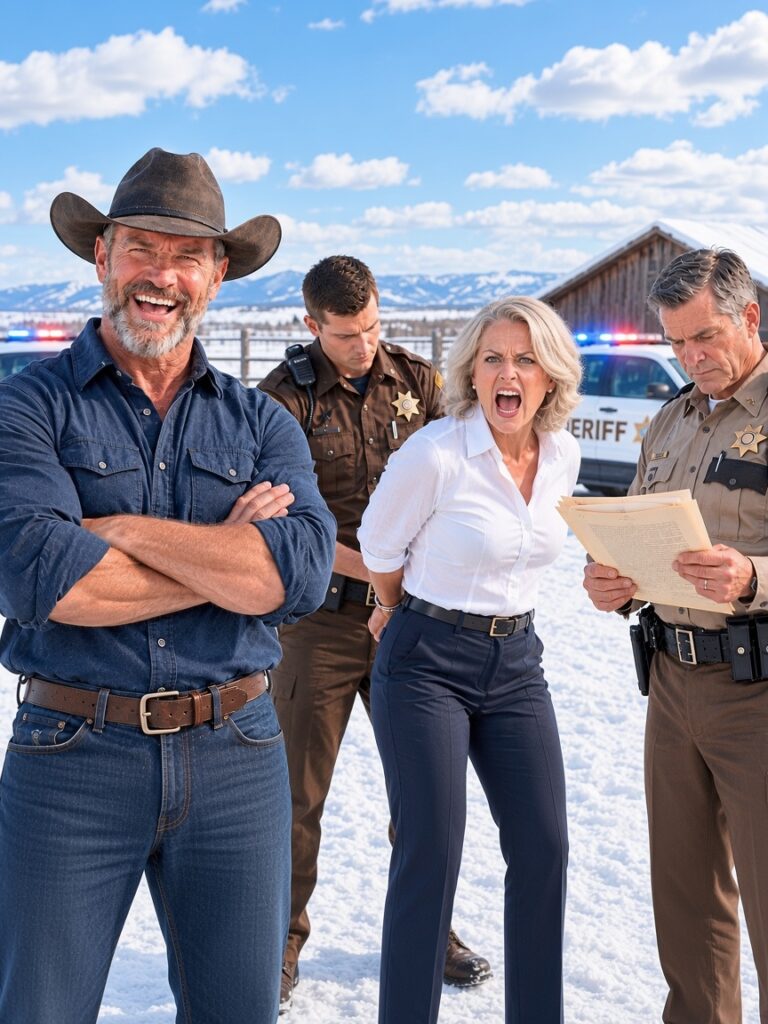
Four days later, Norris and five other deputies arrived at my house.
Vanessa had come with them.
She was holding a folder and demanding that they remove me.
PART 3: THE DEED REVEALED WHAT VANESSA’S EVICTION ORDER COULD NOT
Norris stood between Vanessa and me.
“Ma’am, you said you have an eviction order. Let me see it.”
She handed him a document.
He read the heading, turned a page, and looked up.
“Who issued this?”
“The association.”
“This is an HOA enforcement notice.”
“It’s an eviction order.”
“No, ma’am. A homeowners association notice is not a court order authorizing deputies to evict somebody.”
Vanessa’s face reddened.
“Our attorneys confirmed our jurisdiction.”
“That doesn’t establish a right to remove him.”
I pointed toward the house.

