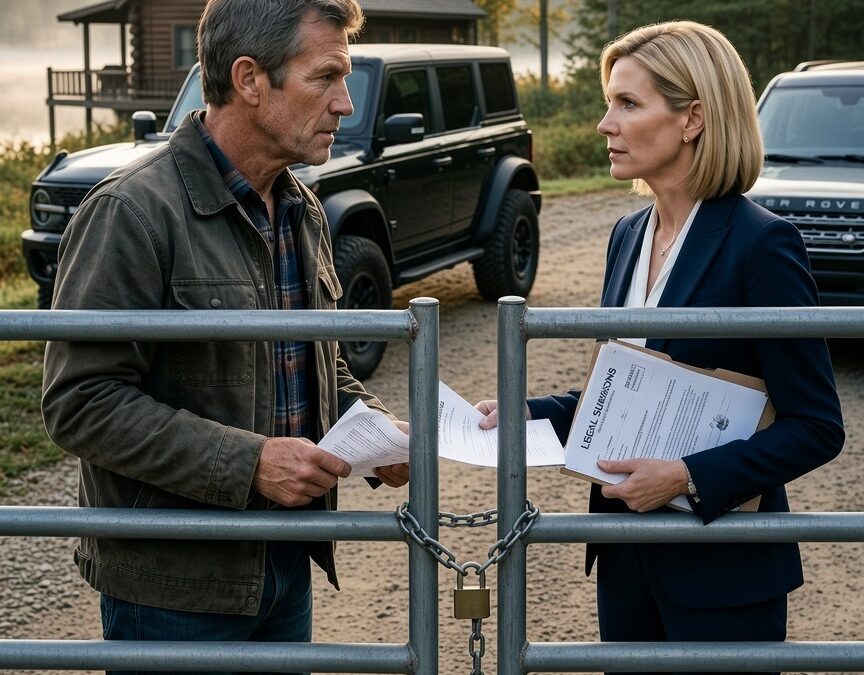
The woman who’d spoken earlier looked toward Victoria.
“Why didn’t we know any of this?”
Victoria closed her folder.
“We’ve acted in the community’s best interests.”
Robert answered before I could.
“Then we should have the documents to support what we’ve been telling people.”
The gathering broke up without a vote or a dramatic confrontation.
A few residents thanked me for explaining. Others remained angry about the inconvenience.
I understood both reactions.
The following week, the county completed its administrative review of the physical access and boundary records.
Its written findings identified the road corridor as part of my parcel and noted the HOA’s alterations. It did not establish an HOA ownership interest or resolve any private easement claim.
My attorney said the remaining question would require an agreement or a court’s determination if the association continued disputing access.
Victoria’s attorney contacted him shortly afterward.
This time, the HOA wanted to negotiate.
PART 5: The Road Reopened Only After Everyone Respected Its Boundaries
Victoria arrived alone for our next meeting.
She carried a small envelope instead of her clipboard.
“The board reviewed the county findings and our attorney’s advice,” she said.
“And?”
“We want a proper access agreement.”
I opened the side gate so we could speak without shouting through the bars.
“What changed?”
She looked toward the gravel lane.
“We can’t keep treating an assumption as permission.”
It was the first straightforward acknowledgment I’d heard from her.
Over the next several weeks, our attorneys negotiated a written arrangement. The HOA removed its signs, documented the repairs it had made, and accepted that maintenance work required my approval.
The agreement defined permitted access, responsibilities for damage and upkeep, and how the gate would be operated. It also addressed the association’s historical-use concerns without requiring me to surrender ownership or unrestricted control.
Nothing happened overnight.
There were revised drafts, disagreements over insurance, and several conversations about what residents actually needed.
I rejected one version that would have allowed the board to expand access without consulting me.
The final version required changes to be agreed upon in writing.
When the documents were ready, Victoria came to the cabin.
We sat at my kitchen table with copies of the agreement between us.
She signed first.
Then I signed.
A few days later, a maintenance crew repaired the damaged gravel shoulder near the entrance under the agreed terms.
Victoria stopped by as they finished.
She looked toward the lake, then at the private property sign beside my gate.
“I should have talked to you before putting up those signs,” she said.
“You should have.”
She nodded.
There was nothing else to argue about.
Months later, I sat on my porch with a cup of coffee, watching the water move against the old dock.
The cabin still needed work. The fireplace still smoked when the wind shifted, and the gravel road still required attention after heavy rain.
But the entrance was quiet again.
Residents who had permission could use the lane under the agreement. Maintenance crews scheduled their work. Nobody sent me HOA assessments or attached notices to my fence.
I hadn’t bought the cabin to start a fight with a neighborhood.
I’d bought it because I wanted a place that belonged to me.
One evening, I walked down to the gate as the sun dropped behind the trees. I checked the latch, looked at the clear boundary marker, and listened to a vehicle pass along the public road beyond the entrance.
For months, that gate had been where Victoria came to tell me what I had to do.
Now it stood open when I chose to open it.
The road hadn’t moved an inch.
What changed was that everyone finally understood the difference between using someone’s property and having the right to control it.
THE END
Disclaimer: This story is fictional and created for entertainment purposes only. Any names, characters, places, or events are fictitious or used fictitiously. No real person or organization is intended to be portrayed.

