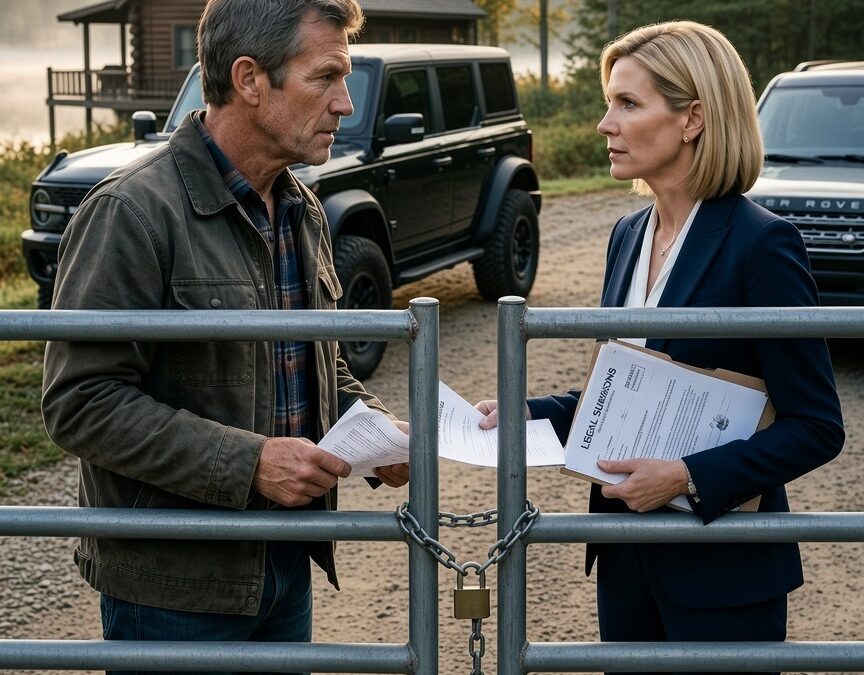
She drove her white Lexus through the entrance and stopped outside my cabin.
I met her on the porch.
“Your contractors came down to my dock yesterday,” I said.
“They were performing routine maintenance.”
“On whose instructions?”
“The board approved the work.”
“The board doesn’t own this property.”
She looked toward the lake.
“You seem determined to make yourself unpopular.”
“I bought this place to live here, not to win a neighborhood election.”
She adjusted the papers on her clipboard.
“Residents have expectations, Nathan.”
“So do property owners.”
She stepped closer.
“People have been coming down this road long before you arrived.”
“I understand that.”
“Then you understand why you can’t suddenly change everything.”
I considered that for a moment.
I hadn’t purchased the cabin intending to close the road. If someone had approached me with a reasonable request, I might have considered limited access.
But Victoria hadn’t requested anything.
She had installed signs, sent contractors, and demanded money.
Then she’d acted offended when I objected.
“I’ve asked you three times for documentation,” I told her. “Bring me something that establishes the HOA’s rights.”
She gave me a thin smile.
“You’ll hear from our board.”
Two days later, I received a document titled Temporary Community Access Agreement.
It would have permitted Pine Ridge Estates to continue using the road while the parties discussed a permanent arrangement.
But its language also gave the association broad authority over maintenance, scheduling, and access management.
There was no clear expiration date.
No meaningful limit on traffic.
And nothing preventing the HOA from treating the arrangement as a basis for future control.
Victoria appeared at my entrance while I was reading it.
“Sign that, and this becomes simple,” she said.
“Simple for whom?”
“For everyone.”
I held up the agreement.
“You’re asking me to hand over control of my road without even establishing your right to use it.”
“I’m asking you to cooperate.”
“Then start by answering my letters.”
She folded her arms.
“Most people would appreciate having their road maintained at no cost.”
“I’ve paid for repairs myself. Your crews made changes without asking.”
“That’s a very narrow way to look at community responsibility.”
I placed the unsigned agreement on my porch railing.
“I’m not signing it.”
She stared at me for several seconds.
“Seven days, Nathan. The board expects compliance.”
“What happens after seven days?”
“We pursue our options.”
She returned to her Lexus.
I watched her drive away, then went inside and called a property attorney whose office was in the nearest town.
I described the situation to his receptionist and arranged an appointment.
That evening, I spread the deed, survey, invoices, and photographs across my kitchen table.
The old leather chair beside the fireplace still smelled faintly of the previous owner’s pipe tobacco. Outside, waves tapped against the dock.
I made a chronological list of everything that had happened.
The first sign.
The gravel work.
The invoices.
The landscaping crew.
Victoria’s agreement.
I had never been particularly interested in legal disputes. I preferred fixing things with my hands and speaking plainly when there was a problem.
But the more I organized the paperwork, the clearer the pattern became.
Victoria treated my silence as consent.
Every time I objected, she responded with another demand.
I checked the gate at the entrance before going to bed.
It had been installed by the previous owner, though the lock was old and rarely used.
I stood there for a while, listening to a vehicle approaching from the neighborhood.
A golf cart came around the bend, its headlights bouncing across the gravel.
The driver slowed when he saw me.
“Evening,” he called.
“Evening.”
“Something wrong with the gate?”
“No. Just checking it.”
He nodded and continued toward the public road.
I watched him disappear.
He hadn’t threatened me. He probably didn’t know anything about the invoices or the unsigned agreement.
That was part of the problem.
Victoria was speaking for people who might not understand what she was demanding on their behalf.
The following morning, I called my attorney’s office again and asked whether they could review the gate issue before our scheduled meeting.
I sent over the documents.
The attorney cautioned me not to assume that ownership alone eliminated possible easement or prescriptive-use claims. He wanted to examine the title history and understand how residents had accessed the lake.
I agreed.
Until we had that answer, I would keep documenting the traffic and avoid making promises.
Then Victoria sent a final notice.
It demanded that I acknowledge HOA control of the access route within forty-eight hours.
I read it twice.
There was no supporting easement attached.
I photographed the notice, added it to my folder, and called my attorney.
When we finished talking, I walked down the gravel lane and stood beside the steel gate.
The road was quiet.
For the first time since buying the cabin, I had a clear plan for what came next.
PART 2: A Tow Truck Arrived Before The Legal Questions Were Answered
Victoria arrived with a tow truck the following morning.
I was outside checking the gate when her Lexus stopped beside the entrance. The tow truck pulled in behind her, its diesel engine rattling.
“Open it,” she called.
The gate was closed, with a notice directing anyone claiming a legal right of access to contact my attorney. I’d left a means of arranging necessary access while the dispute was reviewed.
Victoria pointed at the lock.
“You’re interfering with HOA operations.”
“The association has been told to contact my attorney.”
She turned toward the tow truck driver.
“We need this obstruction removed.”
The driver examined the gate, then looked at me.
“Who owns it?”
“I do. It’s on my parcel.”
“Do you have a court order?” he asked Victoria.
She hesitated.
“The board authorized this.”
He shook his head.
“That’s not enough for me.”
He returned to his truck.
Victoria watched him leave, furious.
“You’re going to regret this.”

