“What’s that program?”
I hesitated.
It was still displaying the emergency allocation logs.
Miller noticed.
“Alex. Did you interfere with her house?”
I could have repeated the story I had rehearsed about unpredictable smart-device behavior.
But the logs were sitting in front of us, and I knew perfectly well what they meant.
“Yes,” I said. “I activated a routine that affected some of her connected devices.”
Miller closed his eyes briefly.
“Of course you did.”
“She destroyed my utility connection.”
“That doesn’t give you permission to take control of her property.”
He was right.
The officers separated us, documented both complaints, and requested that the utility company make the damaged connection safe.
Brenda continued insisting that I should be arrested.
Miller told her the footage showed her damaging equipment and that investigators would review the incident.
He also made it clear that my electronic retaliation would be examined separately.
By the time Gus arrived the following morning, the rain had stopped.
He looked at the utility crew, the police vehicles, Brenda’s exhausted expression, and my garage.
He removed his baseball cap.
“Alex,” he said slowly, “what in the world happened?”
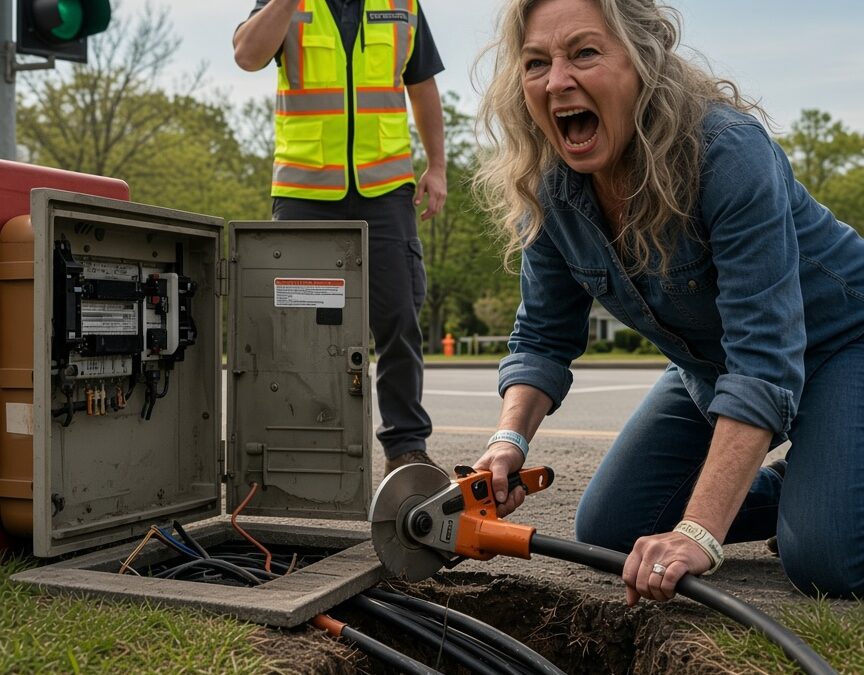
I looked at the severed cable.
“She brought bolt cutters.”
Gus considered that.
“And you?”
I glanced toward Brenda’s house.
“I made a bad decision with a very good computer.”
## Part 5: The Neighborhood Changed And My Machines Finally Fell Quiet Again
The investigation took longer than Brenda or I expected.
West County Electric documented the damaged equipment and repair costs. The police obtained my original footage and interviewed Gus about Brenda’s earlier threat.
Brenda faced criminal proceedings arising from the damaged utility connection.
My actions weren’t ignored either.
Investigators reviewed the smart-device interference, and the city required a technical audit of my municipal support connection before permitting me to resume normal operations.
I cooperated.
It was an unpleasant experience for a man who had spent most of his adult life assuming that sufficiently careful engineering could solve almost anything.
The city eventually allowed the traffic-support service to resume with tighter access controls and independent oversight.
The Judgment of Solomon routine was permanently removed.
I also stopped collecting information about neighbors that had nothing to do with my property or the traffic system.
Dave called that my second retirement.
“First you retired from Omnilink,” he said. “Now you’re retiring from being a supervillain.”
“I prefer experimental systems architect.”
“Sure. That’s what all the supervillains say.”
Brenda resigned from the HOA board while her case was pending.
She later accepted a negotiated resolution to the criminal matter, and the utility pursued reimbursement for its repair costs.
Her house went on the market several weeks afterward.
I never learned every detail of her financial circumstances, and I stopped trying to.
Dave became the new HOA president.
His first project was reviewing the covenants with the rest of the board.
The utility-decorum provision disappeared. The landscaping rules became less restrictive. The Petersons kept their red roses.
Nobody burned the rulebooks, despite Dave suggesting it at least twice.
Instead, the board held a properly noticed meeting and voted on the amendments.
I appreciated the irony.
Gus completed my geothermal installation, and the cooling improvements performed close to the engineering projections.
We became friends.
He occasionally visited after work, usually with a story about an unreasonable customer.
Every few weeks, he would mention the storm.
“Remember that polka music?”
“Unfortunately.”
“Funniest thing I’ve ever heard.”
“Not my finest engineering decision.”
“Didn’t say it was.”
Two months after the incident, Officer Miller called.
He said the city was pleased with the improved traffic performance, then asked whether I had finally learned to keep my private disputes separate from municipal equipment.
“Absolutely,” I told him.
There was a pause.
“Henderson?”
“Yes?”
“Don’t make me come back to that garage.”
I promised I wouldn’t.
That evening, I sat in my familiar chair with a cold beer.
The geothermal system was running efficiently. The servers produced their gentle, steady hum.
On the main monitor, traffic moved smoothly through Elm and Main.
I opened the signal-timing configuration and examined the left-turn sequence.
For a moment, I considered writing one last little adjustment, something that would recognize Brenda’s car and make her wait an extra fifteen seconds whenever she returned to the neighborhood.
The idea made me smile.
Then I closed the configuration window without changing anything.
Brenda had already paid a price for what she did. So had I.
I hadn’t spent twenty years learning to build reliable systems just to turn one into a personal weapon.
Outside, the Petersons’ roses moved in the evening breeze. Dave was carrying groceries into his house. Somewhere down the street, a garage door opened without incident.
I leaned back and listened to the servers.
They were doing exactly what they were supposed to do.
For the first time in months, that was enough.
THE END
Disclaimer: This story is fictional and created for entertainment purposes only. Any names, characters, places, or events are fictitious or used fictitiously. No real person or organization is intended to be portrayed.

