“Never seen a man bring that much paperwork to a police conversation,” he said.
“Preparation saves time.”
“Not sure those officers agree.”
By late afternoon, the trench extended neatly across my side yard.
Brenda crossed the lawn and stopped near its edge.
“You think you’ve won,” she said.
“I think Gus has installed twelve feet of pipe.”
“I helped build this neighborhood. I wrote those rules. You don’t get to ignore them.”
“I’m not ignoring them, Brenda. I’m following the ones that actually apply.”
Her attention shifted toward the heavy conduit entering my garage.
“You love those computers more than anything.”
“They’re important to me.”
“I’ll make sure they get shut down.”
I straightened.
“What does that mean?”
“If nobody else has the courage, I’ll pull the plug myself.”
Gus stopped working.
“Brenda,” I said, “that is utility equipment. Interfering with it could seriously injure you or somebody else. Don’t touch it.”
She stared at me, then turned and marched home.
Gus watched her leave.
“That wasn’t normal complaining.”
“No,” I said. “It wasn’t.”
I saved the camera footage from our confrontation and checked my backup systems that evening. I had designed them for storms and outages, not angry neighbors.
Nevertheless, a storm was approaching.
And Brenda had just given me a reason to be careful.
## Part 3: At Eleven Thirty Seven Brenda Finally Carried Out Her Threat
The rain started after dinner and intensified steadily. Wind rattled the garage door while I monitored the relatively light traffic at Elm and Main.
Around eleven, I checked my generator fuel, automatic transfer equipment, and emergency procedures.
Everything tested normally.
At 11:37 p.m., a motion alert appeared on my side-yard camera.
A figure in a dark raincoat moved along the fence.
I enlarged the image.
Brenda.
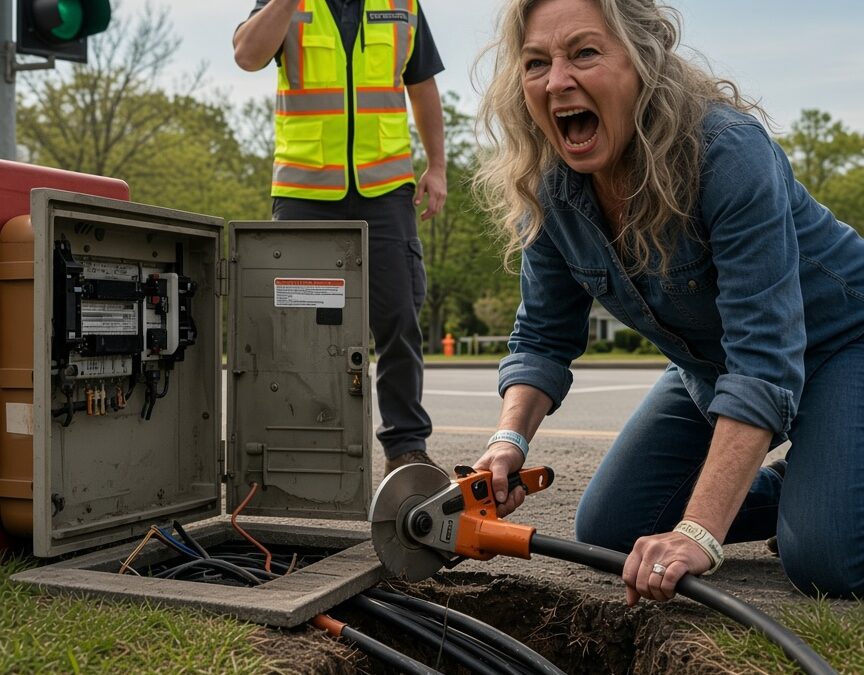
She was carrying a pair of bolt cutters.
For several seconds, I watched in disbelief. She had threatened to interfere with my power, but I hadn’t truly expected her to do it.
I reached for my phone.
Then she stopped beside the utility junction.
“Brenda, don’t,” I said to the empty garage.
She positioned the cutters against the cable.
A flash illuminated the rain.
My monitors went dark.
The ventilation stopped, and the familiar server hum disappeared.
Emergency batteries maintained a few critical circuits. A warning sounded from the control panel.
CRITICAL POWER FAILURE.
MUNICIPAL SUPPORT CONNECTION OFFLINE.
The municipal controllers were designed to revert to their independent timing plans when my system disconnected. That prevented my garage outage from becoming a traffic-safety emergency, but it also meant losing the optimization I provided.
I called emergency services and reported the damaged utility connection, emphasizing the electrical hazard.
Then I activated my backup-power protocol.
I had named it Epsilon Gamma Pi, partly because engineers should occasionally be allowed to amuse themselves.
The generator started behind the house.
The transfer equipment engaged.
My monitors returned one by one, and the servers began their controlled restart.
The traffic interface eventually showed that communications were restored, though the city controllers would require their normal checks before accepting new timing requests.
I saved the footage of Brenda cutting the cable.
Then I looked at a second program on my screen.
It was called Judgment of Solomon.
I had built it as an experimental emergency power-allocation system, using approved local connections and a collection of private smart-home devices that several neighbors had voluntarily linked to my demonstration network.
Its original purpose was to test how limited backup energy might be prioritized during an extended outage.
Over time, I had added something considerably less professional.
A neighborliness score.
Dave ranked highly. So did the Petersons and Frank.
Gerald ranked poorly.
Brenda ranked last.
And hidden in the software was a malicious routine I had written as a joke, never expecting to use it.
I stared at its activation control.
Brenda had deliberately destroyed my electrical service.
I should have left the retaliation program untouched.
Instead, furious and convinced I had earned the right to teach her a lesson, I enabled it.
## Part 4: My Emergency Protocol Delivered A Lesson Nobody Could Easily Forget
My house remained illuminated by generator power. Through the storm, a few participating neighbors’ emergency devices also received limited backup service.
Then the experimental routine began targeting Brenda’s connected equipment.
Her smart refrigerator started playing cheerful polka music.
Her lights flashed an irritating repeated pattern.
Her television displayed pages from my twenty-seven-page HOA response.
The doorbell sounded again and again, accompanied by a synthetic warning about community bylaws.
Outside, her sprinklers activated despite the rain, soaking the flower beds she had spent years protecting.
Her connected garage-door controller also stopped responding.
I watched Brenda return from my side yard and stand motionless on her front walk.
She heard the music.
Then the doorbell began.
She rushed inside.
From my street-facing camera, I could see lights flashing through her windows. I heard her shouting, though I couldn’t make out every word.
At first, I laughed.
Then she tried to leave in her car and discovered the garage door wouldn’t open.
That should have been the moment I stopped everything.
Instead, I watched her emerge into the rain and hurry toward the Petersons’ house.
Mrs. Peterson opened the door.
Brenda gestured toward her own home, visibly shaken.
A few minutes later, police lights appeared at the end of Maple Lane.
I disabled the routine before the officers reached my driveway.
Miller and Davies stepped out into the rain.
Brenda hurried toward them.
“He did this!” she shouted, pointing at my house. “He’s controlling everything!”
Miller looked at my illuminated garage, then at her flashing windows.
“Henderson,” he said when I approached, “tell me what’s going on.”
“Somebody cut my power cable. I have video.”
“Then show me.”
Inside the garage, I played the recording.
Miller watched Brenda approach the junction box, raise the cutters, and make contact with the equipment.
He asked for a copy.
I provided the original file and the system timestamps.
Then Davies pointed toward another monitor.

