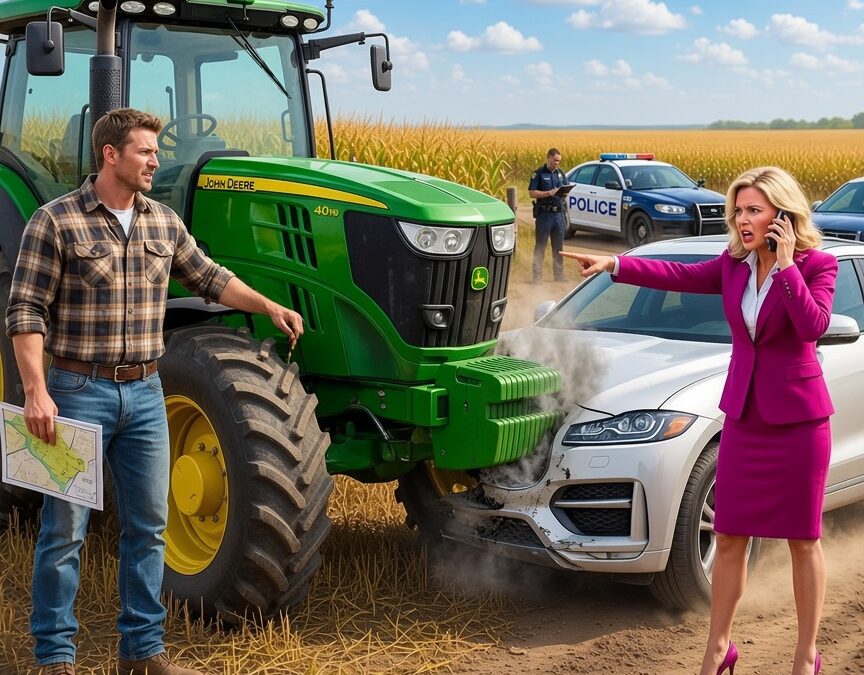
I stopped near the place where the Mercedes had hit my combine.
For months after the collision, I could still identify the spot by the disturbed soil and tire marks.
Now the evidence was gone.
The ground had been worked, planted, and cultivated.
New corn grew where the wreckage had been.
I crouched and rubbed a little soil between my fingers.
My grandfather had taught me how to judge moisture that way.
My father had taught me to pay attention to the smell of the ground before rain.
Patty had taught me that a farm’s value wasn’t measured only by what it produced for the person who owned it.
All three lessons had stayed with me.
The following spring, I was preparing the planter when Jenna called.
“Dad, what are you doing?”
“Getting ready to plant.”
“Of course you are.”
“What’s that supposed to mean?”
“Nothing. Just checking whether you’ve discovered retirement yet.”
“Never heard of it.”
She laughed.
Then her voice softened.
“I was looking at the photographs from that day.”
I knew which day she meant.
“Why?”
“I’m putting together a family album. Mom’s pictures, Grandpa’s, the farm through the years.”
“That sounds nice.”
“I found one of you standing beside the combine after the crash.”
“Not my best angle.”
“Dad.”
“Sorry.”
“You looked so tired.”
“I was.”
She paused.
“I also found one Mom took of you in the same field twenty years earlier. Michael and I were little. You were teaching us how to plant sweet corn.”
I remembered the afternoon.
Michael had spilled half a bucket of seed. Jenna had insisted on wearing pink rubber boots despite the heat.
Patty had photographed us from the edge of the garden.
“I remember.”
“You’re smiling in that picture.”
“Your mother had probably just told a joke.”
“Maybe.”
Jenna was quiet for a moment.
“I’m glad the farm’s still there.”
I looked out the kitchen window.
“So am I.”
After we hung up, I took the framed dollar bill off the wall and cleaned the glass.
The bill was ordinary.
A little worn, slightly creased.
Nobody looking at it would have guessed what it represented.
A developer had offered me twenty thousand dollars for a utility easement.
I’d accepted one dollar because I wanted the paperwork to protect something money couldn’t replace.
Years later, that agreement had become central to a dispute that nearly ended in tragedy.
But the dollar wasn’t the most important thing in the frame.
The agreement was.
And even that wasn’t the whole lesson.
Moren had believed that being HOA president gave her the authority to decide what belonged to whom.
She’d surrounded herself with people who were too intimidated, too busy, or too trusting to question her.
For a while, it worked.
She sent letters. People complied.
She issued fines. People paid.
She made accusations. People believed them.
Then she encountered a property line that didn’t move simply because she wanted it to.
She could have checked the records.
She could have spoken with Grace.
She could have accepted Boone’s first response.
She could have listened to her own board.
She had sixteen months to stop.
Instead, she kept escalating until she drove a Mercedes into a parked combine in front of a deputy sheriff, several cameras, and half her neighborhood.
I never understood why she thought that would solve anything.
Maybe she believed she could frighten me into surrendering.
Maybe she thought damaging the machine would stop the harvest.
Maybe she’d become so accustomed to being obeyed that she couldn’t imagine anybody telling her no.
I don’t know.
And I no longer spend much time wondering.
What I do know is that the law doesn’t change because somebody is loud, and ownership doesn’t change because somebody prints a different boundary on a map.
A title on a homeowners association board isn’t a deed.
A complaint isn’t proof.
And a person who refuses to read the documents doesn’t get to invent what they say.
I’m fifty-three now.
My back is stiffer than it used to be. My knees complain when the weather changes. My old F-150 has more miles on it than I care to admit.
The combine is repaired and running.
Russell still waves from his side of the fence.
Vikram occasionally stops by with coffee, usually to ask about something sensible.
The kids visit when they can.
Every year, I plant corn.
Every year, I harvest it.
And every year, thirty percent goes to people who need it.
Some mornings, when the farmhouse is quiet and the windows are open, I still catch the faint scent of Patty’s lavender soap.
I know it’s probably coming from something tucked away in a drawer.
I don’t care.
I like the reminder.
Last May, I stood in the kitchen holding a letter from Louisa Herrera.
She’d completed her first year of agricultural engineering with excellent grades.
She wrote about a research project involving more efficient irrigation systems for small farms.
At the bottom, she added a handwritten note.
She hoped that one day she’d be able to help preserve farms like mine.
I put the letter beside the framed dollar bill.
Then I went outside.
The planter was attached, the seed was loaded, and the morning was clear.
I climbed into the tractor and started the engine.
Across the southern fence, the houses of Prairie Meadows stood in neat rows.
Beyond them, traffic moved toward Lincoln.
Development would keep coming. Nebraska would keep changing. People would keep arguing about what progress was supposed to look like.
I couldn’t stop all of that.
I didn’t need to.
I just needed to take care of the land I was responsible for, respect the people around me, and make sure the next generation had something worth inheriting.
I eased the tractor forward.
The planter lowered into the soil.
Seeds began dropping into straight, evenly spaced rows.
The same work my grandfather had done.
The same work my father had done.
The same work Patty and I had done together.

