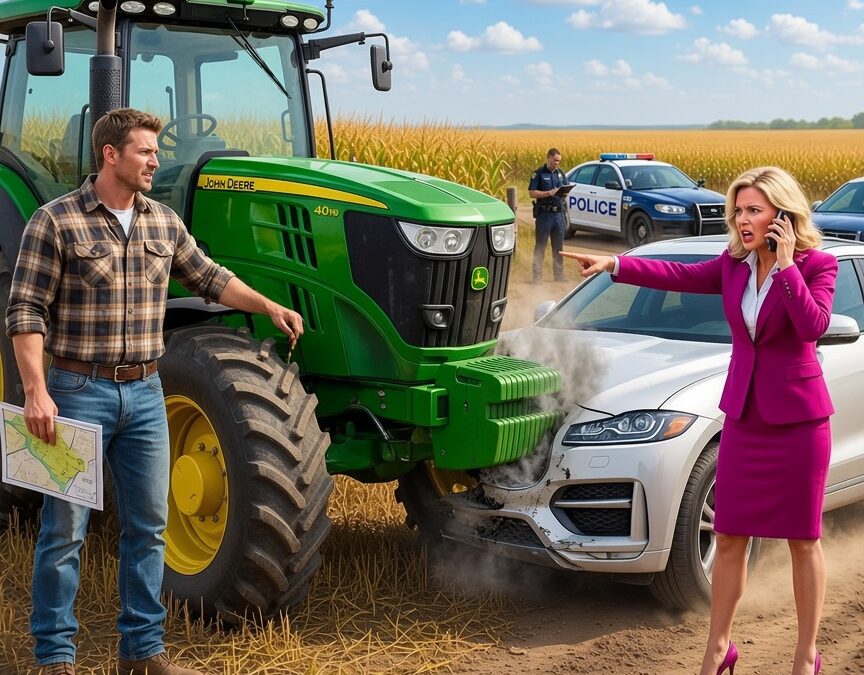
Grace arrived that afternoon with professional surveying equipment and the kind of expression that suggested she had little patience for foolishness.
She spent nearly an hour checking monuments, coordinates, and recorded plats.
Then she approached me.
“Hank, these posts are fourteen feet and seven inches inside your property boundary.”
“You’re certain?”
“Absolutely.”
She showed me the measurements.
“Whoever ordered these placed them on land they don’t own.”
I photographed every post.
Then I called Greenscape Solutions, the landscaping company whose truck I’d seen nearby that morning.
The owner, Mike, answered.
When I explained the situation, he went quiet.
“Mrs. Falstead told us that was HOA common property,” he said.
“It’s not.”
“She gave us a marked map.”
“Then somebody marked it incorrectly.”
Mike arrived with his crew less than an hour later.
He inspected Grace’s survey documentation and immediately agreed to remove the posts.
“We had no intention of trespassing,” he told me.
“I believe you.”
He refunded the twelve hundred dollars the HOA had paid and emailed me the invoice showing Moren’s authorization.
I forwarded everything to Boone.
He called almost immediately.
“Now we’re getting somewhere.”
“Because of the fence posts?”
“Because she’s spending association money on work outside the association’s property. That creates problems for her with her own board.”
That evening, Vikram Patel called.
He was Prairie Meadows’ treasurer.
“Mr. Briggs, I understand Greenscape removed some posts today.”
“They did.”
“Were they actually on your land?”
“Fourteen feet and seven inches inside it. I’ve got a certified survey.”
Vikram sighed.
“Moren told us the work was on HOA common ground.”
“Then she misled you.”
“I think she may have.”
He hesitated.
“Are you planning to sue the association?”
“I’d rather not. I have crops to harvest.”
“I understand.”
“No, Vikram. I don’t think you do. I’ve spent months defending myself against complaints that never should have been filed. I’ve had inspectors at my property, strangers taking photographs, and now contractors installing posts in my field. I don’t want a lawsuit, but I won’t keep absorbing the cost of this.”
“I’ll call an emergency board meeting.”
“Good.”
That night, Boone called at nine.
His voice sounded unusually energized.
“Hank, I found something.”
“What?”
“I went back through the original development filings. Not just your easement. The entire recorded agreement package.”
“And?”
“There’s an indemnification provision in the development documents. Section fourteen, subsection C.”
I waited while he explained.
The clause concerned boundary-related legal disputes involving land outside Prairie Meadows.
Under certain circumstances, Cornerstone had agreed to cover specified legal expenses and liabilities arising from HOA attempts to assert authority beyond the recorded subdivision.
It wasn’t a blank check, Boone cautioned. The precise language and circumstances mattered.
But the clause created a serious financial issue for Cornerstone and the association if Moren pursued litigation over my land.
“Does the board know?” I asked.
“I doubt it.”
“Does Moren?”
“Judging by her behavior, I’d say no.”
I looked at the framed dollar bill hanging above my kitchen counter.
That agreement had seemed like a simple way to protect my property.
Now it might be the document that ended the entire dispute.
“What should I do?”
“Keep farming. Let me handle the legal side. And don’t do anything to provoke her.”
“I haven’t provoked her yet.”
“I know. Keep it that way.”
By early November, harvest was approaching.
I decided to document the southern boundary more thoroughly than ever.
Grace returned and installed highly visible survey markers along the property line, with orange flags and a detailed photographic record.
I asked Russell to film the harvest from his own property.
I called Jenna and explained what had been happening.
She listened without interrupting.
Then she said, “Dad, why didn’t you tell me it was this bad?”
“I didn’t want you worrying.”
“I’m your daughter. That’s part of the job.”
She drove home that Friday.
I also notified Deputy Richardson of my harvest schedule, explaining that Moren had threatened to interfere with operations.
He said he’d arrange a patrol through the area.
Finally, I called Emily Tran.
“Interested in seeing how this ends?” I asked.
“What’s happening?”
“I’m harvesting the field Moren keeps claiming belongs to the HOA.”
“Is she going to show up?”
“I don’t know.”
“Then why invite me?”
“Because after sixteen months of accusations, I think the public deserves to see what actually happens.”
Emily agreed to come.
The evening before harvest, Moren drove into my driveway.
I was sitting on the porch when her Mercedes stopped near the house.
She climbed out wearing dark sunglasses despite the fading light.
“Mr. Briggs.”
“Moren.”
“We need to discuss tomorrow.”
“What’s to discuss?”
“You are not authorized to harvest that field.”
I looked toward the south.
“It’s my corn.”
“It’s community property.”
“No, it isn’t.”
She stepped closer.
“I’ve had an independent assessment.”
“Grace Mendoza’s survey matches the county records. You’re welcome to review them.”
“Those markers are wrong.”
“Then take it to court.”
Her mouth tightened.
“Don’t think I won’t.”
“That’s your decision.”
She pointed toward the fields.
“If you destroy community landscaping or agricultural buffers, I’ll have you arrested.”
“Moren, there’s no community landscaping out there. There’s corn.”
“You think this is funny?”
“No. I think it’s exhausting.”
For a moment, she said nothing.
Then I asked the question I’d been considering for weeks.
“Why do you want my land so badly?”
Her expression changed.
“I don’t want your land.”
“Then why have you spent sixteen months trying to control it?”
“Because your property affects our values.”
“My grandfather farmed here before the subdivision existed.”
“That doesn’t mean progress stops for you.”
“Progress doesn’t give you the right to take somebody else’s property.”
She stared at me.
“You’re going to regret tomorrow.”
I stood.
“Go home, Moren.”
She returned to her Mercedes and drove away.
The porch camera recorded the entire conversation.
Inside, Jenna was standing by the kitchen window.
“Dad, she’s dangerous.”
“She likes making threats.”
“That’s not the same as being harmless.”
I wanted to tell her she was overreacting.

