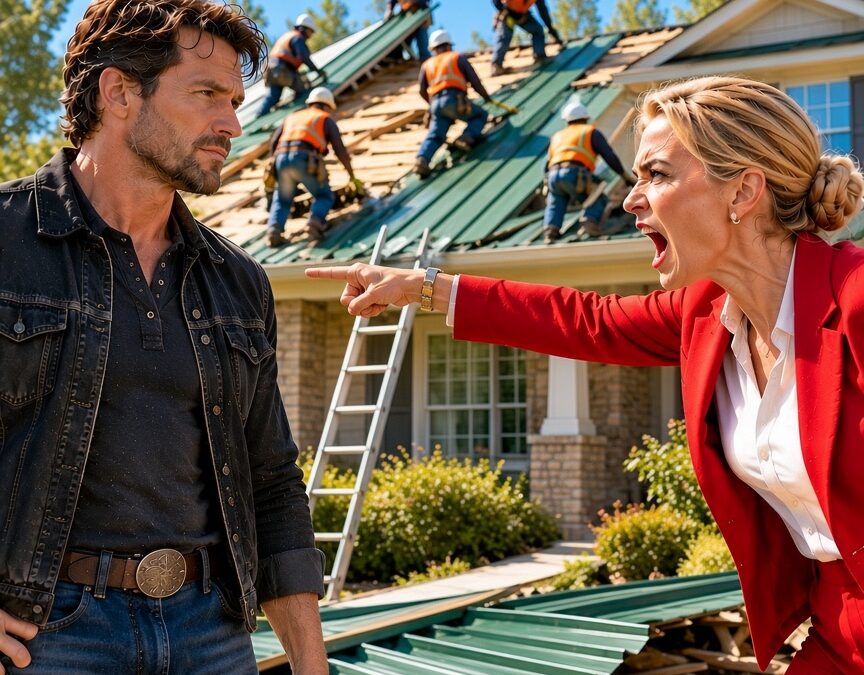
I had spent my career estimating damage to buildings. I knew what careless removal could do to an interlocking roof system.
This wasn’t something I could fix by putting a few screws back.
Then my phone displayed a weather alert.
Heavy rain was expected that evening.
Marla saw the screen.
“If you want a roof,” she said, “you can pay to put it back.”
I looked at her.
“You’re going to pay for every inch of this.”
She took another sip.
“Send the bill to someone who cares.”
Two sheriff’s vehicles arrived minutes later.
Deputy Nolan Brandt approached the scene, taking in the scattered panels, the crew, and Marla standing on my property.
He asked who had authorized the work.
Marla immediately introduced herself as HOA president and accused me of obstructing a lawful contractor.
Nolan listened.
Then he asked, “Do you own this property, ma’am?”
“I represent the community.”
“That’s not what I asked.”
Her mouth tightened.
“No.”
I went inside and brought out the binder I had assembled after Marla’s first violation notice.
Inside were my deed, title policy, certified boundary survey, and the recorded subdivision declaration.
I opened the plat map.
“Here’s Ridgecrest Commons. Here’s its western boundary. And here’s my parcel, outside that boundary.”
Nolan studied the documents.
Marla called the map an administrative error.
“Do you have any document establishing authority over this parcel?” Nolan asked her.
She opened her folder, shuffled papers, and closed it again.
“No document with me.”
Nolan explained that official records would need review, but there was no basis for allowing the work to continue.
Marla protested that neighborhood appearance affected everyone.
“An HOA rule isn’t a property deed,” Nolan replied.
I pointed to the authorization.
“That signature is not mine. I want it documented.”
Harlan agreed to provide the original company records and copies of everything Marla had sent him.
Nolan took statements and told everyone to preserve the evidence.
Before leaving, Marla approached me.
“You should have replaced that roof when I told you to.”
“You just admitted you ordered this.”
She smiled.
“Prove it.”
Then she drove away.
My phone buzzed.
Tessa had sent me a video.
In it, Marla stood beside her SUV before sunrise, instructing the crew to continue removing the roof even if I came outside and objected.
I watched it twice.
Then I called an emergency roofing company.
Gus Lowell arrived within an hour. He inspected the exposed decking, damaged seams, torn underlayment, and bent trim.
“This needs professional reconstruction,” he said. “Those panels weren’t released properly. They were ripped apart.”
His crew installed heavy tarps and secured them as tightly as possible.
I moved my computer, client files, and drafting equipment out of the room beneath the damage.
Before anything was discarded, I photographed it. Gus signed a written condition report. I saved the damaged materials.
By afternoon, a county inspector had confirmed the absence of a valid permit, and a stop-work order had been issued.
Deputy Brandt documented the suspected trespass, damage, and forgery. He explained that any criminal charges would depend on further investigation.
I contacted my attorney, Diane Kessler.
She told me to preserve everything, communicate in writing, and avoid making repairs without proper documentation.
At four that afternoon, Marla emailed me a final compliance notice.
She demanded I sign a statement acknowledging that the roof removal had been authorized.
If I refused, she threatened to bill me for the contractor’s wasted time.
I forwarded the email to Diane.
Then I replied that my property was not part of Ridgecrest Commons, that I had never authorized any work, and that no association representative was permitted to enter my land again.
Two hours later, Marla assessed me a $900 fine.
I saved that notice too.
Rain began shortly after eight.
For the first hour, the tarps held.
Then the wind shifted.
Water slipped beneath the damaged eave trim and entered the insulation above my bedroom.
I heard the dripping before I saw the stain.
I placed buckets beneath the leaks and called Gus back.
His crew returned in the storm and secured the covering again.
By morning, the ceiling above my bed had sagged.
I stood in the doorway looking at the soaked drywall.
Eleven years earlier, I had installed that roof myself. I remembered carrying panels up the ladder, measuring every seam, and working through a summer that seemed determined to roast me alive.
Now strangers had destroyed part of it because a woman across the street couldn’t accept the word no.
I didn’t call Marla.
I called Diane.
And I began documenting what it would cost to put my house back exactly as it had been.
## PART 2: THE DAMAGE REPORT TURNED MARLA’S THREATS INTO REAL FINANCIAL EXPOSURE
The next morning, forensic roof inspector Della Whitaker examined the property.
She spent hours checking the seams, fasteners, waterproofing, decking, and damaged panels. When she finished, she told me the crew hadn’t made an ordinary installation mistake. They had deliberately dismantled a functioning roof. Her report arrived later that week, with a total restoration cost of $24,000: $3,600 for emergency covering and drying, $16,900 for the roofing system, and $3,500 for the ceiling and insulation.
I paid for the repairs using savings and a home equity line of credit. Waiting for Marla to cooperate would have meant gambling with another storm. I instructed Gus to match the original roof, not improve it. Same green metal, same profile, same performance. Every invoice documented restoration, not an upgrade.
Ten days later, Marla’s attorney, Franklin Shaw, sent a letter claiming the association had acted to correct a substandard structure. He argued that stopping the workers had caused the additional damage and proposed that everyone pay their own expenses. Diane rejected the offer. She sent the deed, survey, sheriff’s report, notices, video, and invoices, then issued preservation demands for the contractor’s communications and authorization records.

