## PART 1: FIVE STRANGERS STARTED DESTROYING MY ROOF BEFORE BREAKFAST THAT TUESDAY
At 7:14 on a Tuesday morning, I heard my roof being torn apart.
I was standing in my kitchen, waiting for the coffee maker to finish, when a long metallic shriek came from directly above my bedroom. My first thought was that a branch had fallen from the old oak near the fence. Then came the sound of a power drill, followed by hammering.
I ran outside barefoot.
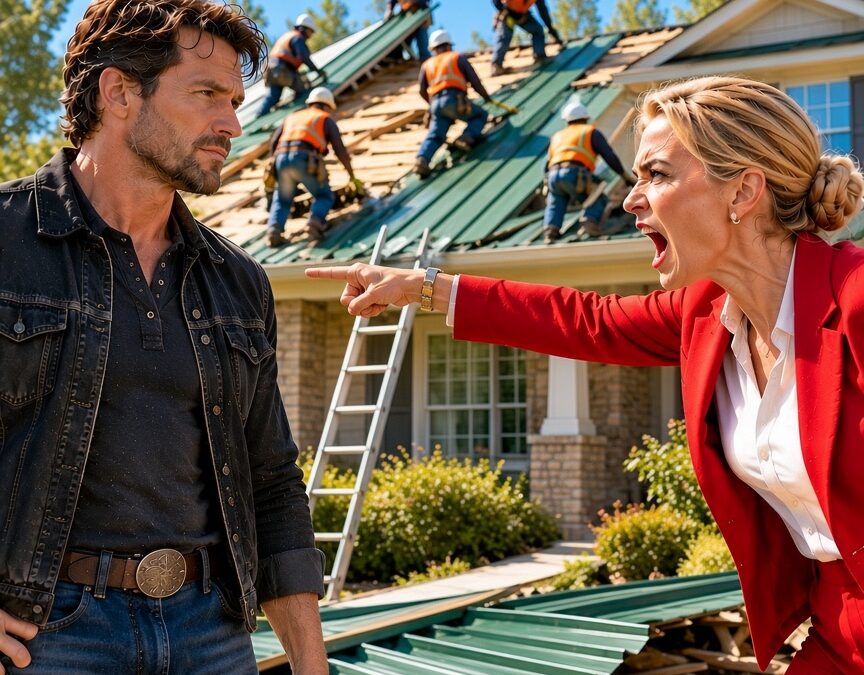
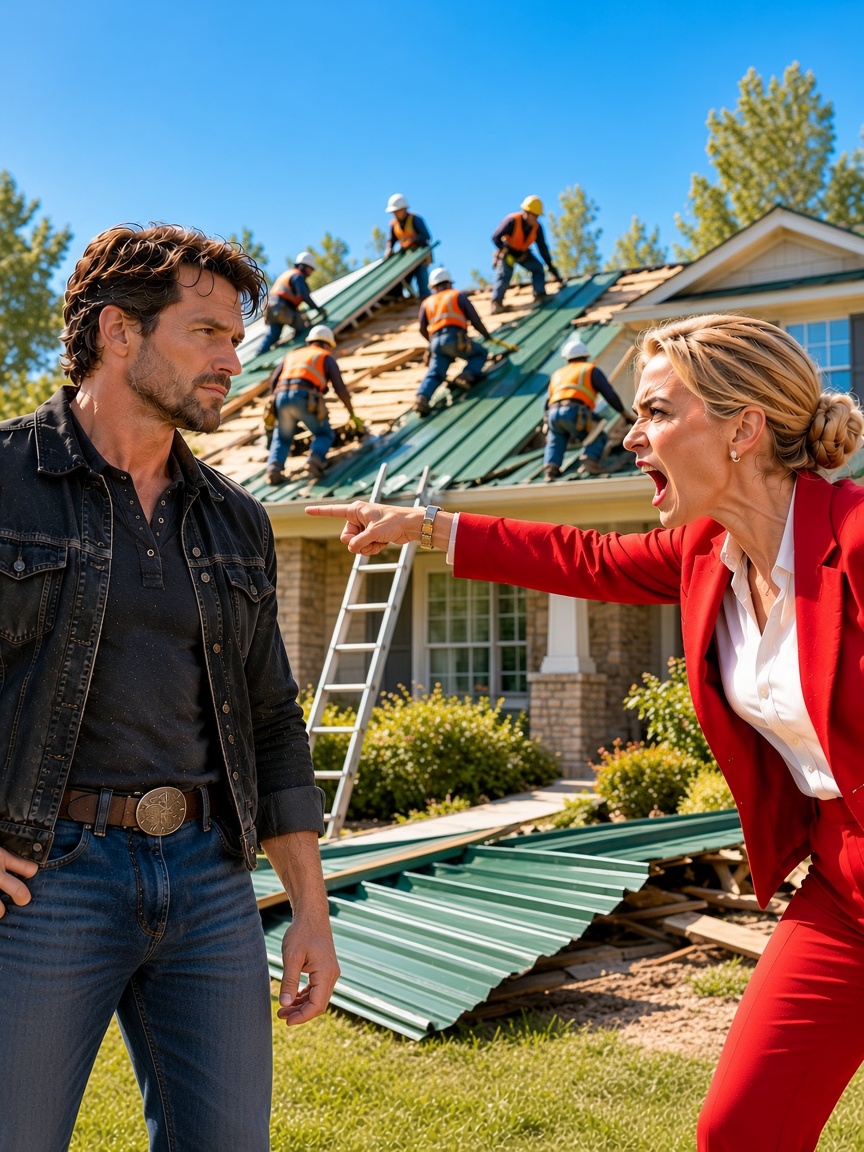
Five men were on my roof. Two were removing fasteners, two were prying up the dark green standing-seam panels, and the fifth was throwing loose sheets onto my lawn.
One panel struck the grass hard enough to leave a deep impression.
“Hey!” I shouted. “What the hell are you doing?”
A man with a clipboard hanging from his belt looked down. He was broad-shouldered, somewhere in his forties, with a hard hat marked Pike Exterior Services.
“Who authorized this?” I demanded.
He pointed across the street.
A white SUV was parked at the curb. Leaning against its driver’s door, drinking coffee from a travel mug, was Marla Voss.
Marla was president of the Ridgecrest Commons Homeowners Association.
And she had been trying to control my house for two years.
My name is Reed Hollister. I had lived on that property long before Marla became president, and my house had existed before Ridgecrest Commons was even developed.
The subdivision wrapped around my eastern property line. My parcel had been specifically excluded from its governing declaration.
I had the deed. I had the survey. I had sent Marla copies of both.
She kept sending violation notices anyway.
Her problem was my roof.
Eleven years earlier, I had installed dark green standing-seam metal panels. I liked the color, the durability, and the way the roof looked against my old white siding.
Marla preferred gray architectural shingles.
Apparently, that preference had become a personal mission.
I crossed the yard toward her.
“Tell your workers to get off my roof.”
She lowered her coffee.
“Good morning, Reed. The board has authorized emergency corrective action.”
“Your board doesn’t have authority over my house.”
“Your roof violates community architectural standards.”
“My house isn’t in your community.”
She smiled.
“You live beside us. That makes you our problem.”
I stared at her.
“Marla, I’ve shown you the county records.”
“And I’ve sent you plenty of opportunities to comply.”
Another panel crashed onto my lawn.
I turned toward the roof.
“Stop working! I’m the homeowner, and I do not consent!”
The crew leader came halfway down his ladder.
“Sir, I’m Harlan Pike. We have signed authorization from the property owner.”
“No, you don’t.”
Marla walked to her SUV, retrieved a manila folder, and held out a document.
At the top, it said Property Owner Authorization.
At the bottom was my name.
Reed Hollister.
The signature looked remarkably like mine. Same slant. Same loops. Same sharp finish on the final letter.
For a second, I couldn’t speak.
Then I said, “I never signed this.”
Marla shrugged.
“You can argue about paperwork later.”
I looked at the paragraph above the signature. It said I had voluntarily authorized the association to remove my existing roof and waived any claim for compensation.
Someone had gone beyond pretending I belonged to the HOA.
Someone had created a document saying I had agreed to have my own house damaged.
I took out my phone and began recording.
“This is Reed Hollister, at my residence, Tuesday morning, approximately 7:20. Workers are removing my roof without my permission.”
I turned the camera toward Harlan.
“I am ordering you to stop.”
He looked at the document in his hand.
“Mrs. Voss told us you’d approved the replacement.”
“She lied.”
“Reed!” Marla snapped. “You need to watch your accusations.”
“Then explain whose signature that is.”
She lifted her coffee.
“Keep working, Harlan.”
He didn’t move.
I asked him for his company name, license information, and the person who had hired him.
He answered my questions.
The job was described as an emergency roof correction. Marla had arranged it, supplied the authorization, and scheduled the crew for seven that morning.
“Did you ever speak to me?” I asked.
“No.”
“Did anyone from your company?”
“Not that I know of.”
“Then you have a serious problem.”
I called the sheriff’s office.
While waiting for dispatch, I contacted the county building permit office and asked whether any permit existed for roof removal at my address.
The clerk checked.
Nothing was on file.
Harlan’s expression changed.
“Marla, where’s the permit?”
“Association maintenance doesn’t require all that bureaucracy.”
“That isn’t how permits work,” I said.
Harlan looked up at the exposed decking.
He called to his crew.
“Shut everything down.”
Marla pushed away from her SUV.
“If you leave this job unfinished, I’ll sue your company. You’ll never get another contract in Briar Glen.”
Harlan stood beside the ladder.
“Ma’am, the owner is telling us he didn’t authorize the work. We need to sort that out.”
“I already sorted it out!”
She marched onto my lawn and pointed at the roof.
“Take the entire section off. I want it gone today.”
“You’re trespassing,” I told her. “Leave my property.”
She refused.
I didn’t touch her. I didn’t approach the equipment. I kept recording.
Across the street, my neighbor Tessa Langford stepped onto her porch.
Tessa was fifty-nine, a retired court stenographer who noticed everything and rarely raised her voice.
She was holding her phone.
“I’ve been recording since I saw the workers arrive,” she called.
Marla turned.
“Delete that. This is an internal association matter.”
“I’m on my own porch, Marla.”
“I can fine you for interfering.”
“You can send whatever letter you like.”
Tessa kept filming.
Harlan ordered his men down. One by one, they climbed off my roof and gathered their tools.
I looked at the damage.
Nearly a third of the metal covering had been removed. The waterproofing beneath it was torn. Several panels were bent beyond repair.

