It wasn’t proof of what happened later, Ellen explained, but it gave us witnesses, a timeline, and a reason to investigate. The emergency order was granted, stopping any transfer until the ownership dispute could be heard. Through formal requests, Ellen obtained the notary’s journal entry and the identification details she had recorded. Grandpa’s name appeared beside a driver’s license number. His actual license, found in his belongings, had a different number. The journal also listed my mother’s phone as the contact number. Ellen sent the discrepancies to the appropriate investigators and kept building the civil case.
The medical records supplied the next piece. Grandpa had spent the entire morning of October fourteenth at the rehabilitation facility, receiving treatment and meeting with his physical therapist. Staff documented his appointments. A nurse remembered him arguing on the phone with Dad that afternoon. Then the notary, questioned about her entry, admitted she had not known Grandpa personally. Mom had introduced a man wearing a brown coat as Walter Bates. He had presented identification, signed, and paid in cash. Asked to look at separate photographs, she identified my father as the man who had signed the deed.
Dad’s lawyer withdrew after the evidence was disclosed. My parents hired someone new, who proposed a settlement granting me the house and twelve acres. I refused. “This isn’t about getting enough land to stop complaining,” I told Ellen. “It’s about whether his signature gets to mean anything.” The developer’s records revealed another twist: my parents had already accepted an advance that would have to be repaid if the sale failed. Their store was deeply in debt. That explained the urgency. It did not explain away the choices they had made, or the weeks they had spent calling me selfish for asking questions.
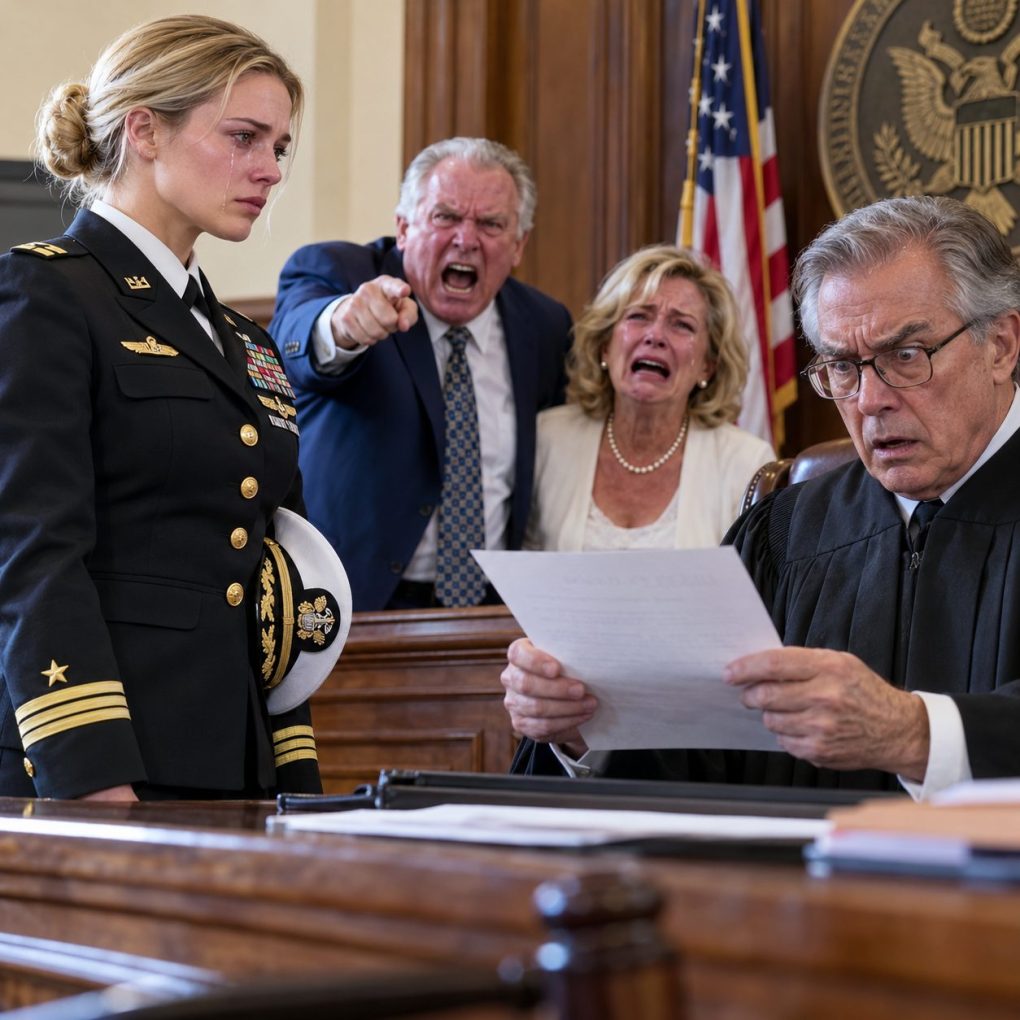
The replacement judge knew nothing about Yemen beyond the disclosure already in the file. She asked about dates, signatures, identification, and custody of documents. Nobody discussed my ribbons. Ruth testified about the coat. The facility staff explained their records. The notary described the signing. Dad claimed she was confused. Mom claimed Grandpa had agreed privately and simply forgotten. When Ellen played the recording, Mom stared at the table. On cross-examination, she admitted arranging the appointment. Then Ellen showed her the email about my deployment. “Why did your daughter’s location matter to a legitimate sale?” My mother had no answer.
I testified last. Ellen asked how often I had spoken with Grandpa while deployed. “Whenever I could,” I said. She introduced our messages about fence repairs, seed orders, and his appointments. Dad’s new lawyer asked whether I could manage a farm while serving. “I can hire people who know more than I do,” I answered. “Grandpa did that when his health failed.” The judge interrupted to clarify that my career did not decide whether the deed was valid. For the first time all day, I could breathe. I wasn’t there to prove I deserved love. I was there to establish what had happened.
The ruling came several weeks later. The judge found the purported deed invalid and ordered it canceled from the property records. Grandpa’s farm remained in his estate, to pass under his will. Ellen explained each remaining step before I signed anything. The separate criminal investigation continued; eventually, Dad pleaded guilty to charges arising from the forged deed, and Mom entered her own plea for helping arrange the fraud. Their sentences included probation and restitution obligations. I didn’t attend to watch them punished. I attended because, after months of being called a liar, I wanted to hear the truth spoken where they couldn’t talk over it.
Afterward, Mom approached me outside. “Your grandfather would hate seeing this family broken.” For a moment, I heard every old command hidden inside that sentence: be quiet, make peace, surrender something. “He asked you to leave his kitchen,” I said. “You came back with a notary.” Dad stood a few feet away, looking older than he had at nine that first morning. “We were losing everything,” he said. “You could have helped.” I thought about the one dollar on the deed. “You never asked for help. You tried to take his last gift to me.” Neither of them answered.
Once the estate transfer was complete, I kept the local tenant farmer Grandpa trusted and paid Ruth for overseeing repairs. On my first long leave, I found his brown coat hanging in the mudroom. I almost threw it away. Instead, I checked the pockets. There was a folded feed receipt with my name written across the back: Ask Caroline about the south fence. I stood there crying over an ordinary reminder. He had expected me to come home. He had made room for a future in which I belonged. At nine the next morning, I opened the farm gate. No uniform. No courtroom. Just my own key.

