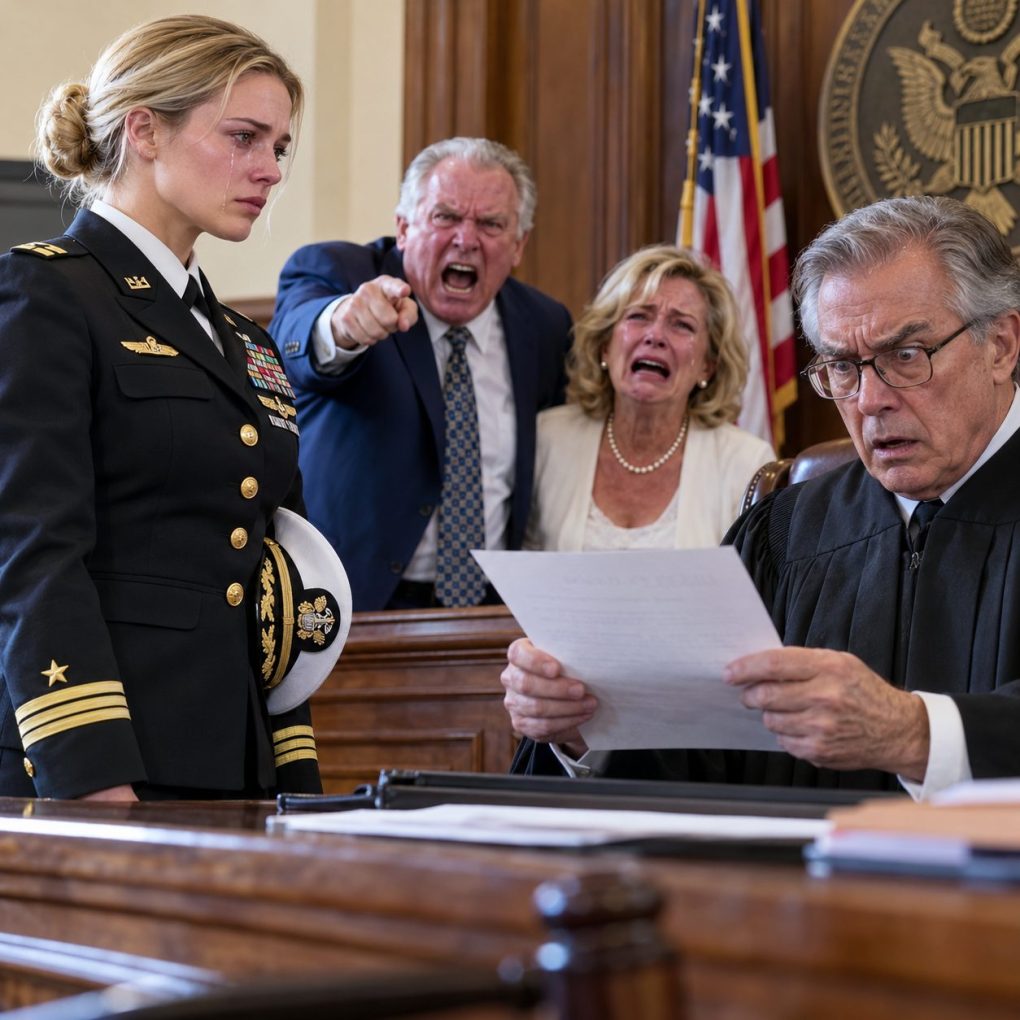
Dad checked his watch. Mom looked at my navy uniform and whispered loudly, “She thinks those medals turn her into a farmer.”
They asked the court to seize my grandfather’s 84-acre farm.
I sat next to my lawyer, Ellen Shaw, and placed my hands flat on the table.
Across the hallway was a document stating that my grandfather had sold the land to my father for one dollar before he died. His will left the land to me. If that document is valid, then the will is meaningless.
“Caroline, you should have stayed abroad,” her father said.
Ellen touched my wrist before I could answer.
The inheritance trial was scheduled for the building’s family courtroom. But there was nothing in that room that gave off a warm, family-like feeling.
Judge Mercer walked in. My father stood there with that pleasant smile he usually used whenever he wanted something for free.
His lawyer called me an absent granddaughter, who hardly ever came to visit.
“Serving in the military creates no connection to this property,” he added.
“An act that no one witnesses until after the funeral cannot be considered an act of kindness,” Ellen said.
The judge looked toward me. His gaze lingered on my ribbons, then moved up to my face.
“Captain Bates… is from Yemen?”
Dad’s smile disappeared.
I recognized the judge. Years ago, he used to stand outside a military hospital, waiting for news about his son.
“Yes, Your Honor.”
He put down his pen.
“I need to reveal a personal connection before this can proceed.”
My mother stopped laughing too.
The judge asked the clerk to adjourn the hearing. Ellen leaned closer.
“What kind of connection?”
Before I could explain, my father stood up.
“We are withdrawing our petition.”
His private lawyer turned to him.
His mother grabbed his sleeve. “Sit down.”
Judge Mercer looked at the papers, then looked at my father.
“Excuse me, lawyer, has the original copy of this document been submitted to the court yet?”
Dad reached for the file.
The employee arrived first.
My father was ready to fight for every inch of land. A simple question made him almost leave. And I’m about to understand why.
The salesperson pushed the file out of my father’s reach.
“The original was submitted yesterday, Your Honor,” she said.
Judge Mercer nodded, then said to both lawyers, “Captain Bates assisted in the evacuation of my injured son from Yemen. I met her at the hospital. That connection needs to be revealed. I will withdraw from the case.”
Dad breathed a sigh of relief, as if he had just escaped from something terrible.
“A different judge will be handling this case,” Mercer continued. “No decision has been made yet regarding the transfer of ownership.”
He gave us a new trial date, while the original verdict is still being held by the court.
Outside, my mother took my elbow.
“You dressed like that to embarrass us.”
“I just finished my assignment and came straight here.”
Dad stood behind her. “Take the farmhouse. We’ll keep the acreage. That’s fair.”
“You just told a court you owned all of it.”
“Don’t turn this into a war.”
Ellen stepped between us. “Send any proposal through counsel.”
As they walked away, I noticed Dad’s lawyer wasn’t walking with them.
That afternoon, Ellen laid copies of the deed and Grandpa’s medical records across her desk. The signature was dated October fourteenth, at his kitchen table.
“He was in rehab that week,” I said.
“A facility stay alone doesn’t prove he couldn’t sign,” she warned. “We need more.”
I called his neighbor, Ruth.
She remembered October fourteenth immediately.
“Your mother brought a mobile notary to the farm,” Ruth said. “I thought Walter had come home.”
“Did you see him?”
A pause.
“No. But I saw your father coming out in Walter’s brown coat.”
Ellen stopped writing.
Then Ruth said something worse.
“There were surveyors out there yesterday. Your dad told them the sale would close Friday.”
My parents weren’t trying to live on Grandpa’s land.
They were trying to unload it before anyone could challenge their paperwork.
Ellen contacted their attorney and sought an emergency order preventing a sale while ownership was disputed. I drove to the farm with Ruth.
The kitchen drawers were open. Grandpa’s metal file box was gone.
On the counter sat a shipping receipt for documents sent to a development company.
Under it was a printed email from my mother.
“Caroline won’t be back until spring. Proceed.”
She had counted on my deployment keeping me away.
Ruth caught my arm before I crushed the paper.
“Walter left something with me,” she said. “He told me to give it to you if your parents ever claimed he’d signed the farm away.”
“What is it?”
She glanced toward the empty driveway.
“A recording. And your mother is on it.”
“A recording of what?” I asked.
Ruth took me next door and unlocked a desk drawer. Inside lay an envelope addressed to me in Grandpa’s shaky handwriting. It held a small recorder, a memory card, and a note: Caroline, I tried to settle this without making you choose sides. I should have known better. Ruth said he had brought it over after an argument with my parents, two weeks before the date on their deed. She had kept it because he asked her to. Until that morning, she hadn’t known they were claiming to own the farm.
We played it at Ellen’s office. Grandpa’s voice came first: “I’m recording this conversation. I want us all clear.” Mom answered, “Fine, record it. You’re still being unreasonable.” Then Dad demanded the land. A developer had made an offer contingent on acquiring the entire eighty-four acres. Grandpa refused. “Caroline gets the farm. You already got the money for your store.” Mom’s answer made my hands go cold: “She’s on the other side of the world. You could sign anything, and she wouldn’t know until it was done.” Grandpa told them to leave. The recording ended with a door slamming.

