
PART 1: THE MORNING SIX DEPUTIES ARRIVED TO TAKE MY FAMILY’S RANCH
At 6:17 on a Tuesday morning, three sheriff’s vehicles came through my ranch gate with their emergency lights flashing.
I was standing on the porch in my work jacket, holding a cup of coffee. The temperature was twelve degrees, and frost covered the railing. I’d been awake since five, checking the weather before heading out to feed the cattle.
The first deputy parked beside my pickup. Two more vehicles stopped behind him.
Then I saw Vanessa Crane climb out of a black SUV.
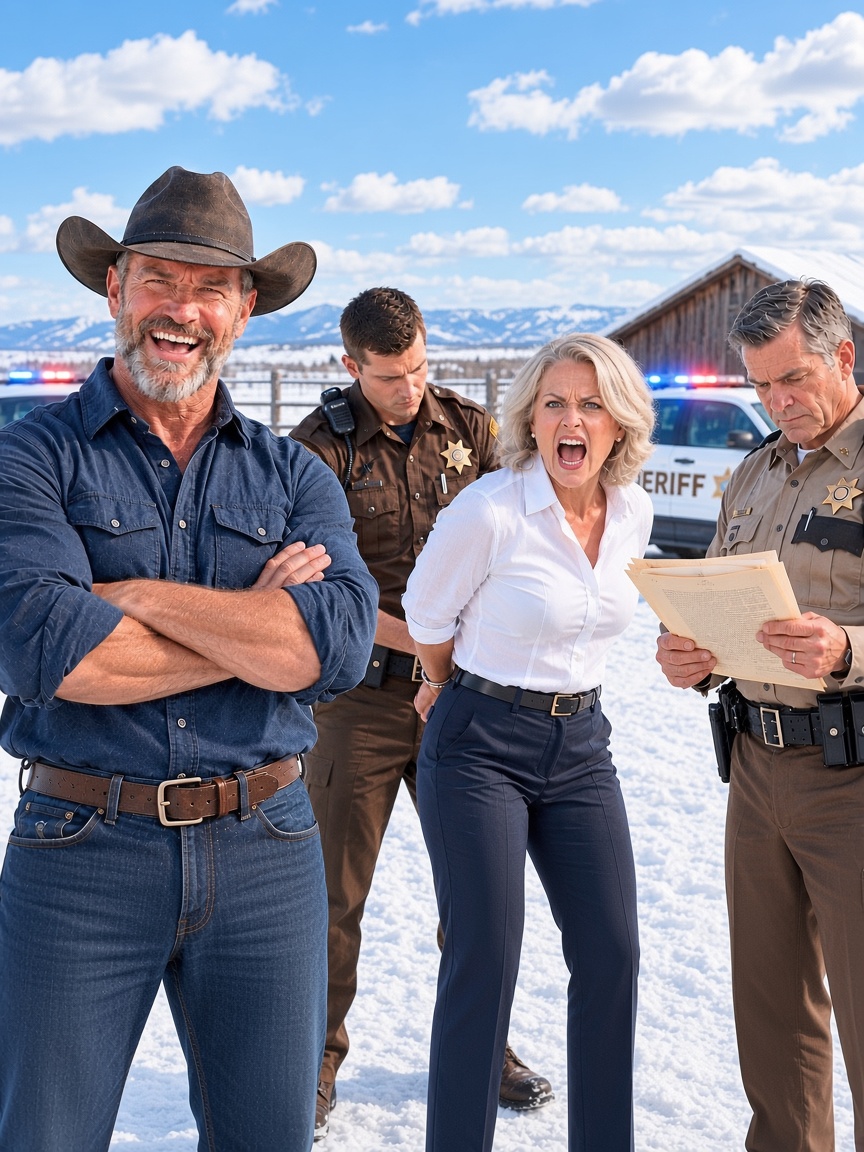
She wore a white winter coat and polished leather boots that looked like they’d never touched mud. She pointed at me before the first deputy had even reached the porch.
“That’s him. That’s the trespasser.”
I set my coffee down.
“Vanessa, what the hell are you talking about?”
She ignored me.
“Deputy, I want him removed immediately. He’s been warned repeatedly.”
The older deputy raised a hand.
“Ma’am, I’ll speak with him.”
I stepped off the porch.
“My name’s Jack Mercer. This is my ranch. Before anybody starts talking about removing me, I’d like to know what authority you’re operating under.”
The deputy introduced himself as Daniel Norris. He was probably in his early fifties, with a weathered face and a deliberate way of speaking.
“We’ve received a complaint concerning possession of this property, Mr. Mercer.”
“From her?”
“Among the documents submitted, yes.”
Vanessa moved closer.
“There’s an eviction order. He needs to leave.”
Norris turned toward her.
“I haven’t established that yet.”
She didn’t appreciate being interrupted. I could tell by the way she tightened her grip on the folder she was carrying.
I knew exactly how we’d reached this point. What I didn’t know was how much damage she’d managed to do behind my back.
My grandfather bought the original Mercer ranch in 1926. He started with a modest stretch of pasture outside Silver Ridge, Wyoming, and built a working cattle operation from there.
My father expanded it over the years. When he died, I inherited 480 acres of pasture, pine forest, creek bottom, and rocky ground.
I’d lived on the property for thirty years.
It wasn’t a glamorous life. Some years the cattle brought in decent money. Other years, equipment repairs and feed costs ate through nearly everything we earned.
But the ranch was ours.
My son Luke understood that better than anybody. He’d grown up helping me repair fences, clear snow, and pull machinery out of places machinery had no business getting stuck.
After he finished school, he chose to stay involved with the ranch rather than move away.
I never asked him to make that decision. He made it himself.
Six years before the deputies arrived, developers built Silver Ridge Estates along our western boundary.
Nearly seventy houses went up behind an elaborate stone entrance. The development included private roads, a clubhouse, a pool, and tennis courts.
I didn’t object.
People could spend their money however they wanted, provided they left my property alone.
For the first few years, most residents did.
Then Vanessa Crane became president of the homeowners association.
Vanessa treated the HOA presidency as though she’d been elected governor.
She inspected landscaping, argued about parking, and sent violation letters over things most reasonable people wouldn’t notice.
I heard complaints from a few homeowners, but none of it concerned me.
I wasn’t a member of Silver Ridge Estates.
I’d never signed its covenants, paid its dues, or attended one of its meetings.
My ranch had existed long before the first house in that development.
Apparently, Vanessa considered that a problem.
The first time she came onto my property, I was repairing a broken fence near the western pasture.
A black SUV pulled up beside the gate. Vanessa got out with two men wearing jackets identifying them as HOA security.
She walked through the opening without asking permission.
“Mr. Mercer? We need to discuss compliance.”
I set my fencing pliers on a post.
“Compliance with what?”
“Our community standards.”
I glanced toward the subdivision.
“You’ve got the wrong address.”
She opened a folder.
“Your agricultural equipment is visible from several residences. We’ve received complaints.”
There was an old hay baler beside my equipment shed. It worked when I needed it, and I wasn’t about to move it because somebody disliked the view.
“Then your residents can look somewhere else.”
“That’s not an acceptable response.”
“It’s the only one I’ve got.”
One of the security guards stepped forward.
“Sir, the association has an access policy.”
I pointed at the fence.
“This is private property. That policy doesn’t apply here.”
Vanessa closed her folder.
“Your ranch is surrounded by our community.”
“Your community was built beside my ranch. There’s a difference.”
She studied me for several seconds.
“You may want to reconsider how you handle this.”
I picked up my pliers.
“You may want to reconsider coming through my gate without permission.”
She left without another word.
Two weeks later, the first violation notice arrived.
It claimed I owed $2,500 for improperly storing agricultural equipment within sight of association homes.
I showed Luke over breakfast.
He read it twice.
“She seriously thinks she can fine you?”
“Apparently.”
“What are you going to do?”
“Nothing.”
I threw the letter away.
The following week, another notice arrived demanding $5,000.
Then came a $10,000 notice.
Eventually, the HOA claimed I’d accumulated more than $38,000 in penalties.
I called its office.
Vanessa answered.
“Mr. Mercer. I assume you’ve received our correspondence.”
“I have. Those fines don’t apply to my property.”
“That’s your interpretation.”
“No. That’s what happens when a person doesn’t belong to your association.”
“We have authority to protect community interests.”
“Not by charging somebody who never agreed to your rules.”
Her tone changed.
“You’d be surprised what our attorneys have established.”
“Then have one of them explain it to my attorney.”
She hung up.
Luke was standing beside the kitchen counter.
“She’s not stopping, Dad.”
“I can see that.”
“We should do something.”

