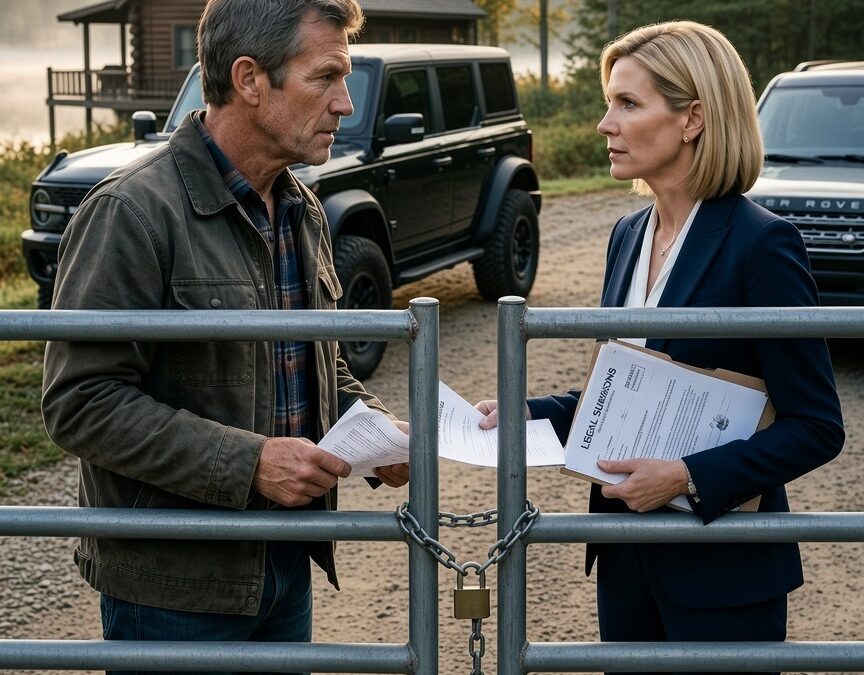
PART 1: The Gate Victoria Thought She Could Force Me To Open
The first time Victoria Ashford threatened to sue me, she was standing outside my steel gate with a clipboard tucked under one arm and three vehicles idling behind her.
“You cannot block a community access road,” she announced.
I finished turning the key before answering.
“It isn’t a community road, Victoria.”
Her expression tightened. “Pine Ridge Estates has used this entrance for years.”
“That doesn’t make it yours.”
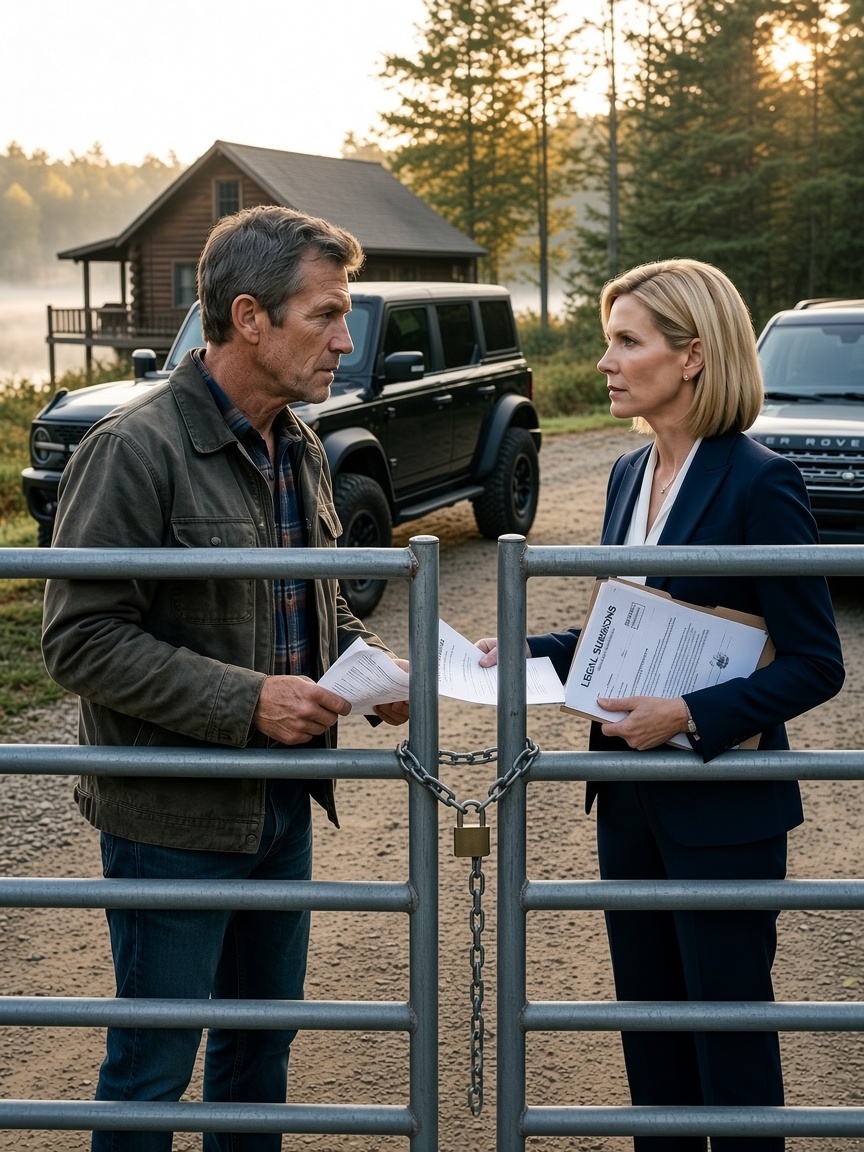
Behind her, a delivery driver leaned out his window to see what was happening. Two residents sat in their SUVs, waiting for me to move. One of them honked, as though that might settle a property dispute.
Victoria looked back at the vehicles, then at me.
“Do you understand how many people you’re inconveniencing?”
I glanced toward the gravel lane running through my woods.
“Do you understand whose land you’re standing on?”
She didn’t answer.
Six months earlier, I’d bought twenty acres and an old lake cabin outside Pine Ridge Estates. I wanted somewhere quiet enough to hear the water from my porch and far enough from town that nobody stopped by without calling.
The cabin needed work. Its cedar siding had faded, the dock leaned slightly toward the water, and the fireplace smoked when the wind came from the north. But the property had something I valued more than polished countertops or a perfect lawn.
Privacy.
A quarter-mile gravel road connected the cabin to the public road. It ran between tall pines, crossed a shallow rise, and curved down toward the lake.
The recorded property description included the road corridor. The survey supplied during the purchase showed the same thing.
I had reviewed both before closing.
My real estate agent mentioned that nearby residents sometimes used the lane to reach the lakeshore. The previous owner had apparently tolerated the traffic.
I assumed that meant an occasional neighbor passing through.
I was wrong.
The first sign appeared three weeks after I moved in.
It stood beside my entrance, mounted on two wooden posts.
PINE RIDGE ESTATES COMMUNITY ACCESS.
I stopped my truck and read it twice.
My property wasn’t part of Pine Ridge Estates. I hadn’t signed its covenants, paid its assessments, or agreed to let its board manage anything.
I photographed the sign and called the number printed beneath it.
Victoria answered.
“Pine Ridge Estates management.”
“I’m Nathan Cole. I own the lake cabin beyond your new sign.”
“Oh, yes. Mr. Cole. Welcome to the area.”
“Who authorized that sign?”
A pause.
“It’s been part of our community access plan for years.”
“That wasn’t my question.”
She explained that residents had historically used the lane to reach the lake and that the HOA maintained the route for everyone’s benefit.
I told her I hadn’t authorized the sign.
She laughed softly.
“I’m sure we can work something out.”
I asked her to remove it.
She said she’d discuss the matter with the board.
Nothing happened.
Two weeks later, I found fresh gravel spread across a section of the lane near my entrance. Tire tracks from heavy equipment cut through the soft shoulder.
Nobody had contacted me.
I called Victoria again.
“Our maintenance contractor repaired a dangerous section,” she said.
“You sent equipment onto my property.”
“We improved the road, Nathan.”
“You could have asked.”
“We’ve always maintained it.”
I stood beside the new gravel, looking at the ruts the truck had left in the grass.
“Don’t send anyone onto my property again without permission.”
Her voice cooled.
“I’ll make a note of your concerns.”
The following month, an envelope arrived.
Inside was an assessment notice from Pine Ridge Estates.
It listed road maintenance, landscaping, administrative expenses, and a contribution toward future improvements.
I read the total, then checked the address.
It was mine.
I called Victoria.
“This bill was sent to the wrong property.”
“No, it wasn’t,” she replied. “Your cabin benefits from community infrastructure.”
“My cabin isn’t in your HOA.”
“The access road connects your property to our neighborhood.”
“The access road belongs to me.”
“That’s your interpretation.”
I took the notice into town the next morning.
At the county records office, I requested the recorded deed and subdivision documents available for Pine Ridge Estates.
The clerk helped me locate the relevant records and explained how to obtain copies of older plats.
I went home with a folder.
The subdivision boundary ended before my property. The road corridor appeared within the legal description of my parcel.
But ownership was only part of the question. I knew long-standing use could create complications, and I wasn’t about to pretend a deed answered every possible access claim.
I sent Victoria a letter requesting any recorded easement, access agreement, or other document supporting the HOA’s position.
I asked her to stop billing me until the issue was resolved.
She didn’t send a deed or an easement.
She sent another invoice.
Then another.
The third included a warning about potential collection action.
I returned each one with a written objection.
Meanwhile, traffic increased.
Residents drove through on weekends with coolers and folding chairs. Delivery trucks used my lane because their navigation systems apparently treated it as a neighborhood road. Maintenance crews arrived without warning.
One Saturday morning, I walked outside and found a landscaping truck parked beside my dock.
Two workers were unloading equipment.
“Who hired you?” I asked.
“Pine Ridge,” one answered.
“This is private property.”
He looked at his work order.
“We were told the lake access was common space.”
I asked them to stop until the ownership question was settled. They called their supervisor and left without an argument.
That afternoon, I photographed every entrance, boundary marker, sign, and section of altered gravel.
I also documented the damage near the dock, where repeated vehicle turns had worn a muddy patch into the grass.
I wasn’t interested in charging strangers for every tire mark.
I wanted control over what happened on land I’d paid for.
Victoria visited the next morning.

