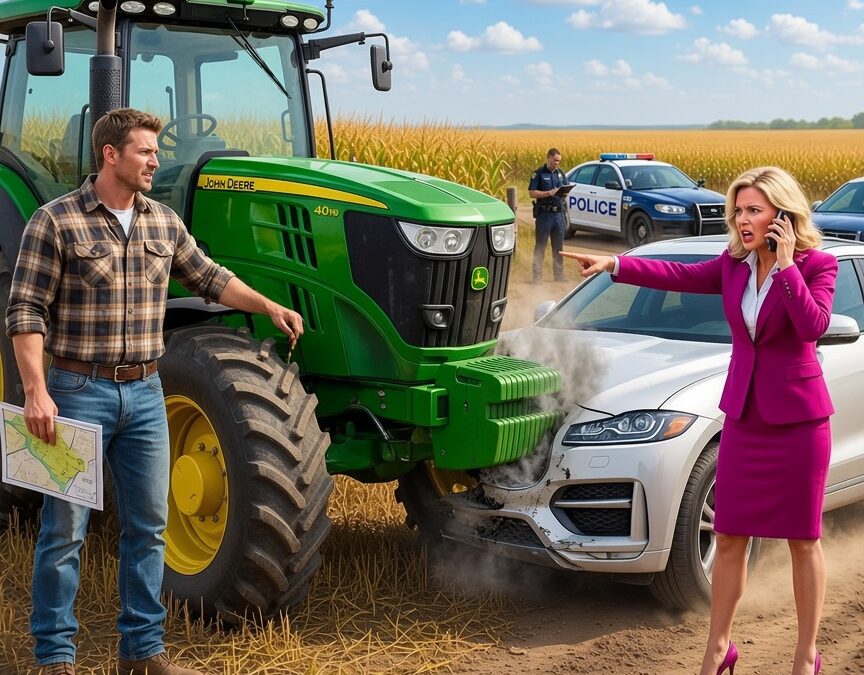
The first thing I heard was my daughter screaming.
“Dad! Get away from the combine!”
I turned just in time to see a white Mercedes bouncing across my cornfield, its tires tearing through rows my family had been planting for seventy-one years.
Behind the windshield sat Moren Falstead, president of the Prairie Meadows Homeowners Association. Her hands were locked around the steering wheel. Her face was twisted with anger, and she was looking straight at my combine harvester.
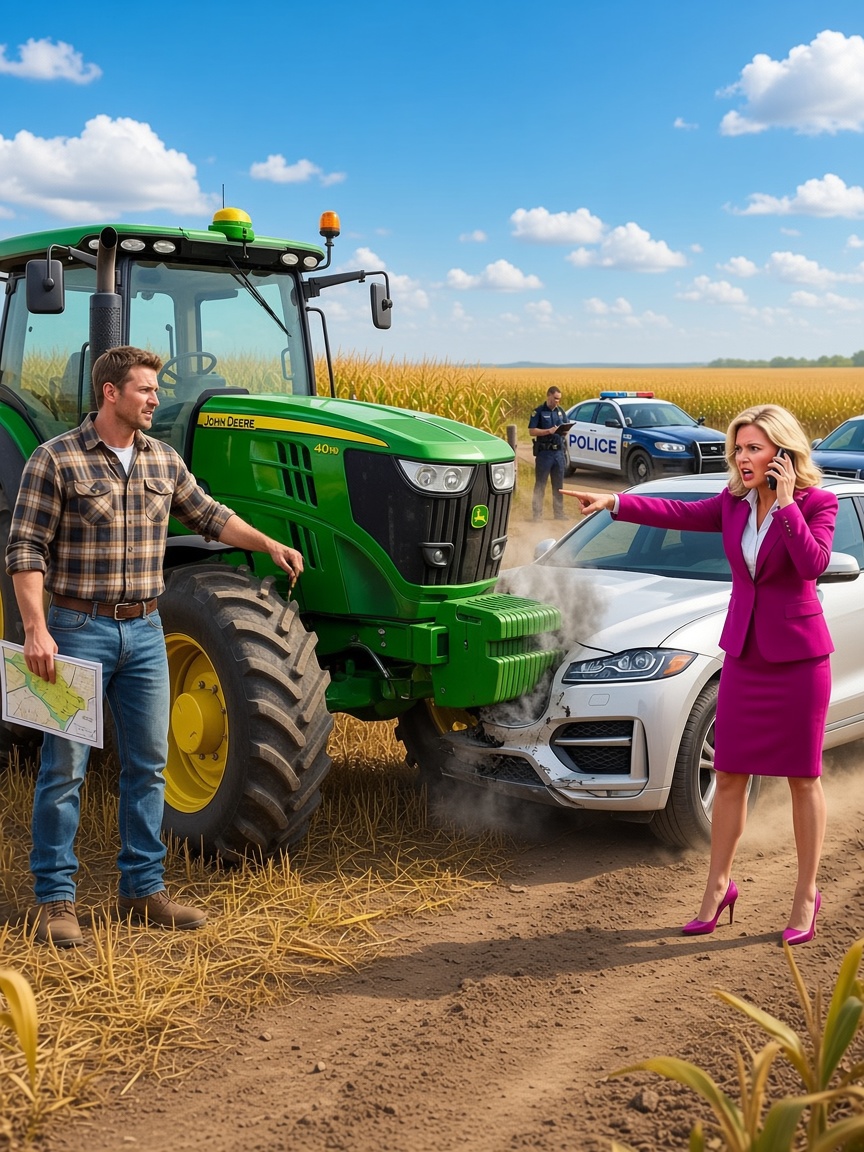
I had left the machine parked with the header disengaged less than two minutes earlier. Eighteen thousand pounds of steel, machinery, and agricultural equipment stood perfectly still in the November sunshine.
Moren accelerated toward it anyway.
Deputy Cole Richardson was running across the field, shouting into his radio. My daughter Jenna stood near the fence with a camera in her hands. Across the road, at least a dozen residents of Prairie Meadows had stopped to watch.
There was no time to understand what Moren thought she was accomplishing.
I jumped backward.
The Mercedes struck the combine’s right rear wheel with a noise like an entire garage collapsing.
The front of the SUV crumpled. The hood folded upward. Both airbags exploded, filling the cabin with white powder. Pieces of plastic scattered across the frozen dirt, and steam began pouring from beneath the buckled hood.
The combine barely moved.
For a few seconds, nobody said anything.
Then the driver’s door opened.
Moren stumbled out wearing expensive boots, a cream-colored jacket, and an expression of absolute disbelief. Airbag dust covered her hair. Mascara streaked her cheeks.
She looked at the wrecked Mercedes, then at me.
“You did this!”
Deputy Richardson reached her first.
“Ma’am, stay where you are. Are you injured?”
She shoved his hand away and pointed at me.
“Arrest him! He’s trespassing on HOA property! He destroyed my car!”
I stood beside my combine, staring at the woman who had just driven a ninety-thousand-dollar SUV into stationary farm equipment.
Sixteen months of complaints, threats, forged accusations, trespassing, and legal harassment had brought us to this moment.
What Moren didn’t know was that three cameras had recorded the collision, a police officer had witnessed it, and the legal document she had spent more than a year ignoring was about to destroy everything she believed she controlled.
My name is Hank Briggs. I’m fifty-two years old, and I’m a third-generation Nebraska farmer.
Until Moren Falstead moved into the subdivision next door, I figured the biggest problems I’d face in my remaining years would be drought, equipment repairs, and the price of diesel.
I was wrong.
Sixteen months earlier, my life had been quiet.
I owned 160 acres outside Lincoln, Nebraska, land my grandfather Walter Briggs purchased in 1952 after coming home from the war. He paid eight thousand dollars for it, which was a fortune to a man who had grown up wearing patched boots and sharing a bedroom with four brothers.
My grandfather wasn’t much for speeches. He believed a man’s reputation came from what he did when nobody was watching.
He built the original barn with help from three neighbors. They worked through an entire summer, eating sandwiches my grandmother made and drinking water from a galvanized bucket beneath the cottonwood tree.
My father inherited the place in 1979. I took over in 1998, shortly after marrying Patty.
We raised two children in that farmhouse.
Our son, Michael, became an electrical engineer in Denver. Jenna moved to Chicago and built a career in commercial photography. Neither wanted to farm, and I never held it against them.
People who romanticize agriculture usually haven’t spent sixteen hours repairing irrigation equipment while thunderstorms roll across the horizon.
Patty understood that better than anybody.
She could operate a tractor, repair a fence, and negotiate with a seed supplier without raising her voice. She also believed that anybody fortunate enough to have food should help somebody who didn’t.
That’s why thirty percent of our annual harvest went to the regional food bank.
She started that tradition during a particularly good season in 2006. We never stopped.
Three years before Moren appeared, Patty died of cancer.
For a while afterward, I couldn’t stand being inside the farmhouse. Every room reminded me of something I’d lost. Her gardening gloves hung beside the back door. Her favorite mug sat in the cupboard. A grocery list she’d written was still tucked beneath a magnet on the refrigerator.
Eventually, I learned to live around the memories.
I kept her vegetable garden going. I fixed the porch railing she’d been asking me to repair. I planted sunflowers along the southern fence because she liked seeing them from the kitchen window.
Most evenings, I ate dinner alone, listened to the weather report, and went to bed early.
I wasn’t unhappy exactly.
I was getting used to a life that had become smaller.
Then Cornerstone Homes purchased the neighboring Pollson farm.
Bill Pollson had farmed that property for forty years. His family had owned it almost as long as mine.
When he sold, I didn’t blame him. His knees were shot, his children lived out of state, and the developer offered enough money to give him a comfortable retirement.
Still, watching bulldozers tear down his grandfather’s barn was hard.
Within eighteen months, three hundred acres of farmland had become Prairie Meadows Estates, a subdivision of two hundred expensive homes with decorative streetlights, landscaped entrances, and an HOA that regulated everything from mailbox colors to the height of ornamental shrubs.
The houses started around seven hundred fifty thousand dollars.
Some cost well over a million.
I watched moving trucks arrive, lawns get installed, and families settle into their new homes.
For the most part, they were good people.
I waved when I passed them. They waved back. Occasionally, somebody stopped at my roadside stand to buy sweet corn or tomatoes.
There was one complication during construction.
Cornerstone needed to run underground utilities across a narrow strip of my property.

