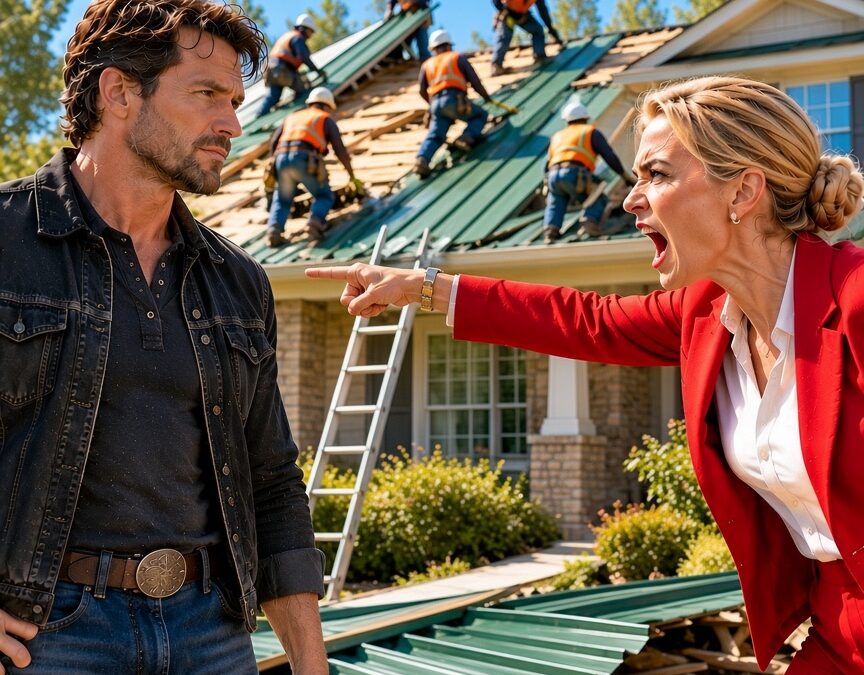
Y comencé a documentar cuánto costaría dejar mi casa exactamente como estaba antes.
## PARTE 2: EL INFORME DE DAÑOS CONVIRTIÓ LAS AMENAZAS DE MARLA EN UNA EXPOSICIÓN FINANCIERA REAL
A la mañana siguiente, la inspectora forense de tejados Della Whitaker examinó la propiedad.
Pasó horas revisando las juntas, los sujetadores, la impermeabilización, el entablado y los paneles dañados. Al terminar, me dijo que el equipo no había cometido un error de instalación común. Habían desmantelado deliberadamente un techo en buen estado. Su informe llegó más tarde esa semana, con un costo total de restauración de $24,000: $3,600 para la cobertura y el secado de emergencia, $16,900 para el sistema de techado y $3,500 para el techo y el aislamiento.
I paid for the repairs using savings and a home equity line of credit. Waiting for Marla to cooperate would have meant gambling with another storm. I instructed Gus to match the original roof, not improve it. Same green metal, same profile, same performance. Every invoice documented restoration, not an upgrade.
Ten days later, Marla’s attorney, Franklin Shaw, sent a letter claiming the association had acted to correct a substandard structure. He argued that stopping the workers had caused the additional damage and proposed that everyone pay their own expenses. Diane rejected the offer. She sent the deed, survey, sheriff’s report, notices, video, and invoices, then issued preservation demands for the contractor’s communications and authorization records.
That night, I enlarged the supposed signature on my computer. A tiny speck beneath the last letter looked familiar. I opened the scanned deed from my original property closing and compared them. The speck matched. So did every stroke. Diane hired document examiner Philip Garo, who confirmed that the signature was a copied image, complete with scanner artifacts from the publicly recorded deed. Nobody had watched me sign that authorization. Someone had manufactured my consent.
Harlan cooperated and supplied Marla’s emails. One described me as a homeowner who had approved the work but become difficult. Another attached the authorization. A text sent the night before instructed him to start early, explaining that once the old panels were removed, I wouldn’t have a choice. Tessa then recovered security-camera footage showing Marla assuring a worker that she had handled the paperwork and that nobody needed to ask me. The evidence left little room for an innocent misunderstanding.
## PART 3: ONE PERSONAL SIGNATURE EXPOSED WHAT THE ASSOCIATION NEVER AUTHORIZED
Diane found another document attached to Harlan’s contract: an authorization warranty. Whoever ordered the work certified that they had personally verified the owner’s consent and agreed to reimburse the contractor for claims arising from a false certification. Marla had signed it in her individual name. Diane cautioned that it didn’t automatically entitle me to collect under a contract I hadn’t signed. But it showed that Marla understood permission mattered and had personally represented that she possessed it.
Then Harlan sent the deposit invoice. Pike Exterior Services had received $4,500 from the Ridgecrest Commons emergency maintenance reserve. Diane notified the full association board. Its treasurer, Wade Pritchard, examined the payment records and found the charge coded to lot 46, a landscaping strip near the entrance. My property wasn’t even listed in the HOA system. Wade found no board vote, no approved contract, and no meeting minutes authorizing work on my roof.
At a special clubhouse meeting, Wade presented the payment and the county boundary map. Marla insisted she had acted to protect neighborhood property values. Board member Carol Jennings asked why association funds had been spent on a house outside the association. Marla claimed I had agreed to the work. Wade showed the document examiner’s findings. Residents began asking about the reserve account, the false lot number, and other decisions Marla might have made without oversight.
The board voted to suspend her spending authority pending an audit. Marla threatened lawsuits, but nobody withdrew the motion. Independent counsel later confirmed that the board had never approved the roof removal, and the association began pursuing the $4,500 deposit separately. Before the meeting ended, Wade pointed to the warranty. “You didn’t sign this for the board, Marla. You signed it personally.” She read the page in silence.
I wasn’t present for that meeting, but Wade’s written account reached Diane. For the first time since the demolition, I could see a distinction Marla had always tried to erase: the neighbors were not responsible for every decision she made in their name. My case would proceed against her for her own conduct, while the association dealt with its missing reserve money.
## PART 4: IN COURT THE EVIDENCE LEFT MARLA NOWHERE LEFT TO HIDE
Months later, my civil case reached Judge Rosalind Avery’s courtroom. I sought $24,000 in proven repair costs. Franklin described Marla as a dedicated volunteer acting in good faith. Diane presented the recorded declaration and certified survey showing that Ridgecrest Commons had never governed my property. When Franklin referred to neighborhood appearance standards, Judge Avery asked him to identify a legal basis for applying those standards to my house. He couldn’t.
Tessa’s video played next. Marla’s voice came through clearly, instructing the crew to remove the roof before I could interfere. Harlan testified that every instruction and authorization had come from her. Philip Garo explained how the signature had been copied from my deed. Diane introduced Marla’s personal warranty, not as a contract I could enforce, but as evidence that she knew homeowner consent was required. Asked whether she had personally confirmed my permission, Marla finally answered, “No. I relied on my authority as HOA president.”

