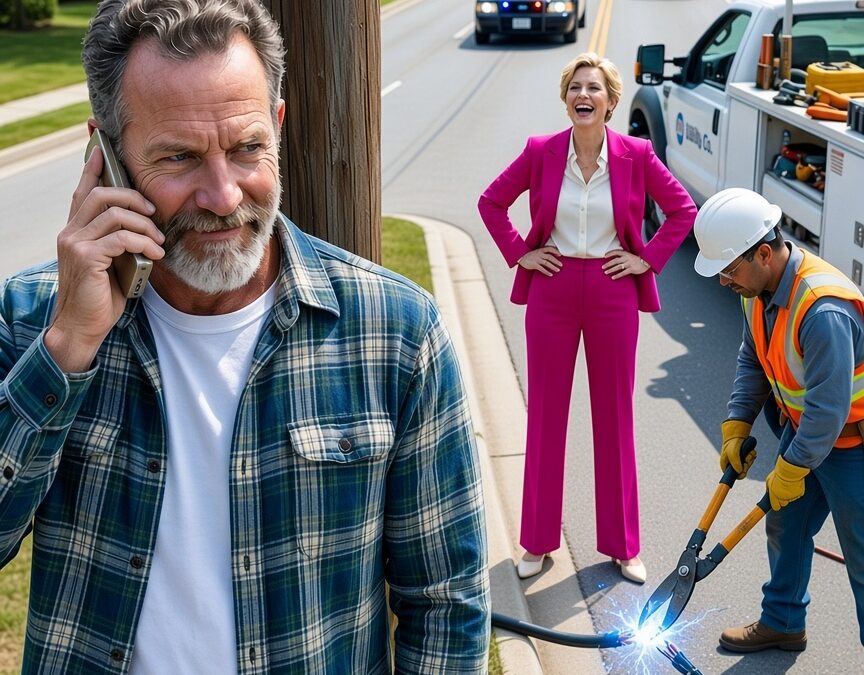
On August 9, our cameras recorded her walking along the southern boundary of the ranch.
She photographed poles, conductors, and easement markers.
She stayed nearly an hour.
Two days later, a county employee contacted the sheriff after Vivian called to ask about permits for removing overhead utility infrastructure.
According to his written account, he explained that a homeowners association could not authorize removal of a utility’s transmission lines.
Vivian ended the conversation abruptly.
By then, investigators had reason to believe an unauthorized operation might be imminent.
I was furious when I learned that.
Not because Vivian disliked the view.
Not even because she had threatened our company.
I was furious because she appeared willing to gamble with the safety of working people and hundreds of customers to settle a dispute over scenery.
I wanted the lines protected.
I wanted the contractor kept away from them.
And I wanted every possible precaution taken.
Helms and our operations team developed a response plan with local authorities.
Our monitoring systems were checked.
Our emergency crews were placed on alert.
We coordinated communications with law enforcement.
Nobody on my team was authorized to allow a dangerous act to occur for the sake of gathering evidence.
That point mattered.
I had spent my life around high-voltage equipment.
A live transmission line is not a prop in a courtroom drama.
It can kill a person before anyone nearby has time to react.
On Wednesday evening, August 13, I sat at the ranch kitchen table with Frieda, Ingrid, Keld, and my father.
Dad was eighty-four.
He had retired a decade earlier but still visited our control center every Tuesday to read outage reports.
He wore his old company service pin on his shirt.
I explained what we knew.
The Crowfoot crew might arrive the following morning.
Law enforcement had been notified.
Our operators would monitor the corridor.
Repair personnel were ready if needed.
Dad listened.
Then he asked, “Do they know what they’re dealing with?”
“The investigators do.”
“I meant the people coming to cut those lines.”
I hesitated.
“I don’t know.”
He looked down at the table.
“Your grandfather built that southern run himself.”
“I know, Dad.”
“He called it the backbone of the system. Every time we expanded north, he said we had to remember where the power came from.”
He rubbed his thumb over the edge of his service pin.
“Don’t let anybody turn his work into a stunt.”
“I won’t.”
I meant it.
At 6:30 the following morning, I was back at the kitchen table with coffee and a notebook.
Frieda had already spoken to our operations staff.
Ingrid had checked the repair trucks.
Keld was preparing for his shift.
The weather was clear.
It was the kind of August morning when the mountains looked close enough to touch.
By ten o’clock, I was at company headquarters.
At 10:37, a Crowfoot Line Works truck turned onto Crazy Mountain Lane.
It was a Ford F-450 towing a bucket lift.
The company name was visible on the door.
Our camera showed the truck moving slowly toward the southern easement.
Keld called me.
“They’re here.”
“I see them.”
“Sheriff’s office has been notified.”
“Good.”
The crew parked near pole 42.
Several men climbed out.
Their foreman, Walden Penhalligan, stood beneath the conductors and looked up.
I knew Walden by sight.
He had worked for Crowfoot Line Works for nearly twenty years.
He had attended safety meetings at our headquarters.
He knew the difference between vegetation clearance and conductor removal.
He knew what high-voltage equipment could do.
That was what made the next hour so difficult to watch.
At first, the crew appeared to be surveying the location.
They moved equipment.
They checked the lift.
They spoke among themselves.
Our operators remained in contact with law enforcement.
We were prepared to isolate the circuit if conditions required it, but the situation was developing quickly, and our monitoring did not provide a complete view of every movement on the ground.
Then Vivian’s Navigator arrived.
She pulled alongside the crew truck and lowered her window.
The camera captured her speaking with Walden.
Later, investigators would establish the substance of the exchange through witness interviews and other evidence.
She wanted the lines removed.
She believed she had authorized the work.
Walden raised concerns.
Vivian dismissed them.
“Community property must be cleared,” she told him.
I stared at the monitor.
“Community property?” I said.
Frieda stood beside me.
“That woman is on our ranch.”
The easement ran across land my grandfather had purchased long before her subdivision existed.
Vivian was standing on property she did not own, ordering a contractor to interfere with equipment she did not control.
She climbed back into the Navigator and drove away.
Walden remained beside the truck.
He looked toward the line.
Then he began preparing the lift.
Keld’s voice came through the radio.
“Bucket moving.”
I reached for the phone.
Our emergency response coordination was already active, but I wanted confirmation that officers were approaching.
The bucket rose.
Walden was carrying a hydraulic cutting tool.
For a moment, I thought he might stop.
He looked down toward the ground crew.
He looked back at the conductor.
Then he moved closer.
The next few seconds remain clearer in my memory than almost anything else that happened that year.
I remember the white truck.
The blue sky.
The shadow of the bucket against the pole.
And the terrible realization that a man with nineteen years of experience was about to make a decision no competent utility worker should ever make.
At 11:47, Walden brought the cutter against the energized conductor.
There was a violent flash.
The camera image flared white.
An electrical arc erupted around the equipment.
The conductor separated and fell.
Protective systems operated, isolating the fault.
Alarms filled the SCADA control center.
Keld’s voice came through the radio, sharp and controlled.
“Southern feeder fault. Pole 42. Circuit open. Dispatch emergency response.”
I was already standing.
“Is everyone clear?”
“Cannot confirm yet.”

