“She took Grandma’s money,” Daniel said. “And when I confronted her, she destroyed her own studio and tried to make it look like someone broke in.”
My stomach dropped.
The courtroom turned toward me.
Daniel looked calm. Professional. Convincing.
That was exactly what he wanted.
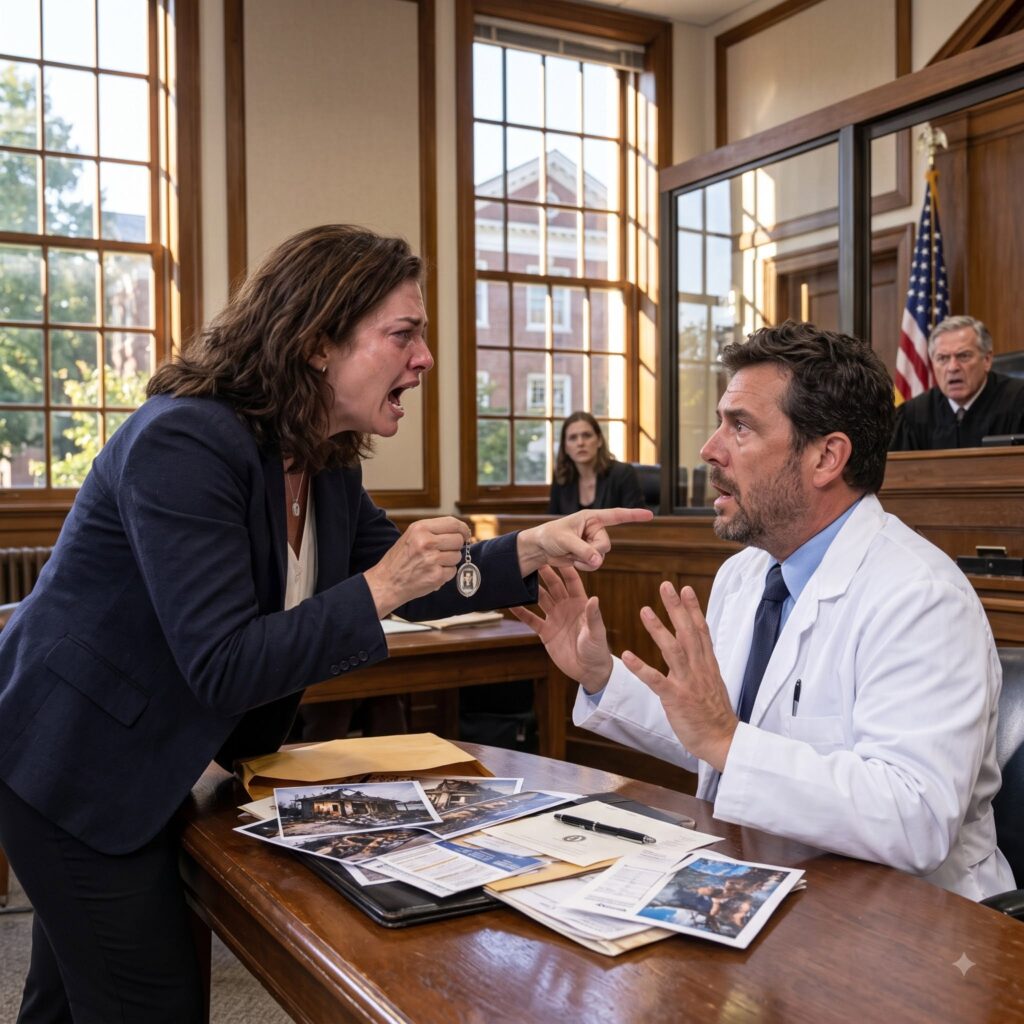
I sat beside my attorney, gripping the small silver locket around my neck.
Inside that locket was the one thing Daniel didn’t know I had.
A recording.
Three days earlier, I had walked into my art studio and found the place destroyed. Canvases were ripped, drawers emptied, framed photographs smashed, and Grandma’s old papers scattered across the floor.
Then Daniel arrived.
He didn’t ask if I was okay.
He didn’t call the police.
He simply stared at the room and said, “This is going to look terrible for you.”
Now, in court, he was telling the judge that the destruction proved I had been unstable and desperate for money.
“She inherited access to Grandma’s estate,” Daniel continued. “She became obsessed with controlling everything. I believe she fabricated the break-in because she was afraid the family would discover what she had done.”
My attorney stood.
“Your Honor, we dispute that characterization.”
Daniel’s attorney immediately objected.
The judge raised a hand.
“Enough. I want evidence.”
Daniel smiled faintly.
Then he produced photographs of my destroyed studio.
“These were taken the morning she reported the damage.”
My heart pounded.
Because I knew exactly what those photographs didn’t show.
The conversation Daniel and I had that night.
The conversation he thought nobody had heard.
The judge looked at me.
“Do you have anything to add?”
I touched the locket.
“Yes, Your Honor.”
Daniel’s expression changed.
I looked directly at him.
“You should listen before you decide who destroyed that studio.”
My attorney placed a small evidence envelope on the table.
Daniel suddenly stopped smiling.
Teaser
Daniel thought the destroyed studio was the final piece of his story. He had photographs, a medical reputation, and a courtroom full of people ready to believe him. But one tiny object had captured something he never expected anyone to hear.
Daniel stared at the evidence envelope.
“What is that?” he asked.
My attorney didn’t answer.
The judge looked toward us.
“Proceed.”
My attorney carefully explained that I had preserved an audio recording connected to the events surrounding the studio.
Daniel immediately shook his head.
“That proves nothing.”
“Then you shouldn’t be worried,” I said.
He looked at me sharply.
My attorney submitted the recording for the court’s review.
A few seconds later, Daniel’s own voice came through the courtroom speakers.
At first, it was quiet.
Then came the sentence that changed everything.
“By tomorrow, they’ll think she did this herself.”
Daniel went completely still.
His attorney stood.
“Your Honor, we object to the authenticity.”
The judge stopped him.
“Was that your client’s voice?”
Daniel hesitated.
“That recording could have been manipulated.”
My attorney produced additional material supporting when and how the recording had been preserved.
The judge ordered a proper review.
Daniel’s face had lost its confidence.
Then came the first major twist.
The recording didn’t begin with the studio being destroyed.
It began earlier.
Daniel had confronted me privately about Grandma’s estate.
He had demanded that I sign documents giving him greater control over several remaining assets.
I refused.
Then his voice changed.
“You’re going to regret making me do this.”
I remembered those words.
At the time, I thought he was simply angry.
Now everyone in the courtroom heard them.
Daniel tried to explain.
“I was frustrated. I didn’t mean anything by that.”
Then another section played.
Daniel was speaking to someone else.
“We just need the studio to look bad enough that the judge believes she staged it.”
My attorney paused the recording.
Daniel’s attorney asked for a recess.
The judge granted one.
During the break, Daniel approached me.
“You don’t understand,” he whispered.
I stepped back.
“You’ve said enough.”
But the biggest surprise came when my attorney received a message from the estate administrator.
There was a discrepancy in Grandma’s financial records.
A transfer Daniel had claimed was authorized by Grandma had been made after her death.
And the authorization document contained a signature that was now being questioned.
Daniel had spent weeks accusing me of stealing.
Meanwhile, someone had been moving money from the estate while directing suspicion toward me.
When court resumed, the judge ordered the disputed records preserved and requested further examination.
Daniel sat silently.
For the first time, he wasn’t controlling the story.
But the recording had revealed only part of what he had done.
There was still one question nobody had answered:
Why had Daniel gone so far to make me look guilty?
My attorney leaned toward me.
“We found another connection.”
I looked at him.
“What connection?”
He lowered his voice.
“The person who helped Daniel prepare those estate documents.”
My blood ran cold.
Because I knew that name.
And it belonged to someone I had trusted for years.
The name my attorney whispered was Margaret Collins.
She had been Grandma’s longtime financial adviser.
For years, Margaret had been the person our family trusted with paperwork, account statements, and estate documents.
I stared at my attorney.
“You’re saying Margaret helped Daniel?”
“We’re saying the records show they communicated repeatedly before and after your grandmother’s death.”
That distinction mattered.
We weren’t going to accuse anyone based on suspicion.
We were going to follow the documents.
The court ordered the relevant estate records preserved while the disputed transfers were reviewed.
Daniel sat across the courtroom beside his attorney, no longer wearing the confident expression he’d had when the hearing began.
The recording from my locket had changed the entire atmosphere.
But it wasn’t the recording itself that proved the financial allegations.
It was what investigators found after the recording gave them a reason to look more closely.
Six years earlier, Grandma had created an estate plan dividing her remaining assets between several family members.
She had also set aside money to help me maintain my art studio.
It wasn’t an enormous fortune.
But it was enough to matter.
Daniel had always complained that Grandma trusted me too much.
He believed I was getting preferential treatment.
I never understood how strongly he felt about it.
Until the investigation uncovered his messages with Margaret.
They had discussed the estate repeatedly.
Some messages were about legitimate paperwork.
Others were not.
There were questions about my finances.
Questions about whether I would challenge certain transfers.
Questions about how convincing the evidence would need to be if the dispute went to court.
Then investigators found something even more important.
One disputed document had been prepared using information from an old estate file.
It contained details that only a small number of people should have known.
My information.
My studio information.
And details about Grandma’s accounts.
The document was presented as if Grandma had authorized a change before her death.
But the date didn’t make sense.
The signature was also questioned.
A forensic review later concluded that the signature did not reliably match Grandma’s known signatures.
That didn’t automatically prove who had created the document.
But it established that the document couldn’t simply be treated as genuine.
Then came the studio.
Investigators reviewed the timeline.
The damage had occurred after Daniel confronted me about the estate.
He had photographs ready almost immediately.
He had already begun telling relatives that I was unstable.
He had even described the studio as evidence before investigators had completed their work.
The recording from my locket explained why.
Daniel had been planning the story before anyone had heard my side.
The recording itself had happened almost by accident.
After Daniel confronted me at the studio, I had felt uneasy about the way he was speaking.
I had been wearing my grandmother’s old silver locket.
It contained a tiny recording device that I had previously kept for personal safety and documentation.
I had forgotten it was active.
That detail turned out to be crucial.
I hadn’t planted it in the studio.
I hadn’t secretly arranged some elaborate trap.
I simply happened to have it with me during the conversation Daniel thought was private.
The original recording was preserved, and its authenticity was later examined.
That was enough to give investigators a starting point.
Daniel eventually admitted that he had been present when the studio was damaged.
He initially denied causing the damage.
But when confronted with the timeline and his own statements, his story changed.
He claimed he had only wanted to make the situation “look suspicious.”
He said he believed that if everyone thought I had staged the damage, the court would question my credibility.
He insisted he never intended for anyone to be physically harmed.
That did not erase what he had done.
He had tried to manufacture a story and use it against me.
Worse, he had allowed our grandmother’s estate to become part of that deception.
Margaret eventually cooperated with investigators.
She admitted that she had shared information with Daniel and had helped prepare documents she should have handled more carefully.
She denied knowing the full extent of his plan.
The estate review uncovered administrative failures and disputed transactions.
Some money was recovered.
Some expenses had to be traced and resolved through the estate process.
The court did not simply hand me Grandma’s entire fortune because of one recording.
That wasn’t how the law worked.
Instead, the disputed documents were removed from consideration until their validity could be established.
The estate was reviewed properly.
The transfers connected to the questionable documents were challenged through the appropriate process.
And my rights as a beneficiary were protected.
Daniel also faced consequences for his actions.
His professional reputation did not protect him from scrutiny.
The fact that he was a doctor mattered only as much as any other person’s professional background mattered.
Being respected in one part of life didn’t make his accusations automatically true.
Eventually, he had to answer for what he had actually done.
The hardest part wasn’t the courtroom.
It was what happened afterward.
My family had divided into camps.
Some relatives apologized.
Others said they couldn’t believe they had doubted me.
A few admitted they had believed Daniel simply because he spoke with confidence and wore a medical coat.
That hurt.
Not because I expected everyone to choose my side.
But because I realized how easily a convincing story can overpower the truth when nobody stops to examine the evidence.
My studio took months to repair.
The damaged canvases could not all be restored.
Some were gone forever.
But I kept one small piece of the old room.
The frame of a painting Grandma had given me.
It had been scratched during the destruction, but it still held together.
I had it repaired and hung it above my desk.
One evening, my attorney called.
“The estate review is finished,” he said.
I sat quietly as he explained the final results.
The disputed transfer had been reversed.
The questionable document was no longer being used to support Daniel’s claims.
The remaining estate assets were distributed according to the valid estate plan.
And my studio fund was protected.
I thanked him.
Then I sat alone for a while.
I thought about Grandma.
She had always told me that family wasn’t defined by who shared your last name.
It was defined by who respected the truth when the truth became inconvenient.
I finally understood what she meant.
Daniel eventually contacted me.
His message was short.
“I know I hurt you. I can’t undo it.”
I stared at it for a long time.
Then I replied.
“You’re right. You can’t.”
I didn’t insult him.
I didn’t threaten him.
I didn’t promise forgiveness.
I simply told him that whatever happened between us next would have to be built on honesty.
He never replied.
And strangely, I was okay with that.
A few months later, I reopened my studio.
The first person through the door was my grandmother’s closest friend.
She looked around at the repaired walls and smiled.
“Your grandmother would have loved this.”
I smiled back.
“She would have hated the mess.”
We both laughed.
The silver locket was still around my neck.
I had replaced the chain and kept it polished.
People sometimes asked why I never took it off.
I always gave the same answer.
“It’s a reminder.”
Not a reminder of revenge.
Not a reminder of my brother.
A reminder that truth doesn’t always arrive dramatically.
Sometimes it sits quietly in a pocket.
Sometimes it’s buried in a document.
Sometimes it’s a statement someone forgot to explain.
And sometimes, when everyone else is listening to the loudest voice in the room, the truth is hiding in the smallest place imaginable.
Daniel had walked into court believing he had framed me perfectly.
He had a destroyed studio.
He had photographs.
He had a convincing story.
He had a white medical coat and the confidence of someone who thought nobody would question him.
What he didn’t have was control over every piece of evidence.
And he certainly didn’t know about the little silver locket around my neck.
The locket didn’t win the case by itself.
It simply opened the door to the truth.
The documents did the rest.
And that was the lesson I carried with me long after the courtroom doors closed:
A convincing accusation is still only an accusation until the evidence supports it.
My brother wanted everyone to believe I had destroyed my own life for money.
Instead, the evidence showed that he had tried to destroy my reputation to protect a story that was never true.
I never got Grandma back.
None of us could.
But I kept the part of her legacy that mattered most.
Her trust.
And this time, I refused to let anyone convince me that protecting the truth meant protecting the people who had betrayed it.