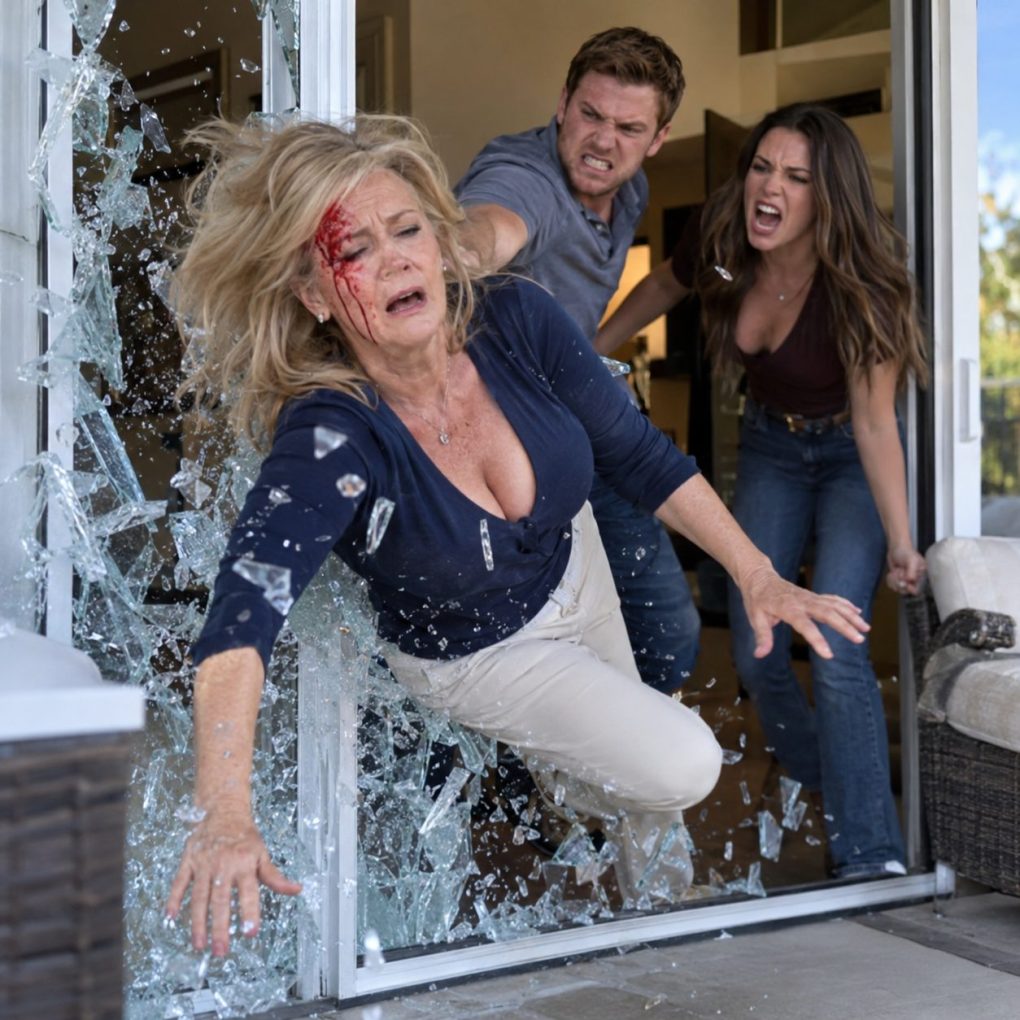
The glass door broke behind me, and I hit the patio on my back.
“Broke and useless,” Melissa said.
Daniel stood over me while blood slipped down my cheek.
“Get up, Mom. You’re making a scene.”
I was sixty-eight. I had come to their house with a casserole and left through a door.
Three minutes earlier, Melissa had pushed a document across the kitchen counter.
“Just sign it. We’re tired of carrying you.”
I hadn’t asked them for a dollar.
When I refused, she grabbed my purse. Daniel caught my arm. I pulled away, and they drove me backward together.
Now my phone lay beside a shard of glass.
I reached for it.
Daniel put his shoe over my hand.
“Call anybody, and don’t expect to see Emma again.”
My granddaughter. Nine years old. Upstairs, supposedly asleep.
Then I heard her voice through the broken doorway.
“Grandma?”
Melissa turned so fast I thought she might fall.
“Go to your room.”
I said nothing. Not when Daniel lifted his foot. Not when Melissa threw my purse onto the lawn.
A neighbor heard the crash and came through the gate. Daniel immediately changed his voice.
“Mom fell. We’ve been worried about her.”
At the emergency room, I told the nurse exactly what happened.
She photographed my injuries. A police officer took my statement.
Afterward, from a hospital bed, I called my lawyer.
“Rachel. Activate the protections. All of them.”
She went quiet.
“Did they try to make you sign something?”
“Yes.”
“Then I need the exact words on that page.”
I closed my eyes, remembering the heading.
Authorization to Replace Trustee.
Rachel drew a sharp breath.
“Evelyn, listen carefully. Your son contacted our office this afternoon.”
“About what?”
“He says you already signed.”
Then my phone lit up with a message from Emma.
Grandma, Mom says hide the blue folder before the police come.
They thought my silence meant they had frightened me into surrender. But somewhere inside that house was a folder they suddenly needed to disappear—and my granddaughter had just told me where to start.
I read Emma’s message twice before handing the phone to the officer beside my bed.
“Please get her out of that house.”
He called another unit. Rachel stayed on the line. “Don’t ask Emma to touch the folder,” she said. “Just tell her to stay somewhere safe.”
I typed: Stay in your room, sweetheart. Help is coming.
For twelve years, Daniel believed I lived on Social Security and what little his father had left behind. That was the life I showed him.
He knew nothing about the warehouse business his father and I had sold, or the investments that followed. After my husband died, I placed the proceeds in an irrevocable trust. Twenty-one million dollars.
An independent trustee managed the money. I received income. Emma would benefit after my death. Daniel and Melissa could not withdraw a cent.
The trust also owned their house. They lived there under a written occupancy agreement, paying utilities and a modest monthly fee. They called it their house because I had never corrected them in public.
Rachel had been preparing to stop an unauthorized sale. That afternoon, Daniel had sent her office a supposed consent bearing my signature. Tonight’s page was meant to make the forgery look legitimate.
“He tried to list the property?” I asked. “More than list it. There’s a buyer.”
My stomach tightened. “Where were they going to put me?” Rachel didn’t answer.
By morning, the trustee had locked down account access, and an emergency court order blocked any transfer or new lien against the house while the disputed documents were reviewed. Their house was frozen. My twenty-one million remained beyond their reach.
Daniel called seventeen times. On the eighteenth, I answered with Rachel listening.
“What did you do?” he demanded. “You told me I was broke.”
“This isn’t funny. Melissa says we’ll lose everything.” “What happened to your concern about my fall?” He hung up.
An hour later, the officer returned. Emma was safe with her maternal aunt. Melissa had handed over the folder voluntarily after officers arrived.
Inside were copies of the forged consent, emails with a buyer, and a draft petition asking a court to declare me unable to manage my affairs.
But the officer was carrying something else. “A neighbor’s security camera caught the patio,” he said. “We have the assault.” For the first time, I could breathe.
Then Rachel opened the last document in the folder. It was a beneficiary request, apparently signed by me, directing Emma’s future share to Melissa. Attached was a letter on a medical practice’s stationery.
Rachel studied the doctor’s name. “Evelyn. Have you ever seen this physician?” “No.”
The officer’s expression changed. “Your son listed him as the person who could confirm your confusion.” Rachel turned the letter toward me. The emergency contact was my sister.
“Call her,” I said. “Put her on speaker.” My sister answered on the second ring. “Evelyn? Daniel told me you were resting.” Rachel introduced herself and asked about the physician. Carol went silent. Then she said, “That’s my doctor. Why?” I gripped the blanket. “Did you tell him I was confused?” “No. Daniel asked me for the office number. He said you needed a new primary care doctor.” Her voice started shaking. “What has he done?”
Rachel sent her a photograph of the letter. Carol read it aloud, stumbling over the sentence claiming she had witnessed repeated episodes of disorientation. “I never said that. I haven’t even seen you in two months.” The officer wrote down her response and arranged a formal interview. An hour later, the practice manager confirmed that the letter was not theirs. The physician had never examined me. Someone had copied the office letterhead and added his name.

