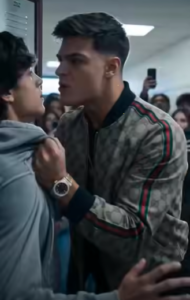
 Julian Cross had my hoodie twisted in one fist.
The trophy case rattled behind me as he shoved me against it. Thirty students crowded the hallway, their phones raised. The assistant principal had walked past, dismissing the scene as “hallway drama.”
Julian smiled at the cameras.
“Your poor dad can’t teach you anything, Alex,” he said. “Except how to beg for scraps.”
The laughter stung worse than the shove.
My father worked as a mechanic on the east side. He came home with grease beneath his fingernails, aching shoulders, and a quiet pride in fixing things other people had given up on. Julian had never met him. He knew nothing about him.
But he knew exactly which words would hurt me.
Then Julian stepped back, lifted his leg, and began winding up for a roundhouse kick.
I recognized the movement.
My father had taught me Muay Thai in the narrow space behind our garage. Not to win fights. Not to impress anyone. He’d taught me how to stay balanced, how to recognize danger, and how to protect myself if I couldn’t get away.
For a split second, I saw the kick coming.
I also saw the trophy case, the students, and the assistant principal disappearing around the corner.
I had no room to retreat.
“Don’t,” I said.
Julian laughed.
“Make me.”
The kick that missed
His leg swung toward me.
I moved out of its path, protecting my head and creating a little space. Julian’s kick struck nothing but air. His momentum carried him forward, and his planted foot slipped on the polished hallway floor.
I didn’t launch a counterattack.
I didn’t try to punish him.
As he stumbled, I stepped away, keeping my hands up and my distance. Julian caught himself against the lockers with a loud metallic bang.
The hallway went silent.
One student lowered his phone.
Another whispered, “Did he just miss?”
Julian straightened, his face burning.
“You think that’s funny?”
“No,” I said. “I think you should stop.”
He charged toward me.
I moved aside, keeping clear rather than meeting him head-on. He collided shoulder-first with the locker bank. The impact made the doors shake.
A teacher finally came running from the classroom corridor.
“Both of you! Stop!”
I backed away with my palms visible.
“He keeps grabbing me,” I said. “He tried to kick me.”
Julian pointed at me.
“He attacked me!”
But the phones had captured what happened before he fell.
The students who’d been laughing were now watching the footage on their screens.
And for once, nobody was asking me to apologize.
The boy behind the scholarship
My name is Alex Rivera.
I was sixteen, a scholarship student at Oak Creek High, and the son of a mechanic who had spent most of his life repairing cars in a small garage.
Julian was the varsity captain. His father owned half the new developments in town, and Julian had grown up believing that every room belonged to him.
The bullying had started with my clothes.
Then my lunch.
Then my father.
Julian mocked the fact that Dad drove an old pickup and worked weekends. His friends began calling me “Garage Kid.” They shoved me in the hallway, blocked my locker, and filmed me whenever I tried to walk away.
I reported it once.
The assistant principal told me the boys were “just messing around.”
I reported it again after Julian knocked my books out of my hands.
He asked whether I might be “sending the wrong signals.”
After that, I stopped expecting help.
But I kept training.
My father had practiced Muay Thai when he was younger. He taught me the fundamentals in our garage, using an old heavy bag hanging from a beam.
“Technique isn’t permission to hurt someone,” he’d remind me. “If you can leave, leave. If you have to protect yourself, do only what gets you safe.”
I had never told Julian about the training.
I hadn’t wanted him to know.
That afternoon, I understood why my father had always insisted that discipline mattered more than power.
The videos changed the story
The teacher, Ms. Patel, separated Julian and me and called the office.
I sat in the counselor’s room, my hands still trembling. The nurse checked the back of my head where it had struck the trophy case. I was shaken, but I could speak clearly.
Ms. Patel returned with the principal, Dr. Alvarez.
“Several students have shared recordings,” she said. “We need to understand what happened.”
The first video showed Julian grabbing my hoodie and shoving me into the display case.
The second captured his insult about my father.
The third began just before the kick.
It showed me telling him to stop, then moving away as his kick missed. It showed him advancing again and me trying to avoid him.
A student named Brianna had recorded the whole confrontation from the opposite side of the hall.
“I used to think it was just teasing,” she admitted. “But he kept doing it after Alex asked him to stop.”
Dr. Alvarez listened without interrupting.
Then she asked me a question no one else had asked.
“Have you felt safe at this school?”
I looked down at my hands.
“Not for a while.”
She nodded slowly.
“Then we need to address more than today’s incident.”
Julian’s father arrived
By the end of the day, Julian’s father was in the principal’s office.
He wore a tailored suit and carried himself like a man accustomed to negotiating outcomes.
“My son says this was a misunderstanding,” he said. “He has a football future. I don’t want a hallway scuffle destroying his opportunities.”
Dr. Alvarez kept her voice even.
“We’re reviewing the incident and the prior complaints. His athletic status doesn’t change the school’s responsibility to protect students.”
Julian’s father looked at me.
“Alex, boys sometimes say things they don’t mean.”
I thought about my father’s hands, permanently marked by years of work. I thought about Julian using those hands as a punchline.
“He meant it,” I said. “He said it because he knew it would hurt.”
The room fell quiet.
Dr. Alvarez asked Julian’s father to let the investigation proceed.
No one could make the recordings disappear.
The investigation
Over the next several days, the school interviewed students, reviewed the videos, and checked the earlier reports.
The findings confirmed that Julian had repeatedly harassed and physically intimidated me. The hallway incident wasn’t an isolated misunderstanding.
Julian was suspended under the school’s disciplinary policy and removed from team activities while the school determined the appropriate next steps. The students who had participated in the harassment were dealt with according to their individual roles.
The assistant principal was also required to answer for dismissing my earlier reports. The school reviewed its reporting procedures and established a clearer way for students to raise safety concerns.
I wasn’t asked to sit across from Julian and accept an apology.
I wasn’t required to forgive him.
Instead, Dr. Alvarez arranged a safety plan: a staff contact I could reach directly, changes to hallway supervision, and clear instructions that Julian was not to approach or intimidate me.
For the first time, the adults were taking responsibility for making the school safer.
The conversation with my father
That evening, I found Dad in the garage, replacing a worn belt on an old sedan.
He looked up when I walked in.
“School okay?”
I almost said yes.
Instead, I told him everything.
The insults. The shove. The kick. The videos. The principal’s office.
Dad set down his wrench.
“Are you hurt?”
“Just sore.”
He checked the back of my head anyway, then pulled me into a careful hug.
“I wish you’d told me how bad it had gotten.”
“I thought I could handle it.”
“You shouldn’t have had to handle it alone.”
I told him what Julian had said about him.
Dad gave a tired smile.
“Son, a person’s worth isn’t measured by the price of his watch or the name on his building.”
“I know.”
“And what did you do when he tried to kick you?”
“I got out of the way. I didn’t hit him.”
Dad nodded.
“Then you remembered what we practiced.”
I waited for him to say I should have fought harder.
He didn’t.
He simply said, “I’m proud you got home.”
The hallway after the cameras
A week later, I walked past the trophy case again.
The glass had been inspected. The hallway looked exactly as it always had: bright lights, rows of lockers, framed photographs of championship teams.
But the students were different.
Some looked embarrassed. A few offered quiet apologies for filming instead of helping. Brianna stopped me near the stairwell.
“I should’ve said something sooner,” she said.
“Yeah,” I replied. “You should have.”
She accepted that without making excuses.
I didn’t suddenly become popular. I didn’t become the school’s new fighter. I didn’t need to.
I went to class. I kept training with Dad. I learned that I could report what happened without having to prove I was tough enough to endure it.
And Julian’s name no longer made me feel like I had to shrink.
What my father really taught me
At the end of the semester, the school held its athletic awards.
Julian wasn’t there.
I sat near the back with Dad, whose work shirt still smelled faintly of motor oil. When the principal spoke about student safety and the responsibility to intervene when someone is being targeted, I glanced at him.
He was listening carefully.
Afterward, we walked to the old pickup.
“Do you think Julian will change?” I asked.
Dad shrugged.
“That’s up to him. You don’t have to wait for him to change before you live your life.”
I looked back at the school.
For months, Julian had tried to make me believe that my father’s job made me less important. He’d used his size, his money, and his teammates to make the hallway feel like a place I didn’t belong.
But my father had taught me something Julian had never learned.
Strength wasn’t the ability to make someone afraid.
It was the discipline to protect yourself without becoming the person who hurt you.
Julian’s kick had missed.
The real turning point wasn’t the moment he slipped. It was the moment the people watching stopped treating my humiliation as entertainment—and started telling the truth.
I walked beside Dad toward the pickup.
His hands were still stained with grease.
And I had never been prouder of them.