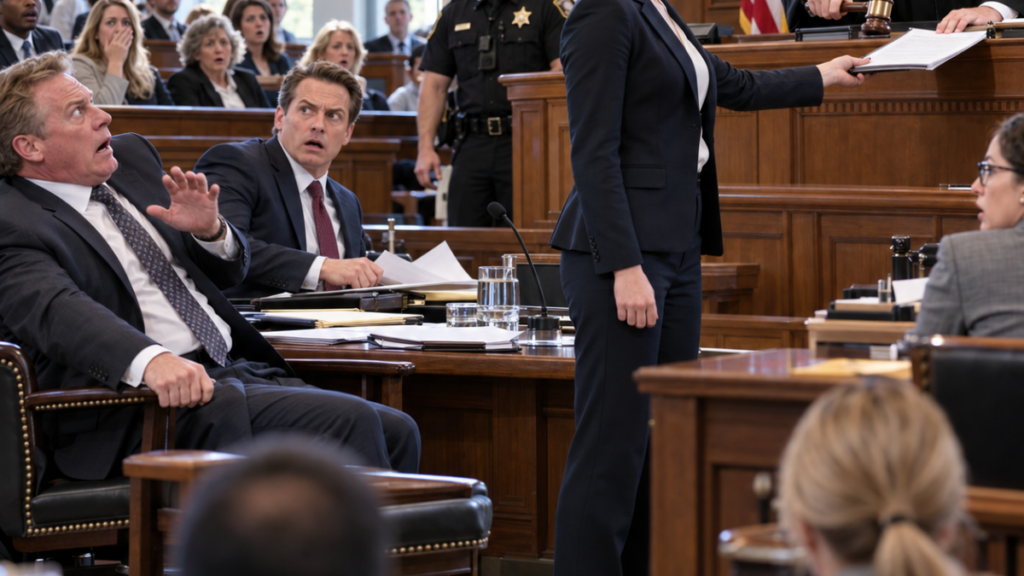
“You Are Wrong. You’re A Stupid Girl,” My Dad Mocked In Court, Thinking I Was Just A Broke Soldier. I Didn’t Flinch While His Lawyer Sneered. I Quietly Handed The Judge My CID Report. He Froze, Slammed His Heavy Gavel, And Glared At My Dad. “Sir… Do You Have Any Idea Who You Just Insulted?”
My father called me a stupid girl in front of a federal judge because he believed the Army had turned me into a broke, obedient nobody who could never challenge his money or his lawyers. I let him laugh. I let his attorney insult my uniform. What neither of them knew was that the battered brown folder beneath my hand contained evidence tied to my dead mother, millions of missing dollars, and one secret that could destroy the empire my father had spent thirty years protecting.
### Part 1
“You’re wrong. You’ve always been a stupid girl.”
My biological father said it loudly enough for the court reporter to stop typing.
For one second, the federal courtroom went strangely still. The ventilation system whispered above the dark oak paneling, a bailiff shifted beside the double doors, and somewhere behind me a spectator coughed before apparently deciding even that sound was too much. My father, Richard Mercer, leaned back in his chair as if he had just delivered the winning argument instead of insulting his daughter on the record.
His attorney, Preston Hale, did not correct him. Hale only adjusted the cuffs of his charcoal suit and smiled at me with the faint amusement of a man watching somebody walk toward a cliff.
I kept both hands flat on the plaintiff’s table.
That disappointed them.
Richard had spent most of my childhood discovering exactly which words could make me cry. Hale had spent the previous half hour portraying me as a bitter daughter who had returned after my mother’s death because I wanted family money. Together, they were waiting for the same thing: tears, anger, a raised voice, anything they could point to and call instability.
Instead, I looked at the brown folder between my hands.
Its corners were soft from weeks in my truck. There was a coffee stain near the bottom edge and a strip of clear tape along the spine. It looked more appropriate for an old tax return than for what it actually contained.
Judge Samuel Whitaker looked over his glasses. “Mr. Mercer, you will address this court with restraint.”
Richard lifted one shoulder. “Of course, Your Honor.”
There was no apology.
Hale stood. “If I may continue?”
The judge nodded.
Hale stepped away from his table and buttoned his jacket. “Captain Natalie Mercer has chosen to present herself as an investigator, a victim, and an heir, all at once. But this is not a military proceeding. A uniform does not transform suspicion into evidence.”
His gaze dropped deliberately to my Army service ribbons.
“Nor does military service entitle anyone to a family fortune.”
Richard’s mouth twitched.
I breathed in slowly through my nose.
There are moments when anger feels powerful but is actually a gift to the person provoking you. My father had taught me that long before the Army taught me anything. He could take a reasonable objection, provoke an emotional response, then spend hours arguing about the response instead of the thing he had done.
As a child, I had never understood the trick.
As an adult, I had investigated people who moved stolen government money through layers of vendors, false invoices, and shell companies. Compared with them, Richard was emotionally sophisticated but financially predictable.
Hale continued. “Mrs. Evelyn Mercer died almost a year ago. My client has endured grief, business instability, and repeated accusations from a daughter who voluntarily separated herself from this family nearly fifteen years earlier.”
Voluntarily.
I almost smiled at the word.
At eighteen, I had left my father’s house with one duffel bag because he told me that if I joined the Army, I could forget my place in the Mercer family.
.
I had believed him.
What I did not yet know was that my mother had refused to forget me.
Judge Whitaker turned toward me. “Captain Mercer, you will have an opportunity to respond.”
“Yes, Your Honor.”
Richard looked at me.
For the first time that morning, the confidence in his face flickered.
My calm bothered him more than anger ever could.
That expression carried me backward almost twenty years, to a dining room twice the size of my current apartment.
The Mercer house sat beyond an iron gate on twelve acres of manicured Virginia land. From the road, it looked like a magazine photograph: pale stone walls, black shutters, white columns, and windows glowing warmly every evening. Inside, everything had rules.
Dinner at seven.
No elbows on the table.
No disagreement with Richard.
No embarrassing the Mercer name.
My mother, Evelyn, came from an old family with investments, land, and trusts established before she ever met my father. Richard liked telling people he was self-made. I learned early that “self-made” sometimes meant using someone else’s money so confidently that eventually everyone forgot whose money it had been.
Evelyn rarely corrected him.
.
She had a quietness that I misunderstood as weakness when I was young.
Only later did I understand how carefully she was surviving him.
The balance of our household shifted when I was eight and my half brother, Evan, entered our lives. Richard had fathered him during an affair with an employee. After the scandal threatened to become public, Richard did something I still find astonishing: he brought the child into our home and behaved as though the betrayal itself entitled him to admiration.
My mother raised Evan kindly.
Richard worshipped him.
I could bring home straight A’s, win a track meet, or place first in a science competition, and Richard would glance at the certificate before asking whether Evan had finished his homework.
At fourteen, I stopped competing.
At eighteen, I stopped asking.
The night I announced I was joining the Army, I placed my paperwork next to Richard’s dinner plate.
He stared at it.
“What is this?”
“My enlistment paperwork.”
My mother’s fork stopped halfway to her mouth.
Richard looked at me, then laughed once. “No.”
“It’s already signed.”
The laugh vanished.
“You are not throwing away the opportunities attached to this name so you can become a government servant.”
“I’ve made my decision.”
“You’ve made nothing. You’re eighteen.”
“I leave Monday.”
The silverware rattled when his palm hit the table.
Evan jumped.
My mother closed her eyes.
Richard pointed toward the front hall. “If you walk out of this house for the Army, do not come crawling back when you discover the world doesn’t care about your little independence experiment.”
I remember the chandelier reflected in his wineglass.
I remember the smell of roasted rosemary potatoes.
Most clearly, I remember realizing that my father believed love was something he could revoke like a company benefit.
I stood.
My mother whispered, “Natalie.”
I looked at her.
She did not ask me to stay.
That mattered.
The next morning she drove me to the recruiting station in complete silence. Just before I got out, she reached across the console and closed her hand around mine.
“Build something that belongs to you,” she said.
Those were the only words she spoke.
I carried them through training, promotions, deployments, and eventually into the Army Criminal Investigation Division, where I discovered I had an instinct for financial cases.
I loved patterns.
Numbers did not become louder when cornered. Bank transfers did not rewrite history because they disliked the conclusion. A date was a date. A signature either existed when it claimed to exist or it did not.
Fourteen years after I left home, I received a call at 2:13 in the morning.
My mother was dead.
She had collapsed at home.
By the time I reached Virginia, the funeral had already become another Richard Mercer performance.
He stood beside her grave in a perfectly tailored black coat, greeting bankers, developers, elected officials, and business associates. I watched him shake hands above the fresh earth covering the woman whose inheritance had funded his first company.
When the crowd thinned, he approached me.
“This is yours.”
He pushed a scratched wooden box into my hands.
“What is it?”
“Your mother left it for you.”
I looked toward the casket.
“That’s all?”
His face hardened. “Don’t start.”
Inside the box were a broken pearl necklace, an old brass locket, and a photograph of my mother holding me when I was five.
Nothing else.
No letter.
No financial documents.
No mention of the Mercer family trust my grandmother had established for my mother decades earlier.
At first I told myself grief was making me suspicious.
Then I asked Richard one simple question.
“What happened to Mom’s trust?”
His reaction answered before his words did.
His face reddened immediately. “She spent it.”
“All of it?”
“She was terrible with money.”
My mother had tracked grocery receipts to the penny.
I watched a bead of sweat form near Richard’s temple.
“Can I see the records?”
His fist struck the desk.
“You disappear for fourteen years, then come back counting money before your mother is cold?”
There it was.
Volume instead of explanation.
I left his office without another word.
That night, while packing, I picked up the wooden box and noticed something strange.
The inside was too shallow for its exterior depth.
I removed the faded lining.
Beneath it was a brass key taped flat against the wood.
A numbered storage key.
The next afternoon, it opened a unit rented under my mother’s maiden name.
Inside were dusty boxes, old coats, family photographs, and a steel lockbox hidden at the rear.
My birthday opened the combination.
At the bottom lay an envelope.
I unfolded the first document.
The title stopped me cold.
Mercer Family Trust — Original Executed Draft.
I turned to the beneficiary page.
Evelyn had divided everything equally.
Fifty percent to Evan.
Fifty percent to me.
But the trust currently registered with the family attorneys contained only one beneficiary.
Evan.
I stood alone in that dusty storage unit, holding two versions of my mother’s last financial wishes.
One had my name.
One had erased me completely.
And both carried what appeared to be her signature.
For the first time, I stopped wondering whether my father had lied.
I started wondering how much he had stolen.
### Part 2
I did not confront Richard immediately.
That was probably the first decision that saved the case.
The daughter in me wanted to drive straight to the Mercer house, throw both trust documents across his desk, and demand the truth. The investigator in me knew better. People destroy evidence when they learn what you know, and Richard had spent decades building relationships with bankers, lawyers, accountants, contractors, and county officials.
So I returned to Fort Belvoir and locked the original trust document in an evidence safe.
Then I started building a timeline.
My office after midnight was not impressive. Gray cinder-block walls, fluorescent lights that hummed loudly enough to make headaches inevitable, two filing cabinets, an aging coffee machine, and a corkboard that had held photographs from an unrelated procurement case the week before.
I cleared the board.
At the center I pinned a photocopy of my mother’s original trust.
Beside it, I placed the amended version produced by Richard’s attorneys after her death.
I drew one line between them.
Then another.
And another.
Evelyn signed the original years earlier.
Eight months after she died, a new authorization suddenly appeared transferring control of nearly everything into accounts managed by Mercer Development Group.
That fact alone made me sit down.
I checked it again.
Then a third time.
The document bore my mother’s signature.
The creation date was eight months after her funeral.
For the first time since finding the storage unit, my hands shook.
Not because I was afraid.
Because some part of me had still wanted an innocent explanation.
Maybe the documents had been scanned late.
Maybe the bank had migrated an old file.
Maybe metadata had changed during archival processing.
Investigators survive by distrusting convenient conclusions, even when those conclusions support what we desperately want to believe.
I needed an examiner.
Major Daniel Cho worked two buildings away and had spent most of his career identifying forged procurement records. He was patient, dry, and incapable of pretending a weak theory was stronger than it was.
He studied the copy for several minutes.
“You want the professional answer or the friendly one?”
“Professional.”
“I need the original digital file.”
“I’m working on it.”
“If the embedded date is authentic and the signature was inserted afterward, this gets ugly.”
“It’s already ugly.”
“No.” He pushed the page back toward me. “Right now it’s family ugly. What you’re describing could become federal ugly.”
That distinction followed me home.
I lived in a small two-bedroom apartment twelve minutes from base. Richard would have hated it. No vaulted ceilings, no imported tile, no wine cellar. My kitchen table had a scratch across one corner from a move three years earlier.
Everything inside it belonged to me.
I made coffee and opened public property records.
Over the next two weeks, the pattern emerged slowly.
My mother’s lake property had been sold below market value to a company linked to one of Richard’s golf partners.
A commercial building owned outright by her trust had been refinanced.
Then came withdrawals.
Two hundred thousand.
Four hundred fifty thousand.
Seven hundred thousand.
Each withdrawal occurred within days of a financial problem at Mercer Development Group.
A stalled shopping-center project.
An overleveraged apartment acquisition.
A failed zoning fight.
My mother’s trust had become the company’s emergency oxygen tank.
When Mercer Development could not breathe, Richard reached into Evelyn’s estate.
The transfers did not move directly.
That would have been too obvious.
They went through companies with harmless names: Ridgepoint Consulting, Meridian Asset Services, Hawthorne Capital Management.
I searched corporate registrations.
Some traced to Richard.
Some traced to his friends.
One traced to my brother Evan.
That stopped me.
Evan was twenty-six and technically vice president of operations at Mercer Development.
Technically.
The last time I had seen him before the funeral, he spent ten minutes telling me about a new Italian sports car and fifteen seconds asking where I was stationed.
He was not stupid.
But he had been protected from consequences for so long that he had never developed the instinct to ask why anything happened.
Richard told him where to sit.
Evan sat.
Richard told him what to sign.
I suspected Evan signed.
That did not make him innocent, but it made him useful.
I requested archived corporate filings.
Three days later, a certified envelope arrived at the base mail center.
I recognized the name before opening it.
Hale, Bishop & Crowe.
Preston Hale.
Richard’s lawyer.
The letter accused me of harassment, misuse of private financial information, intimidation, and attempted extortion.
Then Hale threatened my career.
If I continued investigating Richard’s finances, he wrote, they would submit formal complaints to Army leadership claiming I had abused my position to pursue a private inheritance dispute.
For about thirty seconds, I felt the old pressure in my chest.
Not fear of the lawsuit.
Fear of contamination.
My career was mine.
Richard had never paid for it.
He had never attended a promotion ceremony or sent a card after a deployment. He did not get to put his hands on the one life I had built beyond his reach.
I read the letter twice.
Then I made a copy and placed the original in a folder.
I did not throw it away.
Threats are evidence too.
That evening Richard called.
I let it ring.
He called again.
On the fourth attempt, I answered.
“What?”
“You’ve been digging through records that don’t belong to you.”
“I requested public filings.”
“You are playing a dangerous game.”
“No, Richard. I think I’m finally understanding the game you’ve been playing.”
Silence.
Then came the familiar laugh.
“You always were dramatic.”
“Why does a trust authorization carry Mom’s signature eight months after her death?”
Silence again.
Longer this time.
I heard ice shift in a glass.
Then he said, “You have no idea what you’re looking at.”
“Then explain it.”
“I don’t answer to you.”
“You might have to answer to someone.”
His voice hardened. “You think because you wear a uniform, people are going to treat your fantasies like evidence?”
There it was again.
The uniform.
In his mind, Army meant obedient.
Simple.
Poor.
He still imagined me at eighteen, dragging a duffel bag into a recruiting office because I had nowhere better to go.
He had never bothered learning what I actually did.
“Stop digging,” he said.
“No.”
“You have nothing.”
“We’ll see.”
He hung up.
Two days later, Daniel Cho called me into his lab.
He had obtained the original bank file through proper legal channels after I submitted the preliminary discrepancy through Army CID because some of the shell entities also appeared in a defense-vendor database. That connection transformed the case from a private inheritance dispute into something larger.
Daniel rotated his monitor toward me.
“The signature image was imported.”
“When?”
“The PDF was generated after your mother died.”
I stared at the screen.
“Could the signature have come from a legitimate earlier form?”
“Yes.”
“So it isn’t enough.”
“No.”
I felt disappointment.
Then Daniel scrolled.
“But this is.”
He showed me a layer inside the file.
The signature had been copied from a medical authorization my mother signed years earlier. Microscopic compression artifacts matched.
Someone had taken her name from an unrelated document and digitally transplanted it onto a financial authorization after she was dead.
I felt something inside me become very quiet.
Daniel studied my face.
“You okay?”
“No.”
“Want five minutes?”
“No.”
That evening I drove to the Mercer estate.
Richard met me on the porch holding a cigar.
“What are you doing here?”
“I wanted to see you.”
“You’ve seen me.”
“I know the signature was copied.”
His expression changed for less than a second.
That was enough.
He recovered quickly. “Get off my property.”
“Mom trusted you.”
“Your mother understood that I ran the finances.”
“After she died?”
His eyes narrowed.
Then he smiled.
“You’ve spent too much time around criminals, Natalie. Now you see crimes everywhere.”
“I see patterns.”
“You see what you want to see.”
He stepped closer.
“You were never meant for this family. Evelyn was too sentimental to admit it. You rejected everything we gave you and now you’re back with your hand out.”
Ten years earlier, I might have argued.
Instead, I said, “I don’t need your money.”
“Then leave.”
“I need the truth.”
“You couldn’t handle the truth about this family.”
“I’ve handled worse things than you.”
The cigar trembled slightly between his fingers.
I turned away.
He called after me. “You have nothing!”
I reached my truck, opened the door, and looked back.
“Then why are you scared?”
I drove away before he answered.
At the first stoplight, I pulled out my phone.
There was one person who had once controlled every ledger inside Mercer Development.
Her name was Joanne Keller.
Former chief financial officer.
She had resigned five years earlier without explanation.
I had not spoken to her since I was a teenager.
I sent one message.
This is Natalie Mercer. I found my mother’s original trust. I think you know what happened to it.
My phone rang less than a minute later.
Joanne did not say hello.
She said, “Do not call me again from your regular number.”
Then she whispered the sentence that changed the entire investigation.
“Your father didn’t just steal from Evelyn.”
### Part 3
Joanne chose the meeting place.
A twenty-four-hour diner beside Interstate 95 where the coffee tasted burned and the vinyl seats had cracks repaired with gray tape.
I arrived first.
She parked behind the building ten minutes later and entered through the side door wearing a long navy coat and a baseball cap pulled low over her forehead. I almost did not recognize her.
The Joanne Keller I remembered had been sharp and polished, the kind of executive who wore structured jackets and walked through Mercer Development carrying three folders at a time.
The woman sliding into the booth across from me looked exhausted.
She wrapped both hands around her coffee.
“Are you recording this?”
“No.”
“Are you here as a daughter or CID?”
“Right now?”
“Yes.”
“Both.”
She gave a humorless laugh. “That’s dangerous.”
“I’m discovering that.”
For several seconds, she watched the parking lot through the window.
Then she said, “Your mother knew.”
“Knew what?”
“That Richard was draining the trust.”
The words hurt more than I expected.
“When?”
“About six years before she died.”
“Why didn’t she stop him?”
“She tried.”
Joanne opened her handbag and removed a folded piece of paper.
It was not an official document.
It was a photocopy of a handwritten note.
Natalie needs protection from Richard. If anything happens to me, find a way to reach her.
My mother’s handwriting.
I read it twice.
“Why didn’t you contact me?”
“Because I was afraid.”
“At least you’re honest.”
Joanne flinched.
I immediately regretted the sharpness.
She stared into her coffee. “You should be angry.”
“I don’t know what I am.”
“Richard had leverage on everyone. Loans, jobs, marriages, affairs, business failures. People around him didn’t just work for him. They became dependent on him.”
“And you?”
“My husband’s company owed Mercer Development almost two million dollars.”
I leaned back.
“He threatened the debt?”
“He threatened to force bankruptcy if I talked.”
“Did you help him move the trust money?”
Her eyes lifted.
“Yes.”
It was barely audible.
“How much?”
“At first, I thought the transfers were authorized. Your mother had signed broad management agreements years earlier. Richard used those documents to create the appearance that everything was legitimate.”
“And later?”
“Later I knew.”
I let the silence sit between us.
Outside, a tractor-trailer rolled past, vibrating the glass.
“Why did you leave?”
“Because he ordered me to create an account under Evan’s information.”
My attention sharpened.
“What kind of account?”
“A holding company.”
“Ridgepoint?”
“No. Apex North.”
I knew the name.
It appeared in three wire transfers I had not yet connected to an owner.
“Who controlled it?”
“Richard.”
“Whose name was on it?”
“Evan’s.”
That fit my theory.
Richard had not merely favored Evan.
He had positioned him.
“What did the account receive?”
“Trust money. Corporate money. Money from vendors.”
“What vendors?”
She hesitated.
“Some worked with government facilities.”
That explained the CID connection.
“How much documentation do you have?”
Joanne looked at me for several seconds.
Then she reached into her bag again.
This time she removed a small solid-state drive sealed in an anti-static sleeve.
“I copied everything before I resigned.”
I did not touch it immediately.
“Why?”
“Insurance.”
“Against Richard?”
“Against everybody.”
“What’s on it?”
“Raw ledgers. Wire confirmations. Company authorizations. Scans of notes Richard gave me. Internal emails. I don’t know how much is still relevant.”
“Did you alter anything?”
“No.”
“Has anyone else had access?”
“No.”
I finally took it.
It was surprisingly light.
Years of theft sat inside an object smaller than my palm.
“If you give me this, you may have to testify.”
“I know.”
“He’ll destroy you publicly.”
“He already did privately.”
That was the moment I understood Joanne.
Fear had kept her silent.
Guilt had kept her awake.
She was not giving me the drive because she suddenly became fearless.
She was giving it to me because fear had stopped being worth the price.
I returned to base and followed evidence procedures exactly.
No private laptop.
No casual copying.
No shortcuts because the suspect happened to be my father.
I recused myself from certain investigative decisions and turned primary evidentiary control over to Special Agent Marcus Reed, who had no connection to my family.
Reed was forty-three, blunt, and suspicious of everybody.
Especially me.
“This goes where the evidence goes,” he said.
“I know.”
“If it clears your father, it clears your father.”
“I know.”
“If it implicates you, we follow that too.”
“I know.”
He studied me. “Good.”
The forensic review lasted days.
I slept badly.
Every morning I ran before sunrise until the cold air hurt my lungs.
Every evening I returned to the apartment and stared at my mother’s photograph.
I kept remembering the recruiting station.
Build something that belongs to you.
Had she known even then that Richard might one day try to take everything else?
Reed called me on Thursday.
“We found government vendor money.”
“How much?”
“Enough.”
“Through Apex North?”
“Yes.”
“And the trust?”
“Mixed into the same network.”
That created a jurisdictional bridge Richard had never anticipated.
He had not simply stolen from a family trust.
He had mixed stolen private assets with money connected to companies servicing federal contracts.
The financial trail widened.
Search authority followed.
Bank records arrived.
Then emails.
Richard had used language he believed was clever.
Move Evelyn’s reserve.
Run it through the boy’s vehicle.
Keep Natalie’s name nowhere near this.
My stomach turned when I read that line.
Not because he had excluded me.
Because of the casual way he wrote it.
As if I were a stain to be kept off paperwork.
Then we found something worse.
An email to Preston Hale.
Subject: revised beneficiary structure.
Hale replied: If the original surfaces, we have exposure.
I stared at those words.
Richard’s lawyer knew.
Maybe not everything.
But enough.
The courtroom case began as a civil petition challenging trust administration.
The federal investigation continued separately.
Richard, assuming the civil case was my only weapon, decided to crush it aggressively.
Hale filed motions questioning my standing.
They accused me of fabricating the storage-unit discovery.
They argued the original trust was a draft that had been superseded.
Then Richard made a mistake.
He demanded a hearing.
He wanted an audience.
That was always his weakness.
Private victory was never enough for him. He needed witnesses.
The hearing was scheduled in federal court because of overlapping asset freezes and federal claims tied to the emerging investigation.
One week before the date, Evan called me.
I almost did not answer.
“Natalie?”
His voice sounded thin.
“What?”
“Dad says you’re trying to send him to prison.”
“I’m following evidence.”
“He says you stole documents.”
“Did he tell you about Apex North?”
Silence.
“Evan?”
“What is Apex North?”
My chest tightened.
“A company registered under your information.”
“I don’t own a company called that.”
“You’re listed as principal.”
“No.”
“Did Dad ever put documents on your desk and tell you to sign them?”
Another silence.
Then, “Sometimes.”
“How often?”
“I don’t know.”
“Did you read them?”
“Natalie, I had hundreds of documents.”
“That’s not an answer.”
“No.”
His breathing changed.
“What did I sign?”
“I don’t know yet.”
“Am I in trouble?”
“I’m not your lawyer.”
“He told me it was routine.”
“He told you a lot of things.”
“He wouldn’t set me up.”
There it was.
Faith.
The same faith I once begged Richard to give me, Evan had handed to him without question.
“I hope you’re right,” I said.
But I already suspected he was not.
The night before court, Reed handed me the finalized CID financial analysis authorized for disclosure.
“You understand what happens tomorrow?”
“Yes.”
“This isn’t your chance to punish your father.”
“I know.”
He looked at me carefully.
“Do you?”
I thought about it.
“I wanted punishment when I first found the trust.”
“And now?”
“Now I want the record to be accurate.”
He nodded.
“That answer I believe.”
I returned home and laid out my Class A uniform.
I pressed every crease.
Polished every button.
Aligned every ribbon.
Richard had spent years dismissing my military career as evidence that I lacked ambition.
Tomorrow, I would wear that career into court.
Not as decoration.
As history.
The next morning, I entered the courtroom carrying one brown folder.
Richard saw it and smiled.
Hale leaned over and whispered something to him.
They both laughed.
They thought I had brought a few sentimental documents from my mother’s storage unit.
They had no idea federal investigators had spent weeks verifying every page.
And they had no idea the first person their evidence was about to destroy was not Richard.
It was Evan.
### Part 4
The hearing began at nine.
By nine-thirty, Hale had turned my life into a story I barely recognized.
According to him, I had abandoned a loving family for the Army, returned after my mother’s death, become obsessed with money, and then exploited investigative contacts to intimidate my grieving father.
Richard sat beside him with the expression of a wounded patriarch.
If I had not grown up watching him perform innocence, I might have admired the technique.
Hale paced slowly.
“Captain Mercer wants this court to believe she seeks truth rather than money.”
He turned toward me.
“Yet she filed a claim for assets worth millions.”
I answered only when asked.
“I filed to prevent disputed assets from being transferred.”
“But you would benefit if the trust were restored.”
“Yes.”
“So you have a financial interest.”
“Yes.”
Hale smiled.
He thought agreement weakened me.
It did not.
Investigators learn quickly that defensiveness creates openings. Facts survive clean answers.
Then Richard testified.
That was when he called me stupid.
Hale had asked why my mother would remove me from the trust.
Richard looked directly at me.
“Because Evelyn finally realized Natalie was irresponsible.”
My jaw tightened.
Hale continued. “Irresponsible in what way?”
“She threw away every opportunity we gave her.”
“I joined the Army.”
Richard laughed. “Exactly.”
Judge Whitaker looked up.
Richard leaned closer to the microphone.
“You’re wrong about all of this, Natalie. You were always wrong. You’re just a stupid girl who thinks wearing a uniform makes you important.”
The court reporter stopped.
The bailiff shifted.
Something rustled in the gallery.
I felt the old wound open.
Not fully.
Just enough to remind me it existed.
For years I had imagined reaching a point where his words meant absolutely nothing.
That was unrealistic.
Some injuries become scars, not erased skin.
The difference was that I no longer obeyed the pain.
I looked at Judge Whitaker.
“Your Honor, may I submit supplemental evidence relevant to the trust’s authenticity and subsequent transfers?”
Hale stood immediately.
“Objection.”
The judge frowned. “Basis?”
“Surprise and prejudice.”
“The evidence was disclosed under protective order.”
Hale’s face changed.
Only slightly.
The judge looked at the clerk.
“Bring it forward.”
I stood.
My chair scraped the floor.
I carried the brown folder toward the bench.
For the first time, Richard stopped smiling.
The clerk delivered it to Judge Whitaker.
He opened the folder.
The first section contained the original trust recovered from the storage unit and laboratory confirmation of paper, ink, and signature characteristics.
The second section contained the amended authorization.
The third contained the Army CID forensic analysis connecting the signature image to an earlier medical document and showing the amended PDF had been created after my mother’s death.
The fourth contained verified wire transfers.
Judge Whitaker read silently.
Thirty seconds passed.
Then a minute.
Hale rose.
“Your Honor, these materials involve conclusions outside the proper scope of this proceeding.”
The judge did not look up.
“Sit down.”
Hale hesitated.
“Your Honor—”
“Mr. Hale.”
He sat.
Judge Whitaker turned another page.
Then another.
Finally he looked at me.
“Captain Mercer, what is your present position with Army CID?”
“I serve as a special agent specializing in financial investigations.”
Richard’s face went blank.
The judge looked toward him.
“Mr. Mercer, were you aware of that?”
Richard swallowed.
“She works for the Army.”
“That was not my question.”
“No.”
Judge Whitaker’s gaze shifted toward Hale.
“Counsel?”
Hale adjusted his tie.
“I was aware Captain Mercer had investigative responsibilities.”
“Financial?”
“I did not know the exact nature.”
I knew that was not true.
The threatening letter had specifically accused me of using financial-investigation resources.
But I stayed silent.
The judge lifted the forensic report.
“This report indicates a document bearing Evelyn Mercer’s signature was created eight months after her death.”
Hale stood again.
“The defense contests that conclusion.”
“You may contest it.”
The judge’s voice hardened.
“You may not pretend it does not exist.”
He turned to Richard.
“Mr. Mercer, you have spent this morning describing your daughter as financially ignorant.”
Richard gripped the table.
Judge Whitaker continued.
“For clarity, the woman you repeatedly dismissed is a trained federal investigator whose work includes complex financial fraud.”
A murmur moved through the room.
Richard stared at me.
I had seen him angry.
I had seen him contemptuous.
I had never seen him confused.
His version of me had survived because he never updated it.
In his mind I was still eighteen, standing beside a dining-room table, choosing a life he considered beneath him.
The judge flipped to the transfer summary.
“More concerning, however, are these transactions.”
Hale’s shoulders stiffened.
The first transfer left my mother’s trust and entered Ridgepoint Consulting.
The second moved through Meridian Asset Services.
The third traveled to Apex North.
Judge Whitaker stopped.
“Who owns Apex North?”
No one answered.
The judge looked toward the witness list.
“Evan Mercer is present?”
My brother sat behind Richard.
His head lifted sharply.
“Yes, Your Honor.”
“Take the stand.”
Evan looked toward our father.
Richard did not turn around.
That told me everything.
Evan walked toward the witness box.
He looked pale.
After the oath, Judge Whitaker asked, “Mr. Mercer, are you an owner or principal of Apex North LLC?”
“No.”
Hale rose. “Your Honor, my client—”
“Your client is Richard Mercer.”
Hale stopped.
Judge Whitaker looked at Evan again.
“Your name appears on the organizational documents.”
Evan stared at the papers.
“I’ve never heard of it.”
“Is that your signature?”
His lips parted.
“Yes.”
“Then explain.”
“I can’t.”
Richard finally looked up.
“Evan.”
One word.
A warning.
My brother heard it too.
His face changed.
Judge Whitaker noticed.
“Mr. Mercer, do not communicate with the witness.”
Richard leaned back.
Evan studied the documents.
“I signed papers Dad brought into my office.”
“How many?”
“I don’t know.”
“Did you read them?”
His voice broke.
“No.”
The gallery was silent.
I watched my brother’s hands tremble.
For most of his life, Evan believed favoritism meant safety.
He had never understood that a controlling parent does not necessarily love the favored child more.
Sometimes the favored child is simply more useful.
The clerk handed him bank records.
Fourteen transfers.
More than four million dollars.
All routed through an account associated with him.
“I didn’t do this,” Evan whispered.
Hale stood. “The documents do not establish criminal intent.”
“No one asked you about criminal intent,” Judge Whitaker said.
Evan looked toward Richard.
“Dad?”
Richard stared straight ahead.
“Dad, what is this?”
Nothing.
“Did you put this in my name?”
Richard’s jaw tightened.
“You don’t understand business.”
That sentence destroyed Evan more effectively than any accusation could have.
His face collapsed.
“All these years, you told me I was running operations.”
“This is not the time.”
“You said I was your partner.”
“Evan.”
“You used my name.”
Judge Whitaker raised a hand.
“Mr. Mercer, control yourself.”
Evan pressed his palms against his eyes.
I should have felt satisfaction.
I did not.
Watching Richard’s favorite child realize he had been disposable did not heal anything inside me.
It only proved the poison had reached everyone.
Hale requested a recess.
The judge denied it.
I turned toward Special Agent Reed, who sat near the rear of the courtroom.
He gave the smallest nod.
The next exhibit had been cleared.
I reached into my document case.
It contained an audio file recovered from one of Richard’s longtime associates.
The recording did not merely connect him to the accounts.
It revealed why he had placed them in Evan’s name.
And when Richard saw the device in my hand, every trace of color disappeared from his face.
### Part 5
The recording came from Gregory Shaw, a developer who had purchased my mother’s lake property through one of Richard’s side agreements.
Gregory had not approached investigators out of conscience.
He approached them because people become cooperative when they realize someone else intends to make them the scapegoat.
His attorney negotiated carefully.
In exchange for truthful cooperation and records, prosecutors would consider the extent of his role separately.
Among the evidence Gregory surrendered was a recording from a private dining room.
He had made it himself.
Not to expose Richard.
To protect himself.
Judge Whitaker allowed the relevant portion to be played.
The courtroom speakers crackled.
Then I heard my father’s voice.
Relaxed.
Amused.
Nothing like the injured widower sitting fifteen feet away.
Gregory’s voice came first.
“What happens if anybody traces Apex back to the family?”
Richard laughed.
“They’ll find Evan.”
I glanced toward my brother.
His eyes closed.
The recording continued.
Gregory asked, “You’re comfortable with that?”
“Evan signs whatever I put in front of him.”
Someone poured a drink.
The sound was painfully ordinary.
Then Richard said, “If something goes wrong, he’s an adult and an officer of the company. Let him explain why he never reads anything.”
Evan made a sound beside the witness stand.
Not quite a sob.
Not quite a gasp.
Richard did not look at him.
Gregory asked another question.
“And Natalie?”
My spine stiffened.
My father laughed again.
“Natalie plays investigator for the Army. She’s probably chasing stolen laptops in Texas. She doesn’t know the first thing about real money.”
Gregory said something too muffled to understand.
Then Richard replied, “Evelyn always thought that girl was special. Stubborn, difficult, impossible to control. I removed the problem.”
The recording ended.
No one moved.
For years, I had wanted proof that Richard’s treatment of me was deliberate.
Sitting in that courtroom, I finally had it.
I discovered something unexpected.
Proof did not feel good.
It felt cold.
Judge Whitaker removed his glasses.
“Mr. Hale?”
Hale rose slowly.
“I need to confer with my client.”
“I imagine you do.”
“May we have a recess?”
This time the judge allowed fifteen minutes.
Richard and Hale disappeared into a side conference room.
Evan remained seated.
He looked at me.
“I didn’t know.”
I said nothing.
“Natalie, I swear.”
“I believe you didn’t know about some of it.”
“Some?”
“You still signed documents without reading them.”
His face tightened.
“Dad told me—”
“I know what Dad told you.”
“You think I deserve this?”
“No.”
The answer surprised him.
I continued.
“I think you were careless because you believed being his favorite protected you from consequences.”
Evan looked down.
“That’s different.”
“It doesn’t feel different right now.”
He rubbed both hands over his face.
“I thought he loved me.”
There was no useful response to that.
So I gave him the truth.
“He probably does in whatever way he understands love.”
Evan looked up.
“That’s worse.”
“Yes.”
The hearing resumed.
Hale’s tone had changed.
The arrogance was gone.
He now challenged narrow details, attempted to exclude individual transactions, and argued that Richard’s recorded statements were being interpreted without sufficient context.
Judge Whitaker listened.
Then Special Agent Reed was called to authenticate the federal investigative summary.
The moment Reed identified himself, Hale’s posture became rigid.
“What exactly is Army CID investigating?” Judge Whitaker asked.
Reed answered carefully.
“Potential fraud involving entities connected to federal contracting, including financial flows that overlap with assets disputed in this civil matter.”
“Is Captain Mercer directing that investigation?”
“No.”
That mattered.
Hale had built half his attack on the accusation that I had used my authority for personal revenge.
Reed explained my disclosure, my partial recusal, and the independent handling of evidence.
Hale’s theory collapsed one careful answer at a time.
Then came his own problem.
A document entered into the record showed his firm had received the original trust schedule years earlier.
The schedule included my name.
Judge Whitaker looked directly at Hale.
“Your firm possessed this?”
Hale’s face tightened.
“The firm did.”
“And later presented a beneficiary schedule that omitted Captain Mercer?”
“The later document was provided by the client.”
“Did anyone at your firm investigate the discrepancy?”
“I cannot speak to every internal review.”
“That is not an answer.”
Richard leaned toward him.
Hale pulled away.
That tiny movement did not escape anyone.
By lunchtime, father and lawyer were no longer sitting as allies.
They were sitting as two men calculating which one might survive by blaming the other.
Judge Whitaker ordered continued freezing of the disputed trust assets and referred the apparent document irregularities for further criminal review.
He did not send Richard to prison from the bench.
Real courts are not television.
Criminal investigations require charges, motions, discovery, evidence standards, negotiations, and sometimes months of waiting.
But he did something Richard understood immediately.
He removed control.
A neutral administrator would supervise the trust.
Mercer Development could not move disputed assets.
Relevant corporate accounts were frozen pending federal review.
Richard was no longer allowed to treat my mother’s estate like an extension of his wallet.
When the judge announced those orders, my father stood.
“You can’t do this.”
Hale grabbed his arm.
Richard jerked away.
“I built that company.”
Judge Whitaker stared at him.
“Sit down.”
“You don’t understand what freezing those accounts will do.”
“Sit down, Mr. Mercer.”
“My employees—”
The gavel struck once.
“Bailiff.”
Richard sat.
I watched his face.
That was the first time I ever saw him obey someone he could not punish afterward.
Outside the courthouse, reporters had gathered because word of the federal investigation had leaked.
I avoided them.
Evan followed me down the hallway.
“Natalie.”
I kept walking.
“Please.”
I stopped beside a window overlooking the plaza.
“What?”
“What happens to me?”
“I don’t know.”
“You work these cases.”
“I’m not working yours.”
His mouth tightened.
“Can you tell them I didn’t know?”
“I’ll tell the truth about anything I personally witnessed.”
“That’s it?”
“That’s all I owe the truth.”
He looked hurt.
Some part of me wanted to comfort him.
Another part remembered every Christmas he had ignored my calls because Richard told him I had abandoned the family.
Every birthday dinner where my empty chair became a joke.
Every year Evan enjoyed the benefits of a system built partly by erasing me.
He had been manipulated.
He had also chosen not to look.
Both things could be true.
“Natalie,” he said quietly, “did Mom really leave you half?”
“Yes.”
“I didn’t know.”
“I know.”
“If I had known—”
“You would have asked Dad what he wanted you to believe.”
He flinched.
I regretted the cruelty but not the conclusion.
“I have to go.”
“Natalie.”
“What?”
He looked toward the courtroom doors.
“Do you hate me?”
I thought about it.
“No.”
He exhaled.
Then I added, “But that doesn’t mean we’re close.”
His shoulders fell.
For once, I did not rush to soften the consequence.
Three weeks later, federal agents entered Mercer Development’s headquarters with warrants.
Hard drives were imaged.
Accounting records were seized.
Employees were interviewed.
Richard’s office, the one with the private terrace and framed magazine covers, was sealed.
Hale withdrew as his personal attorney after retaining his own counsel.
Evan resigned.
Joanne testified.
The empire did not collapse in one cinematic explosion.
It came apart room by room.
Account by account.
Signature by signature.
And while investigators worked through thousands of records, I returned to my mother’s wooden box.
I had kept it on a shelf untouched since finding the key.
One Sunday morning, I decided to repair the torn lining.
When I removed the remaining cardboard base, something slipped onto the floor.
A folded sheet of paper.
My name was written across the front.
Natalie.
I sat down before opening it.
The first line was in my mother’s handwriting.
If you are reading this, then Richard has probably tried to convince you that I chose him over you.
My vision blurred.
There were four pages.
And by the time I reached the second, I realized my mother had known much more than Joanne ever told me.
She had been preparing for war too.
### Part 6
My mother’s letter began with an apology.
Not for loving me.
For failing to leave.
I sat on the floor of my apartment with the wooden box beside me and read slowly.
Natalie, if you are reading this, then Richard has probably tried to convince you that I chose him over you. I need you to know that the greatest regret of my life is allowing fear to look like agreement.
I pressed my fingers against my mouth.
The apartment was silent except for the refrigerator humming in the kitchen.
She wrote about my childhood.
About the first time Richard told her I was “too difficult.”
About the way he resented that I questioned rules instead of accepting them.
About the night I announced I was joining the Army.
I wanted to tell you to run, she wrote. Instead, I told you to build something that belonged to you because I knew if you stayed, Richard would spend the rest of your life teaching you to doubt yourself.
I stopped reading.
For fourteen years, I had replayed that morning at the recruiting station.
Sometimes I imagined different endings.
My mother asking me to stay.
My father arriving unexpectedly.
The three of us reconciling in a parking lot like families did in sentimental movies.
Her letter gave me something better.
Reality.
She wanted me gone because escape was the only gift she believed she could safely give.
The next pages explained the trust.
She had discovered Richard was borrowing against assets without permission.
When she confronted him, he promised to restore everything.
Then he began isolating her from financial advisers.
She quietly created copies.
Storage records.
Old statements.
The original trust.
She had also confronted Preston Hale.
That detail stunned me.
According to the letter, Hale told her the disputed transfers could be “restructured” and warned that challenging Richard publicly could create tax problems and damage Mercer Development.
My mother wrote one sentence beneath that description.
He spoke as Richard’s lawyer while pretending to speak as mine.
I copied the letter and gave the original to Reed.
It strengthened the timeline but did something far more important for me personally.
For the first time, grief became separate from guilt.
I had always wondered whether leaving had abandoned my mother.
Now I understood she had considered my escape a victory.
Months passed.
Richard was indicted on multiple federal counts connected to fraud, falsified records, and transactions involving the contracting network.
Hale faced separate scrutiny.
Evan cooperated.
He was not treated as blameless, because signing corporate documents carries responsibility, but investigators found substantial evidence that Richard controlled the entities and deliberately positioned him as a buffer.
The news spread quickly.
Mercer Development lost financing.
Projects were sold.
Board members who once praised Richard’s genius suddenly issued statements claiming they had known very little about daily operations.
I learned another truth about power.
Many people admire it only while it appears permanent.
Richard’s criminal case eventually ended without a dramatic trial.
His attorneys negotiated.
He entered guilty pleas to several major counts in exchange for dismissal of others and a sentencing process that took into account the recovered assets, cooperation on remaining financial issues, and his age.
I attended sentencing.
Not because I wanted to watch him suffer.
Because I wanted to hear the record.
Richard stood before the judge in a plain dark suit.
No gold cuff links.
No audience of developers.
No assistants rushing around him.
When offered the opportunity to speak, he did what he had always done.
He made himself the victim.
“My decisions were made to protect a company that employed hundreds of people.”
The prosecutor looked down.
Richard continued.
“My family turned against me during an extremely difficult period.”
Family.
Not my daughter.
Not Evelyn.
Family as an abstract shield.
Then his eyes found me.
“I wish Natalie had come to me privately.”
I nearly laughed.
I had.
He had thrown me off his property.
Judge Whitaker, who handled portions of the related proceedings, asked Richard a simple question.
“Do you accept that you falsified authorization connected to your late wife’s assets?”
Richard paused.
His attorney whispered something.
“Yes.”
“Do you accept that you moved funds through entities established under your son’s identifying information?”
Another pause.
“Yes.”
“Do you accept that your daughter’s challenge to those transactions was factually justified?”
That answer took longest.
Finally Richard said, “Yes.”
It should have felt victorious.
Instead, I thought about my mother.
She should have heard it.
The sentence was significant.
The financial penalties were devastating.
Assets obtained through the fraudulent scheme were subject to recovery.
I was awarded my lawful share of the remaining trust property through the civil proceedings.
Evan received what the valid trust provided for him, reduced by legitimate adjustments required by the court.
I did not fight him for his half.
That surprised him.
We met outside the courthouse after the final trust order.
“You could have argued I shouldn’t get anything,” he said.
“Mom wanted you to have it.”
“After everything?”
“Her decision matters more than my anger.”
He stared at me.
“I don’t know what to do with that.”
“You don’t have to do anything.”
He nodded.
Then he asked, “Can we start over?”
I looked at him.
“No.”
The word hurt him.
I saw it.
I continued before he could misunderstand.
“We can build something different if your actions support it. But we don’t get to pretend the past disappeared.”
“So that’s a maybe?”
“That’s exactly what I said.”
For the first time in my life, Evan accepted an answer without pushing for a more comfortable one.
Over the following year, we spoke occasionally.
Coffee.
A birthday call.
A conversation about our mother.
I did not become his protective older sister.
He did not become my best friend.
But he stopped defending Richard.
More importantly, he stopped asking me to forgive him quickly.
That allowed something honest to exist.
Richard was different.
His first letter arrived three months after sentencing.
Natalie, I am your father. Whatever happened, that will never change.
I folded it and placed it in a drawer.
The second said he had made mistakes.
The third blamed Hale.
The fourth blamed stress.
The fifth blamed my mother’s advisers.
Not one letter simply said: I chose money and control over you. I harmed your mother. I tried to make you doubt yourself. I was wrong.
I stopped reading them.
Then one afternoon I received a request through his attorney.
Richard wanted a meeting.
No cameras.
No lawyers.
No investigators.
Just us.
I considered refusing.
Then I remembered something my mother wrote near the end of her letter.
You do not owe reconciliation to anyone simply because they regret losing access to you.
I agreed to meet him once.
Not to reconcile.
To see whether he understood anything at all.
He chose a coffee shop beside a highway, the kind of place he once would have considered beneath him.
When I entered, I almost walked past him.
He looked twenty years older.
Richard Mercer, who once controlled boardrooms by leaning back in a leather chair, sat hunched over a paper cup in a wrinkled sweater.
He watched me approach.
For several seconds, neither of us spoke.
Then he asked the question I had expected.
“Are you happy now?”
I sat down.
“No.”
He looked surprised.
“You destroyed everything.”
“No, Richard.”
My voice was calm.
“You destroyed it. I documented it.”
His jaw tightened.
And just like that, I knew the meeting had not been requested because he had changed.
He had requested it because he still needed someone else to carry the blame.
### Part 7
Richard stared at me across the scratched coffee-shop table.
Cars moved along the interstate beyond the window.
A server carried plates behind us.
Nobody recognized him.
That might have been the cruelest consequence of all for a man who spent his life needing every room to know his name.
“You think you’re better than me,” he said.
“No.”
“You always have.”
“I spent half my childhood trying to convince you I was good enough for you.”
He looked away.
“That isn’t how I remember it.”
“I know.”
Memory had always been another asset Richard believed he could control.
He took a drink of coffee.
“I made difficult decisions.”
“You forged Mom’s authorization.”
“For the company.”
“You used Evan’s identity.”
“I protected him.”
“You made him the first person investigators would find.”
His face hardened.
“He benefited from that company his entire life.”
“That doesn’t make him responsible for crimes you hid from him.”
Richard stared at me.
“You’re defending him now?”
“I’m stating facts.”
He gave a bitter laugh.
“Always the investigator.”
“Yes.”
I surprised myself with the pride I felt saying it.
Richard looked toward the window.
“I gave you everything.”
“No. Mom gave you the money that created everything.”
His eyes snapped back to mine.
“That’s not true.”
“You built the business. I’ll give you that.”
He relaxed slightly.
“But you built it using resources you later pretended never existed.”
The relaxation vanished.
“You came here to humiliate me.”
“No.”
“Then why agree to meet?”
I thought about the answer.
“Because some small part of me wanted to know whether losing everything had made you capable of telling the truth.”
“And?”
“It didn’t.”
His face changed.
For a moment, I saw age rather than power.
“You hate me.”
“I used to.”
The admission caught him off guard.
“I used to imagine you losing the house, the company, the people who laughed at your jokes because you paid their salaries. I thought watching that happen would make me feel restored.”
“And it didn’t?”
“No.”
“What did?”
“Understanding I didn’t need anything from you.”
That silenced him.
I stood.
He looked suddenly alarmed.
“That’s it?”
“Yes.”
“I’m your father.”
“You’re the man who fathered me.”
His lips parted.
There are sentences people imagine delivering dramatically.
In reality, mine came out quietly.
I did not need volume.
“You taught me that family love could be withdrawn whenever I disappointed you. Mom taught me something better. She let me leave.”
Richard’s eyes dropped.
For the first time, he looked ashamed.
Or tired.
I no longer cared enough to determine which.
“Natalie.”
I placed five dollars on the table.
“Goodbye, Richard.”
He reached for my wrist.
Then stopped before touching me.
I looked at his hand.
He lowered it.
“I don’t want to die with you hating me.”
I considered him.
“That’s another request about what you want.”
He closed his eyes.
I walked out.
The cold air outside smelled like rain and gasoline.
I stood beside my car for a moment and waited for the emotional collapse I had expected.
It never came.
There was sadness.
Grief.
Even pity.
But no doubt.
I did not forgive him.
Not because I wanted revenge.
Because forgiveness, at least the version Richard wanted, meant access without accountability.
He wanted the comfort of my presence without the work of becoming safe.
I refused.
I changed my number.
His letters went through attorneys if legally necessary.
Otherwise, they were returned unopened.
My life became quieter.
The trust recovery left me with more money than I had ever expected to possess.
At first, I wanted nothing to do with it.
Every dollar felt contaminated.
Then I remembered my mother’s note.
Build something that belongs to you.
I decided to use part of my share to create the Evelyn Mercer Legal Defense Fund, a nonprofit supporting military families dealing with financial exploitation, identity misuse, and complex fraud.
Reed laughed when I first told him.
“Subtle name.”
“I’m done hiding her.”
Joanne joined the advisory board.
Not immediately.
She spent months cooperating with prosecutors and confronting her own role.
One afternoon, she called me.
“I don’t think I deserve to be associated with your mother’s name.”
“Then earn it.”
She was silent.
“What does that mean?”
“It means guilt isn’t useful by itself.”
She eventually helped design a financial-literacy program for military spouses.
Evan rebuilt slowly.
Without Richard, he discovered how little he understood about running a business.
For once, he did not buy another title.
He took a job at a mid-sized property-management firm under a supervisor who did not care who his father had been.
Six months later, he invited me to lunch.
“I got yelled at yesterday,” he said.
“For what?”
“I signed off on a maintenance estimate without checking the contractor’s numbers.”
I stared at him.
He laughed awkwardly.
“I know. I know.”
“What happened?”
“I stayed until nine and fixed it.”
“That’s progress.”
“I thought you’d say I was an idiot.”
“I don’t confuse mistakes with identity.”
He went quiet.
Then he said, “Dad did.”
“Yes.”
“I did too.”
That surprised me.
“How?”
“With you.”
I waited.
“I believed whatever he said because it made my life easier. If he said you abandoned us, then I didn’t have to ask why you stopped coming home.”
I looked at him.
“I’m sorry,” he said.
No excuse followed.
That mattered.
“I accept the apology.”
His eyes widened.
“But?”
“But trust takes time.”
He nodded.
“Fair.”
Two years after the courtroom hearing, I received an invitation to speak at a training conference for young investigators.
The subject was financial fraud inside families.
I almost declined.
Then I realized I had spent much of my life treating my family history like classified information.
So I went.
I did not tell the audience everything.
Some things belonged to me.
But I told them one principle I wished someone had given me years earlier.
“The most dangerous suspect is not always the person who lies well,” I said. “Sometimes it’s the person whose version of reality you have been trained to accept before the investigation even begins.”
Afterward, a young lieutenant approached me.
“My dad controls all my finances,” she said quietly.
I did not tell her what to do.
I gave her resources.
Names.
Questions.
Options.
Agency mattered.
That evening, I returned home and found a package outside my apartment.
No return address.
Inside was the brass locket from my mother’s wooden box.
I froze.
I had not sent it anywhere.
Then I found a note.
Natalie,
I had the clasp repaired. I thought you should have one thing from Mom that wasn’t broken.
Evan.
I sat at the kitchen table holding the locket.
Inside were two tiny photographs.
One showed me at five.
The other showed Evan as a baby.
For once, I did not feel erased by that.
I understood what my mother had done.
She had loved two children inside a house controlled by one destructive man.
Richard had spent years teaching us that love required competition.
He had been wrong about that too.
The next morning, another envelope arrived through official mail.
It was notice that the final disposition of my mother’s recovered assets had been completed.
The legal fight was over.
Every disputed property.
Every transfer.
Every account.
Finished.
At the bottom of the notice was one final item.
A small parcel of land had never been transferred out of my mother’s name.
Three acres overlooking the river.
I recognized the address.
It was where she used to take me when I was a child whenever the Mercer house became unbearable.
For the first time since her death, I knew exactly where I wanted to go.
### Part 8
The river property was smaller than I remembered.
Childhood does strange things to scale.
The hill that once seemed enormous rose only gently from the road, and the path through the trees took less than ten minutes to walk.
Still, the place felt untouched.
Wind moved through bare branches.
Water flashed silver between them.
I stood where my mother and I used to sit on an old wooden bench and remembered being nine years old, angry because Richard had skipped another school event.
My mother had handed me a thermos of hot chocolate.
“Some people miss beautiful things because they are too busy looking at themselves,” she told me.
At nine, I thought she was talking about my science fair.
At thirty-four, I understood she had been talking about my father.
The recovered land legally belonged to me under the trust settlement.
I could have sold it.
Instead, I built something simple.
Not a mansion.
Not a monument.
A small retreat center used by the foundation for workshops and temporary assistance to military families dealing with financial coercion.
We named the main room Evelyn House.
On opening day, Joanne arrived carrying three binders.
Reed brought bad coffee and claimed it was tradition.
Evan came early and spent two hours assembling folding tables because the delivery crew was late.
At one point I watched him struggle with a table leg.
“You know you’re a Mercer vice president,” I said.
He looked up.
“Former Mercer vice president.”
“Right.”
“I’m qualified for furniture now.”
I laughed.
The sound surprised me.
It felt easy.
That was how I knew healing had finally stopped feeling like a mission.
It was becoming ordinary.
My Army career continued.
I had never planned to leave it simply because Richard mocked it.
If anything, the case reminded me why I loved the work.
Not the dramatic raids.
Not courtroom moments.
The precision.
Taking confusion and turning it into something a person could understand.
A transfer happened here.
A signature came from there.
A lie depended on this fact.
Truth often arrived without thunder.
Sometimes it arrived as a date in metadata.
Sometimes as a nervous former CFO carrying a hard drive into a diner.
Sometimes as a mother hiding a key beneath cheap red velvet because she could not safely confront her husband while alive.
I kept her wooden box.
I repaired the lining.
The brass key was returned after the investigation closed, and I placed it beside the repaired pearl necklace and old photographs.
The letter stayed in a fireproof safe.
I still read it once a year.
Richard wrote occasionally.
I did not answer.
I heard through Evan that he became quieter with age.
His old business friends disappeared.
Some people visited.
Most did not.
I never celebrated that.
Consequences are not the same thing as entertainment.
He lost my presence because maintaining a relationship with him required me to participate in a reality where his intentions mattered more than his actions.
I was done living there.
Three years after the hearing, Evan called.
“Dad’s asking about you.”
“He knows my position.”
“I told him.”
“Thank you.”
“He says he wants to apologize.”
“He’s had years.”
“I know.”
Evan hesitated.
“I’m not asking you to see him.”
That was another sign he had changed.
“Good.”
“I just wanted you to know.”
“I appreciate it.”
Before hanging up, he said, “For what it’s worth, he finally admits you were right.”
I looked through my office window at the river.
“That was never the part I needed.”
“What did you need?”
“For him to stop having power over whether I believed myself.”
Evan was quiet.
Then he said, “I think I understand.”
Maybe he did.
Maybe he eventually would.
Either way, it was no longer my responsibility to teach everyone around Richard how to survive him.
That afternoon I drove to the cemetery.
I wore my uniform because I had come directly from an awards ceremony.
My mother’s headstone stood beneath a maple tree.
I brought wildflowers, the inexpensive purple kind she used to buy from roadside stands.
I sat in the grass.
For several minutes, I said nothing.
Then I told her about the foundation.
About Joanne.
About Evan learning how to apologize without asking the other person to make him feel better.
About the river property.
I even told her about the young lieutenant at the conference.
The wind moved softly through the branches.
“I wish you had left too,” I said.
That truth had taken me years to admit.
“I wish you had gotten your own apartment. I wish you had spent your money on yourself. I wish you had been there when I got promoted.”
My throat tightened.
“But I know you did what you thought you could.”
I touched the repaired locket around my neck.
“And I know you wanted me free.”
That mattered more than inheritance.
More than court.
More than Richard’s conviction.
My father spent my childhood teaching me that value came from being chosen by him.
My mother’s final gift was proof that my life had never required his approval.
The courtroom confrontation people later asked about was dramatic.
Yes, the judge read the CID report.
Yes, Richard discovered in front of a room full of people that the “stupid girl” he mocked had spent years investigating financial crimes more sophisticated than his.
Yes, his expression changed when the evidence reached the bench.
But that was not when I won.
I won years earlier when I walked out of his house with one duffel bag.
I won every time I learned something he said I was too stupid to understand.
I won when I stopped confusing wealth with wisdom.
I won when I accepted that my mother’s fear did not erase her love.
Most of all, I won in that coffee shop when Richard tried one last time to make me responsible for the destruction he caused and I walked away without needing him to understand.
The money recovered from the trust changed lives, but not in the way Richard expected.
It paid for lawyers for spouses whose signatures had been forged.
It helped service members untangle debts created in their names.
It funded emergency housing for people leaving financially abusive families.
The fortune Richard once treated as proof of his power became something he could never have imagined.
Freedom for strangers.
On the fifth anniversary of my mother’s death, our foundation held a small gathering at Evelyn House.
No reporters.
No expensive donors posing for photographs.
Just families, volunteers, investigators, attorneys, and a few children chasing one another across the grass.
Near sunset, Evan found me beside the river.
“You ever think about what would have happened if Dad had just given you your half?”
“All the time.”
“He’d probably still have the company.”
“Probably.”
Evan shook his head.
“He destroyed everything because he couldn’t stand the idea of you having something he couldn’t control.”
I looked toward the retreat house.
Lights glowed through the windows.
People were laughing inside.
“No,” I said.
“He destroyed his version of everything.”
Evan followed my gaze.
I continued.
“This is what was left.”
He smiled.
For once, neither of us needed to say more.
When darkness settled over the river, I walked back toward the building my mother’s hidden evidence had made possible.
The repaired locket rested against my chest.
Behind me, water moved steadily past the shore.
Ahead of me, the doors stood open.
I used to believe justice would feel like watching Richard lose.
I was wrong.
Justice felt like no longer measuring my life by him at all.
THE END!
Disclaimer: Our stories are inspired by real-life events but are carefully rewritten for entertainment. Any resemblance to actual people or situations is purely coincidental.
Disclaimer: This story is fictional and created for entertainment purposes only. Any names, characters, places, or events are fictitious or used fictitiously. No real person or organization is intended to be portrayed.