The next morning, two more appeared.
That’s when the photographs started.
I’d be fishing at sunrise and hear a camera shutter from across the water.
Margaret stood on her deck with binoculars and a phone, documenting my supposedly illegal activities.
At first, I found it ridiculous.
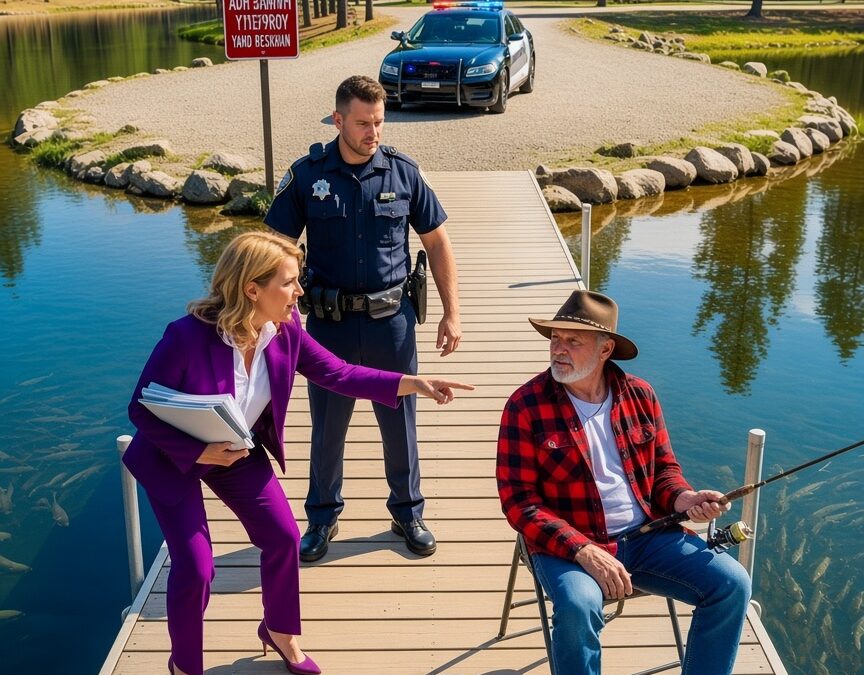
Then she called the sheriff.
After Charlie asked me to leave that morning, I drove home, made another pot of coffee, and opened a storage chest I hadn’t touched in years.
Inside were my grandfather’s old papers.
Deeds, correspondence, survey maps, tax records, and documents from a mining company that had operated in the area before I was born.
Grandpa Blackstone had been an unusual man.
He worked construction most of his life, invested carefully, and occasionally bought property nobody else wanted.
When I was young, he told me he’d acquired certain rights around Pine Ridge Lake after a mining venture failed.
I assumed he meant fishing access or some forgotten mineral interest.
I’d never had a reason to investigate.
Now I did.
The next morning, I went to the county courthouse.
Joyce Miller worked in the land records office.
She’d been there so long that three generations of county attorneys had learned not to argue with her about filing procedures.
She recognized me immediately.
“Theo Blackstone. Haven’t seen you in here since you recorded that cabin deed.”
“Morning, Joyce. I need to look at some old lake records.”
She pointed toward a chair.
“What happened?”
I told her.
By the time I finished, she’d removed her glasses and was rubbing the bridge of her nose.
“Margaret Windham,” she said.
“You know her?”
“She came in last month asking whether an association could impose lake access restrictions.”
“What did you tell her?”
“That she’d need to establish ownership or other lawful authority before making those claims.”
“And?”
“She didn’t seem interested in that part.”
Joyce pulled the association documents Margaret had submitted locally.
The papers were incomplete.
There was no properly established subdivision-wide declaration binding every property, no clear identification of common property, and no deed transferring lake ownership to the organization.
Joyce also checked the available state business records.
She couldn’t find a registered entity matching the association’s claimed formal status.
“An informal neighborhood group can exist without incorporation,” she explained, “but calling yourselves an HOA doesn’t magically give you power over unwilling neighbors.”
“That’s what I thought.”
“Don’t assume this means every fee demand is automatically criminal, Theo. Contracts and property restrictions can get complicated. But from what I’m seeing, Margaret has some explaining to do.”
Then she examined my grandfather’s documents.
She grew quiet.
“Where did you get this?”
“Grandpa’s estate.”
She read the old legal description again.
“Theo, this references the lakebed.”
“I noticed.”
“And comprehensive water-use rights.”
“That’s why I’m here.”
She looked up.
“You need a real estate attorney. A good one.”
Before I left, she helped me locate a 1962 survey referencing Thompson Mining Company.
The map showed Pine Ridge Lake in remarkable detail, including the springs feeding it, the lakebed boundaries, and an old industrial access route near my property.
Joyce pointed to a handwritten notation.
“There’s a reference here to an earlier conveyance. You’ll probably need the state archives to reconstruct the chain of title.”
I thanked her.
She held up a finger.
“And Theo?”
“Yes?”
“Don’t start announcing you own the lake until somebody qualified has verified it.”
“Wouldn’t dream of it.”
That was the plan.
Unfortunately, Margaret had plans of her own.
Three days later, Betty Kowalski came to my cabin carrying a violation notice.
She stood in the doorway, twisting the envelope between her fingers.
“Theo, can you read this?”
I invited her inside.
The notice accused her of violating neighborhood aesthetic standards by displaying unauthorized lawn ornaments.
The proposed fine was fifty dollars per day until she removed them.
I stared at the letter.
“Her garden gnomes?”
Betty nodded.
She had seventeen of them scattered through her flower beds. Some were faded, several were chipped, and one had been repaired with enough glue to qualify as a structural engineering project.
Her husband, Walter, had bought the first two shortly after they married.
He died eight years earlier.
“Walter gave me those,” she said quietly. “I know they’re silly. But every time I work in the garden, I think about him.”
I folded the letter.
“You’re not removing anything.”
“She says she’ll put a lien on the house.”
“She can’t just invent a fine and turn it into a lien.”
“But what if she finds a way?”
That question bothered me more than the letter.
Betty was seventy-nine, lived on Social Security and a modest pension, and had spent most of her life avoiding debt.
Margaret knew that.
She was using legal-sounding threats against people who couldn’t easily afford lawyers.
And Betty wasn’t the only one.
Frank Martinez received a notice demanding removal of his vegetable garden because it was visible from the road.
The Johnsons were told their dock required a new permit.
Another family received a warning about an “unapproved recreational vessel,” which turned out to be a fishing boat they’d owned for eleven years.
Every letter carried the same signature.
Margaret Windham, President.
By the following week, she’d hired a private security guard to monitor the boat launch.
The young man was barely twenty-five.
He wore a black polo shirt, sunglasses, and an expression suggesting he regretted accepting the job.
I walked down one morning with my tackle box.
“Morning.”
“Sir, I’m supposed to tell you this area is restricted.”
“Who told you that?”
“Mrs. Windham.”
“Did she show you a deed?”
He looked confused.
“No, sir.”
“Did she explain who owns the boat launch?”
“No.”
“Well, my property survey says this portion belongs to me. You might want to ask your employer about that.”
He glanced toward Margaret’s house.
“I’m just supposed to take pictures.”
“Then make sure you get my good side.”
I fished for forty minutes.
He photographed me twice and spent the rest of the time staring at his phone.
He quit three days later.
Margaret responded by hiring an attorney.
His letter arrived while I was repairing Betty’s front steps.
It demanded that I stop fishing, pay five hundred dollars in administrative charges, and comply with all association regulations.
The attorney threatened further legal action if I refused.
Betty watched me read it.
“Is it bad?”
“It’s expensive stationery.”
“Theo.”
I handed her the letter.
“She’s trying to scare us.”
“It’s working on me.”
I couldn’t blame her.
I was starting to understand that Margaret wasn’t simply an annoying neighbor who liked rules.
She was determined to force everyone into a system she controlled.
And the more people resisted, the more aggressive she became.
Two days later, contractors arrived to install a white vinyl fence across the old shoreline path.
That path had been used for decades.
It connected several properties to the boat launch, and elderly residents walked it every morning for exercise.
Frank was standing beside the workers when I arrived.
Margaret supervised from her driveway.
“What’s going on?” I asked.
“Safety improvements,” she replied.
“Who authorized construction here?”
“The association.”
“Who owns this section of land?”
“It’s community access.”
“That’s not an answer.”
She folded her arms.
“Mr. Blackstone, your constant obstruction is getting tiresome.”
Frank pointed toward the unfinished fence.
“My doctor wants me walking every morning. This is the flattest route around the lake.”
“You can use the road,” Margaret said.
“The road doesn’t have a shoulder.”
“Then drive somewhere appropriate.”
Frank stared at her.
He’d been a quiet man for as long as I’d known him.
That morning, I watched him decide she wasn’t worth another word.
He turned around and walked home.
I looked at the fence posts.
Then I took out my phone and photographed everything.
Margaret smiled.
“Document all you want. We have legal counsel.”
“So do I,” I said.
That was technically premature.
But it wouldn’t be for long.
The following Monday, I hired Jake Patterson, a licensed surveyor, to examine my property boundaries.
Jake was younger than me by about twenty years, with a sunburned neck and the habit of speaking only after he’d checked something twice.
He spent the morning measuring my shoreline and comparing current records against older maps.
By lunchtime, he was frowning at his equipment.
“Theo, your boundary doesn’t stop where everyone assumes.”
“How far off are we?”
“About thirty feet in one section. The old description includes a strip beneath the present waterline.”
He showed me the measurements.
“That’s interesting,” I said.
“Interesting enough that I’d want to see the original conveyance. And these mining references aren’t ordinary residential deed language.”
That evening, an envelope appeared in my mailbox.
No return address.
Inside was a single handwritten sentence.
Check Thompson Mining Company records at the state archives.
I read it twice.
Somebody else had begun asking questions.
I didn’t know whether the note came from Dale Pemberton, Margaret’s treasurer, or another member of her association.
But I took the advice.
The state archives were nearly three hours away.
I spent three days there, turning pages, examining microfilm, and following transactions through companies that had disappeared decades earlier.
Thompson Mining had purchased extensive interests in Pine Ridge Lake in 1943, hoping to develop a copper deposit beneath the surrounding land.
The project failed.
But the company retained its property interests.
In 1965, those interests passed to Consolidated Holding Company.
When that business dissolved in 1978, certain assets were distributed among its partners.
One partner was my grandfather, Theodore Blackstone Sr.
The records showed that Grandpa later consolidated his interests through a recorded transaction in 1958 involving additional property he already controlled. Subsequent transfers and estate documents traced the relevant rights through my father and eventually to me.
I sat in the archives with the documents spread across a table.
There it was.
A description of the entire lakebed.
Not just a narrow strip of shoreline.
Not just permission to fish.
The whole forty acres beneath the water.
There were also separately described water-use and access rights, subject to applicable state law and the rights of neighboring landowners.
I knew enough about construction and property contracts to understand that the wording mattered.
Owning the bottom of a lake didn’t automatically mean owning every drop of moving water, nor did it erase public regulations or existing easements.
But Margaret’s claim that the lake was unowned community property was beginning to look spectacularly wrong.
I drove home with copies of everything.
The next day, I made an appointment with Samuel Bennett, a real estate attorney in the county seat.
His office occupied the second floor of an old brick building overlooking the courthouse square.
Bennett was in his late fifties, with silver hair, wire-rimmed glasses, and the patient expression of a man who’d spent years explaining complicated documents to people who wished they were simpler.
I laid my papers on his desk.
He examined them for almost an hour.
Every so often, he’d ask a question.
“Has anyone challenged this conveyance?”
“Not that I know of.”