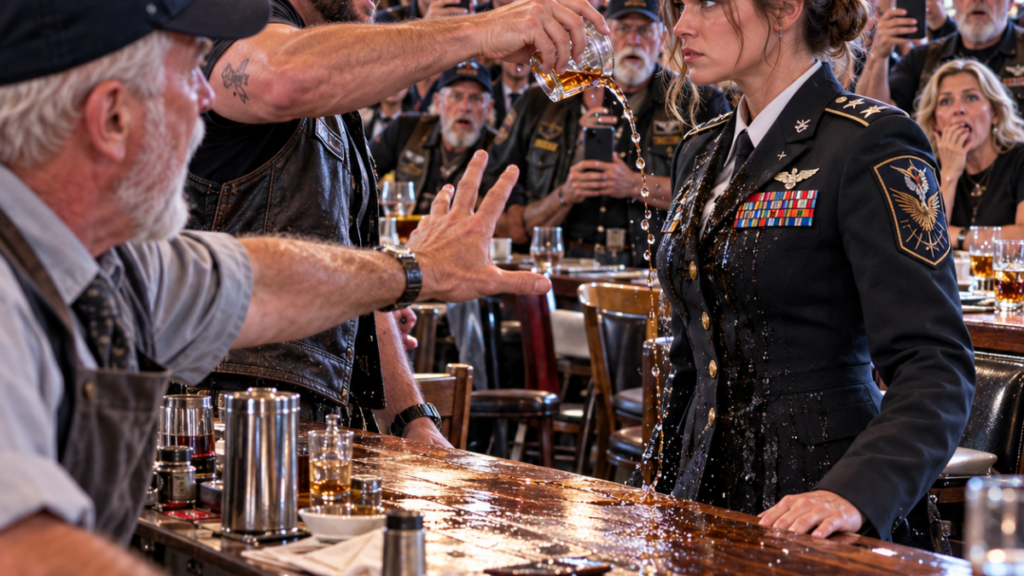
A Young Reservist Poured Whiskey Over My Service Ribbons And Livestreamed Me As A “Fake.” I Said Nothing. Then The Old Bartender Saw The Patch Inside My Lapel And Froze. “Black Kestrel…” Minutes Later, A Brigadier General Walked In: “Major Bennett.” The Whole Legion Hall Went Silent.
“Take off that uniform, fake!” the young reservist shouted before dumping whiskey across my ribbons while hundreds of people watched his livestream. I didn’t argue, didn’t reach for his phone, and didn’t tell him where I had spent the previous nine months. I only opened my jacket to wipe away the stain. That was when the old bartender saw the black kestrel stitched inside my lapel, dropped his glass, and whispered a name I hadn’t heard spoken aloud in three years.
### Part 1
The whiskey hit my chest in a slow amber sheet, soaking the left side of my service jacket before running across three rows of ribbons. For one strange second, I noticed tiny things instead of the man who had poured it—the smell of rye, the cold edge of the brass bar rail against my boot, the hum of an old refrigerator behind the counter. Then the entire American Legion hall went silent, and Tyler Grant smiled into the camera of his phone as if the silence belonged to him. “There,” he told the people watching his livestream. “That’s what happens when somebody wears a uniform they didn’t earn.”
I was thirty-one years old, recently returned from nine months overseas, and tired in a way sleep did not fix. Two nights earlier, I had landed at Dover after an assignment my paperwork described only as extended operational support, followed by eleven hours of debriefing in a windowless room where every folder had a classification stamp and every question had to be answered with painful precision. I had imagined my first free evening would involve takeout, a shower, and perhaps eight uninterrupted hours in my own bed. Instead, I had driven forty minutes to American Legion Post 214 because my grandfather had once called it the only place in town where silence could be comfortable.
His name had been James Bennett, and he had belonged to that post for thirty-six years. When I was a child, he brought me there on Saturday afternoons, bought me ginger ale, and played cribbage with veterans who knew my birthday before I knew theirs. He rarely talked about his years in uniform, but he had a habit of tapping two fingers against the table whenever someone exaggerated a story. “People who did the hardest things usually don’t need to make them sound harder,” he once told me.
That sentence had stayed with me longer than almost anything else he said. It followed me through college, flight school, survival training, my first operational squadron, and later into assignments where my name disappeared from ordinary schedules for months at a time. It was also the reason I had not reacted when Tyler first noticed me sitting alone at the end of the bar. At that point, he was only an irritating stranger with too much confidence and an audience he wanted to impress.
He had arrived with four friends shortly after eight, all of them in their early twenties. Their haircuts were fresh, their voices carried across the room, and their energy had the loose, celebratory edge of people who had just finished something difficult enough to feel proud but not difficult enough to frighten them yet. Tyler wore a reserve-component jacket and kept touching the patch on his shoulder whenever someone looked his way. I later learned he had completed initial training less than three months earlier.
I was wearing service dress because I had come directly from a closed administrative appointment and had not bothered going home first. The jacket was older than most people expected an officer’s jacket to be, softened at the elbows and slightly faded around the cuffs. My wings were above the ribbons, polished but not gleaming, and the fabric still carried the faint chemical smell of aircraft interiors that never entirely leaves your clothes after long enough around them. To Tyler, apparently, none of it looked convincing.
“Hey,” he called from behind me. “Isn’t this side of the bar for actual veterans?”
I heard one of his friends laugh. Frank Mercer, the bartender, stopped drying a glass, but I kept looking into the mirror behind the rows of bottles. “She hear me?” Tyler asked, louder this time, and someone murmured his name in a warning tone that he either did not hear or chose to ignore.
Frank had tended bar at Post 214 for more than twenty years, and before that he had spent two decades in the Army. He had known me since I was small enough to sit on a folded coat just to see over the bar. When I walked in that evening, he had looked at my uniform, looked at my face for half a second longer than usual, then slid a ginger ale toward me without asking. “Welcome home, Claire,” was all he said.
Tyler came closer after I ignored him. I saw his reflection stop two stools away, broad shoulders squared, chin lifted, one hand already reaching into his pocket. “I’m not trying to be disrespectful,” he said, in the tone people often use immediately before doing something disrespectful. “But there are people in this room who actually served, and stolen valor isn’t funny.”
I turned then. “Are you accusing me of something?”
His expression brightened, because I had finally given him what he wanted. “I’m asking questions.”
“No,” I said. “You’re making a statement and pretending it’s a question.”
One of his friends stared at the floor. Tyler’s smile tightened, and his phone appeared in his hand. “Okay,” he said, opening an app. “Then maybe you won’t mind explaining it.”
He started streaming before anyone could stop him. “I’m at Post 214,” he told the camera, angling it so both of us appeared on-screen. “There’s a woman here dressed like she’s Air Force, medals everywhere, pilot wings, whole setup, and something about it does not look right.”
I watched his screen long enough to see comments begin appearing. He mentioned that he had recently finished training, then announced that he knew people who flew and that I was “way too young” to have the decorations I was wearing. The confidence in his voice increased with each response arriving from strangers online. Soon he was no longer asking whether my uniform was real; he was explaining to his followers why it could not be.
Frank said, “Tyler, put the phone away.”
Tyler barely glanced at him. “If she’s legit, she can prove it.”
“I don’t owe your audience anything,” I said.
That should have ended it. Instead, my refusal gave him the excuse he needed to escalate, because people performing for crowds often become prisoners of the character they created five minutes earlier. He stepped closer, gestured toward my ribbons, and laughed. “See? That’s what I mean. People who really served don’t act like this.”
I almost smiled at the absurdity of the statement. “How do people who really served act?”
His friends stopped laughing. Tyler glanced at the phone, saw whatever encouragement he was getting, and reached for the whiskey he had left on the bar. “They don’t play dress-up in front of men who earned the right to be here.”
Then he tipped the glass over my uniform.
Nobody moved. I looked down at the liquid soaking into the fabric, breathed once, and reached inside my jacket for the folded cloth I always carried in the inner pocket. When I pulled the lapel aside, a piece of dark embroidery hidden against the lining slipped into the light.
Behind the bar, something hit the mahogany with a hollow crack.
Frank Mercer had dropped his glass.
And he was staring at the inside of my jacket as though he had just seen a ghost.
### Part 2
Frank did not look at Tyler, the spilled whiskey, or the phone recording all of us. His eyes were locked on the small patch sewn inside my jacket, black thread over charcoal fabric, nearly invisible unless the lapel was pulled open under direct light. It showed a kestrel diving with its wings drawn tight against its body, beneath it a row of five small stars and a numerical sequence meaningless to anyone who had never worked around restricted operational designations. I had forgotten the patch was still there.
Three years earlier, someone in a maintenance detachment had handed it to me after an assignment and said, “You might as well keep the thing since nobody’s supposed to admit it existed.” I had sewn it inside the jacket because putting it on the outside would have violated about six different rules, then stopped thinking about it. The jacket became comfortable, deployments came and went, and removing a patch hidden from everyone seemed less important than everything else that required my attention. Until Frank saw it.
He put both hands flat against the bar. “Tyler.”
His voice was quiet enough that Tyler almost missed it.
“Yeah?”
“Turn that livestream off.”
Tyler laughed uneasily. “Frank, come on. You saw what—”
“Turn it off.”
The room changed. There are moments when authority becomes visible even if no one raises their voice, and Frank suddenly seemed larger behind that bar than he had five seconds earlier. Tyler lowered his phone a few inches, but I could still see the live icon glowing on the screen. “Why?” he asked.
Frank pointed toward my open lapel. “Do you know what that is?”
Tyler looked. “A patch.”
Retired Command Sergeant Major Walter Briggs, who had been sitting near the dartboards with a cup of black coffee, turned his chair toward us. Walter was sixty-seven, lean as a fence post, and famous around the post for speaking perhaps twenty sentences on an average evening. He stared at the patch, and the color slowly left his face.
Frank whispered, “Black Kestrel.”
I felt my shoulders tighten. Not because the name was secret in the strictest possible sense, but because hearing it spoken in public felt like watching someone unlock a door I had spent years keeping closed. Tyler noticed my reaction and mistook it for fear. “What, is that supposed to impress me?”
Walter stood.
Frank looked at him. Something passed between the two men that needed no explanation, then Frank turned back to Tyler. “Three years ago, my nephew came home from West Africa,” he said. “He came home with six other men who were not supposed to come home.”
Tyler’s phone was still streaming. I could see comments racing upward, but suddenly he was no longer checking them. Frank drew a breath and looked around the room, perhaps deciding how much he could say without crossing a line he had no right to cross. I almost told him to stop.
I didn’t.
“My nephew was attached to a multinational advisory element,” Frank continued. “Officially, that’s about as specific as anybody needs to get. Their movement was supposed to be routine, except intelligence changed faster than the paperwork did, and they ended up several miles beyond where anyone expected them to be.”
Walter moved closer but did not interrupt. Other people in the hall had turned their chairs toward us now, and even the kitchen door had opened. The smell of fried onions drifted into the room while Frank described seven Americans pinned behind a low wall of dirt and broken concrete, with hostile positions covering the only usable extraction corridor. He did not tell the story dramatically; that made it harder to listen to.
“Support was requested,” Frank said. “Denied.”
Nobody spoke.
“Requested again. Denied again.”
Tyler swallowed.
“The reason was political,” Frank continued. “Different jurisdictions, different airspace, different authorities. Everybody involved had a perfectly reasonable explanation for why nobody could cross the line on the map.”
I remembered the map. I remembered the coordinates blinking on a screen, the voice in my headset, and the silence after my request came back negative. I remembered my copilot saying, “Claire, they’re not going to clear this.”
Frank looked at the patch again. “Then an aircraft appeared where no aircraft had been approved to operate.”
I lowered my eyes.
“It came in low,” he said. “So low the men on the ground thought at first they were hearing something ricochet off the ridge. No identifying broadcast they recognized. No announcement. No dramatic radio call. Just three strikes, fast enough that my nephew said he never understood what was happening until the hostile fire stopped.”
I could smell hot metal again. Not in the Legion hall, but in memory—the heated cockpit electronics, sweat trapped under gear, that sharp electrical odor aircraft develop when they have been pushed hard for too long. I remembered my hands on the controls and the strange calm that arrives when a bad situation becomes simple because there is only one useful thing left to do. Those memories had weight, and hearing someone else describe the event made them heavier.
Frank continued. “Extraction got seven men out. My nephew has two daughters. Oldest one plays soccer, youngest one thinks she’s going to become a veterinarian and keeps bringing injured birds into the garage.”
A few people smiled faintly.
“He gets to complain about the birds,” Frank said, “because somebody made sure he came home.”
Tyler finally looked at me.
Frank tapped one finger against the bar. “The men on the ground called the unknown pilot Black Kestrel because of the way the aircraft came down the ridge. Apparently somebody made patches afterward. Very few.”
Tyler’s face had begun changing. The arrogance did not vanish all at once; it retreated in pieces, fighting with disbelief. “You’re saying she—”
“I’m saying,” Frank interrupted, “that you need to shut your mouth long enough to understand how much you don’t know.”
I folded the cloth I had used on my ribbons. “Frank.”
He looked at me.
“That’s enough.”
His jaw tightened, but he nodded. “Yes, ma’am.”
Tyler heard the word.
I watched him notice it, then watched him look at Walter, who had unconsciously straightened into the posture of a man standing before a superior officer. Tyler finally ended his livestream—or I thought he did—and lowered the phone completely. “Who are you?” he asked.
“My name is Claire Bennett.”
“That’s not what I mean.”
“I know.”
He glanced at my ribbons again, except now he looked at them differently. “Why didn’t you just tell me?”
Because explanation had never been my first instinct. Because I had watched people confuse titles with character too many times. Because saying, “You should respect me because I outrank you,” would have proven nothing except that I knew how rank worked.
Instead, I said, “Would it have mattered?”
Tyler opened his mouth.
Then the front door of Post 214 swung inward, letting a gust of cold November air roll through the hall.
A woman in a dark wool coat entered, looked once at me, once at the whiskey stain across my uniform, and stopped.
I knew her immediately.
Brigadier General Evelyn Cross had personally signed two pages of my operational record.
And judging by her face, she wanted to know exactly what had happened before she arrived.
### Part 3
General Cross did not enter rooms like someone accustomed to being announced. She simply walked forward, and people moved without consciously deciding to do it. Walter Briggs started to stand straighter, Frank removed the towel from his shoulder, and even Tyler’s friends seemed to recognize that someone important had arrived despite the absence of visible rank on her civilian coat. She stopped beside me and studied the dark stain across my jacket.
“Major Bennett.”
The title landed harder than Frank’s story.
Tyler’s head snapped toward me. One of his friends whispered something I could not hear, and another slowly moved his half-finished beer away as though suddenly worried about being associated with the table. General Cross noticed every movement without appearing to look at anyone.
“The morning debrief has been moved to zero-eight-hundred,” she told me. “The car is outside.”
“Yes, ma’am.”
She glanced at the wet ribbons again. “Do you need five minutes?”
Before I could answer, Tyler said, “General, I—”
General Cross turned.
He stopped.
Her expression was not angry. Anger would have given him something familiar to respond to. Instead, she regarded him with the same patient neutrality she once used while listening to a colonel explain why a maintenance failure had somehow survived three levels of inspection.
Tyler cleared his throat. “There was a misunderstanding.”
Frank made a small sound behind the bar.
I raised my hand before he could speak. “There was a livestream.”
General Cross looked at Tyler’s phone. “Was?”
He stared at the screen.
His face changed.
“What?” I asked.
Tyler pressed at the display, swore under his breath, then looked up. “It didn’t end.”
Nobody spoke.
The phone had remained live after he thought he had stopped it. Frank’s story, the mention of Black Kestrel, General Cross entering the room and calling me Major Bennett—all of it had gone out to however many people had joined the stream. Tyler stared at the comments with panic replacing every trace of the smugness he had worn half an hour earlier.
General Cross held out her hand. “May I?”
He gave her the phone.
She looked at the screen for perhaps two seconds, then handed it back. “End it properly.”
This time he did.
I felt less satisfaction than people might expect. My first thought was not that Tyler had humiliated himself; it was that pieces of a story I had spent three years refusing to discuss were now loose on the internet, detached from context and moving faster than anyone in that room could control. Nothing Frank had said was enough to compromise an operation by itself, but speculation has a way of building structures from fragments. I reached for my own phone.
General Cross saw me. “Already being handled.”
I looked at her.
“Your office called mine twelve minutes ago.”
Of course they had. Someone on the livestream must have recognized me or the patch before Tyler even realized what he was broadcasting. In my world, the internet could transform a stupid argument over whiskey into a security review before the glass was dry.
Tyler heard enough to understand the situation had become larger than him. “Am I in trouble?”
General Cross looked at me rather than answering.
That was deliberate. Technically, Tyler was not in my direct chain of command, but his behavior toward another service member, the public accusation, the poured drink, and the livestream gave his leadership several possible reasons to become interested. I could have requested names, statements, footage, and formal action before leaving the building. Nobody in the room would have blamed me.
Instead, I asked him, “How long have you been in?”
“Five months total.”
“How long since training?”
“Eleven weeks.”
“What did they teach you about professional conduct?”
His eyes dropped. “Enough to know better.”
“That wasn’t my question.”
He swallowed. “They taught us that we represent the service in and out of uniform. They taught us not to disgrace another member publicly. They taught us chain of command, respect, and—” He stopped. “They taught us enough.”
“Then what happened tonight?”
Tyler stared at the floorboards. “I wanted content.”
The answer was so simple that several people shifted uncomfortably.
He continued before I could respond. “My videos from training did well. People started following me. Then the ones where I called people out did better, and I guess…” His jaw tightened. “I saw you and decided I knew what I was looking at.”
“You decided before speaking to me.”
“Yes, ma’am.”
“And after I refused to perform for your audience?”
“I got angry.”
“No,” I said. “You got embarrassed. Those aren’t the same thing.”
He looked up.
“You had already told strangers I was lying. When I didn’t cooperate, you needed me to become the person you had described. So you kept escalating until something happened that looked like proof.”
His face went red.
I knew that expression because I had seen variations of it in briefing rooms, training flights, and once in a mirror years earlier after an instructor dismantled an assumption I had defended too long. Humiliation can turn people vicious or honest depending on what they do during the next thirty seconds. Tyler looked at his silent friends and chose honesty.
“Yes, ma’am.”
General Cross said nothing.
I stepped closer to Tyler, not enough to threaten him, only enough that he could no longer speak to a room instead of to me. “You told your followers that you know what real service looks like.”
He nodded.
“You don’t.”
His eyes tightened.
“Neither did I at five months,” I added. “Neither did Frank when he was five months in. Neither did General Cross. That isn’t an insult. You aren’t supposed to know yet.”
Some tension went out of his shoulders.
“Your problem is not inexperience,” I said. “Everyone begins inexperienced. Your problem is that you mistook confidence for competence and an audience for accountability.”
He stared at me.
“If you stay in uniform long enough,” I continued, “you will meet people younger than you who know more than you, people older than you who know less, quiet people who have done extraordinary things, and loud people who have done almost nothing. If you start deciding who deserves respect based on whether they match the picture in your head, eventually you’ll make that mistake somewhere more dangerous than a bar.”
His lips pressed together. “Understood.”
“Do you?”
“I think I’m starting to.”
That was the first useful thing he had said all evening.
General Cross checked her watch. “Claire.”
I nodded.
I picked up my coat, but Frank called my name before I reached the door. He was holding something in his hand.
The patch.
The edge had torn loose when I opened my jacket.
Frank stared at the black kestrel against his palm, then looked at me with an expression I could not read.
“You might want this,” he said.
I reached for it.
He did not let go immediately.
“Claire,” he said quietly, “my nephew told me one more thing about that night.”
I stopped.
“He said the pilot came back.”
My hand went still.
Because that part of the story had never been in any official report Frank should have seen.
### Part 4
For three years, the accepted version of the Black Kestrel story ended with the strikes. The unidentified aircraft came low over the ridge, neutralized the positions blocking extraction, and disappeared before multinational command could determine who had crossed the restricted boundary. That version was incomplete. The first extraction helicopter had suffered a systems warning less than ninety seconds after lifting from the pickup zone, and seven men who thought they had escaped were suddenly heading back toward the same ground.
The aircraft carrying me was already outside the designated area when we heard the broken transmission. My copilot, Daniel Ruiz, looked at me once and said, “We’re low on options.” That was his polite way of saying fuel margins were narrowing, the diplomatic problem had not disappeared, and returning would convert an unauthorized action into something impossible for headquarters to explain away as confusion. I turned back anyway.
Nobody ever wrote that part clearly.
The second time, there were no precision strikes left to make. We flew a low orbit while the extraction helicopter reset and lifted again, staying visible enough to draw attention away from the aircraft carrying the team. Somewhere below, someone fired, and something struck our fuselage hard enough to make the cockpit shudder. We remained until the helicopter crossed the safe line, then headed home with warning lights blinking across the panel.
Daniel and I were met by people whose first question was not whether we were hurt.
It was, “Who authorized you?”
No one had.
That became the problem.
Frank finally released the patch. “My nephew said after they lifted, he looked out the helicopter and saw the same aircraft come back over them.”
General Cross was watching both of us now.
“He said everybody told him afterward that he was mistaken,” Frank continued. “Stress, dust, confusion. Except six other men remembered it too.”
I folded the patch in my hand. “People remember strange things under stress.”
“Is that what happened?”
There are questions civilians imagine soldiers can answer once enough time passes. In reality, some answers remain restricted regardless of whether everyone in the room can already guess them. I gave Frank the only response I could.
“Your nephew came home.”
His eyes held mine for several seconds.
Then he nodded.
“That’s enough,” he said.
Outside, cold air hit my face as General Cross and I walked toward a black government sedan. Frost had begun forming along the edges of parked cars, and somewhere down the street a leaf blower whined despite the ridiculous hour. Ordinary sounds after operational memories always seemed unnaturally loud to me. I pulled my coat tighter.
General Cross waited until we were inside the car before speaking. “That could have gone worse.”
“The stream?”
“The whole thing.”
I looked through the window at Post 214. “Frank knew too much.”
“He knew stories.”
“He knew we came back.”
“So did seven people on the helicopter.”
I glanced at her.
General Cross gave me the look senior officers use when a subordinate is technically correct but missing a larger point. “Claire, classified information and human memory have been fighting each other since classification was invented. What matters is whether details connect to things they shouldn’t.”
“And do they?”
“Not yet.”
The final two words did not comfort me.
The car pulled away from the curb. I watched the Legion sign disappear behind us and tried to tell myself the evening was finished. Then General Cross handed me a tablet.
A paused video filled the screen.
Tyler’s livestream.
It had already been copied.
The frame showed me with my jacket open and the Black Kestrel patch visible. Someone had zoomed in, sharpened the image, and posted a side-by-side comparison with an old photograph from a military aviation forum. In the second image, three pilots stood beside an aircraft with their faces partly obscured by gear, but one wore the same patch.
“How long?” I asked.
“Twenty-three minutes.”
“How many views?”
“Original stream was small. The clipped version is moving.”
I rubbed my forehead. “Great.”
“That is not the part I want you to notice.”
She enlarged the second image.
The photograph was supposed to be impossible. I recognized the location immediately, though I had not seen the picture before. The hangar behind us belonged to a temporary detachment site used during the early phase of the operation, and at the time every personal electronic device was prohibited inside the perimeter.
“Where did that come from?”
“We don’t know.”
My irritation disappeared.
General Cross zoomed in again.
The image quality was poor, but behind the three pilots stood another figure near the hangar entrance. The face was indistinct, yet something about the posture made my stomach tighten.
“You recognize him?” she asked.
“I’m not sure.”
“That’s why tomorrow’s debrief moved.”
I looked closer.
The man in the background had one hand lifted toward his collar, a gesture I remembered because he did it constantly when thinking. His name was Colonel Nathan Vale, and for forty-eight hours during Black Kestrel he had served as liaison between our flight element and the multinational headquarters controlling regional airspace.
He was also the officer who had delivered the second denial for support.
“What happened to Vale?” I asked.
“Retired eighteen months ago.”
“And now?”
General Cross looked out the window. “Private consulting.”
“For whom?”
“That’s one of the questions.”
The car passed through downtown, traffic lights reflecting against wet pavement. I thought again about Tyler, because until that moment I had considered him the entire problem: an immature reservist, a livestream, an embarrassing incident, perhaps some administrative fallout. Suddenly the whiskey on my jacket seemed almost irrelevant.
“Who posted the photograph?”
“Anonymous account created tonight.”
“Before or after Tyler’s livestream?”
“Three minutes after Frank said ‘Black Kestrel.’”
I sat back.
That was too fast.
Someone had not simply searched the internet and found an old image.
Someone had been waiting for the name.
General Cross took the tablet from my hands. “Now you understand why I came to the Legion personally.”
I looked at her.
She met my eyes.
“Claire, tonight may not have exposed Black Kestrel.”
She paused.
“It may have told someone that Black Kestrel is still alive.”
### Part 5
At eight the next morning, I sat in a conference room with no windows, three cups of untouched coffee, and six people whose introductions were deliberately vague. General Cross was there, along with an Air Force investigator, a security specialist, two intelligence officers, and a civilian attorney who spoke only when someone approached the line between useful questioning and information I was not required to provide. The photograph from the livestream clip sat on a monitor at the end of the table. Nobody mentioned Tyler Grant for the first twenty minutes.
The anonymous account that posted the image had disappeared before midnight. Copies remained, but the source profile was gone, and the upload history led through enough layers to make easy attribution impossible. More important, investigators had located a version of the same photograph inside an archived contracting packet connected to a private defense consulting company. The company’s current senior operations adviser was Colonel Nathan Vale.
“Did Vale know you were the pilot?” an investigator named Morgan asked.
“He knew my aircraft and call sign.”
“Your identity?”
“Almost certainly.”
“Did he know about the patch?”
I thought carefully. “The patches were made afterward.”
“By whom?”
“I don’t know.”
Morgan frowned. “You wore one.”
“Someone left three of them in our ready room after the operation. No note.”
General Cross leaned back. “That was never formally investigated?”
“Sir—ma’am,” Morgan corrected himself awkwardly, “at the time there was a considerably larger issue.”
I knew what he meant. The operation had created a diplomatic problem that nobody wanted to make bigger. Our decision had saved lives but violated instructions, crossed an operational boundary, and created paperwork senior officials spent months burying under phrases like emergency deviation and tactical necessity. Investigating souvenir patches had not been high on anyone’s list.
“Vale argued for disciplinary action,” I said.
The room became quieter.
Morgan looked up. “Against you?”
“And Captain Ruiz.”
“For the unauthorized engagement?”
“Yes.”
General Cross watched me. “You never told me that.”
“It went nowhere.”
“That wasn’t the question.”
I folded my hands. “Vale wanted us grounded. Our commander disagreed. The review concluded that immediate risk to friendly forces justified the deviation.”
“Did Vale accept that?”
“No.”
Morgan opened another file. “According to archived correspondence, he resigned his liaison position six weeks later.”
I had not known that.
The security specialist changed the image on the screen. Now we were looking at screenshots from Tyler’s stream: his face, mine, the moment whiskey crossed my uniform, Frank leaning over the bar, then the exposed patch. Time stamps appeared beside each image.
“Here’s what bothers us,” she said. “The anonymous account uploaded its photograph three minutes and twelve seconds after Mr. Mercer verbally identified Black Kestrel.”
“Could have been someone watching live.”
“Exactly.”
I understood.
The leak might not have been triggered by the patch itself. It might have been triggered by Frank saying the name aloud to Tyler’s online audience. Someone watching had access to material they should not have possessed and chose that exact moment to release it.
“Do we know who was watching?”
“Tyler’s platform account data is being preserved. We’ll need process for full records.”
“Has Tyler been told?”
“Not this part.”
I looked around the table. “Good.”
Morgan raised an eyebrow. “You trust him?”
“No. I don’t think he’s involved.”
“Based on?”
“Everything he did was impulsive. This wasn’t.”
General Cross nodded once.
The meeting continued for nearly two hours. By the end, I had answered questions about people I had not thought about in years, old briefings, transportation schedules, maintenance crews, and who might have seen which piece of equipment. Memory under questioning is unpleasant because it exposes how much certainty is actually reconstruction. I could describe the color of Vale’s notebook but not who stood beside him on a particular morning.
When we finally paused, my phone vibrated.
Frank.
I stepped into the hallway before answering. “Everything okay?”
“Claire, I’m sorry to bother you.”
“You aren’t.”
“It’s Tyler.”
I closed my eyes. “What did he do?”
“Nothing like last night.”
Frank hesitated.
“He came back.”
“To the Legion?”
“Seven-thirty this morning. Before I opened.”
I leaned against the wall.
“He cleaned the floor where he spilled the drink,” Frank said. “Then he asked for paper.”
“For what?”
“He wrote apologies. One to the post. One to me. One to you.”
I said nothing.
“He also said his unit contacted him.”
“That was inevitable.”
“He thinks he’s getting thrown out.”
“That isn’t my decision.”
“I told him that.”
Frank paused again. “There’s something else.”
Of course there was.
“He said somebody messaged him during the livestream.”
“What kind of message?”
“At first he thought it was one of his followers. Account told him to zoom in on your jacket.”
I stood straight.
“When?”
“Before the whiskey.”
My hand tightened around the phone. “Frank, are you sure?”
“He showed me the screenshot.”
“Do not let him delete anything.”
“I already told him.”
“Do not forward it either.”
“Understood.”
I ended the call and returned to the conference room.
Everyone looked at me.
“Tyler may not have chosen the patch on his own,” I said.
The security specialist leaned forward.
I explained the message.
Morgan immediately reached for his phone.
General Cross remained motionless. “Exact wording?”
“Frank didn’t read it to me.”
“Then we get it directly.”
Within an hour, Tyler was sitting at the other end of the same table where I had spent my morning. He looked exhausted, unshaven, and several years younger without the confidence he had worn at the Legion. When he saw me, he stood so quickly his chair scraped backward.
“Major Bennett.”
“Sit.”
He obeyed.
Morgan asked him to unlock his phone and locate the message. Tyler opened the archived livestream notifications, scrolled, and placed the phone on the table.
There it was.
An account with no profile picture had sent a message four minutes before Tyler poured the whiskey.
ASK HER ABOUT THE INSIDE OF THE LEFT LAPEL.
A second message arrived thirty seconds later.
IF SHE REFUSES, SHE’S HIDING SOMETHING.
Tyler stared at it.
“I thought it was somebody who knew uniforms,” he whispered.
I looked at the timestamp.
Then at General Cross.
The message had arrived before my jacket ever opened.
Someone watching Tyler’s livestream already knew exactly where the patch was sewn.
### Part 6
Tyler stopped being a disciplinary problem the moment the investigators saw those messages. He became a witness. That did not erase what he had done at Post 214, and nobody pretended otherwise, but the room now contained two separate issues: his behavior and the fact that someone had used that behavior to push him toward exposing something hidden inside my jacket. Tyler seemed almost relieved when Morgan explained the distinction, perhaps because consequences he understood were less frightening than the possibility that he had wandered into something he did not.
“Did the account contact you before last night?” Morgan asked.
“No.”
“After?”
Tyler scrolled.
His face tightened. “Yes.”
He turned the phone around.
The message had arrived at 11:43 p.m.
YOU DID GOOD. SHE NEEDED TO BE SEEN.
A second followed.
DON’T APOLOGIZE.
Tyler looked sick. “I never replied.”
Morgan photographed the screen.
“What made you focus on Major Bennett in the first place?” he asked.
Tyler rubbed both hands across his face. “I saw her uniform.”
“That’s it?”
“Yes.”
“Think carefully.”
Tyler stared at the table.
Then his eyes moved toward me.
“There was a guy online,” he said. “A couple weeks ago.”
Morgan stopped writing.
“What guy?”
“I don’t know his real name. Military content account. He comments on reserve pages, stolen-valor videos, that kind of stuff.”
“Username?”
Tyler gave it.
One of the analysts typed.
“What did he say?” I asked.
Tyler swallowed. “He posted something about women wearing decorations they didn’t earn.”
I felt General Cross shift beside me.
“Specific women?”
“No. Not really. It was like a discussion prompt. People were arguing.”
“And?”
“He said there was a woman around D.C. pretending to be some kind of special operations pilot.”
The conference room went very still.
“When?” Morgan asked.
“Maybe twelve days ago.”
“Did he provide a photograph?”
“I think so.”
The analyst found the account.
A post appeared on the monitor.
The photograph showed a woman crossing a parking lot in civilian clothing. Her face was turned partly away from the camera, hair pulled back, carrying a dark travel bag.
Me.
The picture had been taken outside a facility I had visited during my debrief.
Tyler looked at me, horrified. “I didn’t realize that was you.”
I believed him.
The caption beneath the image did not identify me. It asked followers whether they had noticed “a fake female operator using military spaces around the capital region,” then encouraged people to “call out impostors before Remembrance and Veterans events.” The post had received little attention.
Except Tyler had seen it.
General Cross said, “So last night, he saw Claire at the Legion and thought he recognized her from a rumor already planted in his head.”
Morgan nodded. “Then someone reinforced it during the stream.”
Tyler whispered, “I thought it was my idea.”
That sentence bothered me more than anything else he had said.
Manipulation does not always require sophisticated control. Sometimes all it requires is putting a thought in front of someone already eager to believe it, then waiting. Tyler had wanted a confrontation, wanted an audience, wanted to demonstrate expertise. Someone had simply pointed his existing arrogance in the correct direction.
The analyst opened the account history. Most posts were ordinary military commentary copied from public information, mixed with inflammatory accusations designed to generate arguments. But scattered among them were references to air operations, contracting controversies, and retired officers.
Then we saw Nathan Vale’s name.
Not as a target.
As a source.
Several posts linked approvingly to articles written by Vale about “undisciplined tactical culture” and the danger of operators overriding strategic authority. The articles were public and academic enough to seem harmless.
One phrase made my stomach turn.
Tactical heroism can become strategic misconduct when individuals believe immediate outcomes justify unauthorized action.
I had heard those exact words before.
Three years earlier.
In the room where Nathan Vale argued that Daniel Ruiz and I should lose our flight status.
General Cross read my expression. “Same language?”
“Almost word for word.”
Nobody spoke for several seconds.
Morgan said, “That doesn’t prove Vale runs the account.”
“No,” I replied. “But whoever runs it knows his arguments.”
The investigation shifted rapidly after that. Tyler was released after surrendering copies of his messages and agreeing not to discuss the matter publicly. His unit still had its own questions for him, but those would wait.
Before leaving, he stopped beside me.
“Major?”
“Yes?”
“I wrote you an apology.”
“Frank told me.”
“I know it doesn’t fix anything.”
“No.”
He flinched slightly, but I continued.
“An apology isn’t supposed to erase what happened. It tells me what you plan to do with what happened.”
He nodded.
“I don’t know yet.”
“Then figure it out.”
He looked toward the door.
“Tyler.”
He turned back.
“Stop building your identity around catching other people being wrong.”
His face changed.
I had hit something.
“If the only way you feel competent is by exposing somebody else as incompetent,” I said, “you’ll eventually stop caring whether they actually are.”
He stared at me for a long moment. “Yes, ma’am.”
This time, when he left, he did not look like a man performing remorse.
He simply looked ashamed.
Two days later, investigators established that the inflammatory account had been accessed repeatedly from infrastructure associated with a consulting company that subcontracted for Vale’s firm. It was not enough for a conclusion, but it was enough for subpoenas and interviews.
Then General Cross called me into her office.
Daniel Ruiz was already there.
I had not seen him in fourteen months.
He stood when I entered, smiled once, then placed a folder on the desk.
“Claire,” he said, “you’re going to hate this.”
“Good morning to you too.”
He opened the folder.
Inside was a photograph of the three Black Kestrel patches.
Taken before they had been left in our ready room.
On the back, written in black marker, were three words.
MAKE THEM VISIBLE.
I looked at Daniel.
“Where did you get this?”
“An evidence archive.”
“Whose?”
He glanced at General Cross.
She answered.
“Nathan Vale’s.”
### Part 7
The truth was less dramatic than the theories people online eventually invented and more disturbing because it was ordinary. Nathan Vale had not spent three years plotting revenge against me in some dark room. He had built a consulting career around a worldview in which people like Daniel and me represented everything he believed was wrong with modern operations: decentralized authority, tactical improvisation, and officers willing to act when higher headquarters had not provided explicit permission. Black Kestrel had become his private example of a system rewarding disobedience because the result happened to be successful.
He could not discuss the classified operation publicly. So he discussed its philosophy. He wrote articles, gave closed seminars, advised firms, and argued that “hero culture” encouraged dangerous behavior.
For years, that remained an intellectual disagreement.
Then he learned that an upcoming internal review might use Black Kestrel as a case study supporting broader tactical authority in emergency situations.
That threatened his reputation.
Not his freedom.
Not his money, at least not directly.
His reputation.
General Cross explained it while Daniel and I sat across from her. “Vale believed the review would validate your decision and undermine positions he has been advocating in government and private-sector circles for three years.”
Daniel leaned back. “So he wanted Claire exposed?”
“Not exactly.”
I looked at her. “He wanted controversy.”
She nodded.
If the Black Kestrel pilot could be publicly framed as someone who enjoyed attention, exaggerated her record, or wore questionable insignia, then any future discussion of the operation became contaminated by personality. Vale did not need the world to believe I was literally a fake officer. He needed enough noise around my identity that policymakers would hesitate before using the case publicly or internally.
The online account had spent weeks seeding that noise.
Tyler was never selected by name.
He was simply the person who took the bait.
That distinction mattered.
“There are probably dozens of people who saw those posts,” I said.
“Yes.”
“And if Tyler hadn’t confronted me, someone else might have eventually.”
“Possibly.”
Daniel exhaled. “That’s almost worse.”
I knew what he meant. A plan depending on one specific person can fail. A plan depending on predictable human behavior can wait.
Vale had not ordered Tyler to pour whiskey on me. He had not told him to start a livestream. He had created an environment where someone eager for attention might do exactly that, then an anonymous operator watching the stream nudged Tyler toward my left lapel once the opportunity appeared.
“What happens to Vale?” I asked.
General Cross folded her hands. “That depends on what can be established. Unauthorized retention of sensitive imagery is one matter. How the material was used is another.”
“So no dramatic arrest.”
“This is Washington, Claire. Dramatic arrests are less common than meetings with attorneys.”
Daniel laughed once.
I didn’t.
“What about the review?”
“Still happening.”
“And my name?”
“Still protected where required.”
I thought about Frank saying Black Kestrel in a room full of veterans. About the clip spreading online. About strangers who now knew my face even if they could not prove which stories attached to it.
“Protected is becoming a flexible word.”
General Cross’s expression softened. “Yes.”
A week later, I returned to Post 214.
I wore jeans, boots, and a dark sweater.
No uniform.
The room smelled exactly the same as it had when I was eight—fried food, old wood, coffee, and something metallic near the heating vents. Frank looked up when I entered and reached automatically for the ginger ale.
“You know I’m old enough to drink,” I said.
“I’ve known you since you had missing front teeth. You’re getting ginger ale.”
I sat at my grandfather’s old corner.
Tyler was there.
For half a second, I considered turning around.
He noticed me and stood.
“Major Bennett.”
“Claire is fine tonight.”
That surprised him.
He held a tray of empty glasses.
I raised an eyebrow.
Frank answered from behind the bar. “Community service.”
“Official?”
“Voluntary.”
Tyler looked embarrassed. “I asked if I could help around here.”
“For how long?”
He glanced at Frank.
Frank shrugged. “Until I get sick of him.”
“Could be years,” I said.
Tyler almost smiled.
He did not bring up the investigation. Neither did I. He collected glasses, wiped tables, helped an older veteran carry a box from the storage room, and kept his phone in his pocket.
That was enough for one evening.
Later, Walter Briggs took the stool beside me. “Internet says you’re everything from a secret fighter pilot to an actress hired by the Pentagon.”
“Only one of those sounds fun.”
“Which one?”
“Actress probably gets better hotels.”
Walter chuckled.
Then his face grew serious. “Your grandfather would have hated all this attention.”
“I know.”
“He also would have enjoyed watching that kid clean tables.”
“I know that too.”
Frank set another ginger ale in front of me.
On the television above the bar, a news panel discussed veterans, social media, and misinformation. No names were mentioned, but the theme was obvious. Tyler glanced up at it once, then deliberately went back to wiping a table.
My phone buzzed.
Daniel had sent me a single sentence.
Vale’s contracts are being suspended pending review.
I stared at the message.
No triumph came.
Only relief.
The larger investigation continued for months. Some findings remained sealed. Vale denied directing harassment and insisted his criticisms concerned policy, not individuals. Investigators nevertheless established that restricted photographs had been improperly retained within material connected to his consulting work, and several contracting relationships ended while administrative and legal reviews proceeded.
Tyler’s unit disciplined him separately for his conduct at the Legion.
He was not discharged.
I was glad.
Consequences should fit what a person did, not satisfy an audience’s desire for spectacle.
One Thursday in January, Frank called me.
“You need to come by.”
“Why?”
“Tyler’s leaving.”
“Leaving the unit?”
“No. Deployment preparation.”
I sat up.
Frank continued. “He asked whether you’d come.”
I looked through my apartment window at snow beginning to collect along the street.
“Did he say why?”
“No.”
That meant yes.
Two hours later, I walked into Post 214 and found Tyler alone near the portrait wall.
In his hands was a folded piece of cloth.
My Black Kestrel patch.
### Part 8
“I think this belongs to you,” Tyler said.
I stared at the patch. “Frank gave it to you?”
“No.”
He shook his head quickly. “You dropped it that night after you put it in your coat pocket. I found it under the stool the next morning when I came back to clean.”
I looked at him.
“You kept it for two months?”
His face reddened. “That sounds worse when you say it.”
“It sounds exactly like what happened.”
“Yes, ma’am.”
I waited.
Tyler glanced down at the dark embroidered kestrel. “At first I kept it because I thought maybe I should give it to my unit leadership as evidence.”
“Evidence of what?”
He gave an embarrassed laugh. “I don’t know. By the time I realized how stupid that was, investigators were already involved, and I was scared touching anything would make it worse.”
“That part is surprisingly reasonable.”
He nodded. “Then I kept meaning to return it.”
“But?”
“I didn’t know what to say.”
I took the patch from him.
The thread was frayed along one edge. Five small stars sat beneath the diving bird, symbols almost nobody would understand correctly and far too many people would invent meanings for if they saw them online.
“Here’s what you say,” I told him. “‘Major Bennett, I found this. Here.’”
He looked at me.
“That’s all?”
“That’s all.”
He laughed quietly, mostly at himself.
Frank brought us two ginger ales without asking.
Tyler looked at his. “Does anyone get alcohol in this place?”
“Not if I knew you before thirty,” Frank said.
“You met me at twenty-three.”
“Exactly.”
Tyler shook his head.
For the first time since I met him, he looked comfortable without trying to make anyone else believe he was comfortable.
“You’re deploying?” I asked.
“Training rotation first.”
“Where?”
He told me.
It was nowhere glamorous.
Good.
Most military careers are built in places nobody makes films about: maintenance bays at two in the morning, training ranges in miserable weather, offices where someone catches a mistake before it becomes an accident, long flights with no emergency, guard shifts where absolutely nothing happens. The dangerous myth is that service becomes real only when something dramatic occurs.
Tyler had believed that myth.
Perhaps part of me had once believed it too.
“I wanted to ask you something,” he said.
“Go ahead.”
“That night, why didn’t you report me yourself?”
I considered lying.
Because I was tired.
Because I had bigger problems.
Because I felt sorry for him.
None was entirely true.
“I didn’t protect you,” I said. “Your unit still handled what you did.”
“I know.”
“I simply didn’t demand the maximum possible punishment.”
“Why?”
I turned the patch over in my fingers.
“When I was twenty-four, I nearly washed out of an advanced flight program because I hid a mistake.”
His eyebrows rose.
“Nothing dangerous happened. I misread an instrument indication during training. My instructor caught it immediately.”
“What did you do?”
“I pretended I had seen it at the same time he did.”
Tyler grimaced.
“Exactly.”
“What happened?”
“My instructor knew.”
“Of course.”
“Of course. He could have written it up as an integrity failure.”
“But he didn’t?”
“He made me sit in a room for three hours and explain every decision I made from the moment the indication appeared.”
“That sounds worse.”
“It was.”
I smiled.
“He told me the mistake didn’t scare him. My instinct to protect my ego did. Then he said if I ever did it again, he would personally make sure I never touched another military aircraft.”
Tyler nodded slowly.
“I never did it again.”
“So you thought I could learn?”
“I thought you deserved the opportunity to decide whether you were going to learn.”
His expression became serious. “I think I did.”
“Don’t tell me.”
“What?”
“Show the people you serve with.”
He looked down at his drink.
After a moment, he nodded.
Across the hall, Walter started dealing cribbage cards. Frank argued with someone about whether the television volume was too loud. The heating system clicked on with a metallic groan that sounded exactly as terrible as it had when I was a child.
My grandfather would have liked that nothing had changed.
I slipped the Black Kestrel patch into my coat pocket.
“Are you going to sew it back in?” Tyler asked.
“No.”
“Why not?”
I looked at him. “I finally remembered to take it off.”
He smiled.
Months later, the internal review concluded that the emergency actions taken during the Black Kestrel operation had been justified under the circumstances, while also recommending clearer procedures for situations where tactical necessity collided with delayed authorization. Nathan Vale’s consulting work never fully recovered after investigators documented improper retention of restricted operational imagery. Some matters connected to him remained confidential, and I learned not to confuse unanswered questions with unfinished life.
Tyler completed his rotation.
He sent me exactly one message.
No dramatic speech.
No apology.
Just a photograph of a muddy pair of boots beside a folding cot and four words.
Still learning. Phone stayed down.
I laughed when I read it.
Frank later told me Tyler had become almost annoyingly strict about phones inside the Legion.
“He nearly threw a guy out for filming Walter without asking,” Frank said.
“Progress.”
“Overcorrection.”
“Also progress.”
My own life became quieter.
I moved into a different assignment that kept me closer to home, started running beside the river in the mornings, and finally unpacked two boxes that had followed me through three apartments. Inside one of them I found my grandfather’s cribbage board, still wrapped in an old dish towel.
I brought it to Post 214.
Frank put it behind the bar.
No plaque.
No ceremony.
That would have embarrassed Grandpa.
On the anniversary of the night Tyler poured whiskey across my ribbons, I stopped at the post after work. Frank was polishing glasses. Walter was arguing about football. Tyler was gone again on training orders.
I took my usual seat.
Frank placed a ginger ale in front of me.
“You know,” I said, “one day I’m going to order something else just to make your head explode.”
“No, you won’t.”
He was right.
On the portrait wall behind him was an old photograph of my grandfather. He looked younger than I ever remembered him, wearing a uniform with none of the softness age eventually brought to his face.
I raised the glass slightly toward him.
Frank noticed.
“Still miss him?”
“Every day.”
“He’d be proud.”
I looked into the ginger ale, watching the bubbles climb the glass.
“A year ago I would have told you he’d hate hearing that said out loud.”
Frank smiled.
“He would.”
I smiled back.
Outside, November wind rattled the door.
For years, I believed strength meant being so certain of yourself that other people’s opinions could not touch you. Black Kestrel taught me something different. Strength was making a decision when fear was screaming, then living quietly with the consequences after the cheering stopped.
Tyler taught me something else.
Sometimes the loudest person in the room was not your enemy.
Sometimes he was simply young, afraid of being insignificant, and desperate to prove he belonged.
That did not excuse what he did.
I never pretended it did.
Forgiveness, when it came, was not a declaration and it was not a return to the moment before the whiskey hit my uniform. I never forgot the humiliation of being filmed, judged, and publicly challenged by a stranger who had decided my silence meant guilt.
I simply stopped carrying the anger.
There was a difference.
Frank reached beneath the bar and placed my grandfather’s cribbage board between us.
“One game?”
“You cheat.”
“I’m a veteran bartender. We call it experience.”
“You absolutely cheat.”
“Prove it.”
I laughed and picked up the cards.
Around us, Post 214 carried on the way places with long memories always do. Glasses touched wood, old friends complained about things that did not matter, somebody near the kitchen laughed too loudly, and wind pressed against the windows before moving on.
My old service jacket hung in my apartment closet.
The whiskey stain had come out.
The ribbons were clean.
Inside the left lapel, where the Black Kestrel patch had once been stitched, only a few tiny holes remained in the fabric.
I never repaired them.
I liked knowing they were there.
Not because they reminded me of Tyler Grant, Nathan Vale, an unauthorized flight, or the night half the internet briefly decided it knew who I was.
They reminded me of my grandfather.
Real strength, he used to tell me, operates quietly. It does what needs doing, accepts the weight afterward, and then folds itself back into ordinary life without demanding applause.
For a long time, I thought that meant never letting anyone see what you had carried.
Now I understood it differently.
You could be seen.
You could be misunderstood.
You could even be humiliated in front of a room full of strangers.
And still, none of those people got to decide who you were.
I dealt the first card.
Frank dealt the second.
Outside, the November wind moved on without us.
And inside the old Legion hall, so did I.
THE END!

