“She Eats Last. After My Soldiers. If There’s Anything Left.” The Major Said It Loud Enough For 140 Soldiers In The Rain. I Walked To The Back. A Private Set His Mess Kit Down. “Private, Pick That Back Up. Now.”
The major wanted to humiliate me in front of 140 soaked, exhausted soldiers. “She eats last,” he told the cooks. “After my soldiers. If there’s anything left.” I said nothing and walked toward the back of the chow line. Then a nineteen-year-old private quietly put his tray down. Another soldier followed. Then another. Within minutes, nobody was eating, and the officer who thought I was a nobody was about to discover why half that battalion remembered me—and what I had hidden for seven years.
### Part 1
“She eats last. After my soldiers. If there’s anything left.”
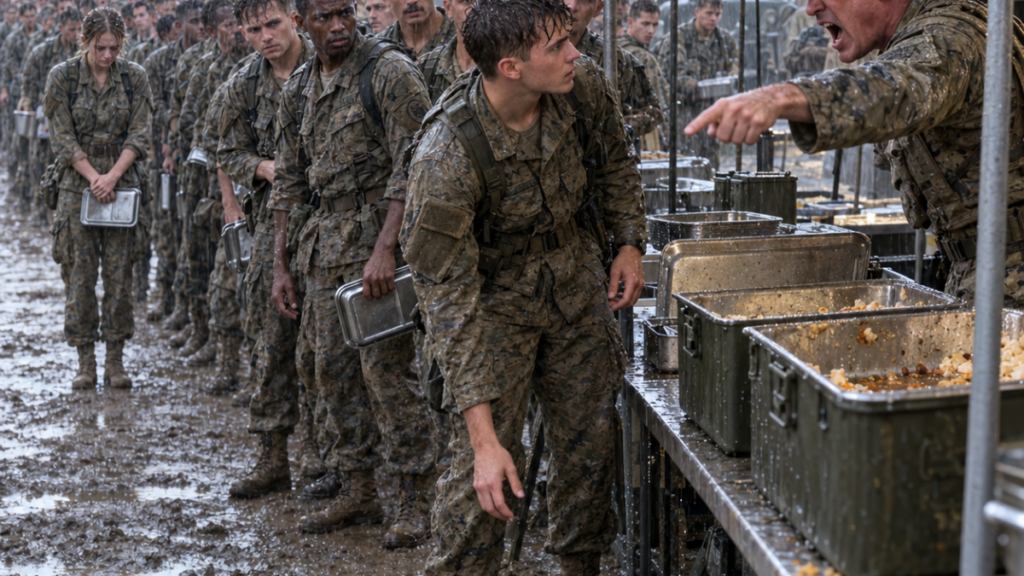
Major Owen Reddick said it loudly enough for every soldier under the sagging blue tarp to hear. Rain hammered the Louisiana pinewoods so hard that water poured from the tarp in sudden sheets, the field kitchen hummed behind the serving tables, and 140 hungry soldiers stood in mud that sucked at their boots every time they shifted their weight. The two staff officers beside Reddick laughed, one immediately and the other half a second later, after apparently deciding the major expected him to.
“Yes, sir,” I said.
I was Master Sergeant Claire Mercer, thirty-nine years old, twenty-two years in the Army, and assigned to the Joint Readiness Training Center as an observer-coach-trainer. My job was not to command Reddick’s battalion, praise it, or make its leaders feel good about themselves. My job was to follow them through simulated combat, watch where their systems cracked, and tell them the truth before those cracks got somebody killed somewhere the enemy was using real ammunition.
The previous evening, I had told Reddick exactly what his logistics plan had done. Two companies had gone thirty-six hours without a hot meal, the kitchen burners were approaching a fuel shortage, and the resupply convoy kept using a route the opposing force had already ambushed twice. Reddick had stared at me across the folding tables in the after-action-review tent and said, “With respect, Master Sergeant, you’re an observer. Observe.”
So when he saw me near the field kitchen that evening, he apparently decided he wanted to make his point again.
I had not even come for dinner. I had come to check fuel.
Still, I walked past the steaming containers of chicken, rice, vegetables, and rolls and started toward the back of the line. There was no reason to argue with him in front of his soldiers. A public fight between an observer and a battalion executive officer would teach those young men and women nothing useful, and I had learned a long time earlier that humiliation usually says more about the person delivering it than the person receiving it.
Then I heard the sound.
A paper tray touching plastic.
I looked sideways.
A young private near the front of the line had set his tray down at the edge of the serving table. He could not have been older than nineteen, with rain dripping from his helmet and the slightly startled face of someone who had not been shaving regularly for very many years. His name tape read SIMS.
“Private,” Reddick snapped. “Pick that back up.”
Sims stared at the tray.
Then he glanced at me.
I kept walking.
I remember thinking that if I stopped and looked directly at him, I would tell him to obey the order. Whatever problem I had with Reddick did not belong on the shoulders of a private. So I fixed my eyes on the muddy ground and took another step.
Behind me, nothing moved.
“Private Sims,” Reddick said, sharper this time. “I gave you an order.”
The rain struck the tarp. Burners ticked beneath the food containers. Somewhere beyond the clearing, a generator coughed and settled back into its mechanical hum.
Sims picked up the tray.
For a moment I felt relief.
Then he carefully placed it down again.
I stopped.
“Are you deaf?” Reddick asked.
“No, sir.”
“Then what’s the problem?”
The boy swallowed. His shoulders were trembling, whether from cold or fear I could not tell. “Sir, I was told we eat before the first sergeant.”
Reddick looked around as though someone had slipped an inside joke past him.
“There is no first sergeant here.”
Nobody answered.
I turned slowly.
Thirty soldiers away, Sims stood beneath the tarp with his hands at his sides. He would not look at me again, but something in the set of his jaw made my stomach tighten. I had seen a soldier put down a tray like that once before.
It had been seven years earlier.
A different rain.
A different country.
And I had spent most of those seven years hoping nobody remembered.
My partner that rotation, Sergeant First Class Thomas Hale, was somewhere across the training area checking the fuel point. That morning he had read the logistics numbers aloud inside our truck while the heater struggled against the fogged windshield. “Bravo and Charlie still on packaged rations,” he had said. “Kitchen fuel down to maybe a day and a half. Resupply convoy still planned on the southern route.”
“The one they hit twice?”
“Twice.”
I had closed my eyes.
“He’s going to hate us,” Hale had said.
“He’s supposed to. It’s a training center.”
Hale had laughed. “You always say that.”
“Because it keeps being true.”
What I had not told Hale was that I recognized the battalion before the rotation even began.
I recognized the crest painted on the vehicles when they arrived.
Seven years earlier, I had belonged to that battalion.
Most of its officers were strangers now. Soldiers transferred, promoted, retired, separated, married, divorced, disappeared into the giant machine of the Army. I had convinced myself there would be nobody left who knew me well enough for it to matter.
Then, on the second day of the rotation, I walked into the field kitchen and saw Sergeant First Class Miguel Ortega holding a ladle.
He almost dropped it.
In 2019, Ortega had been a twenty-three-year-old specialist who sang softly while he cooked and claimed he could make edible gumbo from anything except Army rice. Now he was the battalion’s senior food operations sergeant. His face had changed, his rank had changed, but his eyes had not.
“First—”
I shook my head once.
He stopped.
“Sanitation logs are in the box, Master Sergeant,” he said instead.
That was all he called me for the next week.
Master Sergeant.
Not First Sergeant.
Not the name from seven years earlier.
I thought we understood each other.
Now, beneath the tarp, Private Sims had called me something he should not have known.
And before I could decide what to do about it, another soldier stepped out of line.
He was a staff sergeant, maybe twenty-five, lean and broad-shouldered, with ears that still stuck slightly outward beneath his helmet.
His name tape read NGUYEN.
My breath caught.
I knew him.
The last time I had seen Daniel Nguyen, he had been eighteen years old and crying silently over a nearly empty tray in Afghanistan.
He walked to the serving table.
He set down his food.
Then he returned to his place in line, stood at parade rest, and stared straight ahead.
Two soldiers behind him looked at each other.
They placed their trays down too.
Then three more.
Then an entire squad.
The sound moved through the clearing one tray at a time.
Tap.
Scrape.
Tap.
Nobody spoke.
Major Reddick’s face changed as the wave continued toward the trees.
I stood in the rain watching soldiers I did not know make a choice I had never asked them to make.
And suddenly I understood something that frightened me more than Reddick’s anger.
They knew exactly who I was.
### Part 2
Within three minutes, the chow line stopped being a chow line.
Soldiers who already had food carried their trays forward and placed them carefully on the serving table. Others set empty trays beside the handwashing station. The ones who had not reached the food simply stepped aside and stood in the rain, leaving a long empty channel through the mud where the line had been. Nobody had coordinated it, and nobody gave an order.
Under the tarp, four cooks froze with serving spoons in their hands.
Ortega looked down the length of the clearing.
Then he calmly reached behind the food containers and turned the burners lower so dinner would not scorch.
Major Reddick stared at him.
“Sergeant Ortega, what is going on?”
Ortega folded his arms.
“Food’s holding temperature, sir.”
“That is not what I asked.”
“No, sir.”
Reddick looked toward the soldiers.
“What is this?”
Nobody answered.
For the first time since I had met him, he looked genuinely uncertain.
The sight should have satisfied me. It did not. The soldiers were soaked, exhausted, and hungry, and I knew from the logistics reports that some of them had barely eaten since the previous afternoon. Watching them stand there because of me did not feel like loyalty.
It felt like a debt I had never meant to collect.
Reddick walked toward me through the mud.
His two staff officers followed several yards behind.
When he reached me, he lowered his voice. “Whatever this is, end it.”
“Sir, I didn’t start it.”
“You’re an OCT. You don’t get to stage some kind of demonstration inside my battalion.”
“I didn’t stage anything.”
“A private refused my direct order twice.”
That part was true.
I looked toward Sims.
He stood perfectly still.
Reddick moved closer. “Tell them to eat.”
I said nothing.
“Master Sergeant.”
“Sir.”
“You have one hundred and forty soldiers standing in freezing rain because somebody apparently told them a story about you. I do not care what that story is. I want my soldiers fed.”
So did I.
That was the problem.
I could have walked to the front and told them the whole thing was over. They would have obeyed me because they were disciplined soldiers and because half of them apparently believed I still had some claim on a title I had not worn in years. Reddick would have recovered control of his chow line, and I could have returned to being the quiet observer with the waterproof notebook.
I had become excellent at making difficult things disappear quietly.
Seven years of practice will do that.
Back in 2019, I had been First Sergeant Claire Mercer of the battalion’s forward support company. We were responsible for the cooks, mechanics, fuelers, drivers, and supply soldiers who kept the infantry companies moving. Infantry soldiers get most of the heroic photographs, but nobody stays heroic very long when their trucks have no fuel and their stomachs are empty.
That summer, our battalion occupied a remote combat outpost in eastern Afghanistan.
Everything we needed crossed one bridge.
Then the bridge disappeared.
A flash flood hit the valley around two in the morning. By sunrise, brown water had ripped the concrete span apart, helicopters were grounded by weather, and my food operations team told me we had enough supplies for maybe two days.
The best estimate for resupply was four.
I went to the kitchen tent and found a piece of cardboard.
With a black marker, I wrote:
PRIVATES FIRST. SERGEANTS AFTER. OFFICERS AFTER THAT. FIRST SERGEANT LAST.
Nobody had taught me the rule in a classroom. My grandmother had run a church kitchen in Louisiana for most of my childhood, and she used to say the person holding the ladle had better be the last person worrying about their own bowl.
The Army had a similar tradition.
Leaders eat last.
Not because officers and sergeants are less valuable.
Because when food is short, the people making decisions should be the first ones to feel the consequences.
The first morning, a captain arrived early for breakfast and pointed at the sign.
“I have a briefing.”
“Yes, sir.”
“I need to eat now.”
“Yes, sir.”
“So serve me.”
I shook my head. “After the privates.”
His expression hardened. “First Sergeant, I outrank you.”
“Yes, sir. That’s why you eat after them.”
He stared at me for several seconds.
Then he went to the back.
For two days, the system worked.
Ortega and the other cooks stretched everything they had. They made soup from canned chicken, crackers, vegetables, and ingredients I deliberately chose never to identify. Soldiers got smaller portions, then sergeants got slightly smaller ones, officers smaller still.
I ate last.
On the third day, the numbers stopped cooperating.
There simply was not enough.
So I stopped eating.
I never announced it because soldiers are terrible at allowing their leaders to suffer alone once they notice. I took empty trays back to my tent, waited, then threw them away so everyone would assume I had eaten.
Ortega caught me on the third evening.
He looked at my clean tray.
Then at me.
“First Sergeant, you didn’t eat.”
“I ate.”
“When?”
“When you weren’t looking.”
He folded his arms.
“Yes, First Sergeant.”
The words said obedience.
His face said liar.
That same night, a young infantry private came through the line after twelve hours in a guard tower.
Daniel Nguyen.
Eighteen years old.
Houston kid.
Always thanked the cooks three times for everything.
The food was almost gone.
He sat on an ammunition box with crackers and a little peanut butter and started crying so quietly that I almost pretended not to notice.
I had been carrying a packet of crackers in my cargo pocket.
Emergency food.
My food.
I sat beside him and put it on his tray.
He looked at me.
I looked away.
Eventually, he ate it.
On the fourth day, I collapsed while checking the generator fuel level.
Ortega found me.
A medic gave me fluids and a lecture that lasted almost as long as the treatment. Ortega stood there afterward and made me eat a bowl of soup he had hidden specifically because he suspected I was doing something stupid.
That afternoon, the weather cleared.
A helicopter appeared over the ridge carrying rations beneath it.
Soldiers cheered.
I stood in the kitchen doorway and counted cases.
That was the story they remembered.
Not the other one.
Not September.
Not the convoy.
Not Mason Doyle.
At least, I had thought they did not remember.
Back in Louisiana, Sergeant First Class Hale emerged from the trees and stopped beside me.
He studied the silent soldiers, the abandoned trays, and Reddick’s expression.
“Top,” he said quietly.
Reddick turned. “Sergeant, stay out of this.”
“Yes, sir.”
Hale did not move.
Then he looked at me.
“You don’t owe him this.”
Something inside me tightened.
Reddick heard it too.
“Owe me what?”
Neither of us answered.
That was when I realized the silence around us had become dangerous.
Because Major Reddick was no longer simply angry.
Now he wanted to know the story.
And there was one part of it I had spent seven years making sure nobody ever told.
### Part 3
“Tell them to eat.”
Reddick’s voice was quieter the second time.
That somehow made it worse.
Rain slid down the back of my neck as I looked across the clearing. Soldiers were shivering now. The food under the tarp was cooling. The smell of chicken and rice drifted through the damp air, and some of those young men and women had been surviving on packaged rations long enough that I knew exactly how painful that smell had become.
They were making a point for me.
If I let them go hungry, I would be betraying the point.
I pushed my hood back.
Cold rain struck my face.
Then I walked toward the front.
Private Sims straightened when I approached. Nguyen did too, but his expression had changed from the exhausted face of a staff sergeant in Louisiana to the face of an eighteen-year-old soldier sitting on an ammunition box in Afghanistan. I wanted to tell him he did not owe me crackers, food, loyalty, or seven years of memory.
Instead, I went under the tarp and took a clean tray.
Ortega understood immediately.
He turned the burners higher.
A young specialist beside him filled the tray.
I carried it to Sims.
“Private.”
“Yes, First Sergeant.”
My chest hurt when he said it.
I held out the tray. “Eat.”
He hesitated.
“That’s an order.”
His eyes moved from the food to my face. “You’re supposed to be last.”
“I am.”
He frowned.
I pushed the tray toward him. “But somebody has to make sure everybody else gets fed first.”
He still did not take it.
So I said the thing I had said seven years earlier.
“The rule was never that I suffer while everyone watches. The rule was that nobody gets forgotten. Take the tray.”
He took it.
I returned for another.
Then another.
After about ten trays, Nguyen stepped beneath the tarp, grabbed a stack, and started helping without asking. Two team leaders joined him. Then a platoon sergeant. Soon soldiers were moving through the line again, but now nobody took food for themselves.
They handed meals to one another.
Tray by tray.
Soldier by soldier.
I did not look at Reddick.
I was afraid that if I did, I would see humiliation on his face and feel satisfied.
I did not want to become that person.
That was when I noticed a captain standing near the back.
He had been there the entire time.
I had seen his name on the battalion roster before the rotation and deliberately refused to think about it.
Captain Evan Cole.
Seven years earlier, he had been Second Lieutenant Evan Cole, the distribution platoon leader in my company.
Twenty-three years old.
Brilliant.
Hardworking.
Painfully eager to prove he belonged.
I had liked him.
That fact mattered.
In September 2019, after the bridge was rebuilt and regular supply convoys resumed, there were two main routes to our outpost.
The ridge road was slow and exposed but relatively safe.
The river route cut through a dry wadi and saved almost two hours.
I hated it.
Floodwater earlier that summer had eaten into the banks, leaving soft shelves along the edges. Even when the valley floor looked solid, I did not trust what was beneath it.
One morning, Cole came into the operations tent with a map.
“We’re behind schedule.”
“I know.”
“If we take the wadi, we make up almost two hours.”
“No.”
He frowned.
“The weather’s clear.”
“Ridge road.”
“First Sergeant—”
“Sir, I am not arguing about two hours when you’re carrying fuel trucks through terrain that got rearranged by a flood.”
He stared at the map.
“The wadi’s been dry for weeks.”
“The wadi doesn’t care.”
I tapped the ridge road with my finger.
“Take this. I’ll call battalion and explain the delay.”
He finally nodded. “Roger.”
I went to make the radio call.
Cole took the river route.
No rain came.
No ambush came.
What came was worse because there was nobody convenient to blame.
The third vehicle, a heavy fuel truck, rolled onto the edge of one of those weakened shelves.
The ground collapsed.
The truck rolled into the cut.
Its driver, Specialist Mason Doyle, died.
He was twenty-two.
From Indiana.
Wanted to open his own repair shop after the Army.
Once repaired my coffee maker with a piece from a broken radio and acted offended when I asked how.
I reached the vehicle with the reaction force.
I remember sliding down the dirt on my back.
I remember tasting dust.
I remember trying to help long after there was anything useful left for me to do.
A medic finally put a hand on my shoulder.
Weeks later, an investigating officer sat across from me in a plywood room.
Cole had given his statement before mine.
When he came out, he looked sick.
The investigator asked routine questions.
Time.
Weather.
Vehicles.
Orders.
Then he asked the question that would follow me for seven years.
“First Sergeant Mercer, who approved the river route?”
I could see Cole through the doorway.
Twenty-three years old.
First deployment.
First dead soldier.
I thought I understood how careers worked.
A young lieutenant who had ignored his first sergeant and lost a soldier might technically survive the paperwork, but people would remember. Every commander would hear whispers. Every promotion board would see something between the lines even if the official investigation called it an accident.
I was thirty-three.
Already established.
Already respected.
Already a first sergeant.
So I made a calculation.
“I did, sir.”
The investigator wrote it down.
That was all.
No punishment came.
The accident was determined to have resulted from unstable terrain.
But reputations do not need formal punishment.
A month later, my commander told me the company needed a “fresh start.”
I was reassigned.
Two years afterward, a senior enlisted leader at another post looked at my name and said, “You’re the first sergeant who lost the fueler on that convoy.”
“Yes, Sergeant Major.”
I never corrected anyone.
I had told the lie.
I believed the consequences belonged to me.
Now Captain Cole stepped toward the serving area in Louisiana.
He removed his helmet.
Major Reddick finally noticed him.
“Captain?”
Cole looked at me.
I shook my head.
Once.
The same warning I had given Ortega on the second day of the rotation.
Do not make me the story.
Cole ignored it.
He turned toward Reddick.
“Sir, I need to say something in front of the formation.”
My stomach dropped.
“Captain Cole,” I said.
He kept his eyes on Reddick.
“It’s overdue.”
And suddenly I knew exactly which seven-year-old lie he intended to drag into the rain.
### Part 4
Reddick’s anger faded into confusion.
“Go ahead, Captain.”
Cole stood with his helmet beneath one arm and rain running through his hair.
“Master Sergeant Mercer was the first sergeant of my company in Afghanistan in 2019.”
Several soldiers near the serving tables already knew that.
Others turned toward me.
Cole continued.
“I was her distribution platoon leader.”
“Evan,” I said.
He looked at me then.
There was no accusation in his face.
That somehow made it harder.
“Please.”
One word.
Seven years inside it.
I stopped.
Cole faced the soldiers again.
“On September fourteenth, we lost Specialist Mason Doyle during a supply convoy. His fuel truck rolled into a wadi.”
The cooks had stopped serving.
Nobody told them to.
Ortega lowered his spoon.
Cole swallowed.
“The investigation says First Sergeant Mercer approved the route.”
My hands went cold.
“She didn’t.”
Nobody moved.
“She ordered me to take the ridge road. Twice.”
Reddick’s eyes shifted toward me.
Cole’s voice remained steady.
“I took the river route anyway because we were late. I thought the terrain was safe. I thought saving two hours mattered. I was wrong.”
I could hear the rain hitting helmets.
“I was outside the investigation room when they asked her who approved the route. I heard her say she did.”
He took a breath.
“And I let her.”
For seven years, I had imagined what it would feel like if the truth came out.
I thought I would feel lighter.
I did not.
I felt exposed.
The lie had become part of the architecture of my life. I had built decisions around it, accepted assignments because of it, absorbed sideways looks because of it, and repeated “yes” every time someone attached Mason’s death to my name.
Cole turned toward me.
“I’m sorry, First Sergeant.”
I wanted to tell him to stop.
Instead, Ortega spoke.
“Sir.”
Reddick looked toward him.
Ortega rested both hands on the serving table.
“When the bridge went out that summer, we had enough food for two days.”
Reddick said nothing.
“It took four days to get resupplied. She put enlisted soldiers first, then NCOs, then officers. She ate last.”
He glanced toward me.
“Third day, she stopped eating completely.”
“Miguel.”
“She thought we didn’t know.”
A few soldiers smiled.
Not because it was funny.
Because they knew exactly how impossible that would have been.
Ortega continued. “We figured it out after she collapsed checking generator fuel.”
From farther down the line came another voice.
“I knew before that.”
Nguyen.
He stared at the ground.
“I was eighteen. Came off tower duty late. Food was almost gone.”
I closed my eyes.
Nguyen said, “She gave me the crackers she had saved for herself.”
Silence.
Then a vehicle approached through the mud.
Headlights swept across the clearing.
A Humvee stopped beside the kitchen, and Command Sergeant Major Marcus Reed climbed out.
I almost laughed from disbelief.
In 2019, Reed had been one of our platoon sergeants at the outpost.
Somebody had called him.
In every battalion, somebody always calls the command sergeant major.
He entered beneath the tarp and took in the abandoned trays, the soldiers, Cole, Reddick, Ortega, Nguyen, and finally me.
“Sergeant Major,” Reddick said.
Reed looked at him.
Then at me.
He understood immediately.
He spoke quietly.
“Sir, she always ate last.”
Reddick glanced at the soldiers.
Reed added, “We just didn’t understand back then how often there was nothing left for her.”
That sentence hit harder than Cole’s confession.
Because suddenly I was not remembering myself.
I was seeing myself the way they had.
A thirty-three-year-old woman pretending an empty tray had contained dinner.
A first sergeant sitting beside an exhausted private.
A leader believing nobody noticed what she gave away.
For seven years, I had carried another story entirely.
The convoy.
The lie.
The dead soldier.
I had assumed that was what people remembered.
Apparently, human beings do not always remember you for the thing that broke you.
Sometimes they remember the thing you did while you were breaking.
Reddick stood very still.
Then he walked toward the serving table.
Nobody knew what he was doing until he picked up a clean tray and handed it to a cook.
The specialist filled it.
Reddick carried it through the mud toward me.
Both hands.
Like an offering.
“Master Sergeant.”
I looked at the food.
Then toward the far end of the clearing.
Several soldiers still had not been served.
I shook my head.
“Thank you, sir.”
His jaw tightened.
“Please.”
“Not yet.”
He looked at the tray.
Then at me.
“The soldiers are eating.”
“Not all of them.”
For a moment I wondered if pride would win.
Then Reddick turned.
He walked all the way to the last private standing beneath the trees.
He gave the soldier the tray.
No speech.
No apology.
No performance.
He simply handed over the food and walked back.
Something changed in the clearing.
Not forgiveness.
Not admiration.
Permission.
People began breathing normally again.
The line started moving.
I helped serve until every soldier had eaten.
Then I took my own tray.
Ortega personally filled it.
He added a second roll.
I raised one eyebrow.
He raised both of his.
I decided not to argue.
I ate last.
There was plenty.
Later, after the soldiers returned to their tents, I found Reddick behind the kitchen.
He was waiting beside the fuel cans.
“I’ll accept whatever you put in the report,” he said.
I counted another can.
“One and a half days.”
He blinked.
“That’s your burner fuel.”
“I know.”
“Then fix it.”
He stared at me. “That’s it?”
“No.”
His expression tightened.
“Bravo and Charlie need hot food tonight. Your resupply is sitting in the wrong place, and you keep sending vehicles down a route the opposing force already hit twice.”
“The river route.”
I looked at him.
“Take the ridge road.”
The words almost caught in my throat.
Reddick noticed.
He did not know why.
“Why are you helping me?” he asked.
“Because tomorrow matters more than tonight.”
“That’s not an answer.”
I closed my notebook.
“You made a bad decision while tired and embarrassed. That does not automatically make you a bad officer.”
He waited.
“The difference is what you do next.”
At 2:00 a.m., Reddick sent the convoy over the ridge road.
Before dawn, Bravo and Charlie received hot food and fuel.
I wrote that in my notebook too.
I thought the night was finished.
Then, after breakfast, Captain Cole appeared at my tent holding a document inside a waterproof sleeve.
And when I saw the signature at the bottom, I realized he had not confessed merely to make himself feel better.
He intended to change the official record.
### Part 5
Cole stood at the entrance to the observer tent holding the plastic sleeve against his chest.
“Can I come in?”
I looked at the document.
“You already did the dramatic part last night.”
His mouth moved slightly, but he did not smile.
“This isn’t dramatic.”
That was how I knew it mattered.
I motioned toward the folding chair across from me.
Hale looked between us.
“I suddenly need coffee.”
“You already have coffee.”
“I need better coffee.”
He disappeared.
Cole sat.
He placed the document on the field desk.
“Sworn statement.”
I did not touch it.
“About September fourteenth?”
“Yes.”
“No.”
He blinked. “No?”
“Evan, the investigation ended seven years ago.”
“The investigation ended with a lie.”
“An accident happened. The Army determined unstable terrain caused the rollover. Nothing you write changes that.”
“It changes who ordered the route.”
“That does not bring Mason back.”
“I know.”
He leaned forward.
“I’m not doing this for Mason.”
That irritated me.
Maybe because part of me wanted him to pretend he was.
“Then why?”
“Because I have watched you carry my decision for seven years.”
I looked away.
He continued.
“I saw you at Fort Bliss three years ago.”
My head turned back.
He nodded.
“At the officers’ club. You were across the room talking to a sergeant major. He looked at your name tag, then at you, and I saw his face change.”
I remembered.
“You saw that?”
“Yes.”
“Why didn’t you say anything?”
“Because I was a coward.”
I flinched.
He shook his head.
“I’m not asking you to disagree. I was.”
“Evan—”
“I told myself the investigation called it an accident, so correcting the route decision would not matter. I told myself enough time had passed. I told myself bringing it up again would hurt your career more.”
He laughed once without humor.
“Mostly I told myself anything that allowed me not to admit I had let my first sergeant take the blame for me.”
I looked at the plastic sleeve.
“The battalion commander has a copy,” he said. “She’s forwarding it.”
“You already submitted it?”
“Yes.”
“Without asking me?”
His eyes hardened for the first time.
“You didn’t ask me before taking the blame.”
That shut me up.
He was right.
I had always framed my choice as protection.
The older first sergeant protecting the young lieutenant.
The experienced soldier absorbing damage for the inexperienced officer.
But protection forced on someone can become another form of control.
Cole leaned back.
“You don’t get to carry it anymore.”
“I was the first sergeant. Carrying things was literally my job.”
“Taking care of us was your job.”
He pointed at the document.
“Lying for me was something you decided to do.”
I said nothing.
“Those are different things.”
Hearing my own logic dismantled by the person I had supposedly saved was deeply unpleasant.
Which usually means somebody has found a truth.
I picked up the statement.
Cole had written it plainly.
He described my order to use the ridge road.
His decision to take the wadi.
The rollover.
The investigation.
My false statement.
His silence.
At the bottom was his signature.
CAPTAIN EVAN COLE.
United States Army.
Careful handwriting.
No excuses.
“You understand this could affect you.”
“Yes.”
“Your command?”
“Yes.”
“Your evaluation?”
“Yes.”
“And you submitted it anyway.”
“Yes.”
I put it down.
“Why now?”
Cole stared at the ground for several seconds.
“Because last night a nineteen-year-old private had more courage than I did at twenty-three.”
That answer hurt.
I looked toward the open tent flap where the rain had started again.
Cole stood.
Before leaving, he stopped.
“Mason used to complain about your coffee.”
I froze.
“What?”
“He said fixing your coffee maker was an act of self-defense.”
A laugh escaped me.
Tiny.
Unexpected.
Then my eyes burned.
Nobody had said Mason Doyle’s name to me casually in seven years.
People said it during investigations.
Performance reviews.
Whispered conversations.
Nobody had said it as though Mason had once been alive enough to make fun of coffee.
Cole looked at me.
“He had a ring, you know.”
I shook my head.
“For his girlfriend back home. He kept asking me whether the stone was too small.”
“Was it?”
“A little.”
I laughed again.
“So you told him?”
“That it was perfect.”
“Good lieutenant.”
“Terrible jeweler.”
Then he walked into the rain.
That night, I opened the green steel kitchen box I had carried through every assignment since Afghanistan.
Knives.
Spices.
A dented skillet.
Old utensils.
Things that smelled faintly of metal and pepper even after years.
On the underside of the lid was a name written in grease pencil.
MASON DOYLE.
My handwriting.
I had written it the night he died.
For seven years, I told myself the lie I gave the investigator had been about sacrifice.
Cole was young.
I was older.
He had a future.
I could absorb the damage.
All of that was true.
It simply was not the whole truth.
The rest came to me while rain tapped against the tent roof.
Taking the blame had given me something concrete.
Blame has edges.
You can lift it.
Measure it.
Carry it like a heavy pack.
Grief does not.
Grief is simply the fact that you did everything you believed was right and somebody died anyway.
I had told Cole to take the ridge road.
I had warned him twice.
I had done my job.
And Mason still died.
That truth frightened me more than guilt.
So I chose guilt.
Guilt gave me the illusion that if I had been different, smarter, stronger, more forceful, Mason would still be alive.
Guilt meant the universe had rules.
Grief meant sometimes it did not.
I stared at Mason’s name until the letters blurred.
Then I took the grease pencil.
Below his name, I wrote:
EVAN COLE.
I immediately hated the way it looked.
Two names in the same box.
Like casualties.
I rubbed Cole’s name out.
Then I wrote it again farther away.
Not dead.
Not lost.
Just someone whose burden I had tried to carry until I accidentally prevented him from carrying his own.
I closed the lid.
For the first time in years, I did not latch it.
The next morning, Lieutenant Colonel Natalie Brooks, the battalion commander, came looking for me.
She had read Cole’s statement.
And unlike everyone else, she had also read my original statement from seven years earlier.
One sentence.
She wanted to know why.
### Part 6
Lieutenant Colonel Natalie Brooks found me near the fuel point.
She was forty-two, compact, precise, and known for reading every page people hoped commanders would skip.
“Master Sergeant Mercer.”
“Ma’am.”
“Walk with me.”
We moved beneath dripping pine branches while soldiers prepared for another day of training.
“My executive officer came to see me at five this morning,” she said.
“Major Reddick?”
“He began the conversation by telling me he had been wrong.”
I looked at her.
Brooks almost smiled.
“I’ve had him three months. That may be the first time he has ever begun with that information.”
“He fixed the food issue.”
“He did.”
“And changed the route.”
“Yes.”
“Then he learned something.”
Brooks stopped walking.
“I also received Captain Cole’s sworn statement.”
I said nothing.
“When I took command, I reviewed the battalion’s historical casualty files.”
My stomach tightened.
“I read the Mason Doyle investigation.”
“Ma’am—”
“I remember your statement.”
Of course she did.
One sentence tends to stand out among pages of military language.
I approved the route.
Brooks studied my face.
“I thought it was strange.”
“It answered the question.”
“Yes.”
“That was the problem.”
We resumed walking.
“I should have wondered why it was so short.”
“It happened seven years before you took command.”
“That does not make truth expire.”
I looked down at the mud.
“No, ma’am.”
She stopped again.
“Why did you do it?”
There were answers I could have given.
Cole was young.
I believed I could protect him.
The investigation was already leaning toward accident.
The Army would survive one more first sergeant with a damaged reputation.
Instead, I said, “I thought I was helping.”
Brooks nodded slowly.
“Were you?”
“I don’t know anymore.”
“That’s probably the most accurate answer.”
She offered her hand.
I shook it.
She held on for one extra beat.
Then she released me and walked back toward battalion headquarters.
No ceremony.
No promise to repair seven years.
No speech about honor.
I appreciated that.
Real life rarely resolves itself at the same speed as a story.
The training rotation continued.
Reddick became irritating in a new way: he started listening.
During after-action reviews, when I pointed out a failure, he stopped treating the observation as an attack. Sometimes he disagreed, and sometimes he was right to disagree. The change was not obedience.
It was curiosity.
That mattered more.
On day eleven, I told him one of his casualty evacuation plans depended on a bridge the opposing force had already destroyed.
He stared at the map.
Then at me.
“Ridge road?”
I laughed.
“Different problem, sir.”
“Worth a try.”
By day twelve, Bravo and Charlie were receiving regular hot meals. Kitchen fuel stabilized. Ortega’s cooks stopped looking like they planned to murder the battalion staff with serving utensils.
Private Sims avoided me for two days.
On the third, I found him near the water point.
“Private.”
He snapped upright. “Master Sergeant.”
“You disobey officers often?”
His face drained.
“No, Master Sergeant.”
“Good.”
“Yes, Master Sergeant.”
I let him suffer for another second.
“Why did you put the tray down?”
He looked toward the tree line.
“My squad leader told us about Afghanistan.”
“Staff Sergeant Nguyen?”
“Yes.”
“What did he tell you?”
“That leaders eat last.”
“That’s not enough reason to disobey a major.”
“No.”
“What else?”
Sims hesitated.
“He said sometimes you have to know whether an order is about discipline or somebody’s pride.”
I closed my eyes briefly.
“That is an extremely dangerous sentence to give a nineteen-year-old.”
“Yes, Master Sergeant.”
“Did he also tell you that you can get crushed if you guess wrong?”
“Yes.”
“And?”
Sims looked at me.
“I thought he was wrong to humiliate you.”
There it was.
Not hero worship.
Not a legend.
A private had simply watched an officer use food as punishment against someone beneath him and decided he hated it.
“You could have picked up the tray.”
“I know.”
“You probably should have.”
“Yes.”
“But I’m glad you didn’t.”
His eyes widened.
“Do not quote me.”
“No, Master Sergeant.”
I started to leave.
“First Sergeant?”
I stopped.
“That’s not my rank anymore.”
“I know.”
“Then why does everybody keep calling me that?”
Sims thought about it.
“I think it means something different to them.”
I had no answer.
The final night of the rotation, Ortega organized a field dinner.
Nobody admitted exactly where he found steaks and crawfish.
I asked.
He said, “Logistics.”
I reminded him I had spent most of my career in logistics and therefore recognized theft disguised as confidence.
He smiled.
“Then you understand.”
Two long tables sat beneath the blue tarp.
Chem lights hung overhead.
Rain had weakened to a mist.
The soldiers formed a line.
Privates first.
Then specialists.
Then sergeants.
Then officers.
At the serving table was a piece of cardboard.
I did not need to read it.
I did anyway.
PRIVATES FIRST. SERGEANTS AFTER. OFFICERS AFTER THAT. FIRST SERGEANT LAST.
I stood at the back.
Cole joined me.
Then Command Sergeant Major Reed.
Then Major Reddick.
I looked at him.
He shrugged.
“Apparently this is where leadership happens.”
“That’s not exactly the lesson.”
“I’m still learning.”
We waited.
Nobody ordered him there.
That mattered.
During dinner, Cole and I finally spoke about Mason.
Not the accident.
Mason.
His broken-generator miracle.
His dream of opening a garage.
The girlfriend.
The undersized ring.
The coffee maker.
We laughed.
Then neither of us laughed.
Then we simply ate.
For the first time in seven years, I could say Mason’s name without immediately seeing the overturned truck.
Afterward, Nguyen came to my tent.
He carried a plastic grocery bag.
Inside were crackers and a single cup of peanut butter.
He handed it to me.
“Seriously?”
He smiled.
“You still owe me.”
“For what?”
“I never paid you back.”
“You were eighteen.”
“Debt’s debt.”
I shook my head.
“You know I’m never eating these.”
“I know.”
He left.
I put the crackers inside the green steel box.
Two months later, an official letter arrived.
I read it once.
Then twice.
Then sat down.
After years of being passed over, I had been selected for promotion.
Sergeant Major.
I should have felt vindicated.
Instead, the first person I thought about was Mason Doyle.
The second was the young lieutenant I had once tried too hard to save.
And the third was Major Reddick, standing voluntarily at the back of a chow line.
That was when I understood the story still was not finished.
### Part 7
The promotion did not erase seven years.
I did not expect it to.
There were people who had already formed opinions about me and would never receive the corrected report. There were assignments I had not gotten, professional relationships that never developed, and conversations that would not rewind themselves simply because Captain Cole finally told the truth.
Oddly, that stopped bothering me.
Maybe because I had finally understood something.
I had spent years believing my reputation was the price of protecting someone else.
Once Cole took responsibility, I no longer had to romanticize what I had lost.
Some of it hurt.
Some of it had been unfair.
Some of it was simply gone.
And none of that required revenge.
I remained at the training center another year after promotion.
Personnel officers told me I was wasting time.
Hale told me I had lost my mind.
“You’re a sergeant major now,” he said. “You could get a respectable job.”
“I have one.”
“You live in mud.”
“Character building.”
“You eat food from bags.”
“I cook.”
“You get screamed at by field-grade officers.”
“I like being hated for useful reasons.”
Hale stared at me.
“You need hobbies.”
He was probably right.
Reddick stayed in touch occasionally.
Not personal messages.
Professional ones.
A question about logistics.
A request for feedback on a field feeding plan.
Once, a photograph arrived showing him standing near the rear of a chow line.
No explanation.
I did not reply.
Some things are better without commentary.
Cole’s corrected statement moved through administrative channels slowly.
That suited me.
Nobody called with a dramatic apology.
Nobody restored lost time.
An updated note eventually appeared in the historical record clarifying that the river route had been Cole’s decision and that my original statement had been inaccurate.
That was enough.
Cole received professional scrutiny for admitting it.
He kept command.
Apparently, telling the truth late is still better than never telling it.
One afternoon, he called me.
“First Sergeant.”
“Sergeant Major.”
“Sorry. Habit.”
“What’s wrong?”
“Nothing.”
“That’s suspicious.”
He laughed.
“I’m making the lieutenants conduct a convoy rehearsal tomorrow.”
“Good.”
“I told them if anybody tries to save time by cutting through terrain their first sergeant told them not to use, I will personally make them walk the ridge road.”
“That seems excessive.”
“I learned from an expert.”
I smiled.
Then he became quiet.
“Mason’s mother wrote me.”
My hand tightened around the phone.
“What?”
“The battalion sent her the amended record.”
I sat down.
“What did she say?”
“That she always believed accidents were complicated.”
I waited.
“She asked why it took seven years.”
“What did you tell her?”
“The truth.”
I closed my eyes.
“That I was ashamed.”
Silence stretched between us.
“She wrote back.”
“And?”
“She said shame is only useful if it eventually makes you honest.”
I laughed softly.
“She sounds terrifying.”
“She is.”
“Good.”
A few months later, Nguyen sent me a photograph from a training exercise in Texas.
A field kitchen.
Rain.
A blue tarp.
Soldiers holding trays.
At the back stood Nguyen, newly promoted to sergeant first class.
A cardboard sign was taped to the serving table.
I could not read every word in the photograph, but I knew what it said.
There was no message attached.
There did not need to be.
I printed the picture and put it in the lid of my kitchen box beside the crackers.
The box was becoming less a storage container and more an argument with time.
Mason’s name.
Cole’s name farther away.
Nguyen’s crackers.
The photograph.
Things I once believed were private had turned out to be shared history.
That still unsettled me.
For years, I had told myself strength meant carrying things quietly.
Do not complain.
Do not correct the record.
Do not make your grief anybody else’s problem.
Feed the soldiers.
Finish the mission.
Keep moving.
There is dignity in that.
There is also danger.
Silence can begin as discipline and become identity.
You stop explaining because you do not want sympathy.
Then you stop explaining because you are afraid explanation sounds like weakness.
Eventually you forget there is a difference between being private and disappearing.
The year after my promotion, I was asked to speak to a class of new first sergeants.
I hated public speaking.
I especially hated inspirational public speaking.
So when the course manager asked me to talk about leadership, I said, “No.”
He said, “You’re already on the schedule.”
“That seems unethical.”
“You’re speaking Thursday.”
Thursday arrived anyway.
I stood in front of sixty senior NCOs.
I could have talked about maintenance systems, casualty reporting, food operations, or convoy discipline.
Instead, I told them about a kitchen.
Not the whole story.
Not yet.
I told them a leader’s job is not to perform sacrifice.
It is to make sure sacrifice is not distributed downward simply because rank allows it.
Then someone asked, “Sergeant Major, does that mean leaders should always eat last?”
I thought about Afghanistan.
Louisiana.
Private Sims.
Reddick.
Cole.
“No,” I said.
The room went quiet.
“It means leaders make sure everyone gets fed.”
I let that sit.
“Sometimes that puts you last.”
Another pause.
“But if you are starving yourself just so everybody can admire how selfless you are, you have missed the point.”
A few people laughed.
I did too.
Then I added, “And if you take somebody else’s consequences away from them because you believe you are stronger, be careful. You may also take away their chance to become accountable.”
That sentence was not in my notes.
It stayed with me.
A year later, I heard that Owen Reddick had been selected for lieutenant colonel.
Someone told me his new unit had a field rule.
Junior soldiers eat first.
Senior leaders wait.
No exceptions for briefings.
No exceptions for rank.
Apparently Reddick enforced it personally.
I never asked where he learned it.
I knew.
The better question was whether he remembered why.
Then one rainy afternoon, an envelope arrived at my office.
No official markings.
Inside was a photograph.
Major—now Lieutenant Colonel—Reddick stood beneath another blue tarp beside a line of soldiers.
At the very back.
On the reverse, he had written only six words.
I got it right this time.
I sat there longer than I expected.
Then I opened my kitchen box.
For the first time, I wondered whether I was finally ready to erase Mason Doyle’s name from the lid.
### Part 8
I did not erase Mason’s name.
For seven years, I had believed keeping it there meant accepting responsibility.
Then I believed it meant carrying grief.
Eventually I understood it did not need to mean either.
It could simply mean Mason had existed.
He had been twenty-two.
He fixed engines.
He hated my coffee.
He bought a ring that was slightly too small.
He died.
Those facts belonged together.
I no longer needed to turn his death into a lesson about myself.
So I left the grease-pencil letters where they were.
MASON DOYLE.
Below and farther away:
EVAN COLE.
Beside them, Nguyen’s crackers.
The photograph from Texas.
Later, I added Reddick’s picture.
Not as trophies.
As reminders that people change in directions you cannot always predict.
Cole had changed.
Reddick had changed.
Nguyen had grown from the exhausted eighteen-year-old I fed into the platoon sergeant teaching another generation what the line meant.
Even I had changed, though that took me longest to admit.
Years earlier, if somebody had humiliated me publicly, I would have absorbed it and called that professionalism.
Now I understood professionalism does not require pretending disrespect is harmless.
It requires deciding which response helps the mission instead of your ego.
Sometimes that response is silence.
Sometimes it is correction.
Sometimes it is letting a nineteen-year-old put down a tray.
The strangest part of the Louisiana incident was how little I actually did.
Reddick made the insult.
Sims made the first choice.
Nguyen followed.
The soldiers followed him.
Cole confessed.
Ortega remembered.
Reed confirmed.
Reddick corrected himself.
For years, I had thought leadership meant holding everything together.
That night taught me there are moments when leadership means getting out of the way long enough for other people to decide what kind of people they want to be.
My grandmother would have understood.
She had fed half a church for thirty years from a kitchen barely large enough for three people.
When I was a child, I once asked why she always waited until everyone else had plates before sitting down.
“What if there isn’t anything left?” I asked.
She handed me a spoon.
“Then I should’ve cooked more.”
That was her entire philosophy.
No ceremony.
No martyrdom.
Responsibility.
Years later, when the bridge disappeared in Afghanistan, I turned that lesson into “leaders eat last.”
But my grandmother’s version had actually been better.
Cook enough.
Plan enough.
Pay attention.
Do not let the vulnerable person at the back of the room become invisible.
And if something runs short, the person in charge should feel the shortage before the person with no power does.
That was what Reddick had violated in Louisiana.
Not because he told me to eat last.
Eating last never bothered me.
He used hunger as status.
He wanted the soldiers to see that my place was beneath his.
The reason his humiliation failed was that the battalion had inherited a different meaning for the back of the line.
To them, the back was where the person responsible for everyone else stood.
I had not known they remembered.
That was the part I kept thinking about.
We often imagine that if our good work is not rewarded immediately, it disappeared.
If nobody praises the sacrifice, maybe nobody noticed.
If the person humiliating us does not know our history, maybe our history no longer matters.
But people remember strange things.
A bowl of soup.
Crackers.
A leader standing in mud.
A piece of cardboard.
A first sergeant pretending an empty tray once held food.
Memory travels quietly through organizations and families.
Stories get passed to people who were never there.
Private Sims had never met me before Louisiana.
Yet he knew where I was supposed to stand.
I retired from the Army several years after the promotion.
On my final day, there were speeches.
I disliked most of them.
Hale gave one that was mostly insults.
Nguyen came.
Ortega came.
Cole came.
Reddick sent a letter because he could not.
The kitchen box sat beneath the table where nobody could see it.
Afterward, when everyone else had left, Cole helped me carry things to my car.
He pointed toward the box.
“You still have it?”
“Yes.”
“Mason’s name?”
“Yes.”
He nodded.
We loaded it into the trunk.
Before closing it, Cole looked at me.
“Do you ever wish you’d told the truth that day?”
I thought carefully.
“Yes.”
He looked surprised.
“I thought you’d say no.”
“I wish I had told the truth and then helped you survive telling it.”
He stared at the box.
“That would have been better.”
“Yes.”
“We were both idiots.”
“You were twenty-three.”
“And you?”
“Thirty-three.”
“So?”
“Old enough to be a more sophisticated idiot.”
He laughed.
Then I closed the trunk.
I did not forgive myself in some dramatic moment because I no longer thought forgiveness was the right word.
I accepted what I had done.
The good part.
The damaging part.
The loving part.
The arrogant part.
All of it.
Cole did the same with his choice.
That was enough.
These days, I still cook when I can.
Not because I miss Army food.
Nobody sane misses Army food.
I cook because kitchens make sense to me.
Heat.
Timing.
Preparation.
Someone notices what is running out.
Someone makes sure the quiet person gets a plate.
Last week, I made gumbo for a group of veterans at a community event.
Ortega had improved my grandmother’s recipe years earlier, though I will deny that if he ever asks.
When the pot was ready, people formed a line.
Old habit took over.
I handed bowls to everybody else first.
One man laughed.
“Sergeant Major, you’re doing it again.”
“Doing what?”
“Eating last.”
I looked at the pot.
There was plenty left.
I smiled.
“That’s because I counted.”
After the last person had food, I washed the ladle and hung it on the hook.
Then I filled my own bowl.
I sat at the end of the table.
Not because I deserved the back.
Not because sacrifice makes anyone noble.
Not because I was still punishing myself for Mason.
I sat there because everyone had been fed.
That was always the point.
If you have ever been pushed to the back of a line by someone who wanted you to feel small, remember this: they do not get to decide what the back means.
Sometimes it is humiliation.
Sometimes it is exile.
And sometimes it is the place where the person who has spent years taking care of everyone else has always stood.
You do not need to explain every sacrifice to people determined not to understand you.
But you also do not need to carry another person’s guilt forever just because you once believed you were strong enough.
Let them pick up their half.
Carry yours honestly.
Grieve what deserves grief.
Remember what deserves remembering.
And when the food is ready, make sure everybody gets a plate.
Then eat.
There may be more left than you think.
THE END!

