PART II — THE BANQUET
The great doors of Harlow Hall stood open to the autumn wind. Behind Lady Beatrice Vale, footmen carried trunk after trunk across the marble floor while the Duke of Harlow held both her hands as if the years between them had never passed.
“Six years,” Edmund said. His face had taken on a brightness Clara had not seen since before their wedding. “And you have not changed at all.”
“You are kind to say so,” Beatrice replied. Her voice was warm, her smile practiced. “But you look exactly as I remember you.”
Clara descended the staircase. Her gray morning dress was plain, her dark hair pinned neatly away from her face. She wore no jewels except the simple ring on her hand. Edmund did not turn to see her.
Beatrice did.
“Oh,” she said, looking Clara over. “You must be the housekeeper.”
A footman dropped a hatbox. In the shadows, Mr. Peters closed his eyes.
“No,” Edmund said with a careless laugh. “This is the Duchess.”
“The Duchess?” Beatrice touched one gloved hand to her chest. “Forgive me, Your Grace. You look so capable. I have never seen a duchess carrying so many keys.”
Clara offered her a courteous smile. “Lady Beatrice, welcome to Harlow Hall. We were expecting you on Friday. I’m afraid your room is not quite ready, but Margaret will see that you are comfortable.”
“Of course I will be,” Beatrice said, turning back to Edmund. “I always am wherever you are.”
For the next hour, the house shifted around their guest. Beatrice found the blue room’s curtains too heavy, its bed too narrow, and its view less impressive than she remembered. Margaret and the maids hurried to meet her requests. Clara watched, noticing how Beatrice’s eyes kept straying toward the locked door at the end of the east corridor: Edmund’s study.
At tea, Beatrice asked about the room.
“Is your father’s old study still just as it was?” she said. “I remember reading poetry to you there. You swore you would never let anyone change it.”
“It is exactly as it was,” Edmund replied. “I keep it locked. I’ll show it to you tomorrow.”
“Why wait?”
“I haven’t the key with me.”
Beatrice’s gaze flicked toward Clara’s keys. “How useful that the Duchess keeps them.”
“I carry the keys to the pantry and linen room,” Clara said. “The study is the Duke’s room. I would not enter without his permission.”
Edmund smiled at her. “You see? Clara knows her place.”
Eleanor, seated by the window, said nothing. But Clara saw her grip tighten around the handle of her cane.
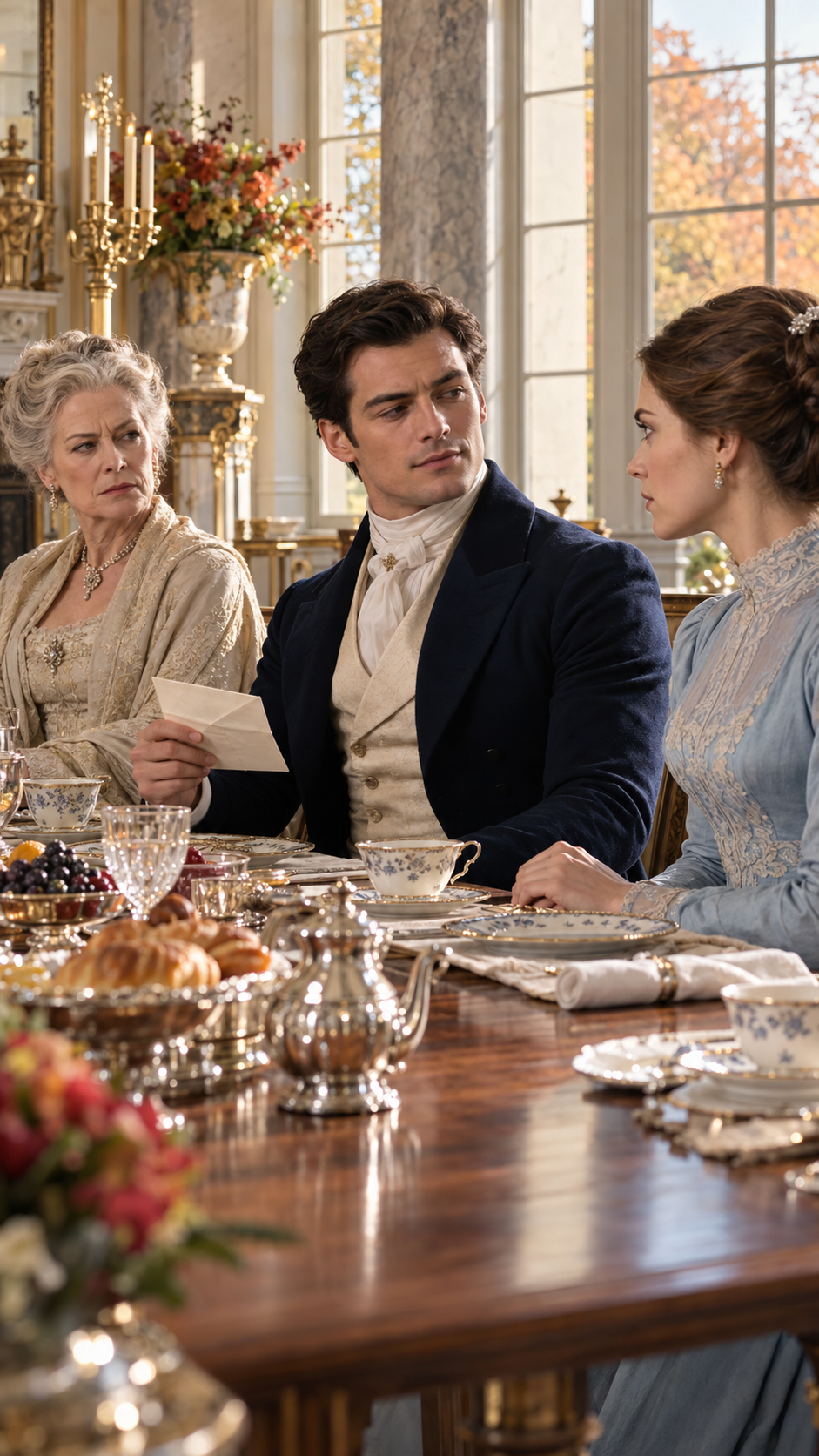
That evening, the four of them dined in the small dining room. Edmund sat at the head of the table, Beatrice at his right, his mother at his left. Clara was placed at the far end, beyond the brightest circle of candlelight.
Edmund talked as if he were making up for seven years of silence. He recalled a ball, a silver gown, a moonlit walk through the rose garden. Beatrice laughed softly and touched his sleeve at just the right moments.
“Do you remember what you promised me that night?” she asked.
“I said I would give you everything.”
“You did.” Beatrice lowered her eyes. “But your father’s debts took it all. Some people have the courage to be ruined. Others sell themselves to be saved.”
She did not look at Clara. She did not need to.
Clara set down her fork. “You must tell us about your travels, Lady Beatrice. You were abroad for six years, weren’t you?”
“Florence, Lake Como, a little of this and that. A modest life.”
“How restful. And your family’s house in Kent—Vale Manor. I heard it was sold.”
Beatrice’s knife stopped above her plate.
“Sold,” she said after a pause. “It was too large for one person.”
“Clara,” Edmund snapped. “Do not interrogate our guest.”
“It’s quite all right,” Beatrice replied, recovering her smile. “I admire women who ask questions. They make such excellent housekeepers.”
Edmund laughed and raised his glass.
Eleanor brought her hand down on the table. The silver jumped.
“Edmund,” she said, her voice cold, “make one more joke at your wife’s expense and I will leave this table, this house, and take the Harlow pearls with me. They are mine, not yours. Do you understand?”
His laughter stopped. Beatrice studied her plate. No one spoke for the rest of the meal.
That night, Clara returned to Edmund’s study. The letters tied in blue ribbon were still in the locked drawer. She read them again, searching their careful phrases for what Beatrice truly wanted. The words were full of the Harlow lands, the family name, the debts, and Clara’s fortune.
They were not love letters.
Beneath them lay the moneylender’s offer: fifteen thousand pounds secured against the West Farms. Two hundred tenant families lived there. Edmund was preparing to risk their homes without even understanding the papers he had signed.
Clara copied the letter’s date and the names involved into her notebook. Then she put everything back exactly as she had found it.
Eleanor stood in the doorway when Clara turned.
“I knew you would find them,” the older woman said. “I have known about those letters for a month.”
“Why didn’t you tell me?”
“I wanted you to see for yourself what you were dealing with.” Eleanor’s voice softened. “I raised a fool. I watched him treat a good woman like furniture, and I let it happen. I will not stop you now.”
“I’m not planning to break anything.”
“No. You are planning to build something. When the moment comes, do not be gentle.”
Clara had just opened her mouth to answer when carriage wheels rattled across the gravel. A moment later, Edmund’s voice rang through the hall—bright, joyful, and entirely unlike the man Clara had lived beside for seven years.
“Beatrice! You’re early!”
Clara’s plan had been set for the night of the banquet. Her father and solicitor were on their way. But Beatrice had arrived before Clara’s letters could even reach them.
“Shall we greet our guest?” Eleanor asked.
Clara closed her notebook. “Yes. Let us be perfectly kind.”
The next two days passed beneath a thin cover of politeness. Beatrice behaved as though she belonged in the house. Edmund followed her from room to room, eager to show her what he had failed to maintain. She praised his taste and listened to his complaints about the marriage as if each one pained her.
Clara said little. She worked through the estate accounts and sent Lucy’s cousin to Millbrook with a second message. It contained only one sentence: Come tonight. Do not delay.
On the afternoon of the banquet, Clara dressed in a gown of pale silver-blue. It had belonged to her mother and had been carefully altered to fit. She wore a small pair of pearl earrings and pinned her hair with a simple silver comb. She looked every inch the Duchess, though she had never needed a title to know what she was worth.
When she entered the ballroom, guests turned to look. Edmund stood near the fireplace beside Beatrice, who wore a dark green gown that caught the light. He glanced at Clara, then looked away.
The seating cards had been changed. Beatrice’s name stood beside Edmund’s at the head table. Clara’s had been placed farther down, beside an elderly cousin she barely knew.
Clara did not correct them.
The first course was served beneath the crystal chandeliers. Conversation rose and fell around the long tables. Beatrice made a point of speaking warmly to everyone while leaving Clara out of each exchange.
Then, as the servants poured wine, Beatrice lifted her glass.
“To old promises,” she said.
Edmund lifted his glass beside her. Several guests smiled, waiting for the story behind the toast.
Clara looked directly at Beatrice.
“To promises,” she said, “and to knowing what they are worth.”
For the first time that evening, Beatrice’s smile faltered.
A servant entered the ballroom and whispered to Mr. Peters. The steward crossed to Clara and bent close.
“Your father has arrived, Your Grace. Mr. Grant is with him.”
Clara kept her expression calm. “Please bring them in.”
The doors opened. Arthur Whitmore entered first, broad-shouldered and silver-haired, with Oliver Grant at his side carrying a leather case. Conversation stopped. Edmund rose so quickly that his chair scraped across the floor.
“Mr. Whitmore,” he said. “You were not expected.”
“I believe I was,” Arthur replied. “My daughter sent for me.”
Beatrice put down her glass. Edmund glanced from Arthur to Clara, his face tightening.
“What is this?” he demanded.
“Something we should have discussed before you signed a loan against the West Farms,” Clara said.
The room went still.
Edmund looked at her as if she had struck him. “You have been in my study?”
“I have been protecting the estate you never bothered to understand.”
Oliver Grant opened his case and laid several documents on the table. “Your Grace, the West Farms belong to the Whitmore Trust. The Duke’s signature does not give him the right to pledge them as security.”
Edmund stared at the papers. “That cannot be.”
“It is,” Clara said. “You signed the agreement seven years ago. You simply never read it.”
Arthur Whitmore placed a second letter on the table—the moneylender’s offer.
“This loan would have put two hundred families at risk,” he said. “It will not go forward.”
Edmund’s gaze shifted to Beatrice. “You knew about the loan?”
She held herself very still. “I knew Edmund wanted to free the estate from his debts.”
“That isn’t what I asked.”
The guests watched her. For once, her smile did not return quickly enough.
Eleanor stood. “The Duchess has worked for this estate every day of her marriage. She has kept its farms alive, its tenants housed, and its name from disgrace. You invited Beatrice here to humiliate her. You may now explain to everyone why.”
“Mother—”
“No.” Eleanor’s voice cut through the room. “You will not silence her again.”
Edmund turned to Clara. Beneath his anger was something else now: fear.
“You knew all this and still let me—”
“I did not let you do anything,” Clara said. “I sent for help before you could take the farms from the people who live there.”
Arthur’s expression remained stern. “The trust will review the estate accounts. Until then, the farms and the house remain protected. The Duke’s personal debts are his own responsibility.”
A murmur moved through the room.
Beatrice rose. Her chair scraped back. “I won’t remain where I am insulted.”
“No one has insulted you,” Clara said. “You are free to leave.”
Beatrice stared at her, then at Edmund. He did not reach for her hand. He did not tell her to stay.
For a heartbeat, the two of them looked like strangers.
Beatrice swept from the room, her green skirts whispering across the polished floor. The ballroom doors closed behind her.
The guests began to talk all at once. Edmund remained standing beside his untouched glass. Clara did not watch him. She turned to Arthur and Oliver.
“Thank you for coming.”
Arthur took her hand. “You should never have had to ask.”
“I know,” she said quietly.
It was the first time in seven years that someone had said it aloud.
THE BANQUET’S AFTERMATH
Beatrice left Harlow Hall before dawn. She took a carriage to the Millbrook Inn and paid her bill with a silver hairbrush. By the time the household discovered she was gone, she was already on the northbound coach.
Edmund did not ask Clara to stop her.
He spent the morning in his study with the documents Oliver had brought. He read every page this time. At first, he insisted the situation could be repaired with another loan. Then Arthur explained what the trust would do if the farms were put at risk again.
The Harlow estate would be reviewed. The tenants would be protected. Edmund’s private debts would not be paid from the trust. He would have thirty days to settle what he owed or surrender control of the house and land.
“You cannot take Harlow Hall from me,” Edmund said.
“It is not yours to lose,” Arthur replied. “It belongs to the trust. The trust permitted you to live here because you were its Duke. It did not give you the right to endanger it.”
Edmund looked toward Clara, waiting for her to defend him.
She did not.
For the next month, Clara stayed at Harlow Hall only long enough to finish the accounts and ensure the tenants were informed. She did not sleep in the room she had shared with Edmund. She packed her belongings into two trunks, leaving behind every dress, jewel, and gift that had come from the Harlow family.
She took her mother’s silver comb, her notebooks, and the small green ledger in which she had recorded seven years of work.
On the morning she left, Edmund waited at the bottom of the staircase.
“Clara,” he said.
She paused, one gloved hand resting on the banister.
“I did not know you were going.”
“You knew I was unhappy.”
“I thought you were content here.”
“You thought I was useful here.”
He lowered his eyes. “I treated you badly.”
“Yes.”
“I want to make it right.”
“You cannot make seven years right with one sentence.”
“I know.”
She studied his face. For the first time, he looked less like a Duke than a tired young man who had let others carry the weight of his life. It did not make her love him. It did not erase what he had done. But it made her understand that he was finally seeing the truth.
“I’m leaving because I need a life that belongs to me,” she said.
“Will you come back?”
“No.”
He flinched at the answer.
“I’m sorry,” he said.
Clara nodded. “I believe you’re sorry. That does not mean I must return.”
She stepped outside into a clear autumn morning. Lucy was waiting beside the carriage, and Margaret had brought a basket of food for the journey. Mr. Peters stood at the front door, his face carefully composed.
Clara thanked them all. Then she climbed into the carriage and did not look back until the house had disappeared behind the trees.
Harlow Hall’s accounts were settled with the trust. Arthur made sure the tenants could remain on their farms while the estate was managed by a proper steward. Edmund kept his title, but he lost control of the land and the money he had never learned to manage.
Clara did not celebrate his downfall. She knew how much damage could be done when a household was ruled by pride and neglect. She also knew she could not spend her life repairing a man who had no wish to change until there was nothing left to lose.
She went to stay with her father for a short time. Arthur offered her a room in his house and every comfort he could provide. Clara was grateful, but she did not want to live as someone’s protected daughter. She wanted work of her own, and a place where her decisions would matter.
That place was Millbrook.
The old mill stood beside the river, its wheel broken and its stone walls weathered. It had been empty for three years. Clara bought it with money her mother had left her, money she had kept untouched since she was twelve.
She hired a carpenter to repair the roof and a mason to strengthen the river wall. The ground floor became a schoolroom with rows of desks, a stove, and a broad blackboard. Upstairs, she planned a workshop where local women could spin and weave wool, keep their own accounts, and sell their work at fair prices. A few small rooms on the top floor would be kept for widows and children who needed shelter.
She named it the Millbrook School.
At first, no one came.
Clara spent the early days cleaning windows, sorting books, and painting the front door. She wondered if she had mistaken hope for a plan. Then a farmer’s daughter arrived with her mother. The girl was twelve and could not read. She sat at the nearest desk and stared at the slate as though it might accuse her.
Clara knelt beside her.
“Show me what you know,” she said.
The girl shook her head.
“That’s all right. We can begin with one letter.”
By the end of the week, two more children had joined. A widow came next, asking if she could learn to keep accounts so no employer could cheat her again. A seamstress wanted to learn enough arithmetic to price her work. Soon the schoolroom no longer felt empty.
Margaret arrived with a carpetbag and took charge of the kitchen without waiting to be asked. Lucy came a few days later. She had discovered that she loved helping the younger children with their letters, and Clara gave her a place as an assistant.
Nora, Beatrice’s former maid, came on a cold morning in December. Her cloak was thin, and she looked as if she had walked a long way.
“I can sew a straight seam,” she said. “Is there work here?”
Clara remembered the quiet young woman who had watched everything in Beatrice’s room and said very little.
“There is,” she replied.
Within a few months, the workshop opened. Women began bringing wool from their farms. Clara helped them set fair prices and keep records of their orders. The school’s students learned to read and write, while the women learned to handle money without surrendering their earnings to anyone else.
Mr. Oliver Grant visited each Saturday to review the legal papers. He always stayed for dinner. When Clara thanked him, he grew awkward and looked down at his plate. Margaret noticed. Lucy noticed. Clara noticed, too, but she did not hurry the friendship into something it was not.
She was learning that a life could be full without a husband at its center.
THE DEBT
In January, a letter arrived addressed to Clara in a hand she recognized.
It was from Beatrice.
The letter was short. Beatrice wrote that she was living in a village in Scotland, in two rooms above a baker’s shop. She taught French and drawing to the miller’s daughters and earned nine shillings a week. She had been paying Sir Julian Crane’s debt in small coins. It would take eleven years.
“I did not deserve the mercy you showed me,” Beatrice wrote. “I thought your quiet meant weakness. I was wrong. I do not expect an answer.”
Clara read the letter twice.
Beatrice had been cruel. She had tried to use Edmund’s pride, and she had intended to benefit from the ruin of the estate. But Clara remembered the panic in her face when the truth had come out, and the way she had left without asking anyone to rescue her.
Clara sat at her desk and wrote four lines.
Keep paying. It is the only thing that works. I wish you better years than the last ones.
She did not add her address. She did not need to. The letter found its way.
In February, Sir Julian Crane came to the school.
He did not knock. He pushed open the classroom door and walked between the desks, leaning on his silver-headed cane.
Sixty children turned toward him. Clara set down the chalk.
“The Duchess of Harlow,” he said. “So this is where you have been hiding.”
“This is a school,” Clara replied. “Whatever business you have with me, you may state it in the hall.”
“My business is simple. Lady Beatrice’s debt remains unpaid. You are wealthy. Pay ten thousand pounds, and I will forget the matter—and refrain from telling the newspapers what was said at your banquet.”
His pale eyes moved over the room. “A school depends so much on reputation.”
The children had gone completely still.
“Please go and fetch Mr. Grant,” Clara told a boy near the door.
“He is not here,” Sir Julian said. His smile was thin. “I made sure of that.”
“I rather think he is,” said a voice behind him.
Oliver Grant stood in the doorway with a police sergeant. Arthur Whitmore was just behind them, his walking stick planted firmly on the threshold.
Oliver opened his leather case.
“I hold sworn statements from thirty-one former borrowers,” he said. His voice shook, but he continued. “They describe charges well above the legal limit. I also heard your demand just now, in front of the entire school.”
Sir Julian’s smile faded.
The sergeant stepped forward. “Sir, I need you to come with me.”
Crane glanced from Oliver to Arthur, then at the children watching him. His hand tightened around his cane. For the first time since Clara had known his name, he had nothing to say.
He left through the front door with the sergeant. His two companions disappeared before they reached the gate.
A little girl in the second row raised her hand.
“Is the bad man gone, ma’am?”
“He is,” Clara said. “Let’s return to our letters.”
THE DOOR
Spring came late that year. When it arrived, it came with warm rain, green banks, and the sound of the mill wheel turning again.
The school grew until every desk was occupied. The women’s workshop had enough orders to keep everyone busy through the summer. Clara hired two more teachers and opened the small rooms upstairs to families who had nowhere safe to sleep.
One Tuesday morning, a man came walking up the lane.
He wore a plain brown coat with worn cuffs. His boots had been repaired. His hands were rough, and pale scars crossed both palms. He stopped at the gate and listened to the children reading through the open windows.
Inside, Clara was teaching a girl how to add a column of figures in a ledger.
The door opened. A child drew in a quick breath.
Clara looked up.
Edmund stood in the doorway with his hat in his hands.
For a moment, neither spoke. Sixty children looked from him to Clara and back again.
“Lucy,” Clara said quietly, “will you take over the sums?”
“Yes, ma’am.”
Clara stepped into the hall and closed the classroom door behind her.
“Edmund.”
“Clara.”
His voice was rough. He cleared his throat.
“I won’t take much of your time. I did not come to ask for anything. I only came to say what I should have said seven years ago.”
She waited.
“I’m sorry,” he said. “Not because I lost Harlow Hall. I’m sorry because I have finally read the ledgers. I know what you carried while I rode to London and called myself a man. I know what you paid and what you kept from me because you were trying to protect the estate.”
Clara looked at his hands.
“I work for Mr. Peters now,” Edmund continued. “I mend fences on the West Farms. I carry grain. I’m learning the tenants’ names. It doesn’t repair what I did. I know that. I only wanted you to know I’m trying to become someone who might have deserved you.”
He swallowed.
“I don’t ask you to forgive me. I don’t ask you to come back. If you would tell me that you heard me, I’ll go.”
From the classroom came the sound of a child reading aloud, stumbling over a long word and then finding her way through it.
“I heard you,” Clara said. “Every word. And I believe you.”
For the first time, hope touched his face.
“I want to thank you,” she continued. “When I came to Harlow Hall, I believed that being a good wife meant making myself smaller whenever you asked. I did not know my own worth. You showed me how much I had been giving, even if you only understood it after it was gone.”
“Clara—”
“I do not hate you,” she said. “But I will not return to Harlow Hall, and I will not return to being your wife. There is no room left in my life for a man who learned what I was worth only after he lost me.”
Edmund lowered his head. He did not argue. He did not ask again.
“Thank you for hearing me,” he said.
“Goodbye, Edmund.”
Clara opened the classroom door. The children were waiting, their books spread across the desks.
She stepped inside and closed it gently behind her.
Edmund remained in the sunny hall. Through the door, he heard Clara’s voice rise above the scrape of benches and the rustle of pages.
“Now then, where were we? Open your books.”
He put on his hat and walked down the steps. The lane was bright with spring flowers. He followed it toward the river without looking back.
Inside the old mill, the lesson continued. The wheel turned steadily beside the school, and the sound of children reading carried out over the water.
Clara returned to the ledger. A little girl leaned close, waiting for her to explain the next column.
“Let’s take it one line at a time,” Clara said.
The girl smiled and picked up her pencil.
Outside, the river moved beneath the open windows. Clara had not won a title or returned to a grand house. She had built something that belonged to her—and, at last, she was free to live in it.

