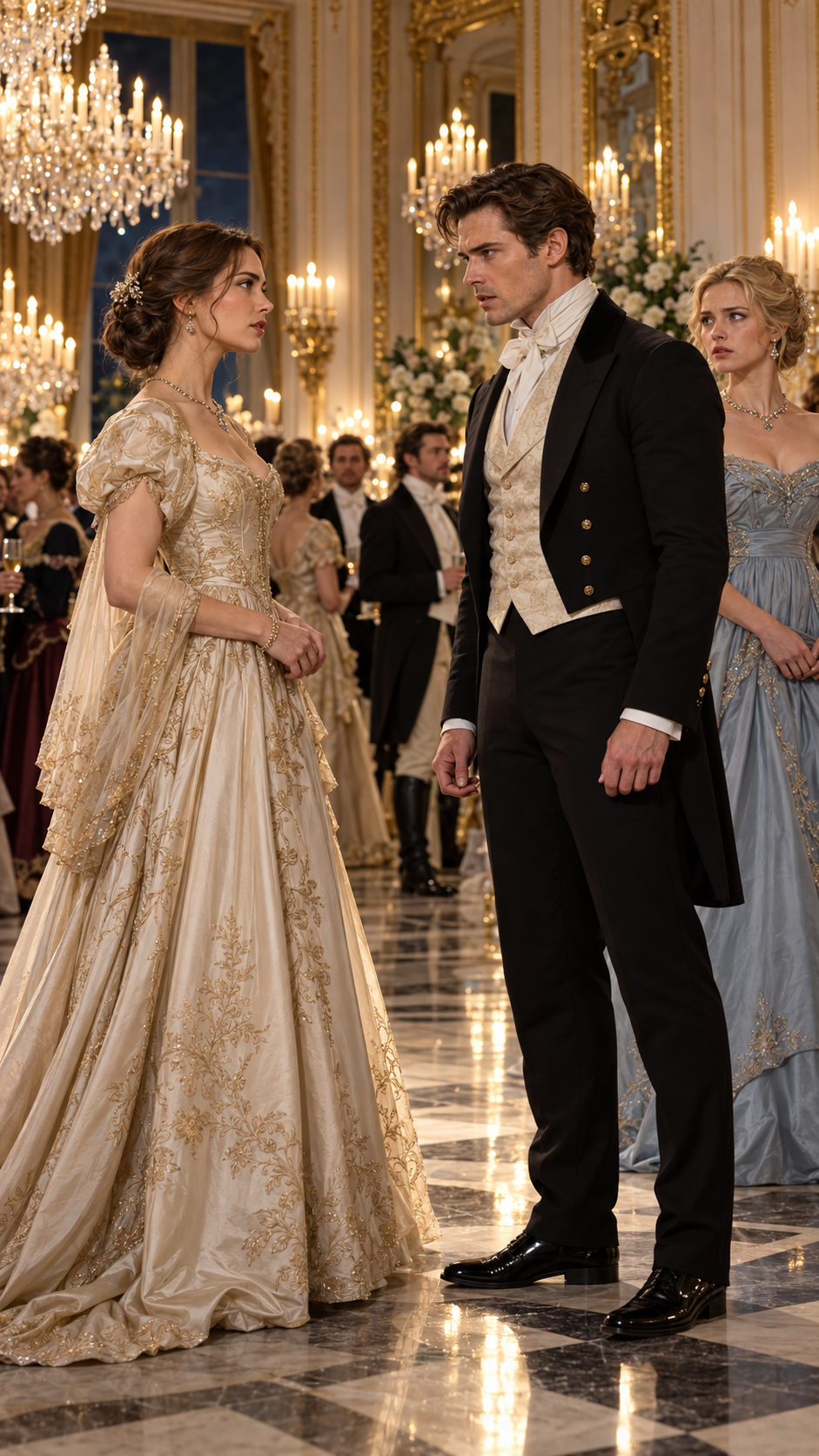
 THE DUKE’S FORGOTTEN WIFE RETURNED — AND LONDON WAS NOT READY
Chapter 1: The Woman Who Owned His Future
“Twenty thousand pounds?”
Nathaniel Pembrook stared toward the ballroom podium, certain he had misunderstood the announcement.
Twenty thousand pounds was not an ordinary charitable donation. It was enough to repair entire streets of neglected cottages, improve a struggling factory, or keep a noble estate from financial disaster for years.
And his estranged wife had just pledged that sum in front of half of London’s aristocracy.
Lady Adelaide Hartwell stood beneath the glittering chandeliers, accepting the applause with the same composed expression she had worn when greeting him moments earlier.
Three years ago, she had left Ravenscroft Hall carrying one small suitcase.
Tonight, she appeared capable of purchasing half the properties belonging to the men who had once mocked her family.
Nathaniel looked down at the cream-colored document in his hand.
Hartwell Mercantile — Acquisition of Northfield Mill.
The familiar name seemed almost to mock him.
Northfield had belonged to the Pembrook family for fifty-eight years. His grandfather had acquired the mill when the family’s commercial investments were expanding. His father had considered it an important part of Ravenscroft’s financial security.
Nathaniel had considered it an inconvenience.
Its profits had declined for years. Repairs had become increasingly expensive. His estate managers had advised selling before its debts threatened other properties.
He had agreed.
Now he wondered whether he had understood anything about the business he had surrendered.
“Your Grace?”
Lady Victoria Montrose stood beside him, her pale-blue gown shimmering under the chandeliers.
“You look dreadfully pale.”
Nathaniel folded the document.
“Northfield has been sold.”
Victoria glanced toward Adelaide.
“To her?”
“To Hartwell Mercantile.”
“How extraordinary.”
There was something in Victoria’s voice that made him turn.
“What?”
She smiled.
“Nothing. Merely that Lady Adelaide has always possessed a remarkable talent for placing herself exactly where she can attract attention.”
Nathaniel studied her.
Once, he would have found the remark amusing. Or perhaps he would have pretended not to hear it.
That had been his preferred method of handling anything unpleasant.
Pretend not to notice.
Avoid an argument.
Preserve appearances.
It had cost him his wife.
“Adelaide does not need attention,” he said quietly.
Victoria’s smile faltered.
“Indeed?”
“She has just donated twenty thousand pounds. I imagine she has earned the right to stand wherever she pleases.”
Victoria looked at him with surprise.
Before she could answer, Nathaniel turned away.
He crossed the ballroom slowly, passing gentlemen whose conversations stopped when he approached.
He knew what they were discussing.
The duke’s abandoned wife.
The merchant’s daughter who had returned with a fortune.
The marriage that had never legally ended.
And, inevitably, Benjamin Mercer.
The American financier stood near Adelaide, speaking with Lord Fairborn. He was handsome in an unassuming way, with the relaxed confidence of a man who had never needed an inherited title to prove his importance.
Adelaide laughed at something he said.
Nathaniel stopped.
He remembered that laugh.
He remembered hearing it in the library while she corrected his arithmetic, in the gardens when he complained about English weather, and at breakfast when she read absurd observations from the newspapers.
He had once believed those moments would continue forever.
Then he had started leaving the breakfast table early.
Returning late from London.
Allowing letters from political acquaintances to interrupt their evenings.
Little by little, their marriage had become a house in which two people occupied separate rooms.
And Nathaniel, who prided himself on understanding the delicate machinery of government, had failed to notice that his own marriage was breaking.
“Your Grace.”
Adelaide’s voice returned him to the present.
She was looking at him.
Mercer offered a courteous nod and moved a short distance away with Lord Fairborn.
Nathaniel found himself facing his wife alone.
“I received a document,” he said.
“Did you?”
“Northfield.”
“Ah.”
Her expression remained pleasant.
“You purchased it.”
“Hartwell Mercantile purchased it.”
“Is there a distinction?”
“A rather important one. I am not the company, Nathaniel.”
It was the first time she had spoken his name without a title that evening.
He felt the difference immediately.
“Why Northfield?”
“Because it was for sale.”
“Adelaide.”
Her eyes sharpened.
“Do not use that tone.”
“What tone?”
“The one you used when you wished me to stop asking inconvenient questions.”
Nathaniel fell silent.
Around them, conversation continued. Crystal glasses chimed. The orchestra resumed playing.
Yet the space between them felt strangely isolated.
“I want to understand,” he said.
Adelaide regarded him for several seconds.
Then she answered.
“That is new.”
The words were quiet.
They struck harder than any accusation.
“Perhaps,” Nathaniel admitted. “But I am asking.”
She glanced toward the document in his hand.
“Northfield has been losing money for years. Your office decided the workers and buildings were not worth further investment. I disagree.”
“You believe you can make it profitable?”
“I believe it was allowed to become unprofitable.”
“Those are serious accusations.”
“Yes.”
“Against whom?”
Adelaide’s expression changed.
For the first time that evening, the warmth disappeared completely.
“Nathaniel, before you ask who is responsible, you should be certain you are prepared to hear the answer.”
He looked at her.
“What do you mean?”
She did not respond immediately.
Instead, she reached into the small silk bag hanging from her wrist and removed a folded paper.
It was a page copied from an old estate ledger.
Nathaniel recognized the handwriting.
His own.
His stomach tightened.
“Where did you get that?”
“From records your office believed were no longer important.”
He stared at the familiar signature.
“What does it prove?”
Adelaide folded the paper again.
“Not here.”
“Then where?”
“My office. Tomorrow morning.”
“Adelaide—”
“Ten o’clock.”
She stepped closer, lowering her voice.
“If you truly want to understand why your family lost Northfield, arrive prepared to listen rather than defend yourself.”
She turned away.
Nathaniel watched her move across the ballroom toward Mercer.
He could have followed.
He could have demanded an explanation.
Three years ago, he would have done exactly that.
Instead, he remained where he stood.
For the first time in years, Nathaniel Pembrook understood that a title did not entitle him to an answer.
And somewhere beneath his wounded pride, an unfamiliar feeling was beginning to grow.
Fear.
Not merely that Adelaide might ruin him financially.
But that the woman he had dismissed as unnecessary might be the only person who understood how much of his life had already been destroyed.
Chapter 2: The Ledger He Refused to Read
At precisely ten o’clock the following morning, Nathaniel entered the offices of Hartwell Mercantile.
He had expected a respectable commercial establishment.
He had not expected a business occupying three floors, employing dozens of clerks, and conducting transactions with merchants from Liverpool, Manchester, Glasgow, and New York.
Men carrying account books passed through the corridors. Letters arrived by the bundle. A large map on one wall displayed shipping connections across the Atlantic.
Nothing about the establishment suggested a business struggling to prove itself.
Everything suggested control.
A clerk escorted him upstairs.
“Lady Adelaide is expecting you, Your Grace.”
Nathaniel entered a spacious office overlooking the busy street.
Adelaide stood beside a long desk covered with account books.
She wore a dark green silk day dress, its simple elegance emphasizing how little she now cared about society’s approval.
Her hair was pinned neatly behind her head.
There were no diamonds.
No elaborate jewels.
Only a small watch attached to her waist and an ink stain on one finger.
For one painful instant, Nathaniel remembered their first winter at Ravenscroft.
She had sat at his library desk looking exactly like this.
He had kissed the ink stain on her hand and declared that his duchess worked harder than any banker in London.
He had meant it as a compliment.
He had never realized how rarely he gave her the opportunity to prove it.
“You are punctual,” Adelaide observed.
“I was instructed to be.”
“How refreshing.”
He nearly smiled.
She gestured toward a chair.
“Sit.”
Nathaniel obeyed.
Adelaide opened the largest ledger.
“Northfield has reported declining profits for six consecutive years.”
“I know.”
“No,” she replied. “You know the profits declined. You do not know why.”
She turned the book toward him.
“The machinery in weaving room two should have been replaced four years ago. Three separate managers requested funding. All three requests were rejected.”
Nathaniel frowned.
“Rejected by whom?”
“Your central estate office.”
“I never saw those requests.”
“That is precisely the problem.”
She turned another page.
“Wages have remained unchanged for four years. Coal allowances were reduced last winter. Several cottages have leaking roofs. The mill’s older looms are operating with inadequate safety measures.”
Nathaniel leaned forward.
“Those conditions should have been reported.”
“They were.”
“To whom?”
“To the people you appointed to manage them.”
He said nothing.
Adelaide opened another folder.
“This is the report concerning Thomas Bell.”
Nathaniel recognized the name faintly.
“There was an accident.”
“A fatal accident.”
“Yes.”
“He left a widow and children.”
Nathaniel looked at the paper.
He remembered signing something.
There had been a recommendation for financial assistance.
An amount had been written beside it.
Twelve pounds.
He stared.
“Surely that cannot be all.”
“It was.”
“Adelaide—”
“Twelve pounds, Nathaniel.”
Her voice trembled slightly, not with weakness but with controlled anger.
“Your London smoking room received a new carpet that cost more.”
Nathaniel closed his eyes.
For several moments, he could not speak.
He remembered the carpet.
He remembered complaining that the original pattern had faded.
He remembered approving the expense without hesitation.
But he did not remember Thomas Bell’s widow.
That realization made him feel physically ill.
“Why wasn’t I told?”
“You were.”
The answer was devastatingly simple.
Adelaide pushed another document toward him.
There was his signature beneath the official accident report.
He examined it.
He had signed the paper between two meetings.
Had he actually read it?
He could not remember.
“I trusted my managers,” he said.
“You trusted that their judgment would spare you inconvenience.”
He looked up.
“You believe I wanted this?”
“No.”
Her expression softened, but only slightly.
“I believe you never bothered to discover whether it was happening.”
Silence filled the room.
Outside, carriage wheels rattled across the cobblestones.
Adelaide turned another page.
“Northfield can be repaired. The looms can be replaced. Safety conditions can improve. Workers can receive proper wages, and the mill can still operate profitably.”
“Then why did my office advise selling?”
“Because closing a ledger is easier than correcting it.”
Nathaniel looked at the figures.
For the first time, he was not seeing columns of expenses.
He was seeing houses.
Families.
People whose lives depended upon decisions made in rooms they would never enter.
“Can you prove the mill is recoverable?”
“Yes.”
“How?”
Adelaide placed a detailed business plan before him.
It contained projected repairs, machinery costs, operating expenses, shipping arrangements, and expected revenue.
Nathaniel studied it carefully.
After several minutes, he raised his eyes.
“You prepared all this before purchasing Northfield?”
“Of course.”
“How long?”
“Several months.”
“Several months?”
“Yes.”
He looked at her in disbelief.
“You were examining my estate’s finances for months?”
“I was examining an investment.”
“But you knew it belonged to my family.”
“Yes.”
“Did that influence your decision?”
Adelaide closed the ledger.
“Do you want the truth?”
“I asked for it.”
“Northfield was undervalued. Its management had failed. Its workers deserved better. Any competent buyer could have recognized the opportunity.”
She paused.
“But yes. I also remembered what Ravenscroft once meant to me.”
Nathaniel’s expression changed.
Adelaide looked toward the window.
“I remember the cottages. The mill road. The tenants who brought flowers when I first arrived. I remember Thomas Bell’s wife serving tea during a village celebration.”
She returned her gaze to him.
“I could not prevent every mistake your family made, Nathaniel. But I could prevent that mill from becoming another abandoned building.”
He looked down.
“I should have listened to you.”
“Yes.”
“I should have listened years ago.”
“Yes.”
There was no satisfaction in her agreement.
Only exhaustion.
Nathaniel stared at her.
“Why did you never tell me how serious the problems were?”
Adelaide gave a short, incredulous laugh.
“I did.”
The room seemed suddenly colder.
“I told you about the steward who stole eight hundred pounds. I told you about the cottages. I questioned the repairs. I examined the coal accounts.”
She leaned forward.
“And every time, you congratulated me, kissed my forehead, and returned to your precious political correspondence.”
Nathaniel remembered.
Every incident.
Every warning.
Every conversation he had dismissed because she would surely take care of it.
“I thought you enjoyed managing those matters,” he said weakly.
“I did.”
“Then—”
“But enjoying a responsibility does not mean I should carry it alone.”
He had no answer.
Adelaide sat back.
“I did not leave because you were busy, Nathaniel. I left because you taught me that my intelligence was useful when it served you and embarrassing when it contradicted you.”
“That isn’t what I intended.”
“I know.”
He looked at her hopefully.
Then she continued.
“That was the worst part. You hurt me without ever considering that you were doing it.”
Nathaniel slowly lowered his gaze.
For years, he had imagined that one explanation might change her opinion of him.
That he could tell her about his father’s expectations.
About the political commission.
About the pressure of protecting Ravenscroft.
Perhaps she would understand.
But sitting across from Adelaide, surrounded by the evidence of his negligence, he realized understanding would not erase what he had done.
“I am sorry,” he said.
Adelaide looked at him.
He had written those words in letters.
He had whispered them to empty rooms.
He had imagined speaking them to her a hundred times.
Now they seemed inadequate.
“I know,” she replied.
He waited.
She reached for the ledger.
“And I must return to work.”
Nathaniel rose.
At the door, he stopped.
“May I visit Northfield?”
Adelaide looked up.
“Why?”
“Because I want to see what I allowed to happen.”
She studied him.
“Are you asking as the Duke of Ravenscroft?”
“No.”
“Then as what?”
Nathaniel swallowed.
“As a man who should have known better.”
For the first time that morning, something like approval crossed her face.
“My carriage leaves Bishopsgate tomorrow at four.”
“I’ll be there.”
“Four means four, Nathaniel.”
“I understand clocks.”
“We shall see whether you understand instructions.”
He almost laughed.
And for one brief moment, the distance between them seemed less impossible.
Chapter 3: The Road Back to Northfield
The rain began shortly after sunset.
By then, London lay far behind them, and the carriage was moving through narrow country roads toward Northumberland.
Adelaide sat opposite Nathaniel, reading reports by the unsteady glow of a carriage lamp.
He watched her for several minutes.
“You will damage your eyesight.”
Without looking up, she replied, “You used to say that.”
“You used to ignore me.”
“I still do.”
A smile tugged at his mouth.
“Some things never change.”
Adelaide turned a page.
“Others change considerably.”
The carriage jolted over a deep rut.
Nathaniel grasped the seat.
“You could put those reports away.”
“I could.”
“Will you?”
“No.”
He sighed.
She looked up.
“Have I exhausted your patience already?”
“Not at all.”
“Remarkable. Marriage has apparently improved you in my absence.”
He gave a quiet laugh.
Then the carriage struck something hard.
A sharp crack sounded beneath them.
Adelaide slid sideways.
Nathaniel reached for her instinctively, catching her around the waist before she struck the door.
For a moment they were very close.
Her hand pressed against his chest.
His arm remained around her.
He felt her breathing.
Then she straightened.
“I’m all right.”
“Are you certain?”
“Yes.”
Outside, the coachman shouted.
The carriage lurched to a stop.
A moment later, the man opened the door.
“Rear wheel, Your Grace. Split through. Can’t continue safely.”
Nathaniel looked toward the muddy road.
“How far to the nearest village?”
“A little over a mile. There’s an inn, the Rose and Crown.”
Adelaide closed her book.
“Of course there is.”
Nathaniel looked at her.
“What?”
“Nothing. I simply imagined my triumphant return to commerce involving fewer broken wheels.”
He laughed.
A real laugh.
For the first time in three years, he forgot to restrain it.
Adelaide stared at him.
“What?”
“I’d forgotten.”
“Forgotten what?”
“That you’re funny.”
Her expression changed.
“No, Nathaniel.”
She drew her cloak around her shoulders.
“You stopped listening.”
He did not answer.
Because once again, she was right.
They walked to the inn beneath cold November rain.
By the time they arrived, Nathaniel’s expensive boots were covered in mud, and Adelaide’s skirts were wet well above the hem.
The innkeeper gave them a private parlor near the fireplace.
Nathaniel ordered tea and food while Adelaide stood before the flames warming her hands.
He removed his gloves.
“Take these.”
“I have gloves.”
“Yours are wet.”
“They will dry.”
“Adelaide.”
She looked at him sharply.
“I do not need rescuing from cold fingers.”
He lowered the gloves.
“I know.”
“Then why insist?”
“Because I remember that your hands become painfully cold in November.”
The answer surprised her.
Nathaniel looked toward the fire.
“I remember more than you think.”
She remained silent.
He placed the gloves on the table.
“You need not wear them.”
After a moment, Adelaide took one.
Not both.
Only one.
A small compromise.
Yet Nathaniel felt grateful for it.
They ate quietly.
For a while, their conversation remained safely concerned with the road, the damaged wheel, and the likely cost of the delay.
Then Nathaniel asked the question he had been avoiding.
“Were you happy?”
Adelaide looked up.
“When?”
“During the past three years.”
She placed her cup down.
“That is a complicated question.”
“I have time.”
“You always had time. You simply spent it elsewhere.”
He accepted the rebuke without protest.
Adelaide looked into the fire.
“At first, I was miserable.”
Nathaniel felt his chest tighten.
“I returned to my father’s house. I scarcely slept. I refused invitations. For weeks, I could not hear a carriage passing outside without looking toward the window.”
He said nothing.
“I kept imagining you would come.”
Her voice remained steady.
“But you never did.”
Nathaniel stared at his hands.
“I wrote.”
“Eventually.”
“I didn’t know what to say.”
“You could have said you wanted me to return.”
“I did.”
“Your letters spoke about arrangements, solicitors, appearances, and avoiding scandal.”
He remembered every one of them.
Careful letters.
Respectable letters.
Letters composed like government memoranda.
“I was afraid you would refuse.”
“So you never asked properly.”
Nathaniel looked up.
“No.”
She watched the flames.
“After a while, I stopped waiting. I went back to work. My father’s business needed attention. There were accounts to examine and contracts to negotiate.”
A faint smile touched her lips.
“Numbers were easier than people. They rarely pretended to mean something else.”
Nathaniel listened.
“I discovered I was good at it. Better than some of the men who had spent their lives insisting women were incapable of understanding commerce.”
“You always were.”
“Yes,” Adelaide said softly. “I was.”
She turned toward him.
“And eventually I realized I did not need your permission to become the woman I had always been.”
The words hurt.
But he understood why they were necessary.
“Did you stop loving me?” he asked.
Adelaide’s expression closed.
“Nathaniel.”
“I know I have no right to ask.”
“Then perhaps you shouldn’t.”
He nodded.
Silence followed.
The rain struck the windows.
At last, Adelaide spoke.
“I stopped allowing love to excuse the way you treated me.”
He raised his eyes.
“That was not the question.”
“It is the only answer I can give you.”
She rose and moved toward the window.
Nathaniel remained seated.
After a moment, he said, “I remember the night you left.”
Adelaide’s shoulders stiffened.
“I remember every word.”
“So do I.”
“I remember you standing in the entrance hall with your suitcase.”
She turned.
“Do you remember me looking back?”
Nathaniel felt the air leave his lungs.
“Yes.”
Her eyes shone.
“I waited.”
“I know.”
“No.”
She shook her head.
“You don’t.”
A tear slipped down her cheek.
“I waited until the carriage reached the gates. I kept looking backward because some foolish part of me believed you would come running out.”
Nathaniel rose slowly.
“Adelaide—”
“I thought you would stop me.”
He could not speak.
“I thought you would finally choose me.”
The fire cracked behind them.
“But you didn’t.”
“No,” he whispered.
“I carried that humiliation for years.”
Nathaniel stood motionless.
He had imagined that she left because she wanted freedom.
He had never understood that some part of her had still been hoping he would ask her to stay.
“I wanted to follow,” he said.
“Then why didn’t you?”
“Pride.”
He swallowed.
“Fear. Cowardice. I told myself you needed time. I convinced myself that following you would make everything worse.”
Adelaide wiped her cheek.
“And what did doing nothing accomplish?”
“Nothing.”
He looked directly at her.
“It cost me you.”
She closed her eyes.
Nathaniel took one step forward, then stopped.
“I cannot change that night.”
“No.”
“And I cannot ask you to forget it.”
“No.”
“But I can tell you that I was wrong.”
Adelaide looked at him.
“I know you were wrong, Nathaniel.”
Her voice broke slightly.
“What I do not know is whether you understand why.”
He stood in silence.
Then he answered.
“Because I allowed you to become lonely in your own marriage.”
She stared.
“Because I treated your loyalty as something guaranteed. Because I preferred the admiration of people who barely knew me to the respect of the woman who understood me best.”
Her eyes filled again.
Nathaniel’s voice lowered.
“And because when you asked me to defend you, I made you defend yourself.”
Neither moved.
The firelight trembled across the walls.
Adelaide looked away first.
“It is late.”
“Yes.”
“We should sleep.”
Nathaniel nodded.
He wanted to reach for her.
To ask whether she believed him.
To beg her for another chance.
Instead, he stepped aside and allowed her to leave the room.
That night, for the first time since her departure, Nathaniel understood that loving Adelaide was not enough.
He would have to become someone she could trust.
And trust was not something a duke could command.
It was something a man had to earn.
Chapter 4: The House She Had Secretly Saved
Northfield changed Nathaniel more than any conversation could have done.
It was one thing to read about dangerous machinery in a London office.
It was another to stand beside a loom that shook so violently the floorboards trembled.
The mill manager showed them the weaving rooms.
Adelaide examined each machine, speaking directly to the workers and asking questions about repairs, operating hours, and safety measures.
Nathaniel followed quietly.
He recognized the surprise on several faces.
The Duke of Ravenscroft was visiting a mill he had owned for years.
Yet he knew less about it than the woman who had purchased it only recently.
At midday, Adelaide introduced him to Mary Bell.
She was a widow with tired eyes and hands reddened from work.
Her husband Thomas had died in the accident Nathaniel had barely remembered.
Mary looked at the duke without smiling.
“Your Grace.”
“Mrs. Bell.”
He removed his hat.
“I came to apologize.”
She studied him.
“For what?”
Nathaniel hesitated.
“For failing your husband. And for failing you afterward.”
Mary’s face remained expressionless.
“My husband is still dead, Your Grace.”
“I know.”
“And my children are still without their father.”
“I know.”
She reached into her apron and produced a folded letter.
“I wrote to your office after Thomas died. I asked whether the estate could help me keep the children in school.”
Nathaniel accepted it.
The Ravenscroft seal was unmistakable.
No answer had been sent.
He felt ashamed in a way no public scandal had ever made him feel.
“I never saw this.”
“That doesn’t surprise me.”
Mary’s voice contained no cruelty.
Only the weary certainty of someone who had learned not to expect much from powerful people.
Nathaniel looked toward her children standing near the cottage doorway.
Then he returned his attention to her.
“I cannot bring your husband back.”
“No, Your Grace.”
“But I can ensure that the estate provides what should have been provided from the beginning.”
Mary watched him carefully.
“Then do that.”
He nodded.
She took the letter back.
“And see that the next woman doesn’t need an apology.”
Nathaniel carried those words with him long after they left.
Three days later, he arranged a pension for Thomas Bell’s children from his personal income.
He told no one.
Not because he wanted to conceal a generous act, but because he was beginning to understand that decency did not require an audience.
Adelaide learned about it from Mary herself.
She said nothing to Nathaniel that evening.
But when he arrived at her office for a meeting, he found that she had already poured his tea.
It was a small gesture.
He treasured it more than any public compliment.
For two weeks they worked together.
Northfield required new machinery. Railway contracts needed renegotiation. Shipping costs had to be reduced, and the mill’s management practices needed serious reform.
Nathaniel discovered that Adelaide could argue for forty minutes over a freight charge and emerge victorious without raising her voice.
Adelaide discovered that Nathaniel, when he genuinely applied himself, was an intelligent and capable partner.
Their conversations became easier.
Occasionally, they even laughed.
Then Nathaniel uncovered a secret that threatened to destroy their fragile understanding.
It began with a routine discussion about refinancing Ravenscroft Hall.
His solicitor arrived carrying documents concerning an old mortgage established during his father’s lifetime.
The estate was heavily indebted.
Nathaniel knew that much.
What he did not know was the identity of its current creditor.
He read the document twice.
Then a third time.
Hartwell Holdings.
For a moment, he could hear nothing beyond the ticking clock.
“Are you certain?” he asked.
The solicitor nodded.
“The debt was transferred eighteen months ago.”
“Eighteen months?”
“Yes, Your Grace.”
Nathaniel rose so abruptly that his chair scraped across the floor.
He had spent eighteen months living in a house whose debt was controlled by the wife he had allowed to leave.
And she had never told him.
He went directly to her London office.
Adelaide was reviewing correspondence when he entered.
She looked up.
“Nathaniel?”
He placed the papers on her desk.
“You own my home.”
Her pen stopped.
“No.”
He stared.
“Do not pretend you don’t know what I’m talking about.”
“I own the debt secured against Ravenscroft Hall. That is not the same as owning the house.”
“You have known for eighteen months?”
“Yes.”
“And you never thought to tell me?”
“Why would I?”
“Because it is my home!”
Adelaide stood.
“The home I left in the rain?”
Nathaniel fell silent.
She looked at the papers.
“Yes, I remember that house.”
He turned away, struggling to control his temper.
“Was this revenge?”
Adelaide’s expression became cold.
“If I wanted revenge, Nathaniel, you would not have learned about that mortgage eighteen months after I bought it.”
He looked back.
“Then explain.”
She opened a drawer and removed a thick file.
“The bank holding your father’s loan was in serious financial difficulty.”
“I knew it was struggling.”
“Did you know Lord Edmund Wikliffe’s agents were attempting to acquire its distressed assets?”
Nathaniel frowned.
“Wikliffe?”
“Yes.”
The name sent a chill through him.
Lord Edmund Wikliffe had once promised Nathaniel a position on a prestigious government trade commission.
It was Wikliffe whose approval Nathaniel had desperately sought three years earlier.
And it was Wikliffe’s connections that Victoria had encouraged him to protect.
“What does he have to do with Ravenscroft?”
Adelaide opened the file.
“If his intermediaries acquired the mortgage, they could demand payment under its terms. Your estate could not have met that obligation without selling substantial property.”
“How substantial?”
“The eastern farms first.”
Nathaniel stared.
“Then the woodland. Possibly the village leases.”
He sat down.
The implications were terrible.
Those lands had supported Ravenscroft Hall for generations.
Losing them would have crippled the estate and affected dozens of tenant families.
“You bought the debt before Wikliffe could acquire it?”
“Yes.”
“Why?”
Adelaide looked away.
“It was commercially sensible.”
“Adelaide.”
“What?”
“Do not speak to me as though I’m stupid.”
She stopped.
For a moment, something like amusement crossed her face.
Then it disappeared.
“You remember that phrase.”
“I remember a great deal.”
She closed the file.
“Ravenscroft was vulnerable. Hartwell Holdings had the capital to acquire the debt. It was a sound investment, and it prevented an aggressive creditor from forcing the sale of properties that would have caused considerable harm.”
“That is not the entire reason.”
“No.”
She lowered her gaze.
“I loved that house once.”
Nathaniel’s expression changed.
Adelaide continued.
“I loved the gardens, the library, the village. I loved the tenants who brought me flowers when I first arrived.”
Her voice grew quieter.
“And I loved the man who lived there.”
Nathaniel could barely breathe.
“I knew what losing Ravenscroft would do to you,” she said.
“After everything I had done to you, you still protected it?”
“I protected something that mattered to me.”
He rose.
“Adelaide—”
She stepped back.
“Don’t.”
He stopped immediately.
Her eyes shone with sudden tears.
“I need you to understand something.”
“Anything.”
“I was not a different woman three years ago.”
Nathaniel remained silent.
“I was not less intelligent. I was not less capable. I was not less loyal.”
She looked directly at him.
“I did not suddenly become worthy of respect because London now admires my fortune.”
A tear slid down her cheek.
“You simply weren’t paying attention.”
Nathaniel felt the truth of those words settle somewhere deeper than shame.
“You’re right.”
She looked almost surprised.
“I know.”
“I wish you weren’t.”
That stopped her.
Nathaniel swallowed.
“I wish there were some argument I could make that would leave me less ashamed of myself.”
Adelaide wiped her cheek.
“There isn’t.”
“No.”
He nodded.
“There isn’t.”
He did not approach her again.
He did not ask her to forgive him.
He simply gathered the documents and left.
For the first time, Adelaide watched him go without feeling abandoned.
And that frightened her almost as much as loving him again.
Chapter 5: The Accusation at Lady Fairborn’s Dinner
Lady Fairborn’s dinner was attended by twenty-four guests.
Adelaide disliked formal dinners now.
Not because she feared society.
She had overcome that particular weakness.
She disliked the exhausting performance of people pretending to be kinder than they were.
Nevertheless, Hartwell Mercantile was negotiating several important contracts, and some of the necessary conversations still occurred around aristocratic dining tables.
Nathaniel was present.
So was Victoria Montrose.
And seated near the head of the table was Lord Edmund Wikliffe.
The evening began pleasantly enough.
Adelaide spoke with Benjamin Mercer about the planned American shipping agreement.
Nathaniel discussed railway connections with another guest.
For nearly an hour, nobody mentioned Northfield.
Then Victoria smiled across the table.
“How fortunate that Lady Adelaide always seems to know which Ravenscroft investments are vulnerable before the market does.”
Adelaide placed her fork down.
Several guests became quiet.
Wikliffe smiled mildly.
“Lady Adelaide clearly possesses excellent commercial instincts.”
“Of course,” Victoria said.
She turned toward Adelaide.
“Though one imagines that being married to the Duke of Ravenscroft provides certain advantages.”
The implication was unmistakable.
She was suggesting that Adelaide had used confidential information from her husband’s estate to enrich herself.
Adelaide held Victoria’s gaze.
“Are you accusing me of something, Lady Victoria?”
“Certainly not.”
Victoria’s smile widened.
“I merely find the timing of your acquisitions fascinating.”
Three years ago, Adelaide would have looked toward Nathaniel.
She would have waited for him to intervene.
He would have considered the host, the guests, the political consequences.
And he would have remained silent.
This time Adelaide was prepared to defend herself.
But before she could speak, Nathaniel set down his glass.
“Lady Victoria.”
His tone was quiet.
Everyone turned.
“Adelaide acquired Northfield after my management failed it.”
Victoria looked surprised.
“Nathaniel, I was only—”
“I know precisely what you were doing.”
The table fell silent.
Nathaniel continued.
“Hartwell Mercantile was not built with Ravenscroft money, information, or influence.”
Wikliffe’s expression sharpened.
“If anything,” Nathaniel said, “the opposite is true.”
Adelaide stared at him.
“Northfield’s workers are safer today because Lady Adelaide identified failures my office ignored. Ravenscroft Hall itself remains secure because of financial decisions she made when she owed my family nothing.”
Victoria’s cheeks reddened.
Nathaniel looked around the table.
“If anyone wishes to discuss mismanagement of Ravenscroft affairs, I am the appropriate person to question.”
A long silence followed.
Then Lady Fairborn deliberately changed the subject.
But the damage had been done.
Not to Adelaide.
To Victoria’s carefully cultivated reputation for grace.
And perhaps to Wikliffe’s confidence.
After dinner, Adelaide found Nathaniel standing near a window overlooking the garden.
“You didn’t have to do that,” she said.
He turned.
“Yes, I did.”
“People will talk.”
“They usually do.”
“Victoria will be furious.”
“I expect she’ll survive.”
Adelaide studied him.
“You may have damaged your political relationships.”
Nathaniel gave a faint smile.
“I spent years protecting those relationships.”
“And now?”
“Now I am attempting to protect something more important.”
Her heart tightened.
“Do not make me into another political cause, Nathaniel.”
His smile disappeared.
“I won’t.”
She watched him carefully.
He continued.
“I defended you because what Victoria said was false. Not because I expect anything in return.”
Adelaide looked away.
“That is new.”
“Yes.”
Nathaniel hesitated.
“I should have done it the first time.”
She remembered the dinner years earlier when Sir William had mocked her knowledge of accounts.
Nathaniel had complained afterward that she had embarrassed their host.
She remembered Victoria speaking contemptuously about merchant families.
Nathaniel had said nothing.
Now he stood beside her in front of the very people whose approval had once meant everything to him.
Part of Adelaide wanted to believe it changed everything.
Another part remembered the carriage disappearing through the gates.
“Thank you,” she said.
Nathaniel looked surprised.
“You needn’t thank me.”
“Perhaps not.”
She turned toward the door.
“But I wanted to.”
He watched her leave.
For a moment, hope felt dangerously close.
Neither of them knew that someone else had been watching their conversation.
Lord Edmund Wikliffe had spent years arranging commercial opportunities through carefully chosen intermediaries.
He had expected Northfield to become one of them.
He had also expected the Ravenscroft mortgage to become available.
Adelaide had prevented both acquisitions.
And now Nathaniel was beginning to examine records Wikliffe had preferred him never to read.
The old nobleman understood something his younger associates did not.
A business rival could often be defeated through negotiation.
But a woman determined to protect the people she loved was considerably harder to intimidate.
He needed a different strategy.
And he knew precisely which wound had never fully healed.
Chapter 6: The Letter That Broke Her Trust Again
Benjamin Mercer arrived at Adelaide’s office three mornings later without an appointment.
That alone alarmed her.
Benjamin was an orderly man. He sent messages before visits and never interrupted her business meetings unless something important had happened.
His face told her the news was unpleasant.
“What is it?”
He placed a newspaper on her desk.
Adelaide read the headline.
Hartwell Mercantile’s financial integrity was being questioned.
The article suggested that the company had obtained privileged information about Ravenscroft assets before purchasing Northfield and the estate mortgage.
No direct evidence was provided.
But the insinuations were carefully phrased.
Adelaide’s expression hardened.
“Who published this?”
Benjamin gave her the name.
“Can we identify the source?”
“Not yet.”
She pushed the newspaper aside.
“Then we demand a correction.”
“There is more.”
Benjamin handed her a letter from Boston.
The American board was concerned that the allegations might damage the company’s credit.
Until the matter was clarified, the planned Atlantic expansion could be delayed.
“For how long?” Adelaide asked.
“Months, possibly.”
She stood.
Months.
The shipping agreement had required extensive negotiation. Hartwell Mercantile had already committed resources to its proposed American operations.
A prolonged delay could damage the entire expansion.
“Someone is trying to frighten our partners.”
“Yes.”
“Wikliffe?”
“I suspect him. But suspicion is not proof.”
Benjamin hesitated.
Adelaide noticed.
“What else?”
He handed her a copied letter.
She unfolded it.
The handwriting resembled Nathaniel’s.
The signature appeared to be his.
The letter discussed bringing Hartwell Mercantile back within manageable terms, regaining control over the Ravenscroft mortgage, and using Victoria’s connections with Wikliffe.
Adelaide felt the room tilt.
“No.”
Benjamin watched her.
“You believe it’s false?”
She read it again.
The words seemed to swim before her eyes.
Manageable terms.
That phrase was unbearable.
Three years ago, Nathaniel had asked her to leave so that his political ambitions might remain manageable.
Now someone was suggesting that he wanted to control her business.
Her money.
The life she had built after escaping his influence.
“I don’t know,” she whispered.
Benjamin said nothing.
That made the situation worse.
Had Nathaniel’s sudden kindness been genuine?
His defense at dinner?
His visits to Northfield?
His careful apologies?
Had she been foolish enough to mistake strategy for remorse?
Adelaide sat down slowly.
Her hands were trembling.
Benjamin moved toward her.
“Adelaide.”
“Please.”
He stopped.
She placed the letter on the desk.
“I need a moment.”
After he left, she stared at the signature.
She remembered Nathaniel standing before Victoria at dinner.
She remembered him holding her gloves at the Rose and Crown.
She remembered his face when she told him she had waited for him to follow her carriage.
Had he been sincere?
She wanted desperately to believe he had.
But she had once believed he would always choose her.
And that belief had cost her three years of happiness.
A message arrived that afternoon.
Nathaniel wished to see her.
Adelaide refused.
An hour later, he came to the building himself.
Her secretary would not permit him upstairs.
Nathaniel did not force the issue.
Instead, he sent a note.
Please let me explain.
Adelaide read it.
Then she looked at the copied letter lying on her desk.
A terrible weariness settled over her.
She took a sheet of paper and wrote four words.
There is nothing to explain.
Nathaniel received the message in the entrance hall.
He read it twice.
Then, without arguing with the secretary, he left.
Adelaide had expected to feel relief.
Instead, she felt as though something inside her had gone silent.
That evening, Benjamin returned.
“I have received confirmation from Boston,” he said.
Adelaide looked up.
“Our American office can be established sooner than planned. You could travel there yourself.”
“When?”
“Within ten days.”
She considered the proposal.
New York and Boston offered opportunities Hartwell Mercantile had never possessed before.
There would be new offices, contracts, ships, and partners.
No London gossip.
No Victoria Montrose.
No Ravenscroft.
And no Nathaniel.
“I’ll go,” she said.
Benjamin studied her.
“You needn’t decide tonight.”
“I’ve decided.”
He sat opposite her.
“Adelaide, are you traveling toward something or running away from something?”
She gave a tired smile.
“Does it matter if the ship travels in the same direction?”
“To me, it does.”
She looked at him.
Benjamin hesitated.
Then he spoke quietly.
“I care for you, Adelaide.”
Her expression changed.
He raised one hand before she could answer.
“I am not asking you for anything. I simply want you to know that your happiness matters to me.”
“Benjamin—”
“You have every right to leave England. Your business will benefit from your presence in America.”
He paused.
“But I don’t want you crossing an ocean merely because London has hurt you again.”
“London didn’t hurt me.”
Benjamin’s expression was kind.
“No,” he replied. “One man did.”
Adelaide looked down.
“And what if I cannot stop loving him?”
For the first time, Benjamin had no immediate answer.
Then he said, “Love does not obligate you to remain where you are unhappy.”
She closed her eyes.
“I know.”
“Then decide what you want when you are no longer afraid.”
That night, Adelaide sat at her desk long after the clerks had departed.
She wrote Nathaniel a final letter.
It was not cruel.
She thanked him for his assistance with Northfield.
She acknowledged that his recent conduct had been honorable.
But she explained that she could not build her future on a trust she no longer knew how to give.
She was leaving for America.
And she hoped he would let the past remain where it belonged.
She sealed the letter before she could change her mind.
At Ravenscroft House, Nathaniel was reading a different letter.
The forged one.
His solicitor examined the paper beneath a lamp.
“The date is impossible,” the man said.
Nathaniel looked up.
“Explain.”
“This paper was manufactured only six months ago.”
“The letter is dated eleven months ago.”
“Precisely.”
Nathaniel stared at the signature.
“Forgery?”
“Almost certainly.”
For a moment, Nathaniel felt such fury that he could barely speak.
Someone had deliberately used his past mistakes to turn Adelaide against him.
And the cruelest part was that the forgery had worked because it resembled the man he had once been.
“Can we prove who arranged it?”
“We can investigate.”
Nathaniel rose.
“Then investigate.”
Lady Rosamund Cavendish soon provided an important lead.
Victoria had sent correspondence to Wikliffe’s office through a maid on two occasions.
The maid remembered delivering letters to a man named Cole.
Nathaniel recognized the name.
Cole had once worked as a clerk at the bank holding the Ravenscroft mortgage.
They located him in a modest lodging house near Clerkenwell.
At first, Cole denied everything.
Then Nathaniel explained the seriousness of the matter.
He did not threaten him with violence.
He did not offer a bribe.
He told the man plainly that investigators would eventually uncover the financial arrangements, and that a clerk who concealed evidence might face consequences alongside the men who employed him.
Cole became visibly pale.
Finally, he admitted what he knew.
Wikliffe had been using intermediaries to purchase distressed properties and debts for years.
Northfield had been one intended acquisition.
Ravenscroft Hall had been another.
Adelaide had prevented both.
When her business began expanding, Wikliffe had attempted to damage its credit and force her into selling.
Victoria had provided information about Nathaniel’s marriage and personal correspondence.
The forged letter was meant to convince Adelaide that her husband had betrayed her again.
Cole had retained copies of transactions and correspondence because he feared becoming the scapegoat if the arrangement failed.
Nathaniel listened in growing horror.
When he returned to his solicitor, the documents were enough to expose much of Wikliffe’s operation.
But there was a cost.
To establish the truth, Nathaniel would have to release financial records revealing the embarrassing extent of Ravenscroft’s debts.
The public would learn how badly he had managed the estate.
His political prospects would almost certainly collapse.
And influential people would discover that the wife he had once dismissed had protected his ancestral home from financial ruin.
His solicitor watched him carefully.
“Your Grace, these disclosures could damage your reputation permanently.”
Nathaniel looked at the documents.
Three years earlier, he would have hesitated.
He would have considered the implications.
He would have wondered what his father would have advised.
This time, he did not.
“Prepare them.”
“Every document?”
“Everything necessary to establish the truth.”
“You understand what people will say?”
Nathaniel looked up.
“Yes.”
He reached for his pen.
“And for once, they will be discussing what I actually did.”
PART 3 — THE ENDING: A LOVE WORTH CHOOSING
Chapter 7: The Man Who Finally Ran Through the Rain
The newspapers carried Nathaniel’s statement the following morning.
For the first time in his adult life, the Duke of Ravenscroft publicly acknowledged serious failures in the management of his estate.
He confirmed that Adelaide had acquired Northfield through legitimate commercial arrangements.
He acknowledged that Hartwell Holdings had purchased the Ravenscroft mortgage from a failing bank.
And he made clear that his wife’s business had not benefited from privileged information or improper influence.
His statement was direct, unusually detailed, and deeply embarrassing to his family.
Within hours, friends began sending worried letters.
One political acquaintance warned that the disclosure could destroy Nathaniel’s future.
Another suggested that he withdraw the statement and allow his solicitor to handle the matter more discreetly.
Nathaniel ignored them.
He had spent too many years allowing discretion to become another word for cowardice.
He was standing in his study late that evening when Adelaide’s letter arrived.
He recognized the handwriting immediately.
His hands went still.
He opened it carefully.
She was leaving England.
She thanked him for the statement, but she could not offer what he wanted.
She could not return to their old marriage.
She could not promise that trust would come simply because he had finally learned to tell the truth.
Nathaniel sat down.
He read the letter twice.
Then he looked toward the small drawer in his desk.
Inside was the velvet box containing Adelaide’s wedding ring.
He had kept it for three years.
On the night she left, he had held that ring until morning.
At first, he had imagined that she would return within days.
Then weeks.
Then months.
Eventually, he had stopped imagining anything.
But he had never stopped keeping the ring.
Nathaniel opened the box.
The gold band lay exactly where he had placed it.
He closed his fingers around it.
For a long time, he remained silent.
Then he looked at the date of Adelaide’s departure.
Her coach for Liverpool would leave early the next morning.
He had only one night.
He knew what he needed to do.
Not to demand forgiveness.
Not to force her to remain in England.
But to ensure she departed knowing the truth.
And this time, he would not remain standing in the doorway while the woman he loved disappeared into the rain.
At five the next morning, London was wet and gray.
Nathaniel left Ravenscroft House before sunrise.
His carriage made reasonable progress until a delivery cart overturned near Islington.
The road became blocked.
Nathaniel checked his watch.
Five forty-eight.
The coach was due to depart shortly after six.
He leaned forward.
“Can we get around it?”
The driver shook his head.
“Not quickly, Your Grace.”
Nathaniel looked toward the street.
Rain ran down the windows.
He opened the carriage door.
“Your Grace?”
“I’ll walk.”
“In this weather?”
Nathaniel stepped into the road.
“I’m aware that it’s raining.”
Then he began to run.
It was not graceful.
His expensive boots slipped on wet cobblestones.
Mud splashed his trousers.
His carefully arranged hair fell across his forehead.
At one corner he nearly collided with a vegetable cart.
The driver shouted something unpleasant.
Nathaniel apologized without stopping.
He ran through streets where shopkeepers were opening their shutters and coachmen were preparing for the day.
At six seventeen, breathless and soaked, he reached the coaching yard.
The Liverpool coach stood beneath the awning.
Luggage was strapped behind it.
Passengers were climbing aboard.
And Adelaide stood beside Benjamin Mercer, wearing a dark green traveling cloak.
Nathaniel stopped.
For one terrible moment, he was afraid he had arrived too late.
Benjamin saw him first.
Their eyes met.
Benjamin looked at Adelaide.
Then back at Nathaniel.
“Lady Adelaide,” he said quietly. “I believe there’s someone you should speak to.”
She turned.
And the world seemed to stop.
Nathaniel stood several yards away, breathing hard.
Rain dripped from his hair.
His boots were filthy.
His coat was soaked.
For three years, Adelaide had forbidden herself from imagining such a sight.
She had spent too many nights remembering the carriage at Ravenscroft Hall.
Too many nights imagining footsteps behind her.
Too many mornings waking from dreams in which Nathaniel had finally come running after her.
Now he was standing there.
And she did not know what to do.
“Nathaniel?”
He crossed the yard.
“You’re leaving?”
“Yes.”
“I know.”
“Then why are you here?”
The coachman called for passengers.
Nathaniel reached into his coat and removed a packet of documents, protecting them from the rain.
“I didn’t write that letter.”
Adelaide went still.
He handed her the papers.
“I know saying so isn’t enough. The evidence is here.”
She opened the packet.
There were copies of Cole’s statements, correspondence connected to Wikliffe, and the solicitor’s findings concerning the forged document.
Adelaide read several pages.
Her face changed.
“The signature?”
“Forged.”
“And Victoria?”
“Provided information. Wikliffe arranged the financial pressure.”
Benjamin stepped closer.
He examined the documents without interrupting.
Adelaide continued reading.
Nathaniel waited.
For once, he did not attempt to control the speed at which she understood something.
At last, she lowered the papers.
“You released the estate accounts.”
“Yes.”
“Everything?”
“Everything necessary.”
“Nathaniel, your debts are now public.”
“I know.”
“Your political career—”
“May be over.”
She stared at him.
“Why would you do that?”
He looked at her.
“Because you deserved the truth.”
Her eyes filled.
“You could have cleared your name without exposing all of this.”
“Perhaps.”
“Then why?”
“Because I was responsible for the failures those records revealed.”
He paused.
“And because I am finished asking other people to carry the consequences of my decisions.”
Adelaide looked away.
The coachman called again.
“Last passengers!”
Benjamin glanced toward the carriage.
Nathaniel stepped back.
“I didn’t come to stop you.”
She looked at him in disbelief.
“You ran through half of London to tell me that?”
“Yes.”
“Nathaniel—”
“I came because three years ago, you left believing I had chosen everything else over you.”
His voice became unsteady.
“And I allowed you to believe it.”
Adelaide’s lips trembled.
“I cannot change that night,” he continued.
“I cannot give you back the years we lost. And I cannot expect you to forgive me because I have finally begun behaving like the man I should have been.”
Rain fell between them.
“But I needed you to know something before you left.”
Adelaide whispered, “What?”
Nathaniel swallowed.
“That I loved you badly.”
Her breath caught.
“I loved you selfishly. I loved how you made Ravenscroft feel like a home. I loved your laughter, your intelligence, your loyalty.”
He looked directly into her eyes.
“But when loving you required me to defend you, to disappoint powerful men, to risk my reputation, I failed.”
Tears slipped down Adelaide’s cheeks.
Nathaniel did not reach for her.
“I was a coward,” he said.
“And I am sorry.”
She covered her mouth.
For a moment, neither spoke.
Then Nathaniel continued.
“If you leave England, I will not stand in your way. If you remain in America forever, I will respect that decision.”
His voice lowered.
“But if there is ever a place for me in your life again, I would like the chance to love you properly.”
The coachman shouted her name.
Adelaide looked toward the carriage.
Then toward Benjamin.
Then back at Nathaniel.
“You expect me to stay because you made a speech?”
“No.”
“You think running through the rain makes everything disappear?”
“No.”
“I am not your dutiful duchess waiting to be welcomed home.”
“I know.”
“And I haven’t forgiven you.”
Nathaniel nodded.
“I know that too.”
Adelaide stared at him.
“Then what do you expect from me?”
“Nothing.”
She frowned.
“Nothing?”
“Nothing.”
He stepped back.
“That is what I should have understood years ago. Love is not a debt that becomes payable because one person finally regrets losing it.”
Adelaide wiped her eyes.
Benjamin looked toward the waiting coach.
“Boston will still exist next month,” he said gently.
Despite herself, Adelaide laughed through her tears.
Nathaniel almost smiled.
She looked at the coach again.
For a moment, she imagined the journey.
Liverpool.
The ship.
The Atlantic.
A new office overlooking an unfamiliar street.
A life that would belong entirely to her.
She could still choose it.
Nothing Nathaniel had said changed that.
But perhaps she no longer needed an ocean between them to prove she was free.
Adelaide drew a long breath.
“I am not coming home with you.”
Nathaniel nodded.
“I understand.”
“I am not promising anything.”
“I know.”
She looked directly at him.
“But I’m not taking this coach.”
Nathaniel closed his eyes.
Only for a moment.
Relief moved through him so intensely that he nearly lost his balance.
When he opened them, Adelaide was still standing before him.
Not his.
Not yet.
Perhaps not ever again.
But she was there.
And that was enough for today.
Chapter 8: The Choice That Saved Ravenscroft
Four days later, Adelaide and Nathaniel entered a private boardroom near Threadneedle Street.
Benjamin Mercer accompanied them.
Two solicitors were present, along with Lord Edmund Wikliffe.
The older nobleman rose courteously.
“Lady Adelaide. Your Grace.”
Adelaide took her seat.
Nathaniel sat beside her, not at the head of the table.
Wikliffe noticed.
He also noticed the leather portfolio Adelaide placed before her.
“An unpleasant misunderstanding,” he began.
Benjamin folded his hands.
“Forgery is a rather serious misunderstanding, Lord Wikliffe.”
Wikliffe’s smile thinned.
“I assume you are referring to the allegations in the newspapers.”
“We are referring,” Adelaide replied, “to the documents demonstrating that your intermediaries attempted to acquire distressed properties through arrangements that were deliberately concealed.”
Wikliffe looked at Nathaniel.
“Your Grace, surely you understand that aggressive commercial practices are hardly uncommon.”
Nathaniel’s expression remained controlled.
“I understand the difference between negotiation and deception.”
Wikliffe leaned back.
“I see your wife has become quite persuasive.”
Nathaniel did not respond.
Adelaide opened the portfolio.
“The records are detailed. Your former clerk retained copies of payments, instructions, and communications connected to the attempted purchases.”
Wikliffe’s jaw tightened.
“You place considerable faith in a disloyal clerk.”
“I place faith in evidence,” Adelaide answered.
Benjamin added, “Our American board has confirmed the Atlantic agreement. The financial pressure you hoped to create has not succeeded.”
Wikliffe’s expression darkened.
For a moment, he said nothing.
Then he changed tactics.
“Lady Adelaide, perhaps there is a solution that serves everyone’s interests.”
Adelaide waited.
“Northfield remains a difficult investment. Your company could avoid considerable expense by transferring it to my group.”
“On what terms?”
“In exchange, I could arrange the purchase of the Ravenscroft mortgage at its full value.”
The room became still.
Wikliffe looked toward Nathaniel.
“The duke’s ancestral estate would be relieved of the present uncertainty. His obligations could be settled discreetly.”
Adelaide felt her chest tighten.
It was a clever offer.
Wikliffe understood exactly where to place the pressure.
Ravenscroft Hall was not merely property to Nathaniel.
His mother was buried there.
He had grown up beneath its roof.
Generations of Pembrooks had been born and died within its walls.
Losing that house would wound him deeply.
And Adelaide knew it.
She turned toward Nathaniel.
Three years earlier, he would have chosen Ravenscroft.
His family name.
His title.
His political future.
He would have convinced himself that sacrificing something of hers was necessary for protecting something of his.
Now the choice stood before him again.
“Nathaniel?”
He looked at her.
Wikliffe waited.
Adelaide’s voice was very quiet.
“If I refuse, Ravenscroft could remain at risk.”
“I know.”
“The eastern farms could still be threatened.”
“Yes.”
“You understand what he’s offering?”
“Perfectly.”
She searched his face.
“Then what should I do?”
Nathaniel answered without hesitation.
“Don’t sell Northfield.”
Wikliffe frowned.
Adelaide stared.
“Nathaniel—”
“Don’t sell it.”
“You could lose Ravenscroft.”
“Yes.”
The simplicity of his answer silenced her.
Nathaniel looked toward Wikliffe.
“A house is not worth purchasing with my wife’s freedom.”
Wikliffe opened his mouth.
Nathaniel continued.
“I made that bargain once.”
He turned back to Adelaide.
“And I will not make it again.”
Something inside her gave way.
Not her courage.
Not her independence.
The wall she had built around the part of herself that still loved him.
For three years, she had wondered whether Nathaniel could ever understand what truly mattered.
Now he had answered without calculating the cost.
Adelaide slowly opened her portfolio.
“Fortunately,” she said, “I had no intention of selling Northfield.”
Wikliffe’s expression changed.
She removed the Ravenscroft mortgage documents and placed them before the solicitors.
“As previously instructed, the debt will be transferred into the Ravenscroft land trust.”
Nathaniel turned toward her.
“What?”
Adelaide continued calmly.
“The main house, agricultural leases, and village cottages will be protected from forced liquidation. Independent trustees representing the estate, tenants, and creditors will oversee the arrangements.”
Benjamin concealed a smile behind his hand.
Nathaniel stared.
“You planned this?”
“Yes.”
“When?”
“Three weeks ago.”
“Three weeks?”
Adelaide raised an eyebrow.
“You were busy learning to read your own accounts.”
Benjamin coughed.
Nathaniel looked at him.
“Are you laughing, Mercer?”
“Certainly not, Your Grace.”
“You are.”
“A small respiratory difficulty.”
Adelaide almost smiled.
Wikliffe did not.
He had lost the leverage on which his entire proposal depended.
His voice became cold.
“You understand that transferring debt into a trust does not make financial obligations disappear.”
“Of course,” Adelaide replied.
“It provides an orderly structure for meeting them. Something I believe Ravenscroft has needed for a considerable time.”
Nathaniel looked at her with admiration.
She had anticipated the problem.
Protected the estate.
And preserved her independence.
But she had not used that protection to demand anything from him.
He understood now why she had insisted on keeping business and marriage separate.
A partnership that depended on one person surrendering power was not a partnership.
By the end of the meeting, Wikliffe had no profitable bargain to offer.
Within the following month, formal inquiries began into his banking arrangements and the conduct of his intermediaries.
His influence did not disappear overnight.
Men like Edmund Wikliffe rarely fell in a single dramatic moment.
But doors began closing.
Several commercial partners withdrew.
Creditors asked difficult questions.
And the government trade commission that Nathaniel had once been desperate to join distanced itself from Wikliffe.
For the first time, Nathaniel felt no regret about losing that opportunity.
The position had once seemed like the greatest achievement of his life.
Now he understood how nearly it had cost him everything worth keeping.
Chapter 9: The Woman Who Refused to Hate
Victoria Montrose left London before Christmas.
But before she departed, Adelaide encountered her in the drawing room of a mutual acquaintance.
For a moment, neither spoke.
Victoria looked thinner than Adelaide remembered.
Her elegant composure remained, but something brittle had entered her expression.
“I suppose you’ve come to enjoy this,” Victoria said.
Adelaide removed her gloves.
“No.”
Victoria laughed without amusement.
“You should. Everyone knows what happened.”
“That is unfortunate.”
“You’ve ruined my reputation.”
Adelaide looked at her steadily.
“I did not forge a letter, Victoria.”
Victoria’s face tightened.
“You have everything now. Your fortune. Your husband. London’s admiration.”
Adelaide remained silent.
Victoria stepped closer.
“You won.”
Adelaide considered the word.
“No.”
“Don’t pretend to be noble.”
“I’m not.”
She picked up her gloves.
“I spent three years rebuilding a life someone else helped break. I would rather have had those three years.”
Victoria looked away.
For a moment, Adelaide saw not merely the rival who had helped destroy her marriage, but a woman who had made a terrible mistake while pursuing the approval of people who never truly cared about her.
That did not excuse what Victoria had done.
But Adelaide no longer wanted to carry bitterness into the life she was building.
At the door, she stopped.
“I hope whatever you wanted was worth what it cost you.”
Victoria said nothing.
Adelaide left.
Outside, winter sunlight fell weakly across the street.
She stood beside her carriage for a moment, breathing the cold air.
There had been a time when she would have imagined this encounter as a victory.
She would have rehearsed clever insults.
She would have pictured Victoria humiliated before London society.
Instead, she felt only sadness.
So much damage.
So many years.
All because people had confused pride with worth and ambition with happiness.
Adelaide climbed into her carriage.
For the first time in a long while, she did not look backward.
Winter settled over Northumberland.
Nathaniel returned to Ravenscroft Hall and began the difficult business of becoming a better landlord.
The east roof was repaired.
Coal allowances were restored before the coldest weather.
New looms with improved safety guards were installed at Northfield.
Mary Bell’s eldest son began an apprenticeship in the estate office.
Nathaniel visited the mill regularly.
He read reports.
He asked questions.
And when he did not understand something, he admitted it.
The first time he publicly acknowledged an accounting mistake, one of his stewards looked so astonished that Nathaniel nearly laughed.
He did not become a perfect man.
He was still impatient.
He disliked lengthy meetings.
He occasionally made decisions too quickly and had to reconsider them after Adelaide pointed out something important he had missed.
But he learned.
More importantly, he continued learning when nobody was watching.
Adelaide noticed.
She also noticed that he never again used his title to demand access to her time.
He wrote letters.
Sometimes she answered.
Sometimes she did not.
He waited.
In January, he sent a detailed note concerning Northfield’s new machinery.
In February, he wrote about Mary Bell’s son and his progress in the estate office.
In March, he sent a letter containing no business at all.
Only a few lines.
The crocuses have appeared beside the south wall. You always said they were too stubborn to understand winter.
Adelaide read the note three times.
She remembered planting those flowers.
Nathaniel had complained that they would never survive the cold.
She had told him that some beautiful things were simply too stubborn to surrender.
She folded the letter.
Two days later, she traveled to Ravenscroft.
Not because Nathaniel had asked.
He had not.
She went because she wanted to see the crocuses.
She found them growing beside the south wall, their fragile purple petals pushing through the damp soil.
Nathaniel discovered her there shortly after midday.
She wore a traveling dress and muddy boots.
He stopped several paces away.
For a moment, he simply stared.
Adelaide raised an eyebrow.
“Have you forgotten how greetings work?”
“No.”
“Then why are you looking at me like that?”
“I’m trying not to frighten you away.”
She smiled faintly.
“You were never that frightening.”
“That is devastating.”
“It was intended to be.”
He laughed.
They walked through the garden together.
Nathaniel told her about repairs to the eastern cottages.
Adelaide described progress on the Boston shipping arrangements.
The conversation was comfortable.
There were no declarations.
No desperate promises.
No attempt to turn a pleasant afternoon into proof of reconciliation.
At the garden gate, Nathaniel stopped.
“Will you stay for tea?”
Adelaide considered him.
“Will you ask me whether I’ve forgiven you?”
“No.”
“Will you attempt to persuade me to return permanently?”
“No.”
She studied his expression.
“Then yes.”
Nathaniel smiled.
“Excellent.”
Adelaide looked toward the house.
“Although I should warn you that I intend to inspect the repairs while I’m here.”
“Of course.”
“And I shall complain if I find something unsatisfactory.”
“I would be disappointed if you didn’t.”
She laughed.
Nathaniel opened the gate.
And this time, when she walked toward Ravenscroft Hall, she did so of her own free will.
Chapter 10: A Different Kind of Marriage
Spring brought warmer weather and more frequent visits.
Adelaide continued dividing her time between London, Northfield, and Ravenscroft.
She maintained her offices.
She negotiated contracts.
She refused to allow any reconciliation, however promising, to become an excuse for surrendering the life she had built.
Nathaniel never asked her to.
One afternoon, they sat together in the Ravenscroft library examining the schedule for repairs to the village cottages.
Adelaide frowned at a figure.
“The western cottages cannot wait until August.”
Nathaniel looked at the schedule.
“The workmen are already committed.”
“Hire another crew.”
“There isn’t another competent crew within twenty miles.”
“There is one in Alnwick.”
“They’re committed.”
“To whom?”
Nathaniel smiled.
“Me.”
Adelaide looked up.
“What?”
“I hired them yesterday.”
She stared at him.
“You knew I was going to ask.”
“I am learning.”
Her mouth curved.
“Insufferable man.”
“You married me.”
“That is hardly evidence of sound judgment.”
He laughed.
So did she.
For several minutes, they continued reviewing accounts.
Then silence settled between them.
It was not the old silence.
Not the painful quiet of two people avoiding the truth.
It was comfortable.
Safe.
Adelaide rested her pen on the table.
“Nathaniel?”
“Yes?”
“I’m still afraid.”
He turned.
“Of what?”
She looked down at her hands.
“Of needing you again.”
His expression softened.
Adelaide continued.
“I spent three years learning to live without you. I built something that belongs to me. I learned that I could be happy without being anyone’s duchess.”
“I know.”
“And now…”
She stopped.
Nathaniel waited.
“Now I find myself wanting to be here. And that frightens me.”
He considered her words carefully.
Then he said, “You don’t have to need me.”
She frowned.
“What?”
“You don’t have to need me in order to choose me.”
Adelaide stared.
Nathaniel moved around the desk but stopped before reaching her.
“Keep Hartwell Mercantile.”
“I intend to.”
“Keep your offices. Your money. Your accounts. Every key you own.”
Her eyes filled.
“And your ridiculous American shipping partner.”
“Benjamin is not ridiculous.”
“He is occasionally unbearable.”
“So are you.”
“An unfortunate coincidence.”
She laughed softly.
Then Nathaniel became serious.
“If you ever choose me again, Adelaide, I want it to be because your life is already whole and you would like me to be part of it.”
She looked at him for a long time.
“You make that sound very simple.”
“I suspect it will be horribly difficult.”
A tear slipped down her cheek.
She smiled.
“There you are.”
“Where?”
“The man I married.”
Nathaniel’s expression changed.
Adelaide reached up and touched his cheek.
“No,” she whispered.
She shook her head.
“The man I thought I married.”
He covered her hand with his.
“And now?”
She looked into his eyes.
“Now I think perhaps you are finally becoming him.”
Nathaniel moved no closer.
He waited.
Adelaide leaned forward and rested her forehead against his.
For several moments, neither spoke.
Then she kissed him.
Gently.
Without urgency.
Without believing a kiss could erase three years.
When she drew back, Nathaniel’s eyes were wet.
“Was that forgiveness?” he whispered.
“No.”
He nodded solemnly.
“Excellent.”
Adelaide laughed.
“You’re learning.”
“I have become suspicious of easy victories.”
“You should be.”
Outside, sunlight fell across the gardens.
For the first time, Adelaide allowed herself to imagine a future that included Nathaniel.
Not the old future.
Not the life in which she waited while he pursued the admiration of strangers.
Something new.
Something they would have to build together.
Summer arrived.
Northfield’s production increased.
The repaired machinery reduced accidents and improved efficiency.
The workers’ wages rose as the mill returned to profitability.
Hartwell Mercantile’s Atlantic shipping arrangements progressed, and Benjamin Mercer returned to Boston to oversee the American operations.
Nathaniel learned to tolerate Benjamin with reasonable civility.
He never quite stopped being jealous.
One morning, Adelaide received a letter from America while they were having breakfast at Ravenscroft.
She smiled as she read it.
Nathaniel noticed.
“Good news?”
“Benjamin sends his regards.”
“How unfortunate.”
Adelaide lowered the letter.
“He says Boston remains available should I tire of England.”
Nathaniel concentrated intensely on buttering his toast.
“Does he?”
“Yes.”
“How charitable.”
She studied him.
“You’re jealous.”
Nathaniel looked offended.
“I am a duke.”
“And?”
“We call it strategic concern.”
Adelaide laughed so hard that she nearly spilled her tea.
Nathaniel looked at her.
There it was again.
That laugh.
For years, he had imagined that happiness required extraordinary achievements.
A political appointment.
A prestigious commission.
A great speech before important men.
Now he understood that happiness could be a woman laughing over breakfast.
A repaired cottage roof.
A ledger balanced honestly.
A letter answered without obligation.
A door left open without assuming the person on the other side owed you the act of walking through it.
And sometimes, happiness was simply knowing how someone took their tea.
Chapter 11: The Ring He Never Threw Away
In September, nearly a year after Adelaide’s return to the London ballroom, Nathaniel asked her to meet him in the library after dinner.
She found him standing beside the fireplace.
A small velvet box rested on the table.
Adelaide stopped.
“Nathaniel?”
He turned.
“You look terrified,” she observed.
“I am.”
“That’s encouraging.”
“Your compassion remains overwhelming.”
She approached slowly.
Nathaniel opened the box.
Inside lay her old wedding ring.
Adelaide stared.
For a moment, she was standing in the entrance hall again.
Rain beyond the doors.
A small suitcase in her hand.
Nathaniel watching her with an expression she had once mistaken for indifference.
She remembered pressing the ring into his palm.
I hope the life you chose keeps you warm.
Her eyes filled.
“You kept it.”
“Yes.”
“All this time?”
“All this time.”
She touched the edge of the box.
“I assumed you might have sold it.”
Nathaniel looked almost offended.
“I couldn’t.”
“Why?”
He considered the question.
“Because it was the last thing you gave me before leaving.”
Adelaide looked down.
“I nearly sent it to you a hundred times,” he continued.
“Why didn’t you?”
“Because every letter I wrote was about what I wanted.”
He removed the ring and placed it on the table.
“This belongs to the marriage we had.”
Adelaide looked up.
Then Nathaniel reached inside his coat and produced a second box.
Her breath caught.
He opened it.
Inside was a sapphire ring surrounded by small diamonds.
It was beautiful, but not extravagant.
No enormous family jewel.
No Ravenscroft crest.
Nothing designed to display status before society.
It was a ring chosen for her.
Nathaniel looked at Adelaide.
“I don’t want our old marriage back.”
Tears filled her eyes.
“I don’t want the wife who made herself smaller so I could feel larger.”
His voice trembled slightly.
“I don’t want you to give up one office, one account, one opinion, or one ridiculous American business partner.”
Adelaide laughed through her tears.
“Careful.”
“I know.”
He smiled faintly.
“That belongs to the life you built.”
She nodded.
“Yes.”
“And I love that life because it belongs to you.”
Adelaide covered her mouth.
Nathaniel took a breath.
Then he knelt.
For a moment, Adelaide could only stare.
The Duke of Ravenscroft, who had once been too proud to follow her through the rain, was kneeling before her in the very library where he had once asked her to disappear from his political life.
“I am not asking you to return to the marriage we destroyed,” he said.
“I am asking whether you would consider building a different one with me.”
Adelaide looked down at him.
“On whose terms?”
He answered without hesitation.
“Ours.”
The fire cracked softly.
Outside, the evening wind moved through the trees.
Nathaniel waited.
He did not promise perfection.
He did not offer grand declarations about never making mistakes again.
He simply looked at her with the patient understanding he had spent years learning.
Adelaide thought of the first wedding.
The grand ceremony.
The proud faces.
The expensive flowers.
The promises they had made without understanding what keeping them would require.
She thought of the carriage.
The rain.
The lonely years.
Then she remembered Mary Bell’s children.
The repaired cottages.
The winter crocuses.
Nathaniel reading reports by candlelight.
The man who had finally run through the rain without expecting to be rewarded for it.
Her heart softened.
“Are you certain?” she asked.
“More certain than I’ve ever been.”
“I won’t always agree with you.”
“I would be disappointed if you did.”
“I will keep my business.”
“I would never ask you to surrender it.”
“I will travel to America when necessary.”
“I know.”
“And there will be days when remembering what happened still hurts.”
Nathaniel’s expression became serious.
“Then on those days, I’ll listen.”
Adelaide stared at him.
That was the answer she had needed.
Not a promise that their past would disappear.
But a promise that it would no longer be ignored.
She drew a slow breath.
Then she held out her hand.
“Yes.”
Nathaniel closed his eyes.
A tear slid down his cheek.
Adelaide smiled.
“Nathaniel?”
“Yes?”
“You’re supposed to put the ring on.”
“I know.”
“Then why are you sitting there?”
He laughed shakily.
“I’m having a private emotional collapse.”
Adelaide laughed through her tears.
Nathaniel slipped the sapphire ring onto her finger.
It fit perfectly.
He rose slowly.
For a moment, they simply looked at one another.
Then Adelaide stepped into his arms.
Nathaniel held her carefully.
Not as something he had regained possession of.
But as someone who had chosen to trust him again.
“I love you,” he whispered.
Adelaide closed her eyes.
“I love you too.”
The words no longer frightened her.
Because this time, they were not being spoken to keep her from leaving.
They were being spoken in a room where she was free to stay.
Chapter 12: The Wedding They Finally Deserved
Their second wedding was small.
Very small, by the standards of London society.
There were no hundreds of aristocratic guests.
No political calculations.
No elaborate arrangements designed to impress people who barely knew them.
The ceremony took place in the chapel at Ravenscroft Hall.
Lady Rosamund Cavendish attended and cried throughout most of it.
When questioned afterward, she insisted that her eyes had merely been irritated by the flowers.
Benjamin Mercer crossed the Atlantic for the occasion.
Nathaniel greeted him politely.
“I trust your journey was comfortable.”
“Perfectly.”
“Good.”
Benjamin regarded him.
“And I trust you understand that if you break Adelaide’s heart again, America is prepared to annex her.”
Nathaniel raised an eyebrow.
“That seems diplomatically aggressive.”
“I consider it a reasonable precaution.”
Adelaide, standing nearby, sighed.
“Will you two behave?”
“Of course,” Benjamin said.
“Certainly,” Nathaniel agreed.
Neither sounded particularly convincing.
Adelaide laughed.
Among the guests were several workers from Northfield.
Mary Bell attended with her children.
Her eldest son, now apprenticed in the estate office, wore his best coat and looked intensely uncomfortable beneath the attention of the household staff.
Adelaide welcomed them personally.
Their presence mattered to her.
They represented the people whose lives had become part of hers.
And Nathaniel understood that a marriage was not separate from the way two people treated the world around them.
Victoria did not attend.
Wikliffe was occupied with proceedings connected to his financial dealings.
Neither absence troubled Adelaide.
She had stopped measuring happiness by the presence or approval of people who had once made her feel small.
When the chapel doors opened, Nathaniel turned.
Adelaide stood at the entrance wearing an ivory gown of understated elegance.
Her chestnut hair was arranged simply, with pearls at her ears.
She carried a small bouquet of white flowers.
For a moment, Nathaniel remembered seeing her walk toward him on their first wedding day.
He had been proud.
Proud of the beautiful bride.
Proud of the impressive ceremony.
Proud that his future appeared settled.
But he had not understood what was being entrusted to him.
Now he did.
As Adelaide approached, he felt none of the old triumph.
Only gratitude.
And a profound sense of responsibility.
When she reached him, he offered his hand.
She took it.
The ceremony was simple.
Their vows were spoken quietly.
There was no need to perform for society.
Nathaniel promised to respect Adelaide’s independence, to listen when she disagreed, and to stand beside her when life became difficult.
Adelaide promised honesty, loyalty freely given, and the courage to continue building a life with him without pretending their past had never happened.
When the ceremony ended, Nathaniel kissed his wife.
Applause filled the chapel.
Lady Rosamund began crying again.
Benjamin offered her a handkerchief.
Mary Bell smiled.
And Adelaide looked at Nathaniel with an expression he had once feared he would never see again.
Peace.
Not the fragile peace of avoiding conflict.
The stronger kind.
The peace of knowing they could disagree, stumble, and sometimes hurt each other’s feelings without abandoning one another.
Nathaniel leaned toward her.
“Lady Ravenscroft.”
Adelaide raised an eyebrow.
“Careful, Your Grace.”
He smiled.
“Mrs. Hartwell, then?”
“That depends on whether you’re addressing your wife or your business partner.”
“And if I am addressing both?”
She leaned closer.
“Then you had better speak very politely.”
Nathaniel laughed.
Adelaide took his arm.
Together they walked out of the chapel into the autumn sunlight.
This time, neither was walking away alone.
Chapter 13: The House That Became a Home
One year later, Ravenscroft Hall sounded different.
The eastern roof no longer leaked.
The neglected cottages had been repaired.
The old nursery, closed for years, had finally been opened.
Not for the reason certain gossiping relatives had hoped.
Adelaide had transformed two unused rooms into an estate school where children from tenant families could continue their studies through winter.
Nathaniel had initially asked whether the arrangement would require considerable expense.
Adelaide had shown him the figures.
He had examined them carefully.
Then he had approved the plan.
Afterward, he had asked whether the children would require additional books.
Adelaide had looked at him for a long time.
Then she had kissed his cheek.
He had considered that an excellent return on a modest investment.
Northfield was profitable again.
The mill employed skilled workers under improved conditions, and the new machinery had made production safer and more efficient.
Hartwell Mercantile had established its Boston office.
Adelaide remained managing director.
She continued traveling when business required it.
Some members of society found this arrangement peculiar.
A duchess running a commercial enterprise.
A husband who did not attempt to control her affairs.
A marriage in which both partners openly admitted their mistakes.
Adelaide found London’s concern remarkably easy to endure.
Nathaniel occasionally joined her in the office.
He was useful in negotiations involving estate lands and railway arrangements.
He was considerably less useful when he attempted to explain financial calculations to clerks who already understood them better than he did.
Adelaide corrected him.
He accepted the correction.
Usually.
Sometimes he argued first.
Then he apologized.
They laughed about it afterward.
But not every day was easy.
There were mornings when Adelaide remembered the past too sharply.
A careless remark at dinner could remind her of Victoria’s insults.
A delayed carriage could bring back the night she left Ravenscroft.
Sometimes, when Nathaniel became preoccupied with work, she felt the old loneliness approaching before she could reason it away.
On those days, she spoke.
And Nathaniel listened.
Occasionally, he failed to understand immediately.
But he no longer dismissed her feelings merely because they made him uncomfortable.
Once, after a difficult disagreement about his travel arrangements, Adelaide left the dining room before their conversation was finished.
Nathaniel almost allowed her to go.
The old instinct returned.
Give her time.
Avoid making matters worse.
Wait until tomorrow.
Then he remembered the carriage disappearing through the gates.
He rose.
He found Adelaide in the library.
She stood beside the window, arms folded.
“I don’t want to argue,” she said.
“Neither do I.”
“Then why are you here?”
“Because I do not want silence to become another wall between us.”
She turned.
Nathaniel continued.
“I should have told you about the change in plans before making arrangements.”
“Yes.”
“I thought it would be easier to discuss afterward.”
“That is precisely what you used to do.”
“I know.”
She looked down.
“And it frightened me.”
Nathaniel approached slowly.
“I am sorry.”
Adelaide drew a long breath.
“I don’t want to be afraid of ordinary disagreements.”
“Then we will have ordinary disagreements until they become ordinary again.”
She looked at him.
“You make that sound simple.”
“I suspect it will require considerable practice.”
Her expression softened.
“You really are an irritating man.”
“So I have been informed.”
He held out his hand.
She took it.
The disagreement did not disappear.
They discussed the arrangements properly.
They made a different plan.
And afterward, Adelaide realized something important.
A happy marriage was not one in which nobody ever felt hurt.
It was one in which neither person had to suffer alone.
On a cold November evening, Nathaniel went looking for his wife.
He found her in the library.
A large ledger lay open before her.
The fire burned warmly.
Outside, rain touched the windows.
For a moment, Nathaniel stood in the doorway.
Seven years earlier, Adelaide had stood in another doorway while he worked late into the evening.
“Come to bed,” she had told him then.
“The letters will still be wrong in the morning.”
He had asked for twenty minutes.
He had kept her waiting for nearly two hours.
At the time, he had barely noticed.
Now he remembered the incident with painful clarity.
“Adelaide?”
She did not look up.
“Hmm?”
“Are you coming to bed?”
She dipped her pen into the ink.
“Give me twenty minutes.”
Nathaniel stared.
Then Adelaide looked up.
She saw his expression.
Slowly, she smiled.
He crossed the room.
But he did not close her ledger.
He did not take the pen from her hand.
Instead, he pulled out the chair beside hers and sat down.
Adelaide raised an eyebrow.
“What are you doing?”
“Waiting.”
“You could go upstairs.”
“I could.”
“You may be here considerably longer than twenty minutes.”
“I know.”
“And I don’t require supervision.”
“I know.”
She studied him.
“Then why are you sitting there?”
Nathaniel leaned back.
“Because the last time you asked me to wait for you, I made you wait alone.”
Adelaide’s expression softened.
She looked down at the ledger.
For a moment, she could not speak.
Then she turned it slightly toward him.
“Northfield.”
Nathaniel glanced at the figures.
“Problem?”
“Nothing terrible. Coal costs.”
“May I see?”
She pushed the book closer.
Nathaniel examined the columns carefully.
The fire cracked.
Rain ran down the glass.
There was no orchestra.
No London society.
No gathering of important men waiting to judge his choices.
Only two chairs.
One ledger.
A warm room.
And the woman he loved.
After a while, Nathaniel pointed toward a figure.
“I believe this is wrong.”
Adelaide’s pen stopped.
Slowly, she turned her head.
“I beg your pardon?”
Nathaniel immediately reconsidered his confidence.
“The figure may be wrong.”
“You just said it was wrong.”
“I spoke with youthful recklessness.”
“You are thirty-eight.”
“I feel remarkably young.”
Adelaide placed her pen down.
“Show me.”
Nathaniel examined the column again.
Then a third time.
His expression became thoughtful.
Adelaide waited.
Finally, he cleared his throat.
“I appear to have been mistaken.”
She leaned back.
“Imagine my surprise.”
“You might show some mercy.”
“I did.”
Nathaniel looked at her.
She smiled.
“I remarried you.”
He laughed.
And Adelaide laughed with him.
Their laughter filled the room, warm and familiar.
Nathaniel reached for her hand.
This time, she gave it freely.
For a while, they sat quietly together.
Then Adelaide rested her head against his shoulder.
“Do you ever think about that night?” she whispered.
Nathaniel knew exactly which night she meant.
“Yes.”
“Does it still hurt?”
“Every time I remember it.”
She nodded.
“Me too.”
He kissed her hair.
“I wish I had followed you.”
“I know.”
“I wish I had listened sooner.”
“I know.”
He looked toward the rain.
“Sometimes I wonder how different our lives might have been.”
Adelaide lifted her head.
“Perhaps.”
She studied his face.
“But we cannot spend the rest of our lives living inside what might have happened.”
Nathaniel looked at her.
“No.”
She touched his cheek.
“We can only decide what happens now.”
He smiled.
“And what happens now?”
Adelaide glanced at the ledger.
“Well, first we finish these accounts.”
“Of course.”
“Then we go upstairs.”
“That sounds promising.”
“And tomorrow morning, you will accompany me to Northfield.”
Nathaniel sighed theatrically.
“Must I?”
“Yes.”
“What if I have other responsibilities?”
“You do.”
She smiled.
“You married me.”
Nathaniel laughed.
Then he drew her hand to his lips.
“Yes,” he said softly.
“I did.”
And this time, he understood what those words meant.
Much later, when the fire had burned low and the ledger was finally closed, they walked together toward the staircase.
Adelaide stopped near the entrance hall.
Above the doorway hung the old black-and-gold Ravenscroft crest.
For a moment, she remembered herself standing beneath it in the rain, holding a small suitcase.
She remembered the weight of her wedding ring in her palm.
She remembered waiting for a man who never followed.
Nathaniel noticed her silence.
“Adelaide?”
She turned toward him.
He looked concerned.
“Are you all right?”
She glanced once more at the doorway.
Then she smiled.
“Yes.”
He studied her.
“Are you certain?”
Adelaide took his hand.
“I was just remembering something.”
“Something sad?”
“Once.”
He waited.
She looked around the entrance hall.
The polished floor.
The portraits.
The staircase.
The familiar walls that had once seemed so cold.
Then she looked at Nathaniel.
“But not anymore.”
He gently tightened his hand around hers.
Together, they climbed the stairs.
Outside, the rain continued falling over Ravenscroft Hall.
The same rain that had once marked the end of their marriage now surrounded a house filled with warmth.
The estate was no longer merely a monument to the Pembrook family.
It was no longer a prize Nathaniel had struggled to protect.
And Adelaide was no longer a woman required to sacrifice herself to belong within its walls.
She had her fortune.
Her business.
Her independence.
Her voice.
And a husband who had finally learned that love without respect was not love enough.
They had not recovered the years they lost.
Those years were gone.
But they had learned something more valuable than recovering the past.
They had learned how to choose each other in the present.
Every day.
Without obligation.
Without fear.
And without needing to prove anything to the world.
The woman who had once walked out of Ravenscroft Hall believing she had lost everything had returned and discovered that she had never lost herself.
And the duke who had once believed his title was the most important thing he possessed had finally understood the difference between owning a great house and making it a home.
For Adelaide and Nathaniel, happiness did not arrive with a grand announcement.
It arrived quietly.
In shared laughter.
In honest apologies.
In repaired roofs and balanced accounts.
In the patience to listen.
And in two people who had finally learned how to stay.
THE END.

