PART TWO
Chapter One: The Officer in the Rain
To understand the letter in the Duke’s pocket, Grace’s story had to begin in a different kitchen, in a different life.
The Anchor stood at the bottom of Broad Street in Old Portsmouth, close enough to the harbor that, on stormy nights, spray struck its windows. The inn was three hundred years old, with a sagging roof, crooked walls, and a black anchor on its sign that creaked whenever the wind came in from the sea.
Grace Penrose had been born in the room above its taproom. Her mother died when Grace was ten, and from then on the kitchen became her responsibility. Her father, Tom, had spent twenty years as a ship’s cook before he bought the Anchor, but he could burn an egg as easily as a pie. Grace learned quickly. By twelve, she could feed sixty men in a night. By fifteen, sailors crossed Portsmouth for her oyster pies, and officers sent their men from ships at Spithead to bring back her pasties.
She loved the kitchen, her father, and the sea. She had little interest in the men who tried to charm her.
Then, one rainy night in March 1813, a young officer walked into the Anchor.
Frederick Ashton was twenty-three, tall and fair-haired, with water dripping from the brim of his hat and a lieutenant’s single epaulette on his red coat. He was waiting for a transport ship to carry his regiment to India. The ship was late. Frederick was cold, bored, and hungry.
Grace brought him a bowl of mutton stew and a hunk of bread.
He ate in silence, then asked for another bowl. When he had finished that one, he asked who had cooked it.
“I did,” Grace said.
“Then I am going to marry you,” he replied, as solemnly as if he were discussing the weather. “I have never tasted anything like it. My mother’s French cook would weep.”
Grace laughed and returned to the kitchen.
Frederick came back the next night, and the night after that. Storms kept the transport in port for three weeks, and he ate at the Anchor on all twenty-one nights. On the fourth evening, he came into the kitchen to thank Grace and stayed to help peel potatoes. On the tenth, they walked along the harbor wall beneath a moon hidden by clouds. He told her about Ashdown Park, the great house in Hampshire where he had grown up, and about his mother, who was proud, his elder brother, who would inherit the estate, and his younger sister, Lavinia.
“I was always the spare son,” he said. “I had a comfortable life, but I never quite knew where I belonged.”
Grace listened, the wind pulling at her shawl.
“And you?” he asked. “Where do you belong?”
“Here,” she said. “With my father. With the sea. In that kitchen.”
Frederick looked toward the inn’s lit windows. “Then I think I know where I would like to belong, too.”
On the nineteenth night, he asked her properly. He knelt among the pots in the kitchen, hat in hand, and asked Grace Penrose to marry him.
She said yes.
His mother’s answer came in a letter three days later. Frederick read it in the kitchen. His face went white, then red. He tore the letter into small pieces and fed them to the fire.
He would not tell Grace what it said. One piece escaped the flames and landed on the hearth. Later, she picked it up. Only five words remained, written in a fine, sloping hand:
The harbor and tavern girl. Never.
They married at St. Thomas’s Church in Portsmouth on April fifteenth. Tom gave his daughter away, crying into a handkerchief the size of a sail. Half the Royal Navy came to the wedding breakfast at the Anchor.
Nobody from Ashdown Park came.
Two weeks later, Frederick’s regiment finally sailed. Grace went with him.
Chapter Two: The Tamarind Tree
The voyage took five months. For the first three weeks, Grace was seasick. Then she found her way into the ship’s galley, where she began cooking for the regiment. By the time they crossed the equator, the officers and soldiers were eating better than they had in years.
One night, a storm off the Cape of Good Hope threw the ship so far to one side that waves swept over the deck. Below, passengers prayed in the dark. Grace found Frederick on the floor of their cabin, his face pale, his back pressed against the bunk.
He had never been to sea before.
She sat beside him and took his hand. With nothing else to offer, she began to tell him how to make her father’s oyster pie: how to prepare the pastry, how much nutmeg to use, and how to crimp the edges with a fork.
By the time she reached the gravy, he was laughing. At dawn, when the storm passed, they were asleep on the cabin floor, still holding hands.
“If I ever die,” Frederick told her the next morning, “you must tell me how to make a pie. It is the only thing that works.”
They landed at Madras in September, on the hot white beach below Fort St. George. The surf boomed beyond the sand. The air smelled of flowers, wood smoke, and spices. Grace closed her eyes and breathed it in.
She loved India from the first moment.
The Ashdowns lived in a small white bungalow outside the fort, with a deep veranda and a garden full of hibiscus. A tamarind tree stood near the house. Frederick drilled his men in the mornings and returned at noon, when the heat made the world slow down.
Grace could not sit still. She found her way to the kitchen house behind the bungalow, where a gray-haired Tamil cook named Muthu was preparing the regiment’s meals. He was horrified to find an officer’s wife in his kitchen.
Grace came back the next day.
After a week, Muthu stopped trying to send her away and began to teach her. He showed her how to roast and grind spices, how to temper mustard seeds in hot oil, and how to cook rice without making it sticky. He taught her to make curries, flatbreads, and a thin, golden soup of tamarind and black pepper that the Tamil families called milagu thanni.
Muthu’s wife made it. Her mother had made it before her. Now Grace learned to make it, too, with Muthu watching beside the coals and correcting the measure of pepper.
The Ashdown bungalow soon became known for its Sunday suppers. Half the young officers of the 49th found reasons to visit at dinner time. One guest came every week: Major Nicholas Fane, the younger brother of the Duke of Aldridge.
Nicholas had lived in India for twelve years. He had no wife, few friends, and no family nearby. He did not speak much, but he listened. He sat on the veranda with a glass of arrack, heard Frederick laugh, and watched Grace cook through the kitchen-house door.
One evening, after she served him a plate, he looked at it with quiet surprise.
“I have lived in this country for twelve years,” he said, “and I never knew it could taste like this.”
Grace smiled. “Perhaps you have been eating in the wrong places, Major.”
“I believe I have,” he said. “You have given me India back, Mrs. Ashdown. I thought I had lost it.”
In time, Nicholas became Frederick and Grace’s closest friend. He was there when Frederick was promoted to captain in 1816. He was there when news came from Portsmouth that Tom Penrose had died and the Anchor had been sold to pay his debts. He sat with Frederick on the veranda steps while Grace wept in the kitchen house, Muthu’s wife holding her hands.
Nicholas did not try to comfort her with words. He simply stayed.
The following summer, cholera reached Madras.
Men who laughed at breakfast were dead by supper. At Fort St. George, soldiers of the 49th fell ill by the dozen. The regimental surgeon could do little more than record their names.
Grace went to the hospital with Muthu and his wife. They carried two great copper pots of rice water with salt and sugar, prepared from a remedy Muthu’s grandmother had trusted.
The surgeon told Grace to go home. She ignored him.
For three weeks, she tended the sick. She spooned rice water into the mouths of dying men, wiped their faces, held their hands, and wrote letters for soldiers too weak to hold a pen. More men survived than anyone expected. The surgeon could not explain it. The soldiers knew who had stayed beside them.
They called her the captain’s lady.
In the fourth week, Frederick fell ill.
He came home complaining of a headache. By three in the afternoon he could hardly stand. By midnight, his face had turned gray, and Grace knew the sickness she had watched take so many others had found her husband.
Nicholas came at once.
Through the long, hot night, he sat on one side of Frederick’s bed while Grace sat on the other, holding her husband’s hand and offering him rice water. In the dark garden, insects sang beneath the tamarind tree.
Toward dawn, Frederick opened his eyes and asked for a pen.
Grace brought one and held a candle while he wrote slowly on a sheet of paper propped against a book. His hand trembled. When he finished, he folded the sheet and sealed it with wax. On the front, he wrote eight words in a shaking hand.
Then he gave it to Nicholas.
“Keep it,” he whispered. “Don’t give it to her here. Give it to her in England, when she’s home, when she’s safe.”
His fingers closed around Nicholas’s wrist.
“Promise me, Nick. Into her own hands.”
“I promise,” Nicholas said.
Frederick died an hour later, at sunrise, with Grace’s hand in his.
He was twenty-eight years old.
Chapter Three: The Years of Silence
Grace did not cry at first. She washed Frederick and dressed him in his red coat. She sat beside him while the regiment’s carpenter made the coffin. The next morning, she stood at his grave in the military burial ground, without a bonnet, under the fierce white sun. Nicholas stood on one side of her. Muthu stood on the other.
That night, Grace fell ill.
For nine days, she hovered between life and death in the bungalow beneath the tamarind tree. Muthu’s wife nursed her with the same rice water Grace had carried to the hospital.
Nicholas stayed until his regiment received orders to march north. On the sixth day of Grace’s illness, he was ordered to join the campaign against the Maratha princes. He had no choice but to go.
Before he left, he stood by Grace’s bed. She did not know him. He waited a long time, then went out to the veranda and wrote her a note. He left it with Muthu and rode north, Frederick’s sealed letter still in his pocket.
He could not leave the letter with a woman who might die before morning.
Muthu could not read English. In the chaos of that terrible summer, Nicholas’s note was lost. Grace never knew it had existed.
When she finally opened her eyes, she found that Frederick was dead and Nicholas had gone. She did not know whether her friend was alive or dead.
The regiment’s paymaster told her that a captain’s widow was entitled to a passage home and little else. Frederick’s pay had gone toward the bungalow and its servants. There was no money to spare.
In November, Grace sailed for England with Frederick’s red coat and sword in a trunk and eleven shillings in her purse.
She landed in Portsmouth in April 1819, in the rain. She walked from the quay up Broad Street to the Anchor.
The inn’s sign was gone. The windows were boarded. A notice on the door said the premises were to let and gave the name of an attorney in the High Street.
Grace stood in the rain, looking at the place where she had grown up. Then she sold Frederick’s sword to a dealer for four pounds and bought a seat on the coach to Winchester. From there, she walked the last nine miles to Ashdown Park.
Lady Margaret Ashdown received her in the morning room, standing.
“I suppose you had better stay,” she said. “I will not have it said in the county that we turned Frederick’s widow away. But you can hardly expect to be received as one of the family under the circumstances.”
Grace curtsied. “Thank you, ma’am.”
She was given a small room beneath the eaves, once used by a nursery maid. She received no allowance. In return for her board, she read to Lady Ashdown, mended household linen, kept the stillroom, and ran errands to the village.
Whenever there were guests, Grace disappeared. When the family dined, she ate in the kitchen. When neighbors called, Lady Ashdown said her daughter-in-law had never recovered from India and preferred to keep to her room.
Sir Reginald was not openly cruel. He was simply indifferent. Lavinia was too young and too absorbed in her own future to notice Grace at all.
The worst evening came at Lavinia’s eighteenth birthday ball. Two hundred guests filled Ashdown Park. An orchestra played in the long gallery, and supper was laid out for the company.
Grace spent the evening alone in the stillroom, preparing syllabub for the guests.
Near eleven, a group of young ladies wandered down the back passage, giggling as they searched for the cloakroom. They found Grace standing over a bowl of cream.
One of them, a pretty girl in yellow silk, stopped in the doorway.
“Oh,” she said brightly. “Is this the tavern girl Captain Ashton married?”
Her friends laughed.
“Lady Ashdown says she smells of gin,” the girl continued. “Do you think she does?”
Grace stood still with cream dripping from her fingers. The young women left, still laughing.
She never told anyone what they had said. There was no one to tell.
For two years, Grace made herself smaller. She told herself she ought to be grateful for a roof, that Frederick’s family had every right to despise her, and that she had no strength left for another fight.
What she did not know was that, in the autumn of 1819, a letter had arrived at Ashdown Park.
Nicholas Fane had returned from India to learn that his elder brother had died in a fall from his horse. Nicholas was now the Duke of Aldridge. Before he had even unpacked, he wrote to Lady Ashdown to ask after Frederick’s widow. He had a letter from Frederick, entrusted to him on his deathbed, and promised he would place it in Grace’s own hands.
Lady Ashdown wrote back that Grace had never come to Ashdown Park and had gone to America. She said the family had no wish to hear from her.
Then she put Nicholas’s letter into the fire.
Grace was upstairs in the linen room, mending sheets, only thirty feet away.
The Duke spent two years searching. He wrote to ports and towns in America. He placed notices in newspapers and hired an agent to examine shipping lists. Lady Ashdown was his last lead.
He accepted her invitation to dinner because he hoped that sitting at her table might make her tell him where Grace was. He did not know Grace was still in the house.
He had not come for Lavinia.
Chapter Four: The Letter in His Pocket
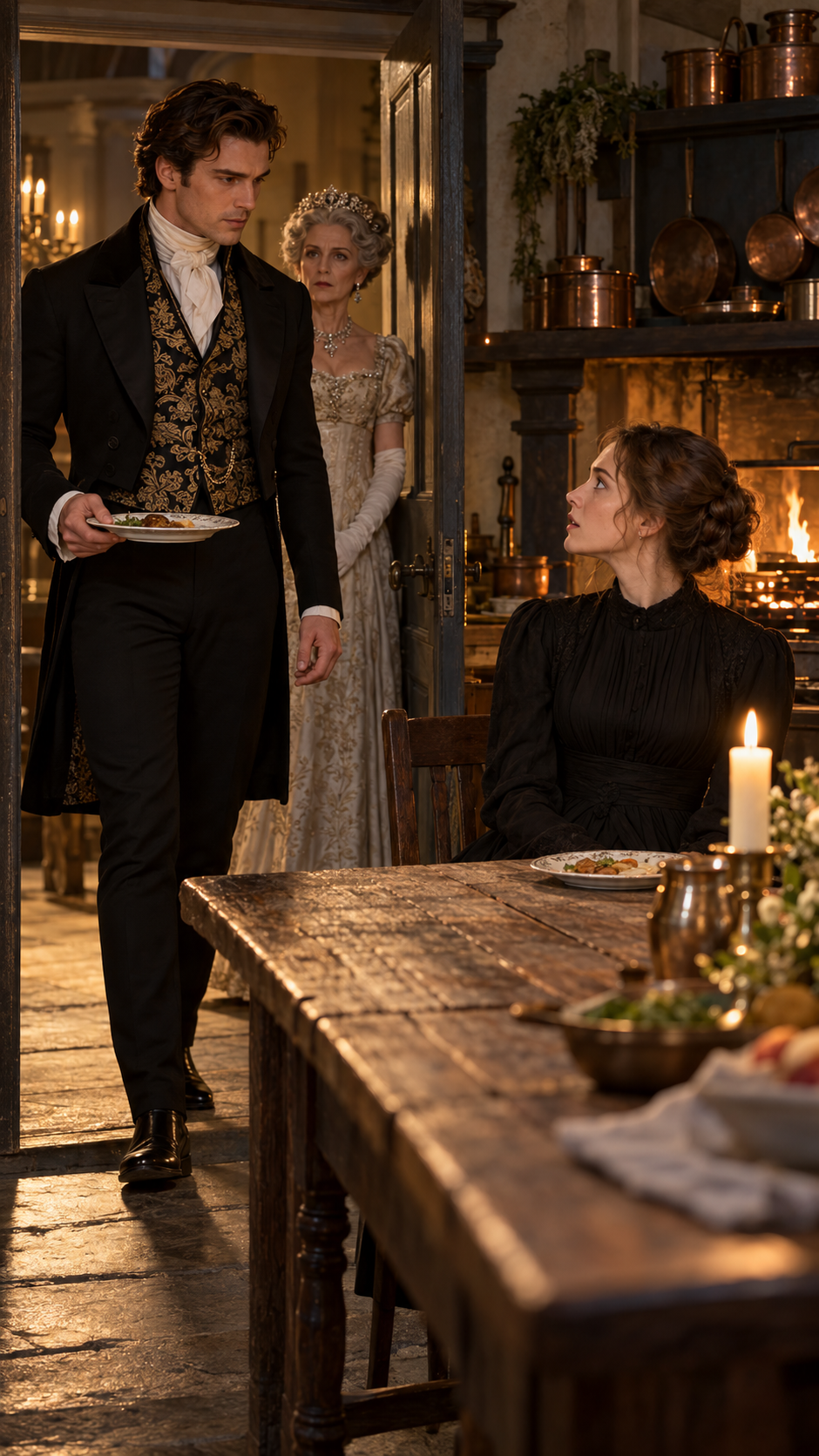
When the Duke stepped into the kitchen that night, Grace stared at him as if she were seeing a ghost.
“Major Fane,” she whispered. “You’re alive.”
“So are you.” His voice was not quite steady. “They told me in Madras you had died. Then they told me you had sailed. Then I lost you.”
He looked across the table at her.
“I left you a note, Grace. Didn’t you get it?”
She shook her head.
“I came home in the summer of 1819,” he continued. “My brother was dead, and I was a duke, God help me. The first thing I did was write to Ashdown Park and ask where you were. Lady Ashdown told me you had never come here. She said you had gone to America.”
The kitchen went silent.
Grace turned toward her mother-in-law.
“I did it for the family,” Lady Ashdown said, her voice tight. “I would not have a duke asking after a tavern girl and giving the county something to gossip about.”
“You told him I’d gone to America,” Grace said.
She spoke quietly, hands flat on the scrubbed table.
“I was in this house when your letter came. I had been here six months. I mended your sheets upstairs while you told him I was gone.”
Lady Ashdown’s face tightened.
“You never said Frederick’s name to me once in two years,” Grace continued. “But he was my husband. He was the best man I ever knew. His last wish was a letter to me, and you burned the only road it had to reach me.”
“I did not burn Frederick’s letter,” Lady Ashdown said quickly. “I never had it. I burned only the duke’s.”
“You burned the road that would have brought it to me.”
Grace stood. She was small and thin in her black dress, but for once she did not feel small.
“Please go back upstairs, Lady Ashdown. Your dinner is getting cold. I cooked all of it. I would hate for it to go to waste.”
Behind the range, Mrs. Dawlish made a sound that might have been a cough or a laugh. She turned it into a sneeze.
Lady Ashdown looked at Grace for a long moment, then turned and went back up the stairs. Sir Reginald followed, red to the ears. Lavinia stared at the Duke, then fled after them.
For a moment, Grace and Nicholas were alone with the cook and the two maids.
“I wrote to Boston, New York, Philadelphia, Baltimore, and Charleston,” he said quietly. “I searched shipping lists for two years. Last spring, I came within a week of sailing to America myself.”
“Why?” Grace asked. “Why go to all that trouble for a letter?”
He was silent.
“Because I promised him,” he said. “Frederick was the best friend I had in twelve years in India. The only man who could make me laugh.”
He looked at her.
“And because of you. Those five years of Sunday suppers on your veranda—you were the only home I had in that country. When I thought you were dead, I thought I had lost the last of it.”
He picked up his knife and fork.
“Do you mind if I finish this? It is the best lamb I have had since Madras. I believe I know why.”
Grace looked at him. Then, quite suddenly, she laughed. It sounded rusty, like a door that had not opened for a long time.
Mrs. Dawlish laughed behind the range. The two maids joined in. The Duke ate his dinner at the servants’ table and pretended not to notice the others watching him.
When he finished, he folded his napkin and reached into his coat. He laid a letter on the table between them.
The paper was creased and yellowed. The red seal remained unbroken.
Grace stared at the eight words on the front:
To my wife, Grace, into her own hands only.
“He wrote it the night he died,” Nicholas said. “You were holding the candle. He made me promise to give it to you in England, when you were safe.”
His eyes lowered to the letter.
“I am sorry it took so long. I have carried it in my pocket every day for three years.”
Grace’s hands shook as she picked it up.
“I can’t read it here,” she whispered.
“I understand.”
Nicholas stood. “I will call tomorrow, if you will let me.”
He hesitated, then added, “If you want to leave this house tonight, send one of the maids to the Swan at Old Alresford. My carriage will be there until morning.”
He bowed to Grace, to Mrs. Dawlish, and to the two kitchen maids. Then he went up the back stairs and out the front door without returning to the dining room.
That night, Grace sat on the narrow bed beneath the eaves. She lit a candle and broke the seal.
Frederick’s handwriting shook across the page. At first, she could barely read it. Then the words came clear.
My dearest Grace,
If you are reading this, I am gone, and you are in England, and Nick has kept his word. Do not cry too long, love. You never could cook when you were crying.
I have one secret to confess, and then I will let you go. When your father’s letter came last year and you cried in the kitchen house for three nights, I wrote to old Hobbs, the attorney in Portsmouth High Street.
Do you remember my godmother, old Mrs. Ashdown of Petersfield, who left me eight hundred pounds when I was twenty-one? My mother always said it was a waste of good money on a younger son. I never touched it. I was saving it for something that mattered.
I told Hobbs to buy the Anchor back from your father’s creditors, every brick and beam of it. The deed is in your name, Grace, not mine. Yours. Hobbs has it in his strongbox waiting for you.
I meant to tell you on your birthday. I am sorry I will not be there. Go home, love. Light the fires. Cook for the sailors again. Laugh in the kitchen until they hear you on the quay.
And whatever my mother says—and she will say a great deal—do not let her make you small. You were never small. You were always the biggest thing in any room you walked into.
All my love, for always,
Fred
Grace read the letter three times.
Then she remembered the rainy morning when she had stood in Broad Street before the boarded windows of the Anchor. She had seen the notice on the door, read the attorney’s name, and walked away from her own front door.
For the first time since she had buried Frederick, she put her face in her hands and cried. She cried for him, for her father, for Muthu and the tamarind tree, and for the two years she had spent in a room beneath the eaves.
When she had finished, she washed her face in the cold water jug. She folded the letter and tucked it against her heart.
Then she took down her trunk and began to pack.
THE ENDING
Chapter Five: The Road Home
At seven the next morning, Grace came down the main staircase in her black dress and bonnet, her trunk bumping behind her. The footman who had spoken up at dinner carried it. No one had ordered him to help. He had appeared at the top of the attic stairs and simply picked it up.
Lady Ashdown was in the morning room. She had not slept. Without her tiara, seated beside a cold grate in a gray wrapper, she looked older than Grace had ever seen her.
“You’re leaving,” she said.
“Yes, ma’am.”
“Where will you go?”
“Home. To Portsmouth. To the Anchor.”
“The Anchor was sold. You told me so yourself.”
“It was bought back.” Grace placed a hand over the letter inside her dress. “Frederick bought it for me with his godmother’s legacy. The deed is in my name.”
Lady Ashdown sat down, as if her knees had given way.
“He never told me.”
“He never told you many things,” Grace said.
“He stopped writing to me the day he married you.”
Grace looked at her mother-in-law. “He still loved you.”
Lady Ashdown stared at her.
“He spoke about you in India. He told Nicholas about the gardens here, and the lake, and how you read to him when he had the measles. He kept your miniature in his writing case. He was looking at it the week before he died.”
Lady Ashdown lifted a hand to her mouth.
“He loved you, ma’am,” Grace said. “Even after the letter you wrote him. He never stopped.”
For a moment, neither woman spoke.
“Will the Duke tell the county what I did?” Lady Ashdown asked.
“I have no intention of telling anyone anything.”
Grace paused at the door.
“I don’t think I’ll need to. Half your servants were in that kitchen last night.”
Lady Ashdown flinched. Grace did not say it to punish her. It was simply true.
Then Grace curtsied, as she had every day for two years, and walked out through the front door. It was the first time she had left Ashdown Park in daylight since she arrived.
Nicholas’s carriage waited at the Swan in Alresford, just as he had promised. Grace walked past it. She bought an inside seat on the Portsmouth coach with the last of the money she had received for Frederick’s sword.
Before she left, she gave the landlord a note for the Duke:
Thank you for keeping your promise to Fred. I am going home to keep mine. You will know where to find me. G. A.
In Portsmouth, Mr. Ezra Hobbs nearly fell off his stool when Grace walked into his office and told him who she was.
“Mrs. Ashdown! God bless my soul. I wrote to you in Madras three times. I wrote to you at Ashdown Park.”
“Her Ladyship wrote back that I had gone to America,” Grace said.
“She did, indeed.”
“May I have my deed, please, Mr. Hobbs?”
He opened his strongbox and gave her the deed and a great ring of rusty keys. Grace held them as if they were the crown jewels.
The Anchor was in a terrible state. It had been empty for six months. The windows were boarded. The taproom roof leaked. Rats had found the kitchen, the black range was rusted solid, and the copper pans and pewter tankards were gone.
Grace stood in the middle of the dark, damp room with the keys in her hand. Rain dripped through the ceiling.
Then she began to laugh.
It was the happiest she had been in three years.
The next morning, she started work before dawn. She scrubbed, swept, and opened the shutters. A carpenter from the dockyard agreed to mend the roof. A blacksmith from the Point came to free the range. Grace paid both men in pies because she had no money.
At the market, she bought spices, rice, and a bag of tamarind from a sailor who stared when she asked for it by its Tamil name.
On the fifth day, a carrier’s cart stopped outside. An elderly woman climbed down with a bandaged hand and a carpet bag.
It was Mrs. Dawlish.
“I’ve given my notice,” she said. “Twenty years I cooked for that woman, and she never came into my kitchen once to thank me. You were there two years and thanked me every day.”
She set down her bag.
“I can’t do much with this hand for a month or two, but I can tell the village girls what to do. I can keep your books. And I know where to buy the best mutton in Hampshire. Where do you want me?”
Grace hugged her so hard the older woman squealed.
On the twelfth day, the Anchor opened again.
Word had traveled from the quay to the dockyard and out to the ships at Spithead. Tom Penrose’s girl was back. The Anchor was serving supper.
By eight, the taproom was packed. Old sailors who had known Grace as a child wept into their ale. Young midshipmen crowded the tables. Eleven soldiers of the 49th Regiment, invalided home from India, stood in a row in their faded red coats.
When Grace came out of the kitchen with a tray, they all removed their hats.
A sergeant with a missing hand stepped forward.
“God bless you, ma’am,” he said. “You saved my life at Fort St. George.”
Grace’s throat tightened. She set down the tray and reached for his hand.
That night, she made pepper water, curry, and rice the way Muthu had taught her. Half of Portsmouth had never tasted anything like it. Within a month, people came from Southampton and Chichester to eat at the Anchor.
After the last customer had left, Grace sat at the kitchen table with a candle and Frederick’s letter. She read it again. Then she took the iron poker and scratched two small letters into the soft wood at the table’s edge:
F. A.
She ran her fingertips over them.
“It’s open, Fred,” she whispered. “I lit the fires. They heard me laughing on the quay.”
The kitchen did not answer. The range crackled, and the sea sighed beyond the window.
For the first time in three years, Grace did not feel alone.
Chapter Six: A Duke in an Apron
Nicholas came on the twentieth night.
He sent no message and brought no servants. He walked in from the rain wearing a plain brown coat, without his star or any sign of his rank. He stood at the back of the crowded taproom like an ordinary customer waiting for a table.
Grace saw him from the kitchen doorway. She stopped, a tray of pies in her hands.
Then she crossed the room and handed him an apron.
“We’re short-handed tonight, Your Grace,” she said. “If you want supper, you’ll have to peel potatoes.”
Nicholas looked at the apron, then at Grace.
“Very well.”
He removed his coat, tied the apron around his waist, and followed her into the kitchen.
The regulars assumed he was a gentleman down on his luck, whom Grace had taken pity on. They called him Nick. He peeled potatoes, carried trays, washed pans, and once dropped a whole tray of tankards in the middle of the taproom. Forty sailors applauded.
Nicholas took his bow.
He came back the next week, and the week after that. He never asked Grace for anything. He worked until the customers were gone, then sat with her at the kitchen table and ate whatever was left.
Some nights they talked about India: the tamarind tree, the surf at Madras, and the Sunday suppers on the veranda. They talked about Frederick, too. It was the first time since his death that Grace had been able to speak about him to someone who had known him.
She told Nicholas things she had never told anyone else. He told her about the campaign in the north, and the men he had lost, and the lonely years before he met the Ashdowns.
One evening, Nicholas brought her a letter from Madras. It had come to Aldridge Court in a careful clerk’s hand. Muthu had heard from an officer returning to England that the captain’s lady was alive. He had paid someone in the bazaar to write to Grace and send his blessing, his wife’s blessing, and a recipe for a lime pickle she had never managed to get right.
Grace read the letter at the kitchen table. She cried, then laughed, then made the pickle.
It came out perfectly.
In August, with the kitchen door open to the yard and the sea air moving through the room, Nicholas set down his fork.
“Marry me, Grace.”
She did not answer at once.
“No,” she said finally. “Not yet.”
He did not look surprised. He waited.
“I spent two years being small in somebody else’s house,” Grace said. “Eating in the kitchen because they were ashamed of me. I’ve had only three months in my own house being myself. I’m not ready to give it up, Nick. Not for anyone, not even a duke.”
She looked down at her hands.
“And I don’t know how to be a duchess. I would stand in a ballroom, and every woman there would think what Lady Ashdown thought: tavern girl.”
“Then don’t be a duchess,” Nicholas said. “Be Grace. Keep the Anchor. Keep the kitchen. I’ll come here if that’s what you’d rather. I would rather be here than anywhere I’ve ever been.”
He paused.
“But I will wait if you want me to. I’ve waited three years already. I’m good at it.”
Grace looked at him across the kitchen table. The lamplight warmed his face. Beyond the open door, the sea sighed in the darkness.
“Ask me again,” she said, “in a year.”
Nicholas nodded.
“In a year.”
Chapter Seven: A Place at the Table
The story of the Duke and the dinner plate traveled to London through kitchens, servants’ halls, and back corridors.
By the end of September, nearly every house in Mayfair had heard that the Duke of Aldridge had tasted a bowl of soup, discovered the widow who made it had been kept in the kitchen, and carried his dinner down to join her.
For a week, people laughed at the story. Then they stopped laughing and began talking about Lady Ashdown.
The invitations to Ashdown Park dwindled. Neighbors who had dined there for thirty years suddenly found other engagements. When Lavinia went to London for the little season, three hostesses in a row were unable to receive her. At the one ball she attended, she sat out every dance.
Lady Ashdown stayed at Ashdown Park through the winter. In the evenings, she sat alone in the morning room with a miniature of a fair-haired boy in a blue coat.
The miniature showed Frederick at seven, laughing.
On a bitter night in January, snow fell thick over the Hampshire Downs. A carriage bearing the Ashdown arms stopped outside the Anchor. The Portsmouth Road had been nearly impassable, and the journey had taken nine hours.
Grace was in the kitchen when the pot boy came to tell her. She wiped her hands on her apron and went out to the taproom.
Lady Ashdown stood in the doorway. Snow clung to her bonnet. Her face was gray with cold. The whole taproom fell silent.
She looked at the smoky room, the crowded benches, the sailors staring at her. Then she looked at Grace. Her hands trembled inside her muff.
Grace crossed the room and took her arm. She led Lady Ashdown to the best table, beside the great fire and beneath the old ship’s bell a dockyard carpenter had found and hung back in its place.
She pulled out a chair. She sent the pot boy for a hot brick and mulled wine.
Lady Ashdown did not sit.
“No,” she said, voice hoarse. “Not here.”
Grace waited.
“I came to ask you a question. I’ve been trying to find the courage since September. I don’t think I’ll find it twice.”
She drew a breath.
“May I eat in the kitchen with you?”
Every person in the taproom heard her. Forty sailors and a dozen old soldiers of the 49th held their tankards halfway to their mouths.
Grace studied the proud, frightened face beneath the snowy bonnet. Then she held out her hand.
“Come through.”
They sat at the long kitchen table by the range while snow passed the window and the taproom noise softened behind the door.
Grace gave Lady Ashdown a bowl of pepper water. She drank every drop and asked for more.
Then she put down her spoon and took a small object from her reticule. It was a miniature in an oval gold frame: Frederick as a boy, laughing in his blue coat.
“He was the only one of my children who ever laughed at me,” Lady Ashdown said. “Reginald was afraid of me. Lavinia was too much like me. But Freddy laughed. He used to come into my room in the morning, climb onto the bed, and tell me I was too grand for my own good.”
Her voice broke.
“When he married you, I wrote him a letter I’ve regretted every day since. He never wrote to me again. I told myself it was your fault, that you had taken him away. It was easier than admitting I had sent him away myself.”
She pushed the miniature toward Grace.
“I want you to have it. It is the only picture of him I have. You knew him better than I did at the end. You made him happy. I never did.”
Her eyes filled.
“I’m sorry, Grace. For the kitchen. For the attic. For the letter to the Duke. For all of it. I have no right to ask you to forgive me. I only wanted you to know I understand what I did.”
Grace picked up the miniature. She looked at the laughing boy who had grown into the young officer who walked into the Anchor in the rain and asked for a second bowl of stew.
“Keep it,” she said at last, and gently pushed it back. “You need it more than I do. I have his letter, and I have this.”
She gestured toward the kitchen, the range, the copper pans, and the sea beyond the dark window.
“He gave me all of this. He gave me my life back.”
Lady Ashdown laid her hand over Grace’s and held it. For a long time, neither woman spoke.
Lady Ashdown stayed three days, until the road cleared. She ate every meal in the kitchen. On the last morning, she kissed Grace on the cheek in front of the whole of Broad Street.
“My son had better taste than any of us,” she said loudly enough for every fishwife on the quay to hear.
Sir Reginald came in the spring. He stood awkwardly in the taproom with his hat in his hands and asked to speak with his sister-in-law.
When Grace came out, he went red.
“I’m sorry,” he said in a rush. “I should have stood up for you. I never did. Freddy would have been ashamed of me. I understand if you send me away.”
Grace gave him a bowl of oyster pie.
He ate three.
After that, he came every month and brought his little boy with him. The child grew up believing the kitchen of the Anchor was the most wonderful place in the world.
Lavinia came in the summer, after a London season that had gone badly from beginning to end. She sat at the kitchen table and cried.
“I was stupid,” she said. “And selfish. I thought only about myself.”
Grace did not tell her it was all right. She simply put a bowl of pastry dough in front of her.
“Then learn to make this,” she said. “It takes patience.”
Lavinia learned. It was the first useful thing she had ever been proud of, and she told everyone.
Chapter Eight: The Question Asked Again
A year to the day after Nicholas first asked Grace to marry him, he returned to the Anchor.
The kitchen door stood open to the yard. The evening was warm and still. Nicholas had peeled four hundred potatoes that year by his own count, broken eleven tankards, and learned to make a passable mutton stew.
He sat opposite Grace at the kitchen table. After a while, he put down his fork.
“It’s been a year, Grace.”
“I know,” she said. “I’ve been counting, too.”
“Well?”
She looked at him for a long moment. She thought of the man who had sat under the tamarind tree and listened to Frederick laugh. The friend who had stayed at Frederick’s bedside through the night. The man who carried a letter for three years and crossed the threshold of a kitchen with his dinner plate in hand.
“I’ll keep the Anchor,” she said. “I’ll cook here every Sunday, whether you like it or not. If your friends in Hampshire don’t like it, they can come and eat, and then they can say what they please.”
“They’ll come,” Nicholas said. “Once they’ve tasted your soup, they’ll never leave.”
“And you’ll carry your own plate.”
“Always.”
A smile warmed his face—the same slow smile she remembered from the veranda beneath the tamarind tree.
They married in October 1822 at St. Thomas’s Church in Portsmouth, where Grace had married Frederick nine years earlier.
Lady Ashdown sat in the front pew on the bride’s side and wept through the ceremony. Sir Reginald gave Grace away, red-faced and solemn. He said afterward that it was the least he could do. Eleven old soldiers of the 49th formed a guard of honor outside the church, their faded red coats bright against the gray stone.
The wedding breakfast was held at the Anchor.
Two hundred people could not fit in its kitchen, so they filled the taproom, the yard, and the street. Sailors, soldiers, fishwives, dockyard men, dukes, and earls ate mutton stew, pepper water, and oyster pie from plain white plates.
The Duke of Aldridge walked through the crowd with his new wife on his arm and carried his own plate to the long table.
He carried it into the kitchen of the Anchor every Sunday for the next forty years.
He carried it into the kitchen at Aldridge Court, too. Once a week, Grace cooked dinner with her own hands, and the servants ate at the same table as the family.
On the first Sunday, the household was uneasy. Forty servants had been told that the new Duchess intended to cook and that they were to dine with the family in the servants’ hall. The old butler, Mr. Pin, who had served three Dukes of Aldridge, privately asked Nicholas whether His Grace was quite certain.
“Quite certain, Pin,” Nicholas said. “Wait until you taste it.”
Pin tasted it. He sat beside Grace and ate two helpings of oyster pie and three bowls of pepper water. At the end of the meal, he stood with tears in his eyes and proposed a toast to the Duchess. The whole hall rose to drink it.
After that, Sunday dinner at Aldridge Court became the most sought-after invitation in Hampshire. Earls and bishops asked to attend. A royal duke once came by special request and ate in the servants’ hall between the housekeeper and the head gardener. He declared it the best dinner he had ever tasted.
No one in the county suggested that a person should eat in the kitchen because they were not good enough for the dining room again.
In the long gallery at Aldridge Court, among portraits of three hundred years of dukes and duchesses in velvet and ermine, one painting drew every visitor’s attention. It showed a small, crowded kitchen, copper pans on the walls, and the sea visible through the window.
At the end of a scrubbed wooden table, a young woman in an apron was laughing. Across from her, a tall dark man in a fine black coat sat with his dinner on a plain white plate, looking at her as if there were no one else in the world.
The painter called it The Duke’s Supper.
Grace always called it home.